


Report: China is Building Launch Pads near Its Nuclear Missile Silos

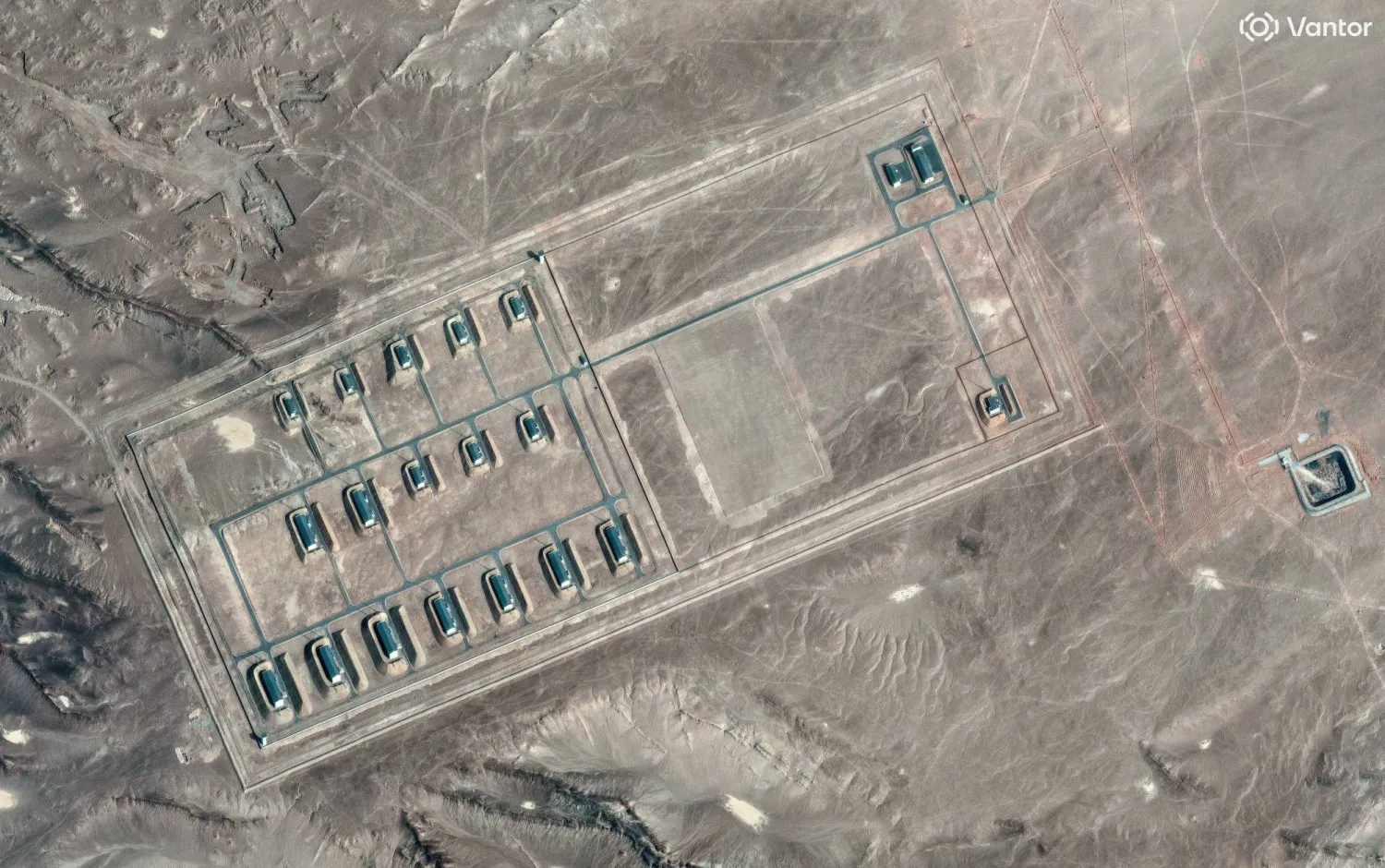
A satellite image shows what security analysts say is a fortified weapons storage installation, revealing revetments around the building, a perimeter wall and guard towers, in the Xinjiang Uyghur Autonomous Region, China, March 19, 2026. Vantor/Handout via REUTERS
TT

Report: China is Building Launch Pads near Its Nuclear Missile Silos

A satellite image shows what security analysts say is a fortified weapons storage installation, revealing revetments around the building, a perimeter wall and guard towers, in the Xinjiang Uyghur Autonomous Region, China, March 19, 2026. Vantor/Handout via REUTERS

In a remote Chinese desert, a vast military complex is taking shape that some security scholars say appears built to ensure no American first strike on China’s nuclear arsenal could reliably knock out Beijing’s ability to hit back.

China’s nuclear missiles can already reach any city in the United States. Now, satellite images reviewed by Reuters show Beijing is building a sprawling web of launch pads, bunkers and communications nodes near the isolated nuclear silos that hold the Chinese military’s longest-range missiles.

The images reveal more than 80 pads for possible use by China’s expanding fleet of mobile missile launchers and air-defense batteries. They also show facilities that may serve electronic warfare, satellite communications and command operations, according to three security analysts, who assessed the imagery for Reuters. (View the story on Reuters.com: )

The scale of the construction, which hasn’t been previously reported, points to a sweeping expansion of hardened infrastructure designed to protect and operate China’s land-based nuclear forces. Taken together, the network signals a significant upgrade in Beijing’s efforts to ensure second-strike capability, underscoring intensifying nuclear competition with the United States as tensions rise over issues such as Taiwan’s sovereignty.

“We can see this infrastructure is being built on a grand scale, covering thousands of square kilometers of desert beyond the silo fields," said Alexander Neill, an adjunct fellow at Hawaii’s Pacific Forum think tank. Depending on the precise capabilities, he said, “we're looking at a very considerable enhancement and diversification of China's strategic nuclear deterrent.” The ability to protect its desert silos is key to China’s stated goal of forging a minimal but credible nuclear deterrent — a policy grounded in the capacity to retaliate if it is struck first. While the People’s Liberation Army (PLA) can fire nuclear weapons from submarines and aircraft, ‌the silo fields in ‌the northwestern Xinjiang region and Gansu province are the core of its nuclear forces. China’s nuclear build-up is among the most scrutinized facets of President ‌Xi Jinping’s ⁠military modernization because ⁠of what some foreign diplomats describe as Beijing’s lack of transparency and failed efforts by the United States to engage the Chinese leadership on its evolving nuclear capabilities and intentions.

A cornerstone of China’s doctrine is its “no first use” policy, meaning its forces wouldn’t initiate a nuclear exchange. But some senior Western diplomats and analysts say China would possibly resort to nuclear coercion to limit outside involvement in a conflict over Taiwan. Xi this month warned US President Donald Trump that mishandling of their countries’ disagreements over Taiwan, which China claims as its territory, could lead them to a “dangerous place.” Taiwan’s government rejects China’s sovereignty claim.

China’s defense ministry didn’t respond to questions about its nuclear program and the developments revealed in the satellite imagery. The Pentagon said it wouldn’t comment on intelligence-related matters.

OCTAGONS IN THE DESERT

The new desert infrastructure is centered on two octagon-shaped installations built over the past six years in eastern Xinjiang. Both are southwest of the Hami nuclear silo fields – one is about 140 kilometers away, the other some 230 kilometers.

Satellite images show the octagon structures contain housing for personnel and large military vehicles. They are flanked by armored bunkers ⁠and fortified weapons-storage areas, as well as airfields and railheads that link the octagons to the Hami silos.

Exercises involving large military vehicles occurred around the ‌northern octagon this month and during April, the images show. Also evident in recent images are large tents and what two analysts said ‌appear to be camouflaged launch sites cut into the desert, some with air-defense missile batteries.

The existence of the octagons has been documented previously. But Reuters is the first to report the extent of the launch-pad network linked ‌to the octagons; recent military activity around one of the facilities; and analysts’ assessments that the pads could field mobile missile launchers and electronic-warfare operations.

Five security scholars interviewed by Reuters agreed the infrastructure broadly ‌could support China’s nuclear program, as well as other military purposes. But they cautioned that key details remain unknown — including the weapons China might deploy at the launch pads and whether the octagon structures house truck-mounted ballistic missiles or facilities for fitting nuclear warheads.

The PLA displayed nuclear-capable weapons during a parade in Beijing last September to mark the 80th anniversary of the end of the Second World War. These included silo-based and truck-mounted intercontinental ballistic missiles (ICBMs). US officials and arms-control analysts say China is expanding and improving its nuclear weapons capabilities faster than any other nation. The latest Pentagon report on China’s military modernization says the country’s warhead production has slowed but it is on track to field 1,000 warheads ‌by 2030. The December report estimated China is likely to have loaded 100 ICBMs across its three main silo fields.

China has also been strengthening its early-warning system, underpinned by its Huoyan-1 satellites, according to US officials. The system can detect an incoming ICBM within 90 seconds of launch ⁠and alert a command center within three to four ⁠minutes, according to the Pentagon — sufficient time for China to fire its own silo-based weapons before they are hit.

‘AN EXTRAORDINARY EFFORT’

Significantly, each octagon sits at the core of a network of dirt roads and conduits that stretch far into the desert. These routes connect to the concrete pads, which are nestled among rocky outcrops and dry creekbeds.

The pads could be used to deploy mobile air-defense missiles, electronic warfare nodes or, from some of the larger ones, road-mobile ICBM launchers, three security scholars said.

Hans Kristensen, director of the Federation of American Scientists’ Nuclear Information Project, said while it was difficult to conclude how the various installations would be used, “it is hard to rule anything out” given the scale of the infrastructure in such a hostile environment.

The conduits that link the pads to the octagon structures may contain fiber-optic cables for communications, Kristensen and Neill said.

At the northernmost octagon, a possible space or microwave communications facility is also under construction, three analysts said, pointing to satellite dishes and two large towers.

“Taken together, I think there is a real possibility that the octagonal structures and the strange towers are linked to C3 - command, control, and communications - as well as maintenance and storage activities related to China's nuclear operations at the Hami ICBM silo site,” said Tong Zhao, a senior fellow in nuclear policy at the Carnegie Endowment for International Peace.

A third octagon-shaped installation south of the Lop Nur nuclear test facilities is less developed. It appears to be used as a target range: Images show pock-marked earth, damaged buildings and what analysts at Vantor, a commercial provider of satellite imagery, said are mock-ups of Western jet fighters.

The extent of the defensive network near its silos potentially sets China apart from the other major nuclear powers. The US and Russia — whose warhead stockpiles and deployed weapons far exceed Beijing’s — rely on a combination of sheer numbers of silos, their relative isolation and hardened construction to deter a first strike, rather than extensive missile defense, Kristensen said.

The scale of what is emerging in China’s northwestern desert has left even seasoned analysts startled.



UN Shipping Agency Opposes Fees for Any Strait, More Details Sought on Trump Post on Cargo Charge

This picture shows ships sailing near the Strait of Hormuz off the eastern coast of the United Arab Emirates at Khor Fakkan on July 13, 2026. (AFP)
TT

UN Shipping Agency Opposes Fees for Any Strait, More Details Sought on Trump Post on Cargo Charge

This picture shows ships sailing near the Strait of Hormuz off the eastern coast of the United Arab Emirates at Khor Fakkan on July 13, 2026. (AFP)

More details are awaited after US President Donald Trump said in a post that Washington was reinstating a naval blockade on Iran and would be reimbursed 20% on ‌all cargo ‌shipped through ‌the ⁠Strait of Hormuz, ⁠the UN's shipping agency said on Monday.

"We are aware of the post and awaiting more details," ⁠a spokesperson with the ‌UN's ‌International Maritime Organization said.

"We have ‌always been consistent ‌on our stance on fees – IMO stands firmly against charging fees for passage ‌through straits used for international navigation. There ⁠is ⁠no legal basis through which to introduce mandatory tolls simply to transit through a strait."

Trump said in a Truth Social post the process would begin immediately, but did not elaborate.


US Citizen Is Found Guilty of Helping Export Tech to Iran in Violation of Sanctions

People walk near an anti-US mural in Tehran, Iran, July 13, 2026. Majid Asgaripour/WANA (West Asia News Agency) via Reuters
TT

US Citizen Is Found Guilty of Helping Export Tech to Iran in Violation of Sanctions

People walk near an anti-US mural in Tehran, Iran, July 13, 2026. Majid Asgaripour/WANA (West Asia News Agency) via Reuters

A Massachusetts man was found guilty Monday of conspiring to unlawfully export electronic components to Iran in violation of US sanctions.

Mahdi Mohammad Sadeghi, who worked at the global electronics company Analog Devices, was accused of helping an Iranian business associate get around American export control laws. US prosecutors say the business associate’s Tehran-based company makes navigation systems for the military drone program of Iran’s Revolutionary Guard. Authorities say the scheme included the creation of a front company in Switzerland.

The second defendant, Mohammad Abedininajafabadi, called Abedini in court documents, was not on trial. He is believed to be in Iran after an apparent prisoner exchange for an Italian journalist.

Sadeghi was found guilty on three of the five charges. He showed no visible reaction to the verdict, which came early in the fourth day of jury deliberations. He and his lawyers did not comment as they left court, and he will remain free until sentencing Oct. 13.

Sadeghi, a 43-year-old naturalized US citizen, chose not to testify. A father of two, he lost his job at Analog Devices due to the charges. Although he was arrested in December 2024, long before the current war with Iran, his trial has unfolded during the conflict.

“At its core, this case is straightforward. You cannot send goods, especially the goods at issue in this case, to Iran. Period. Full stop,” Assistant US Attorney Alathea Porter told the jury. “The defendant knew that, and conspired with Mr. Abedini to do that.”

Assistant U.S. Attorney Jared Dolan, in his closing remarks, said documents, text messages and photos proved that the illegal acts were the “fruits of this relationship” between Sadeghi and Abedini.

“The evidence established that he knew what Abedini was doing because he told him in writing,” Dolan said. “He helped him anyway.”

Sadeghi's attorney, William Fick, told jurors that the scheme laid out by the prosecution “makes no sense” and was full of holes. He said Sadeghi was only offering advice to a longtime friend about how to get business with the semiconductor company, and wasn’t responsible for procuring the parts for Abedini.

Fick said there was no proof the parts ended up in Iran, and he disputed that the Swiss company was a front.

“If you look at the world through dirty glasses, everything looks dirty,” Fick said. “That is fundamentally what the prosecution is asking you to do here.”

Fick also said prosecutors hadn't shown Sadeghi gained anything from the alleged plan — although the prosecution pointed out that they didn't need to prove a motive.

“He had nothing to gain and everything to lose,” Fick said. “He has lived in the country for decades. He was a well-regarded, respected employee on his way up in the company.”

Prosecutors had hoped to introduce evidence during the trial related to an Iranian drone used in a 2024 attack that killed three US troops at a remote base in Jordan.

However, before the trial, defense attorneys sought to exclude any evidence related to Abedini’s role in drone manufacturing or attacks on American troops.

The judge agreed, ruling that prosecutors could only give general evidence about Abedini’s Iranian company and how its technology had potential military applications, including for drones. During a hearing in February, prosecutors acknowledged they didn’t have evidence that Sadeghi “knew anything” about the technology he was accused of exporting was allegedly used on the drone involved in the Jordan attack.

Both defendants have been charged with export control violations. Abedini is separately charged with conspiring to provide material support to a foreign terrorist organization that resulted in the deaths of three service members.

Abedini was arrested at an airport in Italy on a US warrant in December 2024, but was released a month later and returned to Iran. Three days after his arrest, Italian journalist Cecilia Sala was detained while reporting in Iran. Sala, who was believed held as a bargaining chip for Abedini’s release, returned home in January 2025.


US Vows Campaign to End ICC ‘Threat’ to Americans

US Secretary of State Marco Rubio attends a trilateral meeting with Japanese Foreign Minister Motegi Toshimitsu and South Korean Foreign Minister Cho Hyun (not pictured) on the sidelines of the NATO Summit in Ankara on July 7, 2026. (AFP)
TT

US Vows Campaign to End ICC ‘Threat’ to Americans

US Secretary of State Marco Rubio attends a trilateral meeting with Japanese Foreign Minister Motegi Toshimitsu and South Korean Foreign Minister Cho Hyun (not pictured) on the sidelines of the NATO Summit in Ankara on July 7, 2026. (AFP)

The United States on Monday announced a campaign against the Hague-based International Criminal Court (ICC), accusing the tribunal of posing "an intolerable threat to US sovereignty" and threatening sanctions.

"The ICC and its friends are waging a war against our country, not with bullets or missiles, but with statutes, compacts and the force of so-called international law," Secretary of State Marco Rubio said in a video statement.

The State Department said in a statement the campaign will "systematically disable the ICC's ability to operate, target American servicemen or officials, or otherwise threaten American sovereignty."

Relations between the government of Donald Trump and the ICC have been extremely poor, with several court officials, including its chief prosecutor, already under US sanctions.

The sanctions bar the officials from entering the United States and block property and financial transactions involving them in the world's largest economy.

The measures have often focused on ICC investigations involving Israel, a US ally. The court issued arrest warrants in 2024 for Israeli Prime Minister Benjamin Netanyahu and others.

However, in its statement, the State Department focused on what it called the ICC's "intolerable threat to US sovereignty," saying the court "claims the authority to prosecute and even imprison American servicemen and officials operating on behalf of America's national interest."

"Americans never signed up for this, and all American presidents since the ICC's ratification have maintained that the ICC does not have jurisdiction over Americans," the State Department said.

The department listed a range of measures it was considering against the court, including having American diplomats call other nations to urge withdrawal from the body, as well as travel bans and sanctions against ICC officials.

Established in 2002, the ICC prosecutes individuals accused of the gravest atrocities, including war crimes, crimes against humanity and genocide.

Neither Israel nor the United States is a party to the international treaty that established the ICC. Russia is also not a member, and its President Vladimir Putin has been the subject of an ICC arrest warrant since March 2023.