


Hamas Calls Netanyahu’s Plan to Expand Control in Gaza a Dangerous Escalation

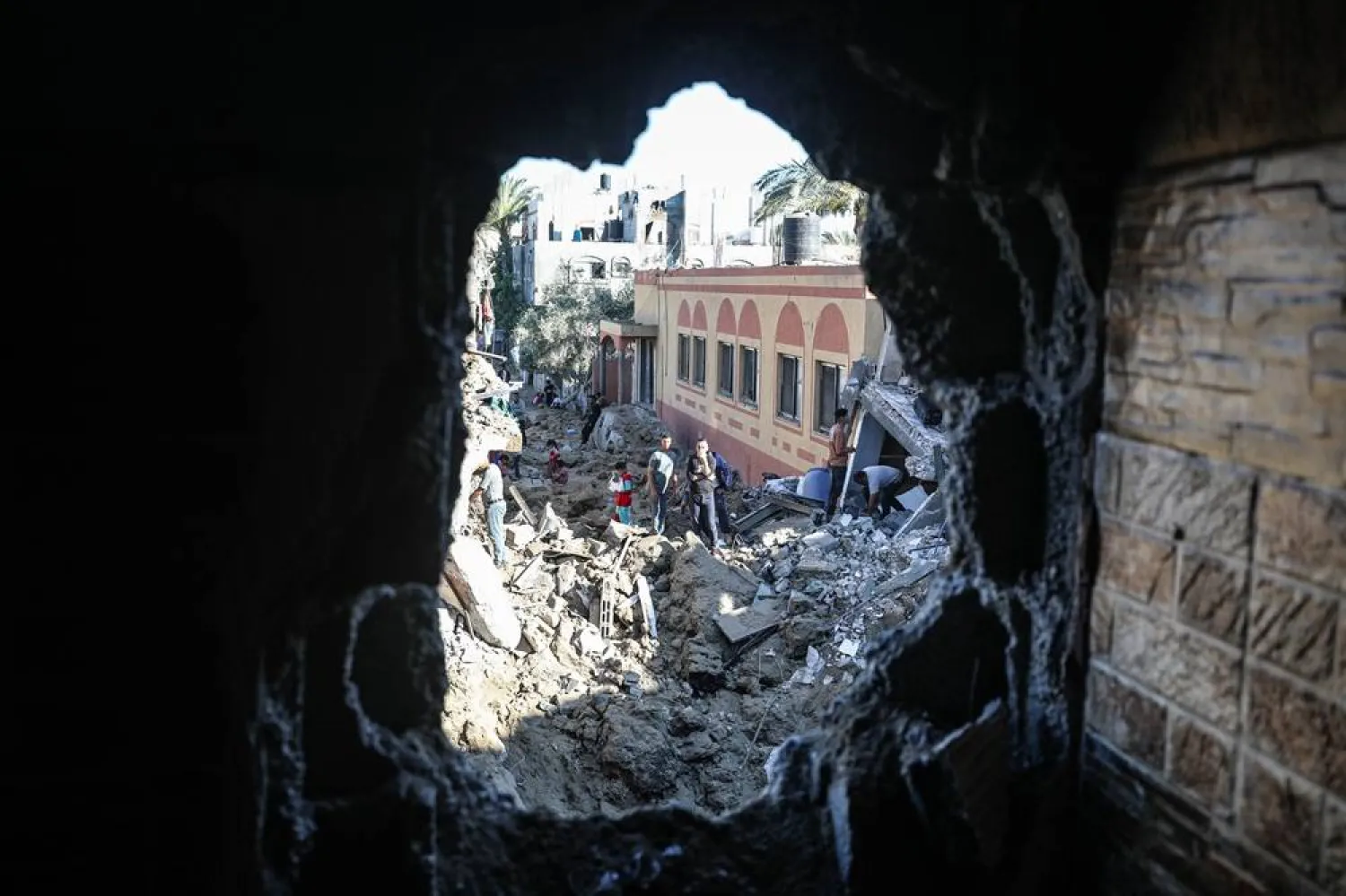
 29 May 2026, Palestinian Territories, Dair al-Balah: Palestinians inspect the rubble of a building destroyed in an Israeli airstrike in Deir al-Balah, central Gaza Strip. (dpa)
29 May 2026, Palestinian Territories, Dair al-Balah: Palestinians inspect the rubble of a building destroyed in an Israeli airstrike in Deir al-Balah, central Gaza Strip. (dpa)
TT

Hamas Calls Netanyahu’s Plan to Expand Control in Gaza a Dangerous Escalation

 29 May 2026, Palestinian Territories, Dair al-Balah: Palestinians inspect the rubble of a building destroyed in an Israeli airstrike in Deir al-Balah, central Gaza Strip. (dpa)
29 May 2026, Palestinian Territories, Dair al-Balah: Palestinians inspect the rubble of a building destroyed in an Israeli airstrike in Deir al-Balah, central Gaza Strip. (dpa)

Hamas said on Friday that Israeli Prime Minister Benjamin Netanyahu's declaration that his country would expand its area of control in Gaza was a dangerous escalation, as residents of the Palestinian territory also voiced alarm at the plan.

Under a ceasefire deal in October Israel's military was to remain in control of 53% of Gaza, but Netanyahu said on Friday that it would expand that area to an initial 70%, without laying out details or a timeline.

The Palestinian group, which triggered two years of devastating warfare in Gaza with its October 7, 2023, attack on Israel, described his comments as a plan for ethnic cleansing and forced displacement of Palestinians.

MAJOR DISPUTES POSTPONED

"Any attempt to impose a new reality of occupation in Gaza is null and illegitimate," said Ismail al-Thawabta, head of the Hamas-run Gaza government media office, adding that Netanyahu's statement "represents a dangerous escalation".

More than eight months into the ceasefire, and with global attention fixed on the war in Iran, Gaza's underlying conflict remains stubbornly ‌unresolved with continued ‌Israeli attacks, little aid reaching civilians and the risk of major new violence.

Israel has already expanded its ‌area ⁠of control in ⁠Gaza from the 53% lying behind a "yellow line" mapped into the ceasefire deal up to around 64%, with an area it has designated as restricted in maps shared with aid groups.

Any further reduction in space available to the more than 2 million Gaza residents who are mostly crammed into tents in the tiny Palestinian territory risks worsening already dire conditions there.

"Where do we go? To the sea? There is no space," said Mohammed al-Shagra, 72, in Khan Younis.

Last year's deal brokered by US President Donald Trump established a Board of Peace to oversee a phased ceasefire, and was ratified by the United Nations Security Council.

However, many of the toughest areas of dispute including the disarmament of Hamas, a full Israeli ⁠withdrawal and the make-up of a Gaza government were postponed to later in the process. ‌

The Board of Peace negotiators have been talking to both sides on the disarmament issue.

Israel ‌and Hamas have repeatedly accused each other of violating the truce. Israeli strikes in Gaza have killed more than 900 Palestinians since the start of ‌the truce while Palestinian attacks have killed four Israeli soldiers.

Israel's military and the prime minister's office did not immediately respond ‌to a Reuters request for additional information and comment on Netanyahu's statement.

A spokesperson for the Board of Peace said it would not have a comment on Netanyahu's statement.

The foreign ministries of permanent UN Security Council members Britain and France did not immediately respond to requests for comment.

A German foreign ministry spokesperson said Germany was concerned about Israeli plans to take more of Gaza and opposed a permanent division of the Palestinian territory.

RISK OF FURTHER VIOLENCE

Facing ‌elections this year and under pressure for Israel's failure to secure its strategic goals in wars in Iran and Lebanon, Netanyahu may be seeking to bolster his standing with voters.

"He's determined ⁠to look tough in front of ⁠the electorate and he's blamed by his opponents for having fought this seven-front war, but having won none of the wars," said Max Rodenbeck, Israel-Palestine Project Director at International Crisis Group.

"Unless there's some sort of pushback from the Trump administration it really does risk a return to something very bloody," he added, pointing to other ways in which Israel has been ramping up pressure on Hamas including continued aid restrictions on Gaza and strikes targeting Hamas figures.

For people inside Gaza, where nearly all the population had to flee their homes during the war and with most still living in temporary tents or shelters, the prospect of increased Israeli military pressure is alarming.

"We see no ceasefire or anything and they keep advancing beyond the yellow line. For how long will the world stay silent?" said Mohammed al-Jundi, a displaced man in Gaza City.

In Israel, a return to tougher military pressure is seen by security hawks as the only way to force Hamas to disarm and achieve a longer-term agreement.

"It looks as if we are taking a step towards another collision. But I believe this time it will be much shorter and maybe would open the path towards a new future," said Kobi Michael, a researcher at Israel's Institute for National Security Studies and a former official in the country's strategic affairs ministry.



Iran Further Undermines Yemen’s Sovereignty as Houthis Violate the Truce

Smoke rises following airstrikes on Sanaa airport in Sanaa, Yemen, 13 July 2026. (EPA)
TT

Iran Further Undermines Yemen’s Sovereignty as Houthis Violate the Truce

Smoke rises following airstrikes on Sanaa airport in Sanaa, Yemen, 13 July 2026. (EPA)

Yemen's legitimate government said it struck Houthi-controlled Sanaa airport on Monday, its biggest flare-up in years with the militants.

The government said it had wanted to prevent an Iranian plane from landing in the capital, after failing to convince a Houthi delegation that went to Tehran for the late Iranian supreme leader's funeral to board a Yemenia flight instead.

The latest escalation threatens to unravel a truce that has been holding since 2022 despite expiring, and comes at a time of heightened tensions as the United States and Iran trade attacks impacting the Gulf and traffic in the Strait of Hormuz.

Yemen's Defense Ministry accused the Houthis of "allowing an Iranian plane to violate Yemeni territory; consequently, the airport runway was targeted".

Following the strikes, the head of Yemen's Presidential Leadership Council, Dr. Rashad al-Alimi, said he had "ordered that the scope of the confrontation not be expanded".

He held the Houthis “fully accountable for the escalation,” saying they had insisted on welcoming a new Iranian flight despite objections and attempts to contain the crisis and avert more tensions.

The government had run out of political and legal options before the arrival of the flight. He added that the government had offered to operate the flight through the Yemenia airline seeing as it is the national carrier.

The Houthis rejected the proposal and insisted on welcoming the Iranian plane outside official channels, stated al-Alimi, saying this was evidence that the militants “were not serving the people or easing their suffering, but deepening the division and imposing a status quo that serves foreign agendas.”

He ordered the army and security forces “to be on the highest level of alert and take the necessary political, diplomatic, legal and military measures allowed by the constitution and international law to protect Yemen’s airspace and land and sea ports.”

Prime Minister and Foreign Minister Shaya al-Zindani held an extraordinary government meeting in the interim capital Aden to discuss the escalation.

The cabinet tasked the Foreign Ministry with intensifying its contacts with friendly nations and regional and international organizations to urge them against the use of Yemen’s airspace outside official channels.

Smoke rises after reports of an airstrike hitting near the Sanaa International Airport, as seen from Sanaa, Yemen, July 13, 2026. (Reuters)

It held the Houthis “fully responsible for the escalation and its consequences”, accusing them of “undermining peace efforts and exposing Yemen and the region to more dangers”.

It also held the Iranian regime responsible for the escalation given its continued support to the Houthis.

Ahead of the strike, the Defense Ministry had urged citizens to evacuate the airport and its vicinity for their safety.

It vowed that it would “deal with any party or plane that tries to violate Yemen’s airspace or orders issued by relevant authorities.”

Government authorities had for days warned that flights to Sanaa should only take place through state institutions.

Houthi sources later said the plane, which was carrying a Houthi delegation, landed in Hodeidah airport.

Yemeni authorities held the Houthis responsible for the escalation for insisting on imposing their own arrangements away from official regulations.

Monday’s escalation took place after the Houthis insisted on receiving Iranian flights at Sanaa airport amid the government’s refusal to operate flights outside official channels.

The United Nations Special Envoy for Yemen, Hans Grundberg, urged the parties to turn to diplomacy, saying his office has "contacted military representatives from all sides".

Earlier in the day, the Yemeni government accused the Houthis of preventing an International Committee of the Red Cross (ICRC) aircraft from leaving Sanaa airport and holding the pilot and co-pilot "hostage".

"All ICRC staff and the crew of the plane are safe and accounted for," ICRC spokesman for the Middle East Hachem Osseiran told AFP.


Spanish PM to Visit Algeria in Bid to Mend Ties

Spain's Prime Minister Pedro Sanchez talks to media during a visit in the area of a wildfire that killed at least 13 people, at the command post set in Turre, Almeria Province, on July 13, 2026. (AFP)
TT

Spanish PM to Visit Algeria in Bid to Mend Ties

Spain's Prime Minister Pedro Sanchez talks to media during a visit in the area of a wildfire that killed at least 13 people, at the command post set in Turre, Almeria Province, on July 13, 2026. (AFP)

Spanish Prime Minister Pedro Sanchez will travel to Algeria next week for an official visit aimed at ending years of tensions between the two countries over the Western Sahara dispute, his office said on Monday.

The visit on July 20 will be Sanchez's first trip to Algeria since relations deteriorated in 2022 after Madrid shifted its longstanding position of neutrality on Western Sahara and backed Morocco's autonomy plan for the disputed territory.

Spain's move was part of a diplomatic rapprochement with Morocco, ending its decades of ambiguity on the issue but angering Algeria, which supports the pro-independence Polisario Front, which opposes Rabat's claim over the former Spanish colony.

Western Sahara, a mineral-rich desert territory with significant phosphate reserves and fishing resources, was controlled by Spain until 1975.

Morocco now controls most of the territory.

In response to the policy shift in Madrid, Algeria suspended a 2002 friendship treaty with Spain and restricted trade ties between the two countries.

Relations have gradually improved since 2025, with commercial exchanges beginning to recover.


New Round of Lebanon-Israel Talks to Begin on Tuesday

 An Israeli military vehicle covered with netting to protect against FPV drones patrols on the Lebanese side of the border, as seen from an undisclosed location along the border, 13 July 2026. (EPA)
An Israeli military vehicle covered with netting to protect against FPV drones patrols on the Lebanese side of the border, as seen from an undisclosed location along the border, 13 July 2026. (EPA)
TT

New Round of Lebanon-Israel Talks to Begin on Tuesday

 An Israeli military vehicle covered with netting to protect against FPV drones patrols on the Lebanese side of the border, as seen from an undisclosed location along the border, 13 July 2026. (EPA)
An Israeli military vehicle covered with netting to protect against FPV drones patrols on the Lebanese side of the border, as seen from an undisclosed location along the border, 13 July 2026. (EPA)

The sixth round of negotiations between Lebanon and Israel are to begin on Tuesday in Rome, a Lebanese official told AFP on Monday.

The two-day talks will begin at 10.00am (0800 GMT), the official said, requesting anonymity.

An Italian foreign ministry spokesperson had earlier said the talks would be held on July 15 and 16, and Israeli Foreign Minister Gideon Saar had confirmed on July 7 that the negotiations would resume "next week".

The two countries, which have no formal relations, began direct talks in April after Tehran-backed Hezbollah drew Lebanon into the Middle East war by attacking Israel in support of Iran the month prior.

They recently reached a framework agreement that calls for Hezbollah's disarmament and a gradual Israeli withdrawal from occupied Lebanese territory while Lebanon's army deploys into "pilot zones".

But the agreement -- rejected by Hezbollah -- does not set a timetable for Israel's withdrawal, and Israeli officials have also vowed that their forces will remain in a "security zone" 10 kilometers (six miles) deep along the frontier for as long as Hezbollah remains armed.

A US military delegation met with Lebanon's army in Beirut last week to discuss the implementation of Israel's withdrawal from a first pilot zone.