


Raise Defense Spending or Else, Hegseth Tells NATO, Europe

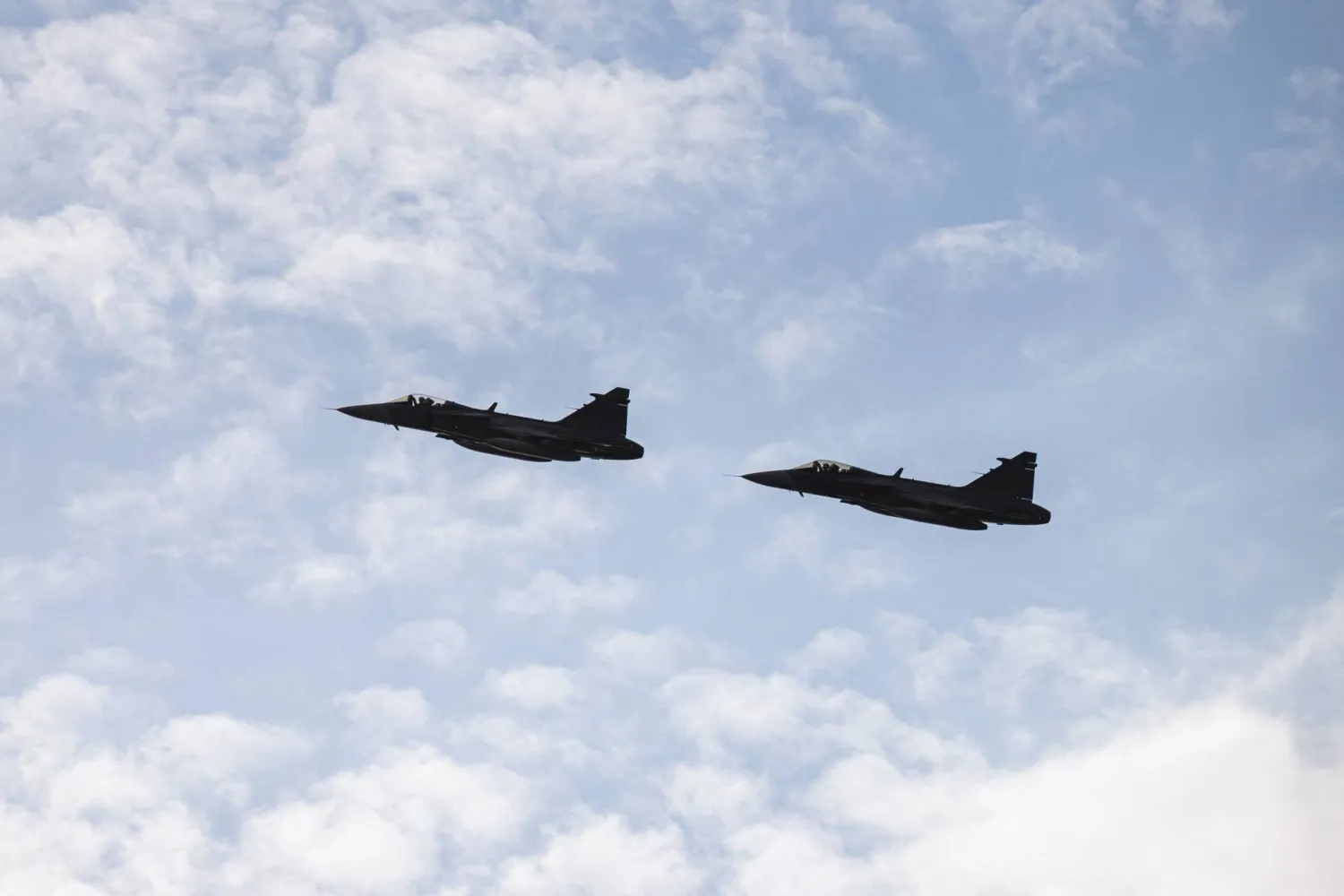
Swedish Air Force Saab Gripen fighter jets fly over Helsingborg, Sweden, on May 21, 2026, during the Meeting of NATO Ministers of Foreign Affairs taking place on May 21-22. (Photo by Jonathan NACKSTRAND / AFP)
TT

Raise Defense Spending or Else, Hegseth Tells NATO, Europe

Swedish Air Force Saab Gripen fighter jets fly over Helsingborg, Sweden, on May 21, 2026, during the Meeting of NATO Ministers of Foreign Affairs taking place on May 21-22. (Photo by Jonathan NACKSTRAND / AFP)

US Defense Secretary Pete Hegseth took another swipe at Washington's NATO and European partners on Saturday, saying those that do not hike defense spending sufficiently "will face a clear shift in how we do business".

NATO members pledged last year to ramp up defense-related spending to five percent of GDP but, despite increased efforts, many states say they may not be able to reach that target, said AFP.

"For too long, polite pleas from our European allies to spend more on their own defense fell on deaf ears," the Pentagon chief said at a defense summit in Singapore.

"They are finally playing catch-up," Hegseth said in a speech at the annual Shangri-La Dialogue conference.

"Allies who refuse to step up and carry their own weight for our collective defense will face a clear shift in how we do business."

Secretary of State Marco Rubio said this month NATO was facing US troop cuts in Europe as Washington focused on other threats and European nations ramped up their defenses.

In Asia, Hegseth reiterated that the region's security had "rested disproportionately on American military power, while many of our allies and partners allowed their own defense capabilities to atrophy".

Many countries in the Asia-Pacific region were indeed stepping up, Hegseth said, using South Korea as a particular example.

"South Korea has invested consistently in its own defense, because it does not have the luxury of treating war like an academic exercise.

"They live on the front lines, and so they build real combat power."

This "reflects simply a clear-eyed understanding of the threat environment", he said.

Hegseth also praised the spending policies of other countries including Australia, the Philippines and Japan.

"You don't have a strong alliance unless everyone has skin in the game. No freeloading," Hegseth said.

Hegseth agreed when asked by a New Zealand delegate whether he considered the Pacific island nation's plan to increase defense spending from one to two percent to be "freeloading".

"If I'm being honest, two percent is not enough, and so two percent is freeloading.

"I don't have anything against New Zealand, (but) I want partners to step up," Hegseth said.


Return to US-Iran Hostilities Is Huge Setback for Civilians, UN Rights Chief Says

An aircraft prepares to land aboard the USS George H.W. Bush, at an unknown location, released July 14, 2026, in this still image taken from a handout video. US Central Command (CENTCOM)/Handout via Reuters
TT

Return to US-Iran Hostilities Is Huge Setback for Civilians, UN Rights Chief Says

An aircraft prepares to land aboard the USS George H.W. Bush, at an unknown location, released July 14, 2026, in this still image taken from a handout video. US Central Command (CENTCOM)/Handout via Reuters

The United Nations human rights chief said on Tuesday the resumption of hostilities between the United States and ‌Iran was ‌a huge ‌setback ⁠for civilians in ⁠the region, and he urged restraint.

"The return to wider hostilities in the ⁠Middle East ‌between the ‌US and Iran ‌is a huge ‌setback for civilians in the region and beyond. It undermines ‌peace efforts and deepens instability, with grave ⁠risks ⁠for human rights across the entire region," the UN high commissioner for human rights Volker Turk said in a statement.

Iran fired missiles at Jordan and Bahrain on Tuesday after the United States launched a five-hour attack on Iranian targets, stepping up a battle for control of the Strait of Hormuz that has pushed up oil prices to four-week highs.

US forces carried out waves of attacks for the third night in a row after Tehran said it had closed the strait, prompting US President Donald Trump to reinstate a blockade of Iranian shipping.

Iran hit back by attacking a Jordan with ballistic missiles while Bahrain said it had fended off an Iranian aerial attack. Jordan said it had shot down four ballistic missiles and explosions were heard in Manama, Bahrain's capital.

The worsening attacks have increased doubts that a memorandum of understanding signed last month will lead to a permanent halt in the war, which has disrupted global energy supplies and raised fears of a rise in inflation globally.


Netanyahu Says Israel Will Deliver ‘Decisive Blow’ if Iran Attacks

Israeli Prime Minister Benjamin Netanyahu looks on during a ceremony marking the 50th anniversary of Operation Entebbe at the President's Residence in Jerusalem, July 12, 2026. (Reuters)
TT

Netanyahu Says Israel Will Deliver ‘Decisive Blow’ if Iran Attacks

Israeli Prime Minister Benjamin Netanyahu looks on during a ceremony marking the 50th anniversary of Operation Entebbe at the President's Residence in Jerusalem, July 12, 2026. (Reuters)

Israeli Prime Minister Benjamin Netanyahu vowed Tuesday to strike powerfully against Iran if it staged a new attack on his country.

"I will say it to the leaders of Iran: Do not count on things remaining quiet if you attack us," Netanyahu said at a conference in Dimona.

The southern town hosts a facility officially dedicated to nuclear research but is widely believed to house Israel's undeclared nuclear arsenal.

"The days are over when someone strikes us and we don't hit back with a decisive blow," Netanyahu added.

He said the strikes would be more powerful than the ones carried out jointly with key ally the United States earlier this year.

"Do not count on a rerun," Netanyahu said, referring to the previous attacks on Iran, according to a video released by his office.

"Because it will not be a rerun, and that was already powerful enough. This will be a different event, much more powerful."

Netanyahu's threat came amid new US strikes on Iran and as US President Donald Trump vowed to reimpose a blockade on Iranian ports.

US strikes on Tuesday also hit the Iranian port city of Bushehr, which hosts Tehran's only civilian nuclear plant.

In retaliation to US strikes that began three days ago, Iran has launched missiles targeting US allies in the region.


Trump Steps Back from Proposal for Hormuz Fees

 A vessel at the Strait of Hormuz, as seen from Musandam,Oman, July 14, 2026. (Reuters)
A vessel at the Strait of Hormuz, as seen from Musandam,Oman, July 14, 2026. (Reuters)
TT

Trump Steps Back from Proposal for Hormuz Fees

 A vessel at the Strait of Hormuz, as seen from Musandam,Oman, July 14, 2026. (Reuters)
A vessel at the Strait of Hormuz, as seen from Musandam,Oman, July 14, 2026. (Reuters)

US President Donald Trump stepped back from a proposal to charge a 20% fee to guard the Strait of Hormuz as part of the conflict with Iran, saying on Tuesday he would instead seek investment deals in the region.

US forces had carried out waves of attacks for ‌the third night ‌in a row after Tehran said it had ‌closed ⁠the strait, prompting Trump ⁠on Monday to reinstate a blockade of Iranian shipping and propose the fee.

But just a little under five hours before the fee had been due to come into effect at 2000 GMT, Trump said the strait was open to all shipping traffic except that of Iran.

Oil futures prices pared their ‌gains after the post after rising earlier on Tuesday.

The worsening attacks had increased doubts that a memorandum of understanding signed last month would lead to a permanent halt in the war, which has disrupted global energy supplies ‌and raised fears of a rise in inflation globally.

Iran had hit back by attacking ⁠Jordan with ballistic missiles while Bahrain said it had fended off an Iranian aerial attack. Jordan said it had shot down four ballistic missiles and explosions were heard in Manama, Bahrain's capital.

Before the war, about a fifth of global oil and gas traffic passed through Hormuz daily. If the US were to impose a 20% fee, it could generate around $240 million a day.

The UN shipping agency said it opposed any fees for straits used in international navigation and that there was no legal basis for introducing mandatory tolls on strait transits.
