


Hamas Weighs Collective Leadership to Fill Qassam Vacuum

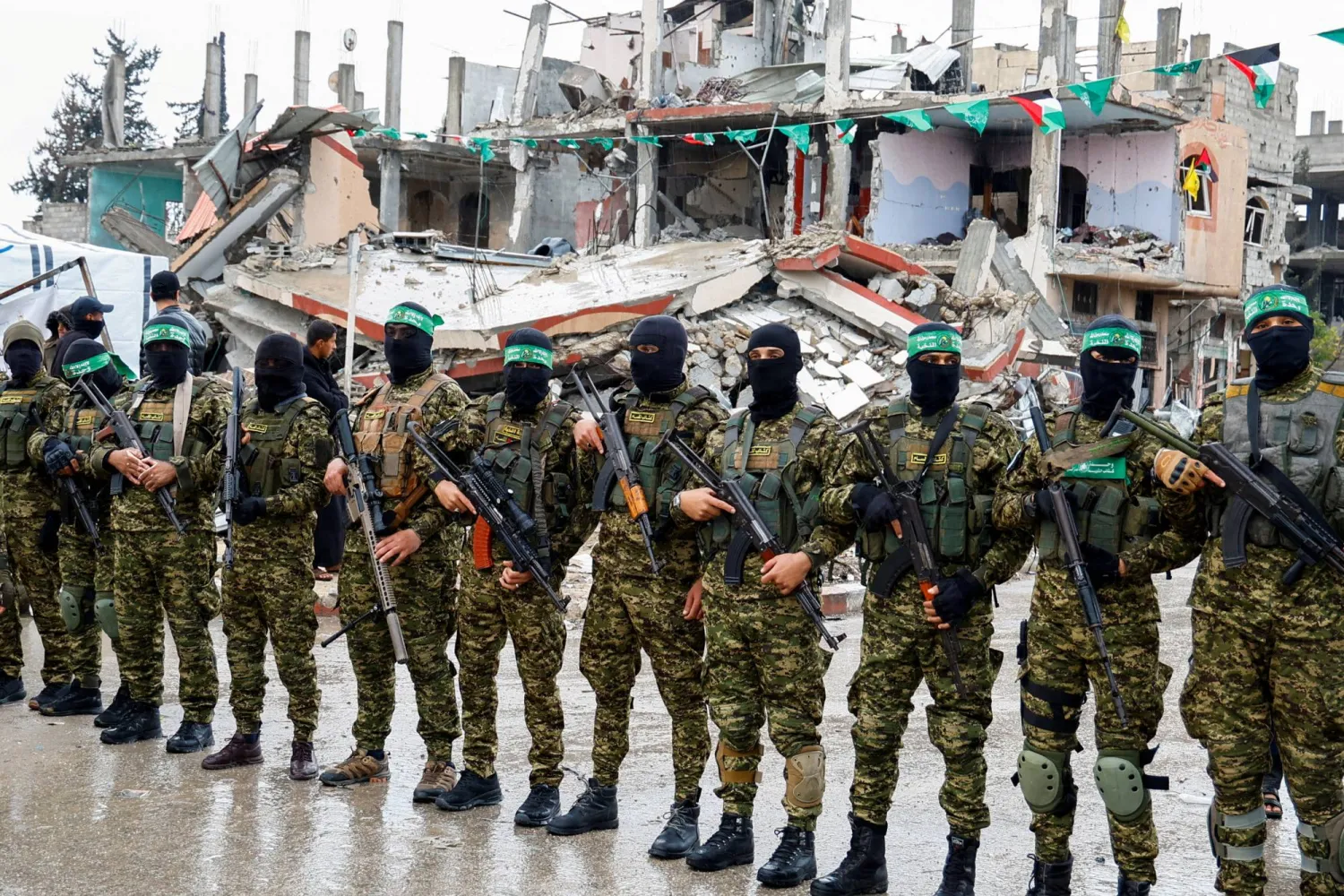
FILE PHOTO: Palestinian Hamas militants stand guard on the day of the handover of hostages held in Gaza, in Rafah in the southern Gaza Strip, February 22, 2025. REUTERS/Hatem Khaled/File Photo
TT

Hamas Weighs Collective Leadership to Fill Qassam Vacuum

FILE PHOTO: Palestinian Hamas militants stand guard on the day of the handover of hostages held in Gaza, in Rafah in the southern Gaza Strip, February 22, 2025. REUTERS/Hatem Khaled/File Photo

A wave of Israeli assassinations targeting commanders of al-Qassam Brigades, Hamas’ armed wing, has thrown the movement and its military command into greater difficulty.

Filling the vacuum at the top of Qassam’s general staff has become harder at what Hamas sees as the most perilous stage in its history since its founding in 1987.

Despite a supposed ceasefire agreement in Gaza since last October, Israel has killed many Hamas and Qassam members and commanders.

In less than two weeks, it killed Qassam commander Izz el-Deen al-Haddad, his successor Mohammed Odeh, and Imad Aslim, deputy commander of the Gaza Brigade and a prominent field commander, after decades of pursuit.

A fourth figure, the new commander of the Northern Brigade, survived and is believed to have been wounded.

Hamas sources told Asharq Al-Awsat that several options are under discussion within the movement, including a “collective leadership” for Qassam, modeled on the leadership council now overseeing Hamas affairs.

With the killings of Haddad and Odeh, Israel has most likely eliminated all those who planned and oversaw the Oct. 7, 2023, attack, as well as the members of the military council and general staff, except for Qassam commander Imad Aqel.

Aqel did not take part in planning or supervising the attack, but is believed to have known about it because he was then responsible for the Home Front Directorate, a post he held until Odeh was killed.

What are the options?

Three Hamas sources in Gaza, speaking separately to Asharq Al-Awsat, agreed that choosing or announcing a new chief of staff could take longer this time than the swift handover from Haddad to Odeh.

They cited several reasons, including “the security situation and Israel’s pursuit of anyone who is chosen.”

One source said the decision had also been complicated by “the internal impact of the assassinations on the movement and the need for more caution.”

A third source said a new commander was likely to be chosen soon, but under tighter secrecy to prevent his identity from being leaked, especially if the choice is a figure not widely seen as a contender.

The sources acknowledged that the assassinations had wiped out senior or charismatic Qassam leaders, making the task of choosing a successor more difficult.

Still, the Gaza sources and a fourth Hamas leader outside the enclave did not rule out a new course, appointing a “leadership council” similar to the body that runs Hamas politically.

The source outside Gaza said: “A council of five of the most prominent remaining military commanders may be formed to run Qassam during this critical period until conditions stabilize.”

Imad Aqel

“There are several options for the Qassam chief of staff. There are candidates for the post, such as Imad Aqel, the last remaining figure in the current military council, as well as others who were once members of the council and left years ago. They may be brought back after being summoned during the current war to take on specific field and administrative roles,” the Gaza sources said.

All sources said Aqel could become chief of staff in the near future.

Three Hamas sources in Gaza said Aqel is a major military figure. Israel has tried to assassinate him at least twice, wounding him in one attempt. During the current war, he lost one son at the hands of armed members of the Doghmush clan south of Gaza City, two days after the Oct. 10, 2025, ceasefire.

The clan abducted and killed him before a decision was issued to attack it, eliminate its gunmen and seize its weapons. Aqel’s other son was killed while taking part in the Oct. 7 attack.

Aqel originally lived in Nuseirat refugee camp in central Gaza. At the start of the second intifada in late September 2000, he was forced to leave the camp and move to the Zeitoun neighborhood in southern Gaza City.

In 2002, he was accused of being behind the assassination of Rajeh Abu Lehia, commander of the Riot Control Unit in the Palestinian Authority police.

Aqel served at various times as commander of the Central Brigade and then the Gaza Brigade. He also headed the Manufacturing Directorate before spending longer years in the Home Front Directorate.

Muhannad Rajab and a mysterious veteran figure

Other Qassam commanders are also being mentioned, including Gaza Brigade commander Muhannad Rajab, Northern Brigade commander Izz el-Deen al-Beik, whom Israel tried to assassinate days ago, and Khan Younis Brigade commander Mohammed al-Bureim. Other former members of the brigades’ military council are also being pushed by some to return to the general staff.

A Hamas source familiar with Rajab said he is “known for strategic thinking and security experience,” qualities that helped him become Gaza Brigade commander despite the presence of more senior military names. His ability to draw up strategies, the source said, enabled him to command the Sabra and Tel al-Islam battalions, and he was close to Haddad.

The source said Rajab has “a strong chance of becoming Qassam commander-in-chief, especially since many field commanders could be nominated to replace him as commander of the Gaza Brigade.”

The name of Northern Brigade commander Izz el-Deen al-Beik also appears as another option, if his health allows, after conflicting reports about his injury in an Israeli strike days ago.

One source said the candidates include a mysterious figure he described as “historical,” whom Israel tried to assassinate several times during the latest war.

The source, who declined to name the candidate to lead Qassam, said they “are not wounded, have considerable security and military experience, and are one of the brigades’ veteran military and security figures.”


Gazans Flee Scorching Tents for a Polluted Sea

 Tents housing displaced Palestinians stand amid summer heat in Gaza City, June 20, 2026. (Reuters)
Tents housing displaced Palestinians stand amid summer heat in Gaza City, June 20, 2026. (Reuters)
TT

Gazans Flee Scorching Tents for a Polluted Sea

 Tents housing displaced Palestinians stand amid summer heat in Gaza City, June 20, 2026. (Reuters)
Tents housing displaced Palestinians stand amid summer heat in Gaza City, June 20, 2026. (Reuters)

Residents of the Gaza Strip have been flocking from suffocating tents to the territory's polluted Mediterranean shore to bathe and wash their clothes, as summer temperatures rise and fresh water remains hard to come by.

Nearly all Gaza's population was displaced during two years of war between Israel and Hamas, with Gazans now crammed into a narrow strip along the coast, mainly in tents and damaged buildings.

"The only outlet in the Gaza Strip, from north to south, is the sea," said Wadie al-Ras, 36, a displaced Palestinian standing on Gaza ‌City's shore.

"The tents ‌we have been staying in since the war ‌are ⁠a torment."

Before war with ⁠Israel broke out in October 2023, Gaza City's sandy beach was a favorite spot for locals to relax. Now it is their only refuge from the crammed, makeshift tents, which are a hotbed of bugs and disease.

Temperatures in Gaza range between 28 and 31 degrees Celsius in the mornings, and inside the tents, it feels far hotter.

The sea offers little comfort. The water is thick with sewage and waste, the ⁠result of a collapse of infrastructure that once served a population ‌of more than two million people.

"The seawater ‌is not clean. There's sewage in it, filled with dirt," said Shehab al-Suwaireki, 36, a ‌displaced father of six.

With no steady supply of fresh water, however, families have been ‌left with little choice.

"We go in and wash (clothes) and bathe then we get out," Suwaireki said. "In any case, germs are getting to our bodies."

Many water pumps have stopped working due to Israeli bombardment, while sewage stations, pumping facilities, and water treatment plants have all been ‌severely damaged, said Husni Muhanna, a spokesperson for the Gaza municipality.

"Residents resort to the beach despite all the dangers," Muhanna ⁠said.

The war began ⁠when Hamas-led fighters attacked Israel from Gaza on October 7, 2023, killing 1,200 people and seizing 251 hostages.

Israel responded with an all-out assault on Gaza that killed at least 73,000 Palestinians, according to health officials in the Hamas-controlled territory.

Despite an October 2025 truce, Israel has continued to carry out deadly attacks in Gaza, which it says aim to thwart imminent attacks by Hamas and other fighters. Hamas has so far rebuffed calls to lay down its arms in exchange for Israel withdrawing its troops.

Aid and basic essentials are scarce.

Nahed Hamouda, a 56-year-old father of four who has been displaced from Jabalia, north of Gaza City, said the tents were "like an oven".

"There's no electricity, no fan, no water, even the food is inedible," he said, as he sat fanning himself with a piece of cardboard.


Lebanon Ceasefire Largely Holds but Fears Persist It May Collapse

 People check destroyed cars following a ceasefire between Israel and Hezbollah in the village of Mayfadoun, southern Lebanon, Monday, June 22, 2026. (AP)
People check destroyed cars following a ceasefire between Israel and Hezbollah in the village of Mayfadoun, southern Lebanon, Monday, June 22, 2026. (AP)
TT

Lebanon Ceasefire Largely Holds but Fears Persist It May Collapse

 People check destroyed cars following a ceasefire between Israel and Hezbollah in the village of Mayfadoun, southern Lebanon, Monday, June 22, 2026. (AP)
People check destroyed cars following a ceasefire between Israel and Hezbollah in the village of Mayfadoun, southern Lebanon, Monday, June 22, 2026. (AP)

A ceasefire largely held in Lebanon on Monday as the country experienced the longest lull yet in three months of war between Hezbollah and Israel, even as fear of renewed hostilities kept displaced people from going home.

A senior Lebanese security official said that adherence to the ceasefire had been "almost total" since Saturday evening, though the official said an Israeli tank fired shells towards a village near Tyre and Israeli forces fired sound grenades in two other locations on Monday. An Israeli drone buzzed over Beirut.

The war has tested the interim US-Iran deal on ending the regional conflict, leading Tehran to announce at the weekend it had once more closed the Strait of Hormuz, saying the US had failed to meet its commitment to halt the fighting in Lebanon.

US Vice President JD Vance, who led Washington's delegation to a first round of talks with Iran aimed at reaching a final peace deal, said on Monday that progress had been made towards ending hostilities in Lebanon, ‌and that the Strait ‌was open.

He said Lebanon was a work in progress.

Hassan Wazni, director of a hospital in ‌Nabatieh - ⁠a city in the ⁠south that has been heavily bombarded during the conflict - said there had been calm since Saturday evening.

"I'm monitoring the situation day by day, and most of the time I'm sleeping in the hospital. This is the longest a ceasefire has held," he told Reuters by phone.

'PEOPLE ARE STILL UNEASY'

But people were hesitant to return, he added, noting that a ceasefire declared on Friday had quickly collapsed, with 20 people in Lebanon killed by Israeli attacks on Saturday, according to Lebanon's civil defense.

"People are still uneasy," Wazni said.

The municipal council of the village of Zawtar al-Sharqiyeh, in a statement circulated on social media, warned residents against returning until safe to do so.

Israeli forces remain deployed deep inside southern Lebanon, occupying a ⁠self-declared security zone where they have been razing villages, saying Hezbollah has embedded itself in civilian ‌areas.

Israeli Prime Minister Benjamin Netanyahu said on Monday that troops had full freedom of ‌action to thwart any Hezbollah direct or emerging threat against them or Israeli citizens, and would remain in Lebanon for "as long as is necessary".

Still, the ‌Israeli military lifted safety restrictions in eight communities near the Lebanese border beginning at 6 a.m. (0300 GMT) on Monday.

VANCE DISCUSSES CEASEFIRE WITH LEBANESE PRESIDENT

A joint statement issued at the end ‌of US-Iranian talks mediated by Pakistan and Qatar in Switzerland said the parties had agreed to create "a de-confliction cell" to ensure adherence to the termination of hostilities in Lebanon.

Israel has yet to issue ⁠any comment on this.

At Iran's ⁠insistence, an interim deal signed with the United States last week requires Washington, Tehran, and their allies to declare an immediate and permanent termination of military operations on all fronts, including Lebanon.

Israel and Hezbollah agreed to a ceasefire on Friday afternoon, only for hostilities to flare up again on Saturday, leading Iran to announce that it had again shut the Strait of Hormuz.

US officials disputed that the strait was closed, but commercially available shipping data showed an immediate impact.

On Saturday evening, an Israeli military official said the military had received updated directives from the political echelon to cease fire. The Israeli military was operating in "a defensive manner within the security zone", the official said.

Lebanese President Joseph Aoun discussed efforts to maintain a ceasefire and halt Israeli military escalation during a phone call with Vance, Qatari Prime Minister Sheikh Mohammed bin Abdulrahman al-Thani, and White House envoy Jared Kushner, the Lebanese presidency said.

Since Hezbollah opened fire in support of Iran on March 2, Israeli attacks in Lebanon have killed 4,106 people, including 773 women, children and health care workers, according to the Lebanese health ministry. The toll does not say how many combatants are among the dead.

Israeli attacks have forced some 1.2 million people from their homes in Lebanon, according to Lebanese authorities.

Direct damage to buildings in south Lebanon in the latest war between Israel and Hezbollah is estimated at around $1.38 billion, a UN agency and Lebanese research center said on Monday.

"In total, 11,095 buildings were completely destroyed, impacting 17,891 housing units, while 2,242 buildings sustained partial damage... and 9,311 buildings incurred minor damage," the United Nations Development Program (UNDP) and Lebanon's government-linked National Council for Scientific Research (CNRS) said.

The assessment compared satellite imagery from late April, nearly two months into the latest war, with those from October 2025.

Israel's death toll from this round of hostilities with Hezbollah includes at least 32 soldiers and four Israeli civilians.


Wife of Iraqi Official Accused of Corruption Allegedly Burns Millions of Dollars in Clay Oven

Iraqi Prime Minister Ali al-Zaidi. (AP) 
TT

Wife of Iraqi Official Accused of Corruption Allegedly Burns Millions of Dollars in Clay Oven

Iraqi Prime Minister Ali al-Zaidi. (AP) 

As the Iraqi government intensifies its anti-corruption campaign, the arrests of senior officials across several ministries have been accompanied by allegations that read almost like fiction.

Two senior officials from the Oil and Electricity Ministries have reportedly confessed to embezzling millions of US dollars and billions of Iraqi dinars, as well as participating in what authorities describe as one of the country’s largest money-laundering operations.

The officials and their alleged backers—widely known in Iraq as the “whales of corruption”—are now at the center of a widening investigation.

At the same time, social media platforms and local news outlets have been awash with stories about how illicit wealth was concealed, whether in fortified homes or on private estates.

One of the most widely circulated claims alleges that the wife and sister of former Oil Ministry official Adnan al-Jumaili burned more than $5 million and billions of Iraqi dinars in a traditional clay oven at a family farm in Salahuddin province before security forces arrived to conduct a search.

An Iraqi source told Asharq Al-Awsat that teams from the Integrity Commission, headed by Mohammed Ali al-Lami and operating under directives from Prime Minister Ali al-Zaidi, have not officially confirmed whether large sums of money were actually destroyed or whether additional cash was found at specific homes and orchards.

According to the source, recovered funds have been deposited in the state treasury pending further investigations into whether the confessed crimes were carried out independently or on behalf of a broader network.

“The scale of these funds and the manner in which they were obtained leave no doubt that those responsible, enjoyed protection from powerful figures,” the source said. “They may have been little more than front men.”

Iraq’s judiciary has issued arrest warrants for the wife and sister of detained former Oil Ministry undersecretary Adnan Mohammed Mahmoud al-Jumaili, accusing them of burning billions of dinars and more than $5 million before security forces reached the property.

According to a statement from the Supreme Judicial Council, headed by Faiq Zaidan, investigators seized assets linked to al-Jumaili valued at roughly $10 million, in addition to real estate, gold and weapons. Al-Jumaili served as undersecretary for refining affairs at the Oil Ministry.

The statement said preliminary investigations uncovered nearly 40 properties in Baghdad, Salahuddin and Erbil, along with approximately $10 million in cash and 3 billion Iraqi dinars.

Authorities also confiscated about 1.5 kilograms of gold jewelry and large quantities of light and medium weapons. Investigations remain ongoing to identify all individuals and entities connected to the case.

From “Most Honest Employee” to Corruption Suspect

Days after al-Jumaili’s arrest, authorities detained Alaa Samir al-Jubouri, director general of the Middle Electricity Distribution Company and the recipient of Iraq’s 2023 “Most Honest Employee” award. Interior Ministry reports said he was caught in possession of tens of billions of Iraqi dinars.

Following al-Jumaili’s arrest, Communications Minister Mustafa Sanad accused him on Facebook of acting as a conduit for political-party corruption and the sale of government posts within the Oil Ministry.

Commenting on the broader anti-corruption drive, Ghaleb al-Daami, a media professor at Mustansiriyah University, said the campaign reflects an unprecedented level of coordination among the government, judiciary and Integrity Commission.

“This is the first time since 2003 that state institutions have worked together in this way,” al-Daami told Asharq Al-Awsat. “In the past, conflicts between executive and judicial authorities often undermined accountability. Today, the process appears markedly different.”