

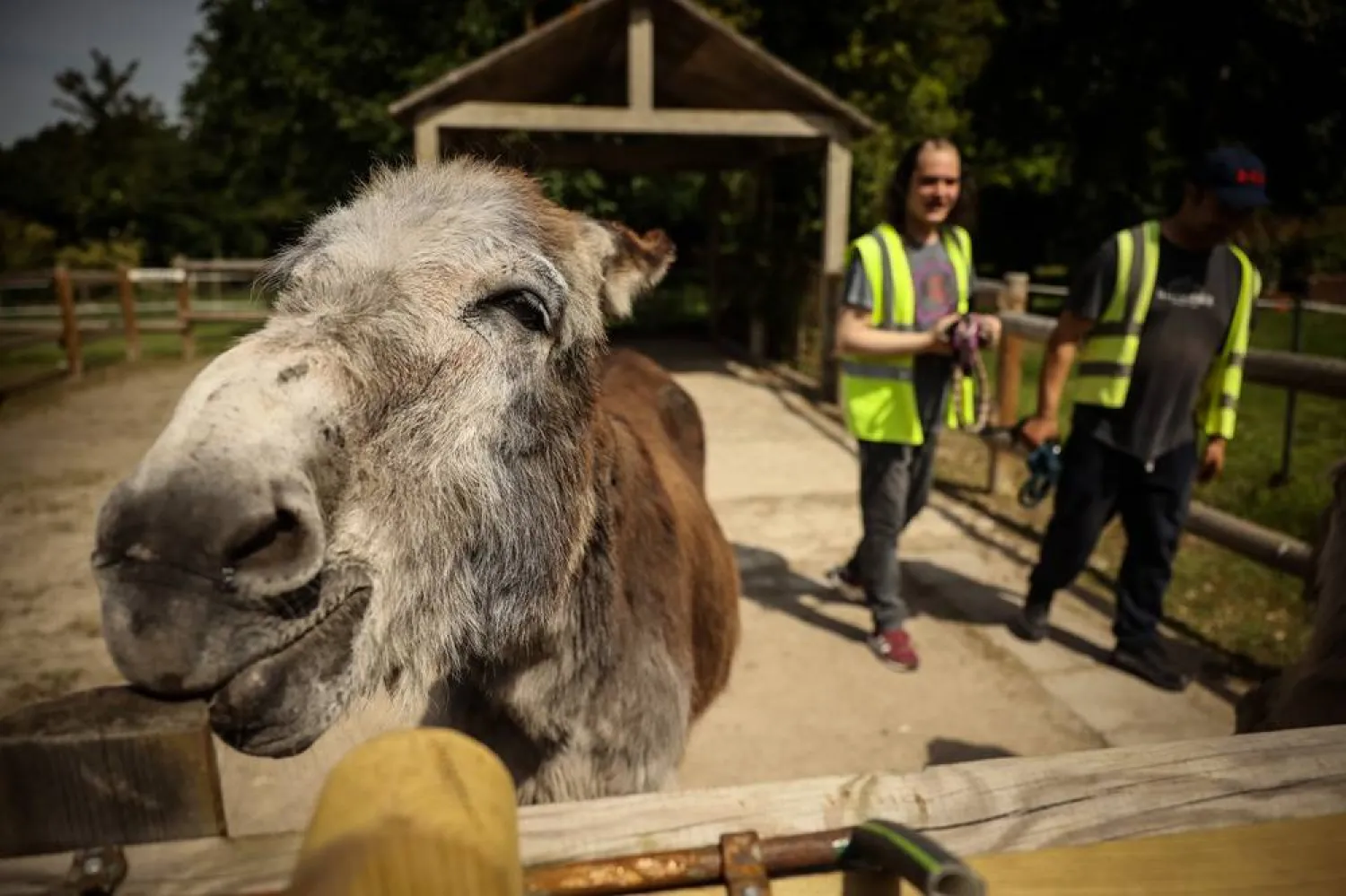

Patients Find Help with Therapy Donkeys at Psychiatric Hospital Near Paris

 Patients with mental health conditions participate in a therapy session involving donkeys at a psychiatric hospital in Neuilly-sur-Marne, in the eastern suburbs of Paris, Friday, May 29, 2026. (AP)
Patients with mental health conditions participate in a therapy session involving donkeys at a psychiatric hospital in Neuilly-sur-Marne, in the eastern suburbs of Paris, Friday, May 29, 2026. (AP)
TT

Patients Find Help with Therapy Donkeys at Psychiatric Hospital Near Paris

 Patients with mental health conditions participate in a therapy session involving donkeys at a psychiatric hospital in Neuilly-sur-Marne, in the eastern suburbs of Paris, Friday, May 29, 2026. (AP)
Patients with mental health conditions participate in a therapy session involving donkeys at a psychiatric hospital in Neuilly-sur-Marne, in the eastern suburbs of Paris, Friday, May 29, 2026. (AP)

Therapy donkeys are helping patients with mental health conditions recover in a psychiatric hospital unit outside Paris that's unique to France.

The 19th century farm buildings and wooded surroundings are a haven within the Ville-Evrard hospital complex in Neuilly-sur-Marne. On Friday, patients took the five donkeys for a walk and cared for them. Some confidently lifted their hooves to remove dirt. Many ended the session with a hug.

“When you take medication that helps you relax ... it’s exactly the same,” said Nathalie, a 60-year-old patient. She and others were identified by their first names only to protect their privacy.

“I’d call it animal medicine,” she said. “It brings relief. You stop thinking about everything else."

‘It helps you break away from the routine of treatment’

Patients attend the sessions free of charge as part of their treatment, which is funded by France’s public health system.

Participants are usually paired with a donkey — Nono, Pitou, Oscar, Manolo or Malraux. Over time, they become familiar with each other’s personalities.

Audrey Seffar, a nurse at the animal therapy unit, said Nathalie's progress after only a few sessions was significant.

“At first, she wouldn’t get out of the cart (provided for people with physical difficulties). But little by little, with encouragement, she did," Seffar said. "The animal serves as a mediator. It’s such an extraordinary one that today she was able to leave the cart and stand beside her donkey."

Another patient, Jérôme, 52, said the program helps reduce loneliness.

“Talking with people, taking part in activities I wouldn’t normally do, it helps me in my daily life,” he said.

He added: “It helps you break away from the routine of treatment and medication. Staying at home isn’t good for me.”

‘They’re emotional sponges’

The first donkeys arrived at Ville-Evrard hospital in 2016 as part of a project launched by Ermelinda and François Hadey.

Ermelinda, a nurse specializing in psychiatry, strongly believed in animal therapy benefits and thought donkeys, known for their calm and social nature, would be perfect. Her husband learned how to train donkeys for therapy work. Some of the animals were adopted through shelters after experiencing neglect or mistreatment.

“A donkey is very intelligent. It understands things very quickly, but you have to explain slowly,” François Hadey said. “Donkeys are calm, serene animals that are generally close to people. Once they’re involved in these interactions, they connect very well with patients. They’re emotional sponges.”

Since 2022, the animal therapy program has had official status as a health care unit in the hospital, allowing it to employ three full-time nurses. Volunteers with a nonprofit group help care for the animals.

The program has expanded to include guinea pigs, chickens, doves, goats, turtles and rabbits. Sessions are tailored to people’s needs and preferences, and smaller animals can be brought to hospital rooms.

Alicia Fabi, an 18-year-old nursing student, said the activity gives patients a chance to leave the hospital environment.

“Every time we come back from the activity, they say they feel good, calm and relaxed, and that they enjoyed the outing. That’s really positive,” she said.

Walking together also allows patients and health workers to develop a deeper relationship.

“We talk about many different things, their illness, their lives and just about everything else. We don’t focus only on the illness because we don’t want them dwelling on it all the time,” Fabi said.

They seek research into the benefits

Health workers say the sessions are designed as therapeutic interventions for living with anxiety, depression, autism, schizophrenia or other conditions. Staff said they can help improve emotional regulation, communication, social interaction and self-esteem.

“Everything we do with the animals allows us to work with the patient,” Ermelinda Hadey said. “We work on feeding the animal, which helps us address the patient’s own eating habits. We work on the animal’s hygiene, and by mirror effect, we work on the patient’s hygiene as well.”

Many patients take intensive treatments, including antipsychotic medications or sedatives, which can make it difficult to find the motivation to participate in activities, she said. That’s where the relationship to donkeys and other animals play a role, she stressed.

“It does not replace a doctor or a medical prescription, but it can help patients regain confidence and a sense of self-worth," Hadey said.

She said more scientific evaluation is needed. They would like animal therapy to be formally recognized by the psychiatric community as a complementary form of care.

“To do that, we need research. We have plenty of accounts from patients ... Caregivers who accompany them see the benefits every day as well. But doctors have so many other responsibilities that they don’t necessarily witness it firsthand,” she said.

At the end of Friday’s session, as patients chatted, a nurse summed up the program’s appeal: “Donkeys are my best colleagues.”


Researchers: 'Master Key' Vaccine Technique May 'Prevent Next Pandemic'

FILE - A sign for flu & COVID-19 vaccines is displayed outside a CVS store in Buffalo Grove, Ill., Sept. 23, 2025. (AP Photo/Nam Y. Huh, file)
TT

Researchers: 'Master Key' Vaccine Technique May 'Prevent Next Pandemic'

FILE - A sign for flu & COVID-19 vaccines is displayed outside a CVS store in Buffalo Grove, Ill., Sept. 23, 2025. (AP Photo/Nam Y. Huh, file)

Known by acronyms that need no explanation, viruses like Covid, Sars and Ebola conjure up images of medics in protective suits and spark fear in populations worldwide.

Vaccines for individual viruses have provided some relief, but new strains pose a constant challenge.

Now, new AI-aided vaccine technology developed by scientists at Cambridge University offer potential immunity against whole families of viruses and could even prevent the next pandemic, according to researchers.

Professor Jonathan Heeney of Cambridge University likened the new technique to having the "master key" for an apartment block.

The main problem with vaccines, he said, was that they were "all historic" so the strain you are vaccinated with might not be the one you end up being exposed to in six months time.

Vaccines were "always chasing the virus", the project lead researcher told AFP in an interview.

"So we're getting rid of that variability by making something that's across the board recognizable by your immune system that should cover you from all these eventualities ... a real big paradigm change," he said.

Canadian Heeney, of the lab of viral zoonotics at Cambridge University's Department of Veterinary Medicine, began work on the project after the 2013-16 Ebola outbreak in west Africa where he was then based.

Ebola had previously been seen in the central African Democratic Republic of Congo, not in west Africa and it was initially misidentified as lassa fever, gastroenteritis or cholera.

The west African outbreak eventually claimed around 11,300 lives, according to the World Health Organization (WHO).

But Heeney said three or four months were spent trying to discover what it was before work could even begin on a vaccine.

"In that time, it spread from Guinea, to Sierra Leone to Liberia, three different countries quickly. The horse had bolted, the fire was raging," he said, adding many health workers were among the victims.

Returning to Cambridge after the west African outbreak, Heeney said there was a determination that "we've got to change the way this works, we can't go through it again".

Harnessing early AI, he said, his team used all the information they could get about various viruses and brought it together.

This allowed them to look for the "similarities and the differences in the important parts of the virus that the immune system responds to", recognizing not just one variant but all of them.

The new technology was all the more vital given the frequency with which viruses are now emerging due to population growth, greater movement across borders and human encroachment on animal habitats, he said.

Viruses that had previously existed harmlessly, residing in animals that had grown resistant, were coming into contact with a new species, humans, and "wow, there's no immunity, no natural defenses... and the virus goes crazy", he said.

A trial involving 39 volunteers -- sponsored by the University Hospital Southampton and published in the Journal of Infection -- found "no significant safety concerns" with the universal Sarbeco coronavirus vaccine made using the AI-aided technology.

The vaccine developed by the Cambridge scientists and biotechnoloy firm DIOSynVax will now move to larger tests.

Plagues have existed throughout history, said Heeney, from the Black Death of the Middle Ages to the 1918-20 influenza pandemic which killed an estimated 25-50 million globally.

Heeney's most pressing concern was a potential influenza outbreak, he said, describing it as one of the "trickier" viruses.

But he was hopeful the new technology could help prevent another deadly pandemic.

"Now, there's a whole different layer of AI, and we have a team using the latest AI technology ... to build a real powerful platform so we can work even faster with more data," he said.

"This, I hope is the start of a whole new era of vaccine manufacturing ... From my point of view it's about proving this technology to the world that it's safe, that it's more effective and actually jump on board.

"I think this opens the door to a whole new kind of technology. Hopefully that can change the future," he said.


Swedish Minister Breaks Ground Bringing Baby to EU Talks

European Union flags flutter outside the EU Commission headquarters in Brussels, Belgium May 5, 2021. REUTERS/Yves Herman/File Photo
TT

Swedish Minister Breaks Ground Bringing Baby to EU Talks

European Union flags flutter outside the EU Commission headquarters in Brussels, Belgium May 5, 2021. REUTERS/Yves Herman/File Photo

Sweden's environment minister brought her baby to an EU meeting Thursday, in a barrier-breaking move she said showed it was possible to be both "a present minister and a present mother".

Romina Pourmokhtari arrived at the ministerial talks in Luxembourg with her three-month-old son, Adam, in a sling with a pram-pushing aide in tow -- becoming the latest public figure to shake up conventions around motherhood and work, AFP said.

"Happy also to be an example of not having to choose between being a present minister and a present mother," the 30-year-old told journalists as Adam rested on her chest.

"There are many things that make Europe a wonderful place to live. One of them being just this, that we can have the possibility of attending meetings and attending to my child."

Her French colleague Monique Barbut promptly gave her a baby gift.

An EU official said it was thought to be the first time a baby was brought to one of the bloc's ministerial meetings.

Mothers are particularly affected by the challenge of juggling work and childcare, with studies showing women tend to miss out on promotions, career opportunities and higher earnings after having a child.

In a bid to make the lives of female lawmakers easier, the European Parliament recently changed its internal rules to allow new mothers the right to vote by proxy.

Pourmokhtari is not the first politician to highlight maternity struggles.

In 2018 former New Zealand leader Jacinda Ardern won accolades for bringing her three-month-old daughter, Neve, to the United Nations General Assembly in the first such appearance by a baby in the organization's history.

A year earlier Larissa Waters made Australian political history by becoming the first woman to nurse her newborn baby in the nation's parliament.

Ardern is still only the second prime minister to have given birth while in office after Pakistan's Benazir Bhutto in 1990.


Norway Brought Its Own Food to the World Cup. But Not Because It Distrusts US Products

Soccer Football - FIFA World Cup 2026 - Group L - England v Ghana - Boston Stadium, Foxborough, Massachusetts, US - June 23, 2026 General view inside the stadium during the warm up before the match REUTERS/Pilar Olivares/File Photo
TT

Norway Brought Its Own Food to the World Cup. But Not Because It Distrusts US Products

Soccer Football - FIFA World Cup 2026 - Group L - England v Ghana - Boston Stadium, Foxborough, Massachusetts, US - June 23, 2026 General view inside the stadium during the warm up before the match REUTERS/Pilar Olivares/File Photo

As Norway excels in its first World Cup appearance since 1998, false claims about what the team is eating are also grabbing attention online, The Associated Press said.

The allegations focus on the quality of American food — more specifically, that the Norwegians distrust it so much that they brought food from home to avoid eating it. Norway's team is based in Greensboro, North Carolina, for the duration of the 2026 tournament, which is being co-hosted by the US, Canada and Mexico.

It's true that the team shipped certain products from Norway for the World Cup, but the reason has nothing to do with concerns about quality.

Here's a closer look at the facts.

CLAIM: The Norwegian men's national soccer team brought its own food to the 2026 World Cup because it doesn't trust the quality of food in the US.

THE FACTS: This is false. The team brought some products from Norway to maintain consistency in players' diets and provide a taste of home, according to its head chef Aron Espeland. Other ingredients have been sourced locally. Nutrition experts say that such a practice is common among elite athletes who play internationally.

“When athletes are competing at the highest level, consistency is important,” Espeland said. “The players are used to certain products and flavors, and familiar foods can contribute both to nutrition and overall well-being during a demanding competition.”

He continued: “Overall, the experience of cooking for the team in the US has been excellent. We have had access to high-quality local ingredients, and our approach has been to combine those with a selection of Norwegian products that help create continuity and a sense of home for the players during the tournament.”

Many of the claims spreading online say the team brought in 1,000 kilograms (2,200 pounds) of food from Norway for the World Cup. Espeland confirmed that the amount is actually about 580 kilograms (1,276 pounds). That consists of 300 kilograms (660 pounds) of Norwegian salmon and trout, 100 kilograms (220 pounds) of halibut, 80 kilograms (176 pounds) of Norwegian brown cheese, and 100 kilograms (220 pounds) of Jarlsberg cheese.

The team, whose support staff includes three chefs, did not bring oranges from Norway, despite social media posts claiming otherwise. Espeland said that players are served freshly squeezed orange juice every morning, made from oranges sourced locally in the US.

Plenty of other teams travel with their own chef and have taken their own food to past World Cups. For example, Argentina and Uruguay each brought thousands of pounds of meat to Qatar in 2022. The US squad traveled to Brazil in 2014 with oatmeal, Cheerios, peanut butter and A1 Steak Sauce.

Such practices are not unusual for elite athletes who compete in different countries, according to experts. The reasons include maintaining routine and consistency, reducing risk of adverse reactions, providing cultural familiarity and accommodating personal preferences.

“Interpreting this practice as a lack of trust in the host nation’s food system misunderstands the purpose of high-performance nutrition,” said Rafaela G. Feresin, an associate professor of nutrition at Georgia State University. “The goal is not to evaluate local food quality; it is to eliminate unnecessary variability during competition. Bringing a chef and familiar ingredients to a major tournament is standard, performance-driven logistics.”

Amy Goodson, a sports dietitian who has worked with professional teams including the Dallas Cowboys and the Texas Rangers, explained that bringing food to international competitions is more about “control, consistency, and performance” rather than distrust.

“Nutrition is a performance variable at the World Cup level,” she said. “These athletes train, travel, and compete with elite intensity, often multiple times in a short window, while managing weather and time zone changes. What they eat directly impacts energy availability, hydration status, recovery, immune function, and even decision-making on the field. When margins are razor thin, fueling consistency becomes critical.”
