


Euphrates Flood Deprives East Syria Farmers from Crops

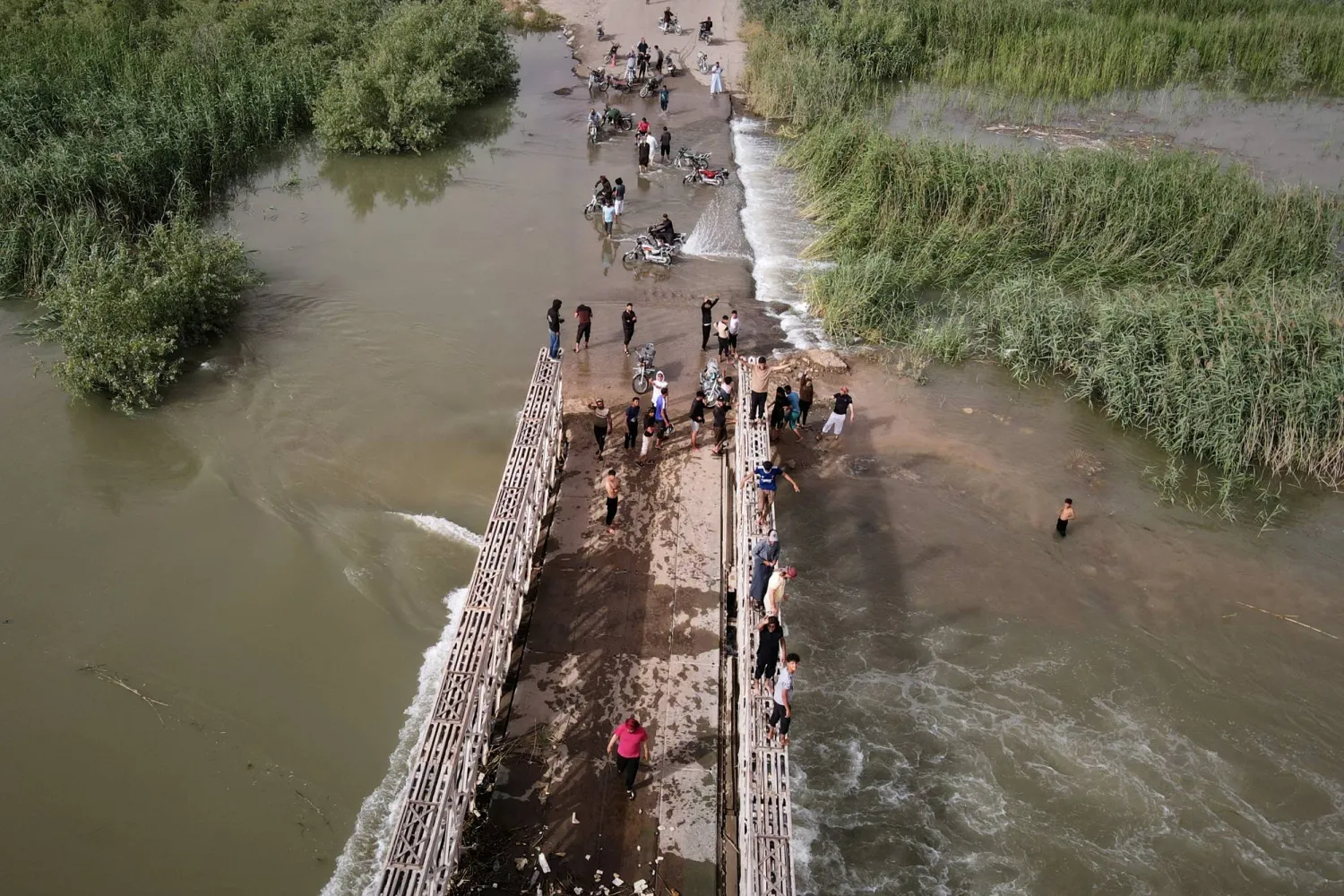
People walk across and stand on a bridge damaged by overflowing waters from the Euphrates River near Deir Ezzor, Syria, Thursday, May 28, 2026. (AP Photo/Omar Albam)
TT

Euphrates Flood Deprives East Syria Farmers from Crops

People walk across and stand on a bridge damaged by overflowing waters from the Euphrates River near Deir Ezzor, Syria, Thursday, May 28, 2026. (AP Photo/Omar Albam)

Farmer Issa al-Moussa walks among his damaged wheat crop in eastern Syria after the nearby Euphrates River flooded in recent days due to heavy rainfall and increased flows from Türkiye.

Syrian authorities have said the country was experiencing an "exceptional" rise in water levels along the Euphrates River, which originates in Türkiye and flows through the Raqa and Deir Ezzor provinces before reaching neighboring Iraq.

The water flooded fields and homes, took bridges and crossings out of service, and disrupted the operation of pumping stations for drinking water and irrigation.

"I ploughed my land, which is six dunams (6,000 square meters) in size, and each dunam cost me one million liras ($75)... This land is lost," Moussa told AFP from his farmland, part of which was still submerged in water.

With his wheat crop destroyed, Moussa has no other source of income to feed his family.

The energy ministry said the floods were caused by "the significant and unprecedented increase in water flows from the Turkish side".

In Moussa's town, where many residents rely on agriculture as a source of income, water covered vast areas of farmland, while farmers stood in their fields assessing their losses.

It also surrounded some houses and small buildings.

Authorities estimated about 5,000 dunams (five square kilometers) of land in Deir Ezzor flooded, as well as about 1,500 dunams in the village of Al-Mahoukiya in Raqa.

"No one knows when this water will dry up," Moussa said, demanding that the government "compensate us, assist the farmers, raise the prices of wheat and cotton for us, and support us with fertilizer, medicines and fuel".

- 'Our lands are gone' -

Farmers in the area said they were not warned early enough to avoid losses to equipment and crops.

"We were not informed that dams would open... our lands are gone," Moussa added.

Syrian Energy Minister Mohammad al-Bashir said " Türkiye’s warning to us about the rising water levels of the Euphrates River came too late".

Syria said last week it had to open the Euphrates Dam floodgates for the first time in decades.

No official Turkish position has been issued regarding coordination with Damascus on the rising water level of the Euphrates.

Turkish media however quoted official sources as saying that water authorities carried out "controlled water releases" from the Ataturk Dam after water levels rose due to heavy rainfall in recent months.

The four-meter rise in water levels also caused around 60 water pumping stations to go out of service, water company chief Ahmad al-Moussa told AFP.

On the riverbank, local resident Ahmad Saadoun pointed at a temporary earthen bridge that collapsed.

"We now struggle to cross from one bank to another... People are now crossing by boat, but it is also dangerous as long as the water has not calmed down," he told AFP.

- No harvests -

In response to the floods, the worst in 30 years, authorities were on the alert, reinforcing earthen barriers and preparing to evacuate if needed.

The energy ministry also said it closed one of the spillways from the Euphrates Dam which it had previously opened in to help reduce the flows.

On Sunday, Raqa water authorities said the Euphrates River water level had dropped by about 60 centimeters in 24 hours -- but the gradual decrease has not yet resolved the crisis.

In other parts of Kharita, the water crept suddenly at night, reaching farmers' homes.

"We were asleep when we saw the water rushing in," Mohammed Khodr al-Hussein, 27, said.

"We ran out... with only clothes on our backs. We left our cars, our livelihoods, our homes, and our farms behind. We have nothing left," he added.

"We farmers live season by season. We borrow at the beginning of each season and wait for the harvest to pay off our debts. Today, our losses are twofold: our money is gone, our crops are gone, and the wheat is no longer fit for harvesting."



France FM: 'Nothing Can Justify' Prolonged Israeli Occupation in Lebanon

French Foreign Minister Jean-Noël Barrot (Reuters)
TT

France FM: 'Nothing Can Justify' Prolonged Israeli Occupation in Lebanon

French Foreign Minister Jean-Noël Barrot (Reuters)

France's foreign minister said Tuesday that nothing could justify Israeli troops remaining deep inside Lebanon, after Israel and Hezbollah clashed overnight despite a US announcement that both sides had agreed to halt fighting.

"Nothing can justify the continuation of military operations and Israel's prolonged occupation deep inside Lebanese territory," Jean-Noel Barrot told France TV.


Barrack’s Appointment May Intensify US Pressure on Iraq to Disarm Factions

Iraqi Prime Minister Ali al-Zaidi meets with US Embassy Chargé d'Affaires Joshua Harris on Sunday. (Prime Minister's press office)
TT

Barrack’s Appointment May Intensify US Pressure on Iraq to Disarm Factions

Iraqi Prime Minister Ali al-Zaidi meets with US Embassy Chargé d'Affaires Joshua Harris on Sunday. (Prime Minister's press office)

The appointment of Tom Barrack as US presidential envoy to Iraq may lead to greater American pressure on Baghdad to meet its demand for the disarmament of factions allied to Iran in an effort to stem its influence in Iraq.

Iraqi Prime Minister Ali al-Zaidi has repeatedly spoken about the disarmament. So far, influential cleric Moqtada al-Sadr was the only figure to comply, announcing that the Saraya al-Salam armed wing will become part of state institutions and come under the direct command of the armed forces.

The move was described as “encouraging”. Sadr, however, had distanced himself from Iran years ago, so it remains to be seen if any of the Tehran-aligned parties will also make a similar move.

Zaidi had declared on Saturday that he was “determined to end all armed presence outside the authority of the state” despite the pressure he is facing from powerful political forces.

He explained that the disarmament of factions will take place in phases and it began with Sadr’s announcement.

The Asaib Ahl al-Haq headed Qais al-Khazali, Badr Organization headed by Hadi al-Ameri, Kataib Sayyid al-Shuhada, Kataib al-Imam Ali, Thar-Allah movement all spoke about the possibility of their disarmament, but they remained vague over how.

In contrast, the Kataib Hezbollah and Nujaba movement refuse to lay down their weapons.

Hussein al-Sheihani, member of the Sadiqoon movement’s politburo, the Asaib Ahl al-Haq's political wing, said the ruling pro-Iran Coordination Framework “is preparing a draft decision that organizes the process to limit possession of weapons.”

It also tackles “how to handle foreign forces in Iraq and discusses how to empower the security forces and air defense system.”

Meanwhile, a prominent Framework member said Barrack’s appointment will increase pressure on Zaidi and his backers in the coalition to address the issue of the possession of weapons outside state control.

Speaking to Asharq Al-Awsat on condition of anonymity, he said: “The Framework is really interested in reaching a solution to this problem. It wants the process to be simple and away from sharp clashes with the government and factions.”

The official spoke of “possible scenarios” about resolving the issue, including “assuring the factions that they will not be persecuted legally and that they may be merged” with government bodies.

Reports have said that the US will not agree to their integration into government agencies until they lay down their weapons.

The official said that the “complete elimination of the factions from the scene is not possible given their military role and the political weight enjoyed by the factions inside the Framework,” which brought Zaidi to power.

Analyst and former diplomat Ghazi Faisal said that Barrack may have a role to play in pressuring the government to disarm the factions.

The process will be based on the constitution and laws that bar the formation of armed groups outside state control, he told Asharq Al-Awsat.

He noted the strategic agreement signed between Iraq and the US in 2008, adding that Barrack may offer support requested by the government, especially the interior and defense ministries, in line with the agreement.

Faisal said that with some factions saying they were ready to lay down their arms, the US wanting to confront Iran’s influence and the Iraqi government’s determination to impose state monopoly over weapons, all parties involved may resolve this file in the coming months.


Guterres: Vital to Keep a UN Force in Lebanon after Current Peacekeepers Depart

UN Secretary-General Antonio Guterres speaks during a press conference at Japan National Press Club in Tokyo, Japan, 20 May 2026. EPA/FRANCK ROBICHON
TT

Guterres: Vital to Keep a UN Force in Lebanon after Current Peacekeepers Depart

UN Secretary-General Antonio Guterres speaks during a press conference at Japan National Press Club in Tokyo, Japan, 20 May 2026. EPA/FRANCK ROBICHON

UN chief Antonio Guterres said Monday that peacekeepers will be needed in Lebanon after the mandate of the current mission expires at year-end -- an option likely to face opposition from the United States and Israel.

Last August, the UN Security Council, under US pressure, decided to end the mandate of the United Nations Interim Force in Lebanon (UNIFIL) on December 31, 2026.

However, it asked Guterres to propose options by June 1 to allow UN peacekeepers to remain in Lebanon, particularly to monitor the Blue Line, which stretches for 120 kilometers (75 miles), marking the de facto border between Lebanon and Israel -- now the middle of the Israel-Hezbollah war.

In a report to the Security Council seen by AFP on Monday, Guterres proposes three options ranging from nearly 2,000 to more than 5,500 UN personnel to monitor the ceasefire and support the Lebanese armed forces.

"Under all proposed options, a uniformed United Nations presence working to facilitate de-escalation, dialogue, liaison and coordination, and support for the Lebanese Armed Forces, would be necessary... towards the overarching objective of a long-term solution to the conflict," the report says.

Concerns over the exit of the UNIFIL come with Israeli troops occupying south Lebanon's border areas, and as Israel and Lebanon hold direct negotiations seeking to end decades of hostilities.

UNIFIL currently counts some 7,500 peacekeepers from nearly 50 countries. They are deployed in south Lebanon near the Blue Line.

The force has been a buffer between Lebanon and Israel since 1978 although its presence has not prevented repeated outbreaks of conflict.

Several Lebanese sources told AFP that Beirut, which has pledged to disarm Hezbollah, supports maintaining a UN presence after the departure of UNIFIL.

"Recent developments have only heightened Lebanon's urgent need for continued UN and international assistance, specifically to facilitate an Israeli withdrawal on the one hand, and to enable the state to extend its authority over its entire territory on the other," said Lebanon's ambassador to the UN, Ahmad Arafa, thanking Guterres for his report.

Several members of the Security Council also support replacing UNIFIL, particularly China and Russia.

"As UNIFIL’s mandate is about to expire, the Security Council must make a responsible decision to ensure the continued UN presence in Lebanon, and to prevent a security vacuum," said Fu Cong, China's UN envoy.

But the US and close ally Israel welcomed the vote in August that ended UNIFIL.

The Trump administration has questioned the effectiveness of UN peacekeeping missions and has withheld part of the US financial contribution to support them, forcing the UN to reduce its troops worldwide.