
Israel Kills 8 in Lebanon, a Day After Trump Said Israel and Hezbollah Will De-Escalate

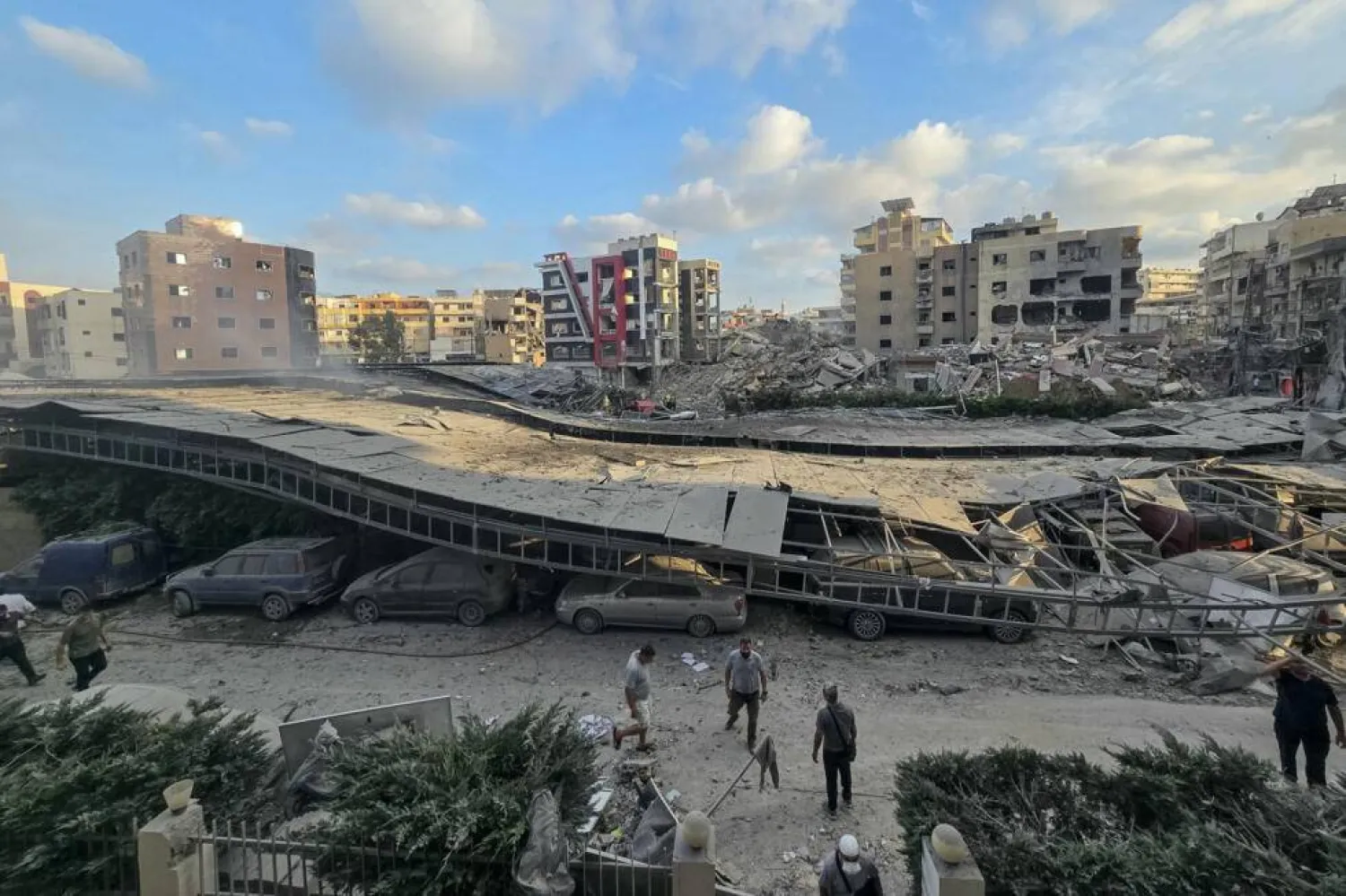
An Israeli strike hit near a hospital in south Lebanon's city of Tyre. KAWNAT HAJU / AFP
TT

Israel Kills 8 in Lebanon, a Day After Trump Said Israel and Hezbollah Will De-Escalate

An Israeli strike hit near a hospital in south Lebanon's city of Tyre. KAWNAT HAJU / AFP

Israeli drone strikes on southern Lebanon on Tuesday killed eight people, including two children and their father, a day after US President Donald Trump said Israel and Hezbollah agreed to dial back fighting. Hezbollah, which is backed by Iran, continued launching dozens of projectiles and drones toward Israeli soldiers in southern Lebanon and civilians in Israel. 

The ongoing hostilities — despite Trump's announcement and a nominal ceasefire that began in April — are deepening displacement for Lebanon's conflict-weary population. They also are a significant sticking point in negotiations to extend a ceasefire in the US-Israeli war in Iran, as Tehran wants any such deal to end fighting in Lebanon, too. 

Two semiofficial Iranian news agencies reported Tuesday that the country cut off communication with mediators facilitating the ceasefire talks. 

Another round of talks between Israel and Lebanon began Tuesday in Washington, where Lebanese negotiators are set to seek a full ceasefire that will prevent future attacks. The talks began in April and were the first in more than three decades between the countries, which have no formal diplomatic relations.  

Hezbollah has rejected direct talks, counting on pressure from Iran. 

The planned talks come days after Israeli ground troops made their deepest incursion into Lebanon in 26 years and Israel then threatened to strike Beirut’s southern suburbs, causing panic in the Lebanese capital as thousands fled. 

Israel says it will keep attacking if Hezbollah does  

Trump said Monday he had spoken with Israeli Prime Minister Benjamin Netanyahu and had communicated with Hezbollah through mediators, and that no troops would be “going to Beirut." But the intensity of attacks between Israel and Hezbollah continued. 

Israeli Defense Minister Israel Katz said Tuesday that Israel previously refrained from attacking Beirut out of deference for negotiations between the US and Iran. But he said Netanyahu informed Trump in a phone call late Monday that Israel will attack Beirut's southern suburbs if Hezbollah continues targeting northern Israel, echoing comments from the prime minister the previous day. 

An Israeli drone strike hit a car on the road linking the southern town of Marjeyoun with the city of Nabatieh, killing James Karam, a dentist from the nearby town of Qlayaa, along with his daughter and son, Lebanon’s state-run National News Agency reported Tuesday. 

The Lebanese army said two soldiers were lightly wounded when a separate drone targeted them on a road outside the city. 

Drone strikes killed two Syrians working at a plant nursery in the village of Jibchit and two people in the nearby village of Toul, the news agency reported.  

A third strike hit a car near the village of Harouf, killing one person. The Israeli military said it wasn't aware of any Israeli strikes in that area. 

NNA also reported that an Israeli airstrike on Monday killed six in the southern village of Marwaniyeh. 

Hezbollah said Tuesday its fighters fired anti-tank missiles on Israeli troops who were pushing into the southern village of Hadatha, about 7 kilometers (4 miles) from the Israeli border. 

Sirens sounded in several areas in northern Israel, its military said in a statement. It added that “a suspicious aerial target" was identified in the area where Israeli soldiers are operating in southern Lebanon, but that no injuries were reported. 

More than 3,400 people have been killed in Lebanon 

The latest round of fighting between Israel and Hezbollah has killed 3,433 people in Lebanon and displaced more than 1 million people.  

According to Netanyahu’s office, at least 27 Israeli soldiers and a defense contractor have been killed in or near southern Lebanon. Two civilians have also been killed in northern Israel. 

Israel’s military said late Monday that a soldier was killed in southern Lebanon. It added that seven more soldiers were wounded in the incident, three of them severely. 

Hezbollah’s use of hard-to-detect fiber-optic drones has been deadly for the Israeli military, which is struggling to respond. 


Houthis Link Educational Support to Loyalty and Affiliation

School supplies distributed to the children of Houthi fighters killed in combat, excluding other poor families, in Sanaa. (X)
TT

Houthis Link Educational Support to Loyalty and Affiliation

School supplies distributed to the children of Houthi fighters killed in combat, excluding other poor families, in Sanaa. (X)

The education system in areas under Houthi control is facing a fresh wave of criticism as the group launched the new academic year during the summer. The Houthis are accused of limiting the distribution of school supplies and cash assistance to their supporters and to the families of fighters killed or missing on the front lines, while also requiring private schools to grant tuition exemptions to the same groups.

The developments come as debate continues over the secondary school examination results announced by the Houthi authorities, with education experts questioning the unusually high pass rates and raising concerns about the impact of these policies on educational equity and the future of education in Yemen.

The controversy unfolds as millions of Yemeni families continue to face worsening economic conditions, leaving many unable to afford even the most basic educational expenses, including tuition fees, school bags, textbooks, and uniforms, amid declining purchasing power and widening poverty caused by the war and the economic crisis.

According to education sources, the Houthi-run so-called Zakat Authority oversaw the distribution of school bags and cash assistance through supervisors affiliated with the group. The sources said the mechanism prioritized the families of Houthi fighters and supporters, while excluding thousands of impoverished families unable to provide basic school supplies for their children.

The distribution process sparked widespread frustration among parents and education advocates, who argued that educational assistance should be allocated according to humanitarian need rather than political considerations or organizational affiliation.

Inequality

"Ibrahim," a parent in the Houthi-held Yemeni capital, Sanaa, told Asharq Al-Awsat that none of his three children received any educational support despite being registered on lists of families in need, while he witnessed school bags and uniforms being distributed to families linked to the group.

He said his family was living under severe financial hardship, yet their needs had been ignored. He argued that if charitable initiatives had supervised the distribution of the aid themselves, some of it would have reached his children.

Other parents in rural areas around Sanaa voiced similar complaints, saying the cost of preparing their children for the new school year had exceeded their financial means, while assistance remained limited to specific groups, deepening their sense of inequality.

Meanwhile, humanitarian sources said Houthi authorities responsible for aid operations and the Zakat Authority had recently confiscated quantities of school bags, notebooks, pens, uniforms, and cash that charitable initiatives had allocated to support poor students at the start of the academic year.

Education sources also said the Houthis had required private schools to waive tuition fees this year for the children of their supporters, as well as the families of fighters killed or captured on the front lines, without providing any compensation to the schools.

The principal of a private school on the outskirts of Sanaa, who requested anonymity, said the administration had no choice but to comply with the directives for fear of punitive measures. She noted that the exemptions did not extend to other students from the poorest families, despite their urgent need for assistance.

Education experts warned that imposing additional financial burdens on private schools without compensation threatens their financial stability and undermines their ability to continue providing educational services under the country's difficult economic conditions.

School supplies allocated by the Houthis for the children of their members. (Facebook)

Secondary School Results Raise Questions

Alongside the controversy over aid distribution, the secondary school examination results announced by the Houthi authorities have prompted widespread debate within education circles after reporting high pass rates and scores exceeding 99 percent for a number of students, despite years of decline in the education sector during the war.

The Education Ministry in the unrecognized Houthi administration announced an overall pass rate of 88.12 percent among more than 210,000 students who sat the examinations. Education specialists said the figure raises questions given the reality facing schools, which continue to suffer from teacher shortages, unpaid salaries, limited resources, and a decline in educational standards.

Education experts believe the conditions facing the education sector make it difficult to explain such a sharp increase in pass rates without releasing data detailing the grading and assessment process in a way that would strengthen confidence in the results and dispel the doubts surrounding them.

Several teachers also expressed surprise at the high scores, saying the level of academic achievement they observed throughout the school year did not correspond with the announced results, particularly in light of repeated student absences and disruptions to the education process.

Cheating Allegations

Yemeni education sources say the high pass rates recorded in Houthi-controlled areas do not reflect an improvement in educational standards. Instead, they attribute the results to widespread cases of organized cheating at some examination centers, along with the circulation of answer keys before and during the exams, which they consider a primary factor behind the higher scores.

Education activists also accused the Houthis of failing around 25,000 male secondary school students this year, claiming the move was part of a policy aimed at pressuring students and encouraging them to join the group's ranks in exchange for better chances of passing. The Houthi authorities have not commented on the allegations.

Several teachers said they had documented irregularities at some examination centers, including weak oversight and allowing certain students to receive assistance while taking the exams. They said such practices undermine the credibility of the examination process and compromise the fairness of student assessment.

In one case, a student from Sanaa said he was surprised to receive a score of 72 percent despite missing most of the school year because he had to work to help support his family. He said he attended only the final examinations, prompting him to question how the results had been calculated.

Meanwhile, a number of high-achieving students expressed dissatisfaction with the announced results, calling for greater transparency in grading procedures and the publication of detailed marks to safeguard students' rights and strengthen confidence in the secondary school certificate.


Deadly Algeria Orphanage Fire Caused by Air Conditioner, Police Say

Rescuers and police officers work at the site of a fire at an orphanage near Algiers, Algeria, July 16, 2026. Algerian Civil Protection/Handout via REUTERS
TT

Deadly Algeria Orphanage Fire Caused by Air Conditioner, Police Say

Rescuers and police officers work at the site of a fire at an orphanage near Algiers, Algeria, July 16, 2026. Algerian Civil Protection/Handout via REUTERS

Algerian police on Friday said a fire that killed 11 people at an orphanage in the capital was caused by an electrical spark from an air conditioning unit.

The blaze broke out before dawn on Thursday at the childcare facility in the Mohammadia suburb of Algiers.

A 52-year-old caregiver was among the dead, police said Friday, but it remains unclear how many children were killed.

Algeria's President Abdelmadjid Tebboune posted online Thursday that "several children" had died.

Nineteen others were injured during the fire, according to Algeria's civil defense.

Forensic experts determined that the blaze originated from an air conditioner that had been running continuously as Algeria endures a heatwave.

The civil defense has said nearly a thousand fires have broken out across the country's north during the past week, with the majority contained.

A municipal worker earlier died battling a fire in the northern province of Setif, according to a local mayor.

Every summer, northern Algeria is struck by forest fires, a phenomenon exacerbated by drought and climate change.

The fires have killed dozens of people in recent years and destroyed thousands of hectares of forest or farmland, along with numerous homes.


Germany Proposes EU Force to Replace UN Mission in Lebanon

15 July 2026, Finland, Helsinki: Johann Wadephul, German Minister of Foreign Affairs, speaks during a press conference following a meeting with his Finnish counterpart in the Finnish capital. (dpa)
TT

Germany Proposes EU Force to Replace UN Mission in Lebanon

15 July 2026, Finland, Helsinki: Johann Wadephul, German Minister of Foreign Affairs, speaks during a press conference following a meeting with his Finnish counterpart in the Finnish capital. (dpa)

German ‌Foreign Minister Johann Wadephul has proposed replacing the expiring United Nations peacekeeping mission in Lebanon with an EU-mandated force to prevent a security vacuum, he told the RedaktionsNetzwerk Deutschland.

"We should examine in the EU whether we can ensure that no security vacuum arises with ‌a European ‌mandate following the UNIFIL ‌mission," ⁠Wadephul said in ⁠an interview published on Friday.

The UN Interim Forces in Lebanon (UNIFIL) mission expires on December 31, 2026. Germany's parliament extended the country's participation in the mission for the final time just weeks ⁠ago.

Wadephul said Lebanon, with ‌a stabilizing ‌government, represented "one of the most hopeful developments ‌in the region at the moment."

Lebanon ‌and Israel held ambassador-level talks at the US embassy in Rome on Tuesday and Wednesday — their sixth ‌round of face-to-face negotiations since a new war erupted on ⁠March ⁠2 between Israel and Lebanese armed group Hezbollah, triggered by the wider regional conflict.

An EU-mandated force could "create the conditions for the Israeli army to withdraw without Hezbollah returning with its terror," the minister added.

The proposal comes as European nations seek to maintain regional stability while balancing relations with Israel and Lebanon.