


Ultra-Orthodox Protesters Block Roads and Trains Across Israel Over Military Draft

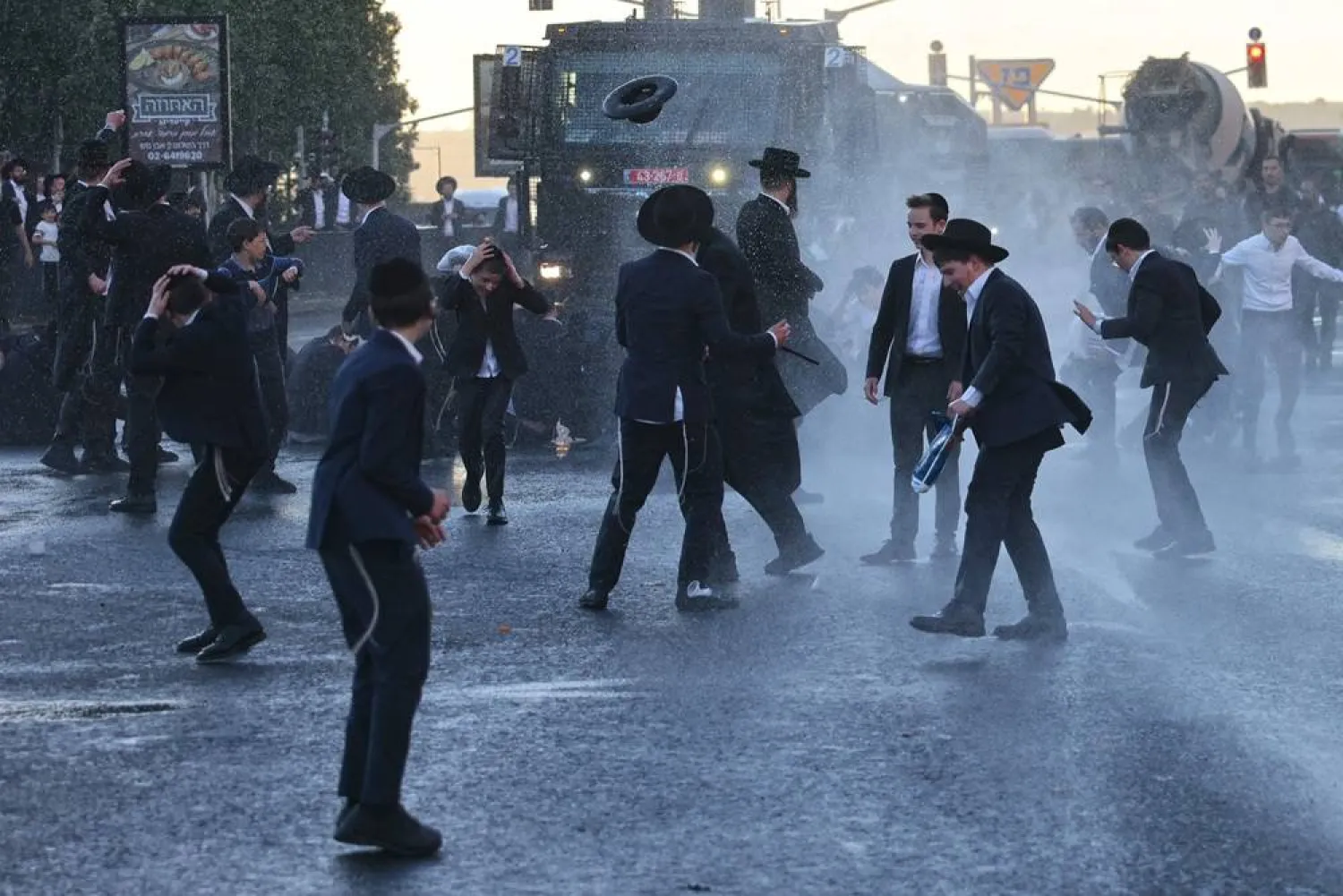
Israeli police use a water cannon to disperse ultra-Orthodox Jews protesting against conscription by blocking the entrance to Jerusalem, on June 1, 2026. (AFP)
TT

Ultra-Orthodox Protesters Block Roads and Trains Across Israel Over Military Draft

Israeli police use a water cannon to disperse ultra-Orthodox Jews protesting against conscription by blocking the entrance to Jerusalem, on June 1, 2026. (AFP)

Tens of thousands of ultra-Orthodox demonstrated across Israel on Monday, blocking roads and trains and setting cars on fire to protest mandatory enlistment in Israel’s military.

Israel’s police said demonstrators blocked major intersections and attacked a soldier who disembarked from a bus near a protest. Police struggled to control the crowds with water cannons and horses.

The protest largely crippled the country’s center, with highways closed and public transportation halted by the massive crowds in both Jerusalem and the Tel Aviv metro area.

Military service is compulsory for most Jewish men and women in Israel. The politically powerful ultra-Orthodox parties have won exemptions for their followers to forgo military service and instead study in religious seminaries, but those exemptions are under threat.

Many Israelis are tired of the longstanding system that has allowed ultra-Orthodox men to skip military service at a time when the military is stretched to its breaking point and many have served multiple tours of reserve duty.

The issue is tearing apart Prime Minister Benjamin Netanyahu’s governing coalition, possibly moving elections up by several weeks this fall after the ultra-Orthodox parties withdrew their support for Netanyahu.

Each year, roughly 13,000 ultra-Orthodox men reach the conscription age of 18, but less than 10% enlist, according to a parliamentary committee.

Faced with severe shortages of soldiers, the military is looking to extend the period of mandatory service. Most Jewish men are required to serve nearly three years of military service, followed by years of reserve duty. Jewish women serve two mandatory years.

“This public is determined, they see this as a war for their lives," said Israel Tropper, a demonstrator in Jerusalem. “From their perspective, going into the Israeli army means giving up religion ... we don’t want to give up our religion, so from our perspective it’s a war for our lives.”

He added that there is no way to force tens of thousands of people vehemently opposed to the idea to serve in the military.

Some protesters held signs condemning Israel saying: “We would rather die as Jews than live as Zionists” and “We refuse to serve an army for the sake of the Zionist religion.”

The ultra-Orthodox, who make up roughly 13% of Israeli society and are the fastest growing sector, have traditionally received exemptions if they are studying full-time in religious seminaries. The exemptions date back to the birth of the state in 1948, when a small number of students sought to revive the Jewish scholarship system after it was decimated by the Holocaust.

Those exemptions — and the government stipends many seminary students receive up to the age of 26 — have infuriated many Israelis.

Israel is currently maintaining a simultaneous military presence in Gaza, Lebanon and Syria, in addition to fighting a war with Iran, which has stretched its robust military to the breaking point.

The Supreme Court said the exemptions were illegal in 2017, but repeated extensions and government delay tactics have left them in place.

Among Israel’s Jewish majority, mandatory military service is largely seen as a melting pot and rite of passage. Many in the insular ultra-Orthodox community fear that military service would expose young people to secular influences.



UN Nuclear Agency Boss Says Inspectors Will Visit Iran’s Nuclear Sites Under Iran-US Interim Deal

An Iranian woman walks past an anti-US mural next to the former US embassy in Tehran, Iran, 22 June 2026. (EPA)
TT

UN Nuclear Agency Boss Says Inspectors Will Visit Iran’s Nuclear Sites Under Iran-US Interim Deal

An Iranian woman walks past an anti-US mural next to the former US embassy in Tehran, Iran, 22 June 2026. (EPA)

The head of the UN's nuclear agency signaled Wednesday that Iranian nuclear enrichment sites would be visited by his inspectors, a key component in the interim deal between the United States and Iran to reach an end to the war.

The comment by International Atomic Energy Agency head Rafael Mariano Grossi was the firmest yet from the United Nations agency, which is viewed as key in determining the status of Iran's nuclear stockpile.

Since Israel launched a 12-day war on Iran in 2025, the IAEA has been blocked by Tehran from visiting enrichment sites where the country is believed to store enough highly enriched uranium to potentially build as many as 10 nuclear weapons, should it choose to rush for the bomb.

Iran long has maintained that its program is peaceful, though it is the only country in the world to have uranium enriched up to 60% purity without a weapons program.

The US and Iran offered contradictory remarks Tuesday about whether those sites would be inspected.

Inspections are ‘going to happen’

“I can understand political statements, they are part of the reality, but the fundamental thing I would like to remind you and draw your attention to is that there has been a Memorandum of Understanding, signed by both presidents,” Grossi told journalists at a news conference at the tsunami-hit Fukushima Daiichi nuclear power plant.

The accord “says explicitly that the nuclear activities that are going to be carried out with the regards to the nuclear material facilities will be supervised by the IAEA — in all letters,” he said.

Grossi added: “Obviously, to do that, we will have to inspect. Whether this happens the day after tomorrow or in one week or in 10 days, it’s important, but not essential. This is going to happen.”

Those inspections are key for the deal, which calls for Iran’s stockpile of uranium to be “downblended” from highly enriched levels.

There was no immediate reaction from Iran.

On Tuesday, Iran’s Foreign Ministry spokesperson Esmail Baghaei told reporters in Tehran that UN inspectors were not scheduled to examine nuclear sites bombed by the US last year, rejecting comments made a day before by US Vice President JD Vance.

IAEA blocked from seeing bombed sites

The IAEA has been allowed to visit other nuclear sites in Iran since the 12-day war in 2025, such as the Bushehr nuclear power plant. But without accessing the enrichment sites, the IAEA says it is unable to verify the status of Iran's stockpile or check the cascades of centrifuges used to enrich uranium.

Both Iran and the IAEA say Tehran hasn't been enriching uranium, but nonproliferation experts worry that Iran may be moving its stockpile to undeclared areas.

The US and Iran agreed to a deal last week that calls for Tehran to dilute its stockpile of enriched uranium and waives US-backed sanctions on the country while giving each side 60 days to hammer out broader agreements.

But the uneasy ceasefire already has been tested by Iran saying it closed the strait again over fighting between Israel and the Iranian-backed Hezbollah in Lebanon. Violence again broke out in Lebanon on Tuesday, but it did not escalate.


NKorea's Kim Claims Progress on Nuclear-armed Navy as New Warship is Placed into Service

A photo released by the official North Korean Central News Agency (KCNA) shows North Korean leader Kim Jong Un (C) speaking during the Second Plenary Meeting of the Ninth Central Committee of the Workers' Party of Korea (WPK) held from 20-22 June 2026 in Pyongyang, North Korea (issued 23 June 2026).EPA/KCNA
TT

NKorea's Kim Claims Progress on Nuclear-armed Navy as New Warship is Placed into Service

A photo released by the official North Korean Central News Agency (KCNA) shows North Korean leader Kim Jong Un (C) speaking during the Second Plenary Meeting of the Ninth Central Committee of the Workers' Party of Korea (WPK) held from 20-22 June 2026 in Pyongyang, North Korea (issued 23 June 2026).EPA/KCNA

North Korea has commissioned a 5,000-ton destroyer that leader Kim Jong Un touts as a symbol of the country’s growing naval and nuclear capabilities, state media reported Wednesday, as Pyongyang seeks to expand its ability to project military power at sea.

North Korea’s official Korean Central News Agency said Kim told a commissioning ceremony Tuesday at the western port of Nampo that warships such as the Choe Hyon show that the nuclear armament of his navy is progressing as planned.

According to The Associated Press, KCNA said the Choe Hyon was formally placed into service with North Korea’s navy after the ceremony and will be tasked with defending the country’s western coast.

Since unveiling the ship in April 2025, Kim has portrayed the Choe Hyon as a major step toward expanding his military’s operational reach and preemptive strike capabilities. KCNA has said the warship is equipped with a range of systems, including anti-aircraft and anti-ship weapons as well as nuclear-capable ballistic and cruise missiles.

South Korean officials and experts say the vessel was likely built with Russian assistance amid deepening military ties between the countries, but some analysts have questioned whether it’s ready for active service.

North Korea has put the Choe Hyon through a series of tests in recent months ahead of its deployment, including launches of what it described as nuclear-capable cruise missiles from the vessel.

“It has clearly become a thing of the past when our navy existed as a force for defending the sea off our land,” Kim said in a speech at Tuesday's ceremony.

“It is rising into a full-fledged service equipped with strategic means as the program of equipping the Navy with nuclear weapons is following its planned course unerringly.”

After years of spurring ballistic missile development, Kim has shifted his focus more toward naval capabilities, including the ongoing construction of a nuclear-powered submarine. Naval capabilities were also a key focus when Kim outlined his five-year military goals at February’s Workers’ Party congress, which included calls for intercontinental ballistic missiles capable of underwater launches.

Kim, following a missile test aboard the Choe Hyon in March, claimed that his efforts to arm his navy with nuclear weapons would “constitute a radical change in defending our maritime sovereignty, something that we have not achieved for half a century.”

State media didn’t elaborate on what Kim meant, but some analysts say North Korea may be preparing to formally declare a maritime boundary that could encroach on waters controlled by rival South Korea.

As inter-Korean tensions worsen, Kim has repeatedly said he does not recognize the Northern Limit Line in the western sea, drawn by the US-led UN Command at the end of the 1950-53 Korean War. The poorly drawn sea boundary has been the site of several deadly skirmishes in past years.

North Korea unveiled in May 2025 a second destroyer in the same class as the Choe Hyon, but it was damaged during a botched launch at the northern port of Chongjin, prompting a furious response from Kim. The country later said the ship, named Kang Kon, was relaunched in June after repairs, but outside experts have questioned whether it’s fully operational.

Kim during Tuesday’s speech said Kang Kon will also be entering service soon. North Korea also has separate plans to build a larger, 10,000-ton destroyer.

Since his nuclear diplomacy with US President Donald Trump collapsed in 2019, Kim has accelerated the expansion of his nuclear arsenal and deepened ties with Moscow and Beijing.

While maintaining a hard-line stance toward South Korea, he has left the door open to renewed talks with Washington, repeating Pyongyang’s demand that the United States drop denuclearization as a precondition for reviving negotiations.

Separately, South Korea’s military said Wednesday it had taken into custody an unidentified North Korean soldier who crossed the heavily fortified inter-Korean border Tuesday night. The South’s Joint Chiefs of Staff said the soldier expressed an intent to defect and that relevant authorities were investigating the incident.


Cyberattack Hits State Banks in Iran

A man uses an ATM of Bank Melli Iran in front of a bank in Tehran, Iran, June 17, 2026. Majid Asgaripour/WANA (West Asia News Agency) via REUTERS
TT

Cyberattack Hits State Banks in Iran

A man uses an ATM of Bank Melli Iran in front of a bank in Tehran, Iran, June 17, 2026. Majid Asgaripour/WANA (West Asia News Agency) via REUTERS

Electronic banking services have been severely disrupted after another cyberattack on several state banks in Iran, dpa said on Tuesday quoting Iranian media outlets.

According to the reports, the three affected banks - Melli, Saderat and Tejarat - temporarily had to shut down their customers' card services nationwide, meaning online payments were not possible.

This was intended to prevent unauthorized access and ensure the security of customers' assets, the IT department of the Banking Coordination Council said, according to the Shargh online news website.

Experts are currently working to restore operations as quickly as possible, it said. However, the council was unable to provide more detailed information. Private banks in the country are not affected by the attacks.

A cyberattack in mid-June disrupted four major state banks, with online payments and numerous cash machines in the capital Tehran stopping working.

“A silent war is unfolding and Iran is under cyberattack,” the Iranian hacker group Black Wolves said on its Telegram channel at the time, claiming responsibility for the attack.

Back in 2022, during the women's protests, there was a major hack targeting Iran's central bank. The surveillance cameras of the notorious Evin prison in Tehran were also hacked.

Published footage showed violent assaults by prison staff on political prisoners.

The hacker attacks are regarded as a form of digital protest against the Islamic system of government in Iran.