


Gov’t Action Cools Saudi Property Prices, Inflation Turns Negative

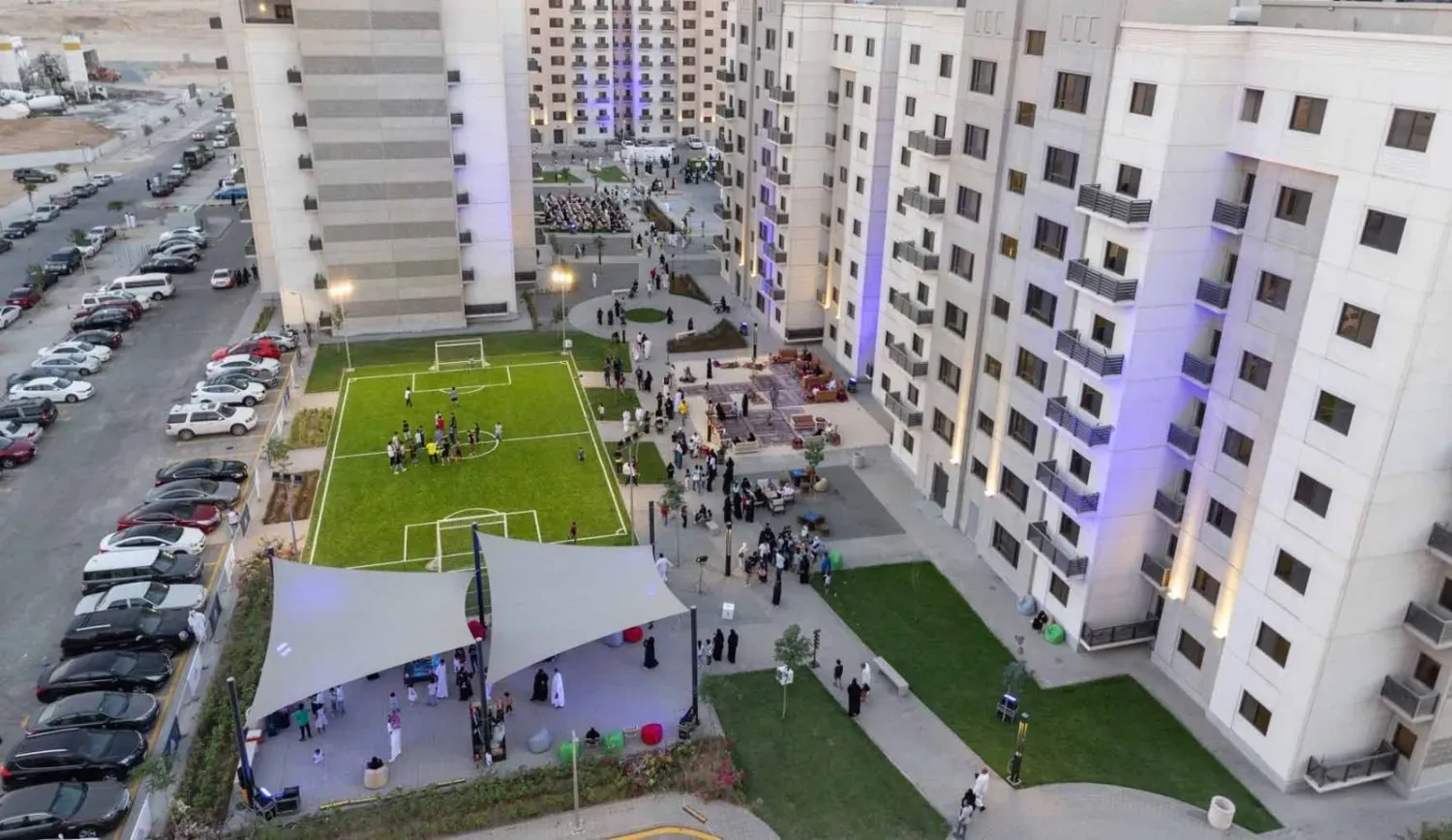
 A National Housing Company project in Jeddah (Company handout)
A National Housing Company project in Jeddah (Company handout)
TT

Gov’t Action Cools Saudi Property Prices, Inflation Turns Negative

 A National Housing Company project in Jeddah (Company handout)
A National Housing Company project in Jeddah (Company handout)

Saudi Arabia’s real estate market is showing clear signs that inflationary pressures are easing, after a package of government measures aimed at increasing supply, curbing land hoarding and rebalancing supply and demand.

The shift reflects the Kingdom’s efforts to reshape the real estate sector and strengthen its stability under Vision 2030.

After uneven price increases following the COVID-19 pandemic, real estate inflation in Saudi Arabia fell to negative 0.7% in the fourth quarter of 2025 from 3.6% a year earlier, according to the annual Vision 2030 report. The decline was supported by government measures aimed at improving market efficiency.

The trend continued in the first quarter of this year. The latest data from the General Authority for Statistics showed the real estate price index fell 1.6% year on year, driven by a 3.6% decline in residential prices. Commercial real estate prices, however, rose 3.4%.

Structural reforms restore balance

The price correction came alongside a series of government interventions aimed at addressing market imbalances, especially limited supply and speculation. In a major move to cool prices in the capital, the government allowed sale, purchase and development in four areas north of Riyadh covering more than 81 square kilometers.

The plan aims to provide citizens with up to 40,000 land plots a year over the next five years, at target prices of no more than 1,500 riyals per square meter.

Khaled Al-Mobid, chief executive of Menassat Realty Co., told Asharq Al-Awsat that the latest reforms had moved the market away from rapid and disorderly price growth toward a more balanced and sustainable phase.

He said increased supply, rent regulation and limits on unproductive landholding had begun to affect market behavior, especially in cities with strong demand. Fees on vacant land and properties, he added, had pushed inactive owners to develop, sell or lease their assets, helping curb speculation and improve the use of real estate assets.

Real estate expert Ahmed Faqih told Asharq Al-Awsat that the government decisions came “in the form of carefully studied doses of treatment” after a deep assessment of the market’s components.

He said housing carries the greatest weight in the inflation index, meaning that cooling the sector feeds directly into broader inflation levels. He expected the impact of the decisions to become clearer over the next 12 to 18 months, adding that this had already begun through the curbing of unreal demand and the increase in actual supply.

Pressure tightens on white land

At the same time, the government stepped up measures against undeveloped land by raising annual fees on white land to 10% from 2.5%.

Vacant properties were also included for the first time in the fee system, covering land and buildings of more than 5,000 square meters. The aim is to reduce the appeal of hoarding and push more units into the market.

Faqih said speculation had been concentrated mainly in land within peripheral development plans, especially in Riyadh. Raising white land fees, along with clear government signals that land was no longer a tool for speculation but for development, marked a turning point in the behavior of investors and speculators, he said.

He added that fees on vacant properties would also help curb speculation in residential products, especially apartments, by encouraging owners to use idle assets rather than keeping them off the market.

In another step to regulate transactions, the real estate market began responding to the Ministry of Municipalities and Housing’s official approval of executive regulations for annual fees on vacant properties.

The regulations allow fees of up to 5% of the value of an unused building within the approved urban boundary. The measure is designed to improve the use of real estate assets and stimulate supply growth inside cities.

Rent freeze

Regulatory policies also extended to the rental market. The Saudi Cabinet approved a five-year freeze on annual rent increases within Riyadh, covering both existing and new contracts, to support stability in the residential and commercial markets.

Al-Mobid said the decision changed investor behavior by shifting attention toward development, operation and sustainable returns rather than waiting for artificial price increases.

He said the rent freeze in Riyadh sent a clear message that the market was moving toward controlling inflation and achieving a better balance between landlords and tenants.

Faqih said the latest regulatory decisions would lead developers and investors to reposition themselves in the market by directing investment toward increasing supply and using the opportunities created by the current regulatory changes.

On the regulatory and digital fronts, the market has made tangible gains in infrastructure. Units listed in the real estate registry exceeded 4 million properties by the end of 2025, while more than 1.2 million upgraded real estate deeds were issued.

More than 3.2 million lease contracts were documented through the Ejar platform, and the number of licensed brokers rose to more than 106,000.

Al-Mobid said the figures reflected a sharp improvement in transparency and a decline in individual discretion because of clearer data. Faqih said Saudi Arabia’s rise of 11 places in international real estate transparency indicators strengthened the sector’s ability to attract foreign capital.

Supply steers the market

On the financing side, the 2025 Vision 2030 report showed continued growth in the individual real estate finance portfolio. Total outstanding individual real estate loans rose to 904 billion riyals, or $241.1 billion, by the end of 2025, from about 420 billion riyals, or $112 billion, in 2020.

Despite the sharp increase in financing, Al-Mobid said the market was no longer driven by financing alone. It had become more influenced by supply, regulations and product quality, he said. That helps explain why residential prices declined even as lending expanded.

Faqih agreed, saying financing had previously pushed up prices because buyers had limited options. The current increase in supply, he said, had helped create a more balanced and fair relationship between supply and demand.

Stable outlook and international appeal

These broad structural shifts helped raise the number of Saudi families who owned their homes to more than 851,000 by the end of 2025, from about 63,000 in 2019.

Looking ahead, Al-Mobid expected the Saudi real estate market to enter a phase of long-term stability based on maturity and data, rather than a temporary correction. He also said values could continue to decline for products whose prices had exceeded fair levels.

Faqih said the new system had created an “innovative investment map” in which real estate investment tools had changed radically, positioning the Saudi market as one of the leading regional and international destinations for sustainable strategic investment.



Egypt’s Private Sector Slump Deepens as Cost Pressures Hit Three-Year High

Muslims attend an Eid al-Adha prayer at El-Seddik Mosque in Cairo, Egypt, May 27, 2026. (Reuters)
TT

Egypt’s Private Sector Slump Deepens as Cost Pressures Hit Three-Year High

Muslims attend an Eid al-Adha prayer at El-Seddik Mosque in Cairo, Egypt, May 27, 2026. (Reuters)

Egypt's non-oil private ‌sector remained mired in contraction in May, as a fresh surge in input costs squeezed demand, forced businesses into aggressive price hikes and triggered the steepest round of job cuts in nearly six years, a business survey showed on Wednesday.

The headline S&P Global Egypt Purchasing Managers' Index ticked up to 47.1 in May from 46.6 in April, ‌but remained beneath ‌the 50.0 no-change mark for ‌a ⁠fifth consecutive month, pointing ⁠to a softer pace of GDP growth in the second quarter than at the end of 2025.

"Job cuts ... accelerated to their fastest pace since June 2020, with firms commenting on both active redundancies ⁠and decisions to leave vacant positions unfilled," ‌said David Owen, senior ‌economist at S&P Global Market Intelligence.

Amid shipping ‌disruptions tied to the Middle East conflict, supply ‌chains deteriorated sharply, with delivery times lengthening at the fastest pace in almost four years.

Input price inflation accelerated for a fourth straight month ‌to its highest level since January 2023, driven by costlier fuel and ⁠electricity, ⁠a weaker pound that lifted import bills, and the strongest wage pressures since January 2018.

Companies passed those costs on through a near-record increase in selling charges, while new orders fell for a fifth month running close to April's 37-month low.

Even so, business confidence climbed to its highest level since August 2024, with firms pinning hopes on improving economic conditions and a recovery in the exchange rate against the dollar.


Iran’s Central Bank Says Inflation at WWII Levels

People shop in a bazaar in Tehran, Iran, 01 June 2026. EPA/ABEDIN TAHERKENAREH
TT

Iran’s Central Bank Says Inflation at WWII Levels

People shop in a bazaar in Tehran, Iran, 01 June 2026. EPA/ABEDIN TAHERKENAREH

Year-on-year inflation in Iran reached a level in May unseen since World War II, underlining the economic pain average Iranians face as the country worries about the war with Israel and the US restarting.

A report Monday by Iran's Central Bank represents the first official acknowledgment of what Iranians shopping, paying for a taxi or visiting a medical clinic already know: The rial currency is battered by the war and uncertainty around it resuming, according to The Associated Press.

Iran's Central Bank said the consumer price index, which measures a basket of goods and services, reached 77.2% in May compared to the year before. It added the rate is 8.5% higher than in April.

Inflation in daily and general needs — like medicine, taxi fares, tobacco and communication fees — rose 113.8% from the year before.

Banknotes and gold coins are on display in a shop in a bazaar in Tehran, Iran, 01 June 2026. EPA/ABEDIN TAHERKENAREH

The Iranian rial has seen a dramatic collapse over the past falling from around 32,000 rials to the US dollar in 2015 to more than 1.7 million rials per dollar today.

Iranian President Masoud Pezeshkian earlier warned citizens that further price increases were likely. “We will definitely have higher prices,” Pezeshkian said in May. “We are fighting and we must accept this hardship,” he added.

Airstrikes this year have greatly damaged Iranian businesses and its oil industry. Meanwhile, the US blockade has been targeting Iranian crude oil shipments trying to reach the international market, a key source of hard revenue. Tax revenues have been depressed by businesses struggling even after the fighting paused.

A private economic think tank in Iran, the Bamdad Institute of Economic Studies, described the current figures as “an unprecedented rate since World War II.” Iran's Central Bank did not acknowledge the significance of the figures.

Iran only saw worse inflation in 1942 during World War II, sparked by the British and Soviets invading the country and taking over its railway, disrupting food supplies. The lack of food, worsened by a poor harvest, sparked hyperinflation and a famine. Hunger and a typhus outbreak killed many.

Economic pressure in the past has sparked nationwide protests, something Iran's regime has been trying to avoid since a crackdown on demonstrators in January killed over 7,000 people, according to activists' estimates.

“I have no doubt that if Trump leaves (Iran without a formal peace deal) ... most probably, we will see something like January by the end of summer because of the economic and social situations,” analyst Mohsen Jalilvand said in a video published by Iran's Fararu news website.

Tehran-based economist Saeed Leilaz, speaking to The Associated Press, warned that annual inflation in Iran could reach 80%.

“Iran’s society cannot tolerate above 25%” annual inflation, he said.


Kremlin: Saudi Arabia Named Guest of Honor at St. Petersburg Economic Forum

Russian President Vladimir Putin delivers a speech during a plenary session of last year’s St. Petersburg International Economic Forum. (Reuters)
TT

Kremlin: Saudi Arabia Named Guest of Honor at St. Petersburg Economic Forum

Russian President Vladimir Putin delivers a speech during a plenary session of last year’s St. Petersburg International Economic Forum. (Reuters)

The Kremlin said Saudi Arabia will be featured as the “guest of honor” at the 29th St. Petersburg International Economic Forum, SPIEF, in 2026, which opens this week.

The Russian presidency said Saudi Energy Minister Prince Abdulaziz bin Salman will lead a high-level delegation of major national institutions and companies, headed by Saudi Aramco.

The announcement coincided with talks in Moscow between Russian Foreign Minister Sergei Lavrov and Saudi Foreign Minister Prince Faisal bin Farhan.

Lavrov said Saudi Arabia’s selection as the guest country for 2026 carried major historical symbolism, coinciding with the 100th anniversary of diplomatic relations between the two countries.

He praised Saudi Arabia’s strong participation in the 2025 forum, also led by Prince Abdulaziz, which included productive talks with Russian Deputy Prime Minister Alexander Novak.

Through its national pavilion, the Kingdom will showcase its investment, export, and tourism potential, hold business talks, and present a rich cultural program.

Anton Kobyakov, an adviser to the Russian president, said the participation would inject new momentum into the strategic partnership between Moscow and Riyadh across energy, industry, transport, finance, and high technology.

Saudi Arabia now joins other Global South countries that have previously received the honorary status, including Qatar, Egypt, the United Arab Emirates, Oman, and Bahrain.

Founded in 1997, the St. Petersburg forum is Russia’s leading annual economic conference.

It brings together heads of state, finance ministers, and chief executives from Russian and international companies to discuss challenges facing emerging markets and the global economy.

The forum draws more than 10,000 participants each year from about 100 countries. In 2025, it posted a record turnout of 24,200 participants from 144 countries and saw agreements worth 6.48 trillion rubles ($89 billion) signed.

Russian President Vladimir Putin has regularly attended the forum’s plenary sessions since 2005, except from 2008 to 2011, when Dmitry Medvedev attended.

This year’s list of official partners and sponsors includes more than 100 major companies and institutions, led by key partners Rosatom and VEB.RF, along with banking and energy players, including Sberbank, Gazprom, and Novatek.