


Iraq Moving Forward with Imposing State Monopoly over Weapons

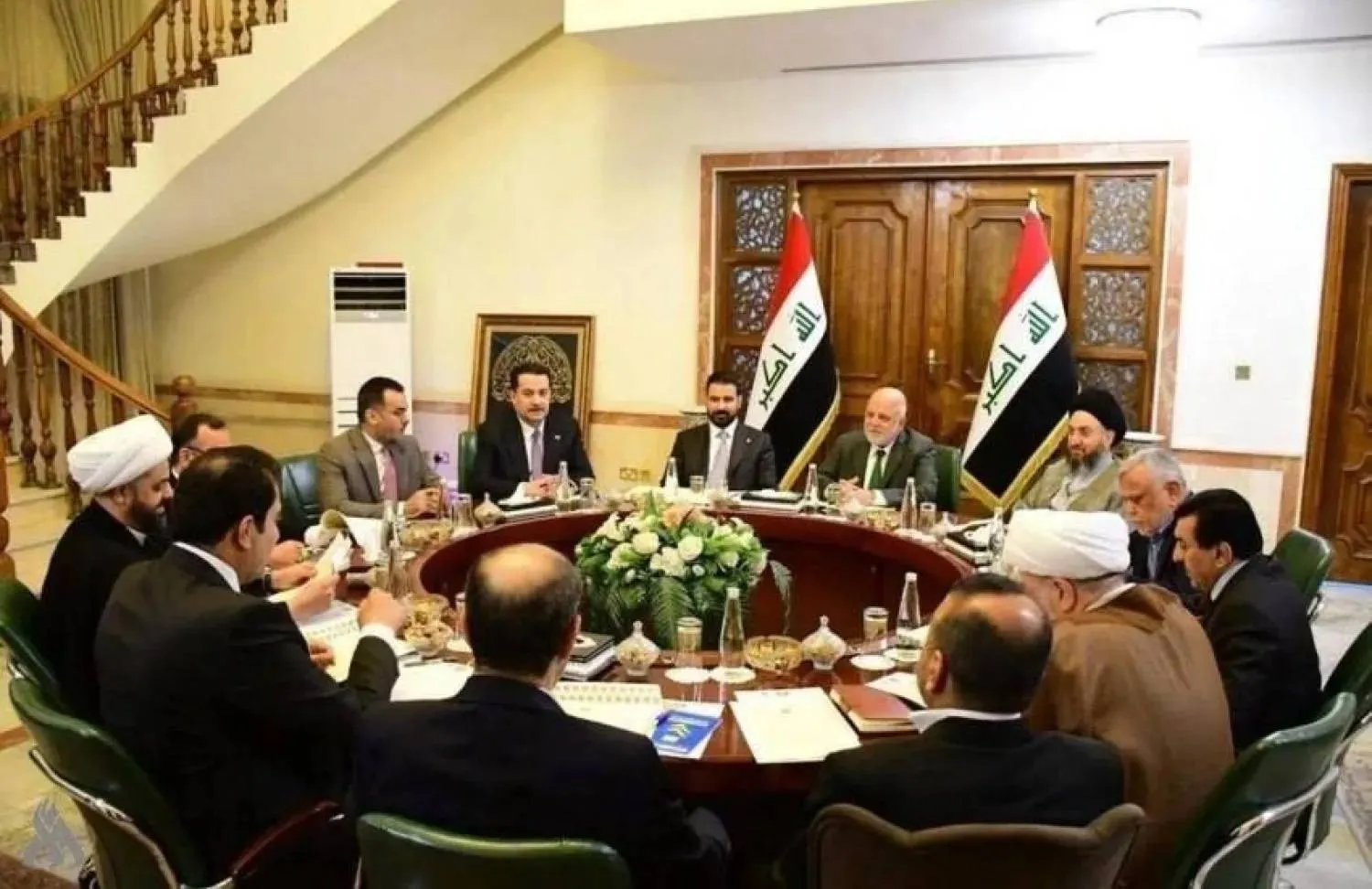
The Coordination Framework expressed its support for government efforts to impose state monopoly over weapons. (X)
TT

Iraq Moving Forward with Imposing State Monopoly over Weapons

The Coordination Framework expressed its support for government efforts to impose state monopoly over weapons. (X)

Iraq is stepping up its measures to impose state monopoly over weapons with some Shiite armed factions declaring that they were dismantling their military wings that have for years operated outside the control of the armed forces even though they are part of the official Popular Mobilization Forces (PMF).

On Monday, the ruling Shiite Coordination Framework tasked Prime Minister and Commander-in-Chief of the Armed Forces Ali al-Zaidi with taking the necessary measures and decisions to “preserve the country’s supreme interests”.

It backed efforts to “impose state monopoly over arms and disengage the PMF from political, partisan and societal frameworks.”

The Coordination Framework is a coalition of Shiite parties and armed factions with varying ties to Iran.

Zaidi attended Monday’s meeting that also said that the decision of war and peace “is a sovereign one that is exclusively controlled by the people of Iraq through their constitutional institutions represented by the government and elected parliament.”

The statement was an implicit rejection of some factions’ involvement in the US-Israeli war on Iran, on Tehran’s side, after they carried out attacks without first referring to the government. It slammed such attacks as “illegal and unconstitutional.”

Moreover, the statement said the PMF is an “official security institution that is bound to the constitution and laws and orders of the commander-in-chief of the armed forces.”

US Embassy Chargé d'Affaires Joshua Harris welcomed the Framework’s statement, saying it was a step forward in consolidating independence and sovereignty for a promising future for Iraq.

Iraq’s National Security Advisor Qassim al-Araji met with Harris on Tuesday, saying: “We underscored the importance of supporting the government’s efforts to ensure that arms remain exclusively under state authority.”

“We also welcomed the Coordination Framework’s position on this issue and its contribution to strengthening stability, reinforcing state authority, and upholding the rule of law,” he added in a post on X.

“We reaffirmed Iraq’s steadfast commitment to peaceful approaches in addressing crises and conflicts, in accordance with international law and diplomatic norms, in a manner that promotes regional and international peace and stability,” he stressed.

An official source in the Framework told Asharq Al-Awsat that disengaging the PMF from political and social frameworks aims to the steer it away from the “control of political leaderships and therefore, prevent it from being dismantled or restructured.”

It explained that American demands for the disarmament of factions also target the PMF seeing as most of the armed groups operate within it. So, the Framework’s statement on Tuesday may have been a preemptive step against demands for the PMF’s restructuring.
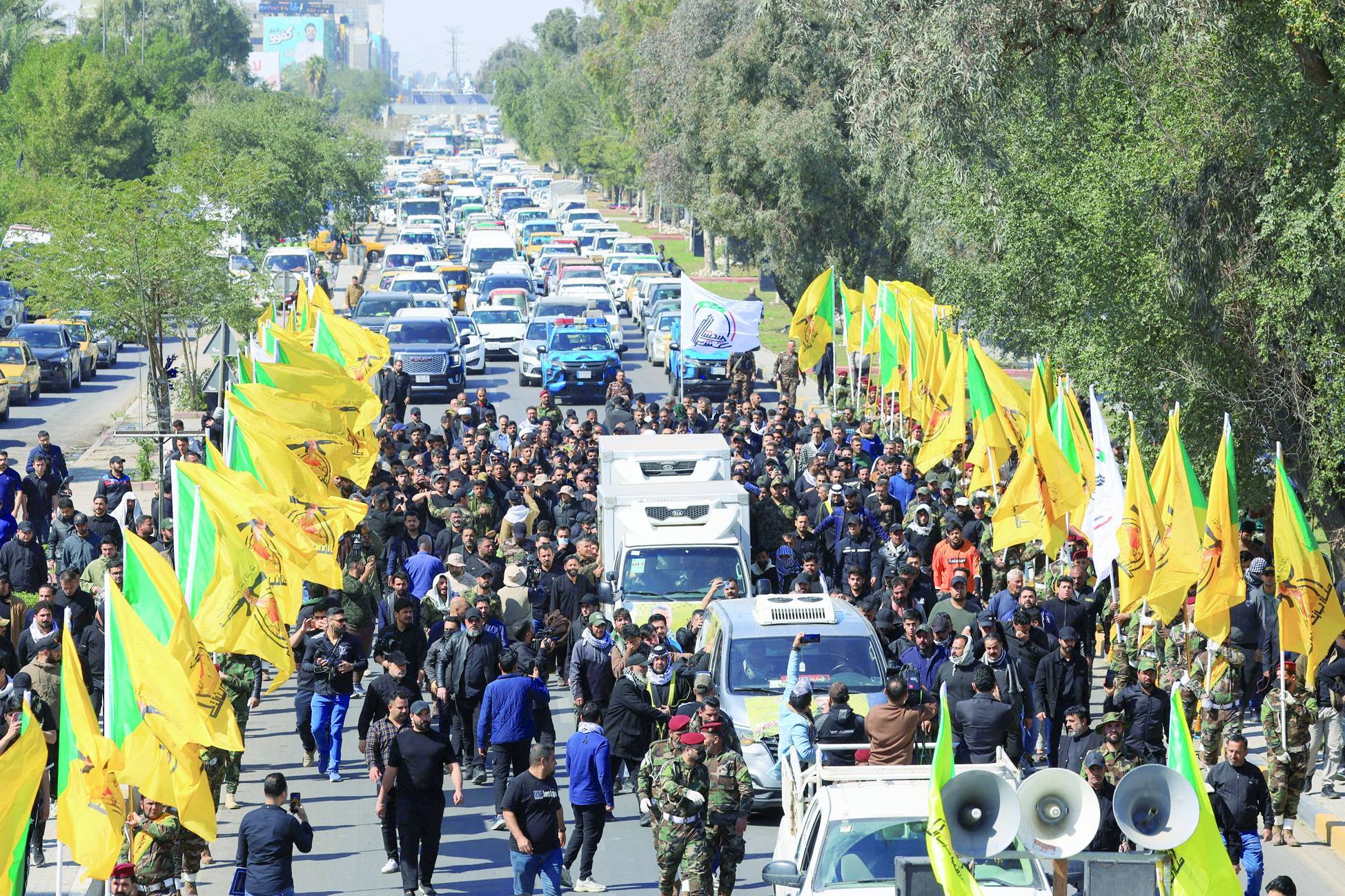
Mourners attend the funeral of members of the Iraqi armed group Kataib Hezbollah who were killed in an airstrike that targeted a PMF headquarters near the western al‑Qaim district on the Syrian border, amid the US-Israel conflict with Iran, in Baghdad, Iraq, March 2, 2026. (Reuters)

Two factions to disarm

In a related development, the Asaib Ahl al-Haq, one of Iraq’s most powerful Iran-backed armed groups, announced on Tuesday that it would begin putting its weapons under government control.

Asaib Ahl al-Haq said it had formed a committee to oversee the move, including an inventory of its fighters, weapons and equipment, and to coordinate with the commander-in-chief of the armed forces. The group cast the decision as a response to calls by Iraq’s top Shiite religious authority and the Framework.

The Kataib Imam Ali faction also said on Tuesday that it was disengaging from the PMF and taking steps to limit weapons to the state.

In a statement, it said the move complies with the demand of the Framework and stems from its “national responsibility” and aims to “bolster national unity.”

In contrast, the Ashab al-Kahf group, which is part of the so-called “Islamic Resistance”, rejected on Tuesday calls for the disarmament of factions.

“Claims that the higher religious authority backs these efforts are baseless,” it charged.

The Kataib Hezbollah and Nujaba movement continue to reject calls to lay down their weapons.

Meanwhile, leader of the Hikma Movement Ammar al-Hakim said the factions are waiting until September to take a “decisive” step on disarmament.

September is the deadline for anti-ISIS international forces to withdraw from Iraq in line with an agreement reached with former PM Mohammed Shia al-Sudani last year.

Observers have said that the disarmament process still lacks clarity, explaining that the leaders of these groups are taking the decisions while the official authorities are not playing a clear role in overseeing that they are being implemented.

Questions also remain about the size of their arsenal and whether they will indeed turn them over to the government authorities.
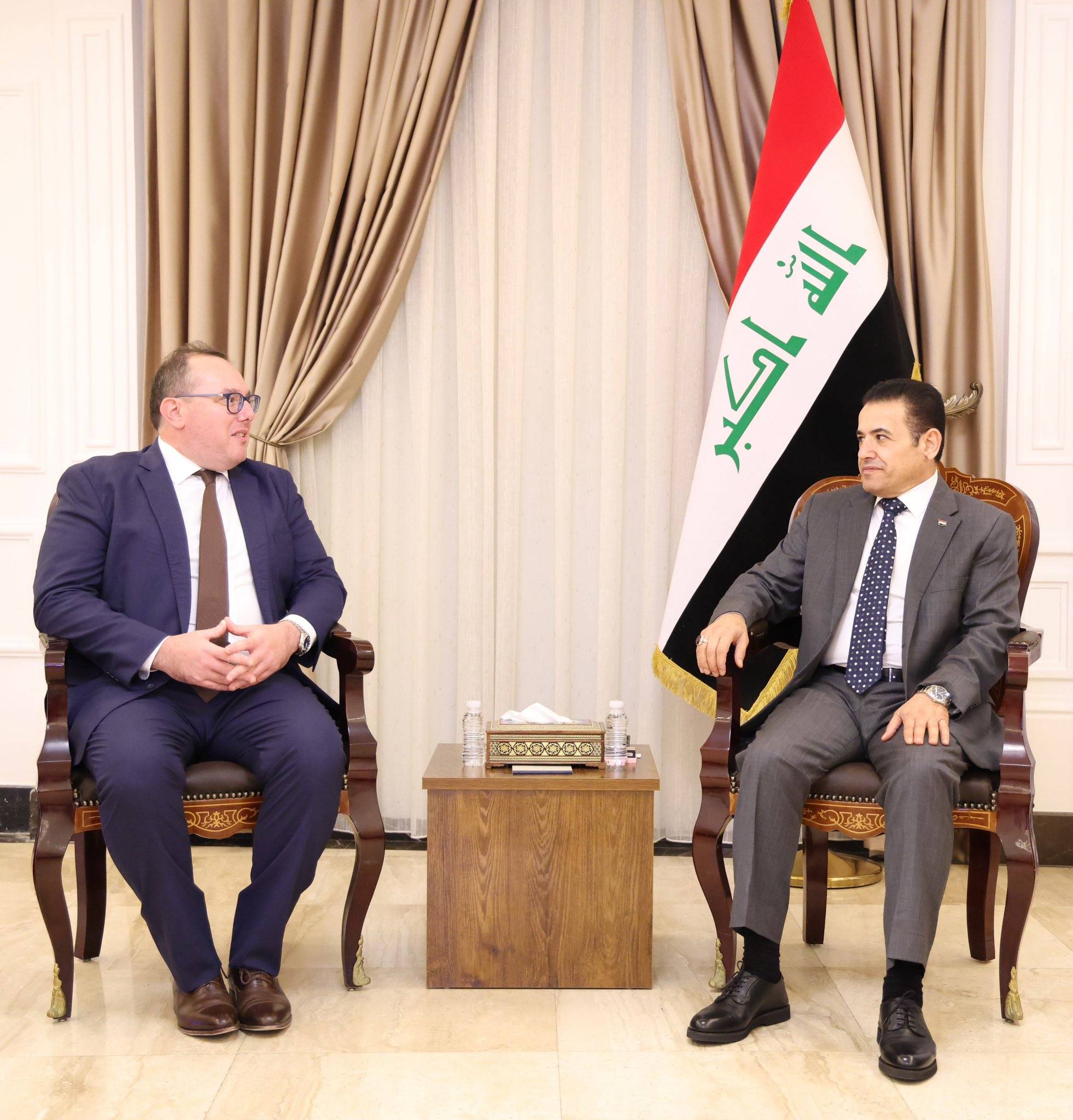
Iraq’s National Security Advisor Qassim al-Araji and US Embassy Chargé d'Affaires Joshua Harris meet on Tuesday. (Al-Araji on X)

Different views

Expert on Shiite groups Ibrahim al-Abadi said it was unlikely that the armed groups will comply with the Framework’s demand to disarm.

In remarks to Asharq Al-Awsat, he said the factions that possess weapons are divided over the state monopoly over weapons.

One group believes that it has no interest in keeping the weapons as the cost has become too high given the US sanctions and the ensuing economic, financial and political losses it will incur, he explained.

This group believes that it has succeeded in “employing the ideology of weapons to achieve its financial and political ambitions. Its goals now do not sustain the ability to maintain the weapons, which are seen as an obstacle to reaching higher positions in power.”

“So, it believes that it is in its best interest to lay down some of the weapons and turn its partisan members into employees that can run their financial empire. This group now tries to curry favor with the Americans, sending them messages and seeking to end the enmity with the US,” he revealed.

“The second group is fearful of the future and wants to keep the weapons as a bargaining chip to keep positions and gains reaped throughout the years they used these weapons to acquire these gains,” he continued.

“So, this group refuses to lay down its arms. However, it will not be able to withstand internal and foreign pressure, and it is weighing the high risks of such a confrontation,” al-Abadi said.

“The third group openly declares its allegiance to the Iranian project and doesn’t even discuss disarmament. It believes that the American project is targeting the resistance forces in the region,” he remarked.

“It is using religious, political and ideological excuses to justify its defiance of the state’s decision to impose monopoly over arms,” he added.



Jordan's Army Says Shot Down 10 Iranian Missiles

This screen grab made on July 18, 2026 from handout video footage released by the US Central Command (CENTCOM) on July 17, 2026 shows what the US military says is the latest wave of precision strikes on strategic Iranian military sites. (Photo by US Central Command (CENTCOM) / AFP)
TT

Jordan's Army Says Shot Down 10 Iranian Missiles

This screen grab made on July 18, 2026 from handout video footage released by the US Central Command (CENTCOM) on July 17, 2026 shows what the US military says is the latest wave of precision strikes on strategic Iranian military sites. (Photo by US Central Command (CENTCOM) / AFP)

Jordan's army said on Saturday it had shot down 10 Iranian missiles with no casualties or damage, as Tehran retaliated against American strikes by pressing attacks on other countries.

"Air defense systems... intercepted 10 Iranian missiles that had entered Jordanian airspace and were targeting the Kingdom's territory (which) were intercepted and shot down," the army said in a statement, adding that there were no casualties or material damage.

The United States and Iran exchanged strikes aimed at infrastructure and military targets on Saturday as their battle over the Strait of Hormuz intensified.

The region has endured days of back-and-forth attacks in a conflict increasingly focused on control of the strait. The collapse of an interim ceasefire leaves no clear end in sight for the war that the US and Israel began more than four months ago.


Lebanon: Aoun Departs for Washington to Meet Trump

FILED - 16 February 2026, Lebanon, Beirut: FILE PHOTO - Lebanese President Joseph Aoun speaks during a press conference. Photo: Markus Lenhardt/dpa
TT

Lebanon: Aoun Departs for Washington to Meet Trump

FILED - 16 February 2026, Lebanon, Beirut: FILE PHOTO - Lebanese President Joseph Aoun speaks during a press conference. Photo: Markus Lenhardt/dpa

Lebanese President Joseph Aoun on Saturday left Beirut for Washington, where he is expected to meet Donald Trump, the Lebanese presidency said, after talks between Lebanon and Israel wrapped up in Italy.

Aoun will hold discussions "with several American officials on the situation in Lebanon and ways to strengthen the ceasefire,” particularly in Lebanon's south, as well as on "the withdrawal of Israel from the Lebanese regions it occupies,” the presidency said.

Meanwhile, the United States has postponed a virtual meeting between Lebanese, Israeli and US military delegations that had been expected on Friday to discuss the first phase of the “pilot zones” plan.

The delay puts the practical rollout of the framework agreement between Lebanon and Israel on hold, particularly the pilot zone arrangements, and renews questions over an implementation process that still has no clear timetable.

The technical meeting was agreed during the latest round of negotiations in Rome. It was intended to finalize the first phase mechanism: Israeli forces would withdraw from several pilot zones, allowing the Lebanese army to deploy there under the supervision of the monitoring committee. The plan would then expand in later stages.

Sources familiar with the negotiations told Asharq Al-Awsat that Washington requested the postponement, saying more time was needed to complete technical files, operational plans and implementation procedures.


Transport Costs: A Daily Burden Weighing on Khartoum Residents

A general view of a public transport terminal in Khartoum (Asharq Al-Awsat)
TT

Transport Costs: A Daily Burden Weighing on Khartoum Residents

A general view of a public transport terminal in Khartoum (Asharq Al-Awsat)

Getting to work, hospital or university in Sudan’s capital, Khartoum, has become a test of survival in a city battered by war.

As transport fares rise, incomes fall and unemployment spreads, thousands of families are being forced to choose between commuting and paying for food, medicine and education.

The crisis has deepened as displaced people return to Khartoum and its three cities while services remain limited and the number of operating vehicles falls far short of demand. Higher fuel, spare parts and operating costs have pushed fares up further.

Passengers face long waits, frequent fare changes and shortages of vehicles on several routes. Damaged infrastructure and road closures have altered routes, lengthened journeys and forced many commuters to use more than one vehicle, sharply increasing daily costs.

Official figures reflect the wider economic strain. Gold export revenues reached about $370 million in the first quarter of this year, while fuel imports exceeded $697 million over the same period, highlighting the gap between export earnings and the cost of essential imports as large parts of the economy remain shut by the war.

For bus driver Abdullah Ali, 50, the transport crisis mirrors his personal losses. His bus was stolen when fighting began, and he was wounded by shrapnel in his right hand before fleeing to Gezira state, then Atbara and Shendi.

After returning to Khartoum about six months ago, he began working as a hired driver on a bus he does not own.

Ali told Asharq Al-Awsat that his income barely covered his daily needs and was not enough to renew his driver’s license. Many drivers were also unable to pay licensing and maintenance fees as fuel, oil, tire and spare-parts prices continued to rise, he said.

Moussa al-Safi, a laborer supporting four children, said transport consumed much of his daily income.

“The war has not only raised prices, but also reduced job opportunities,” he told Asharq Al-Awsat. “A worker pays to travel there and back without any guarantee of finding work or earning money by the end of the day.”

Private-sector employee Sami Abdel Qayoum said he often used more than one vehicle to reach work, taking up a large part of his monthly salary. To save money, he gets off before his destination and walks long distances.

University student Shehab Othman said some students arrived late or missed lectures because they could not afford transport, while others walked long distances to cut daily expenses.

Ezzedine Jaber, a member of the bus union, said short-route fares were about 2,000 Sudanese pounds, while some longer routes cost up to 6,000 pounds. Lower fuel prices were the main way to reduce operating costs and ease the burden on passengers, he said.

The impact extends beyond passenger transport.

“The price of a gallon of diesel has exceeded 40,000 pounds, raising the cost of transporting goods from Port Sudan and production areas to markets and export ports,” economist Mohamed al-Nayer told Asharq Al-Awsat. “That is ultimately reflected in the prices of goods and services.”

In Khartoum, where displaced people and refugees continue to return, transport fares have become part of the cost of survival.

Each increase can mean one less meal for a family, delayed medicine for a patient, a missed lecture for a student or kilometers of walking for a worker trying to protect what remains of their income.