


Indian Stars Push to End Elephants in Bollywood

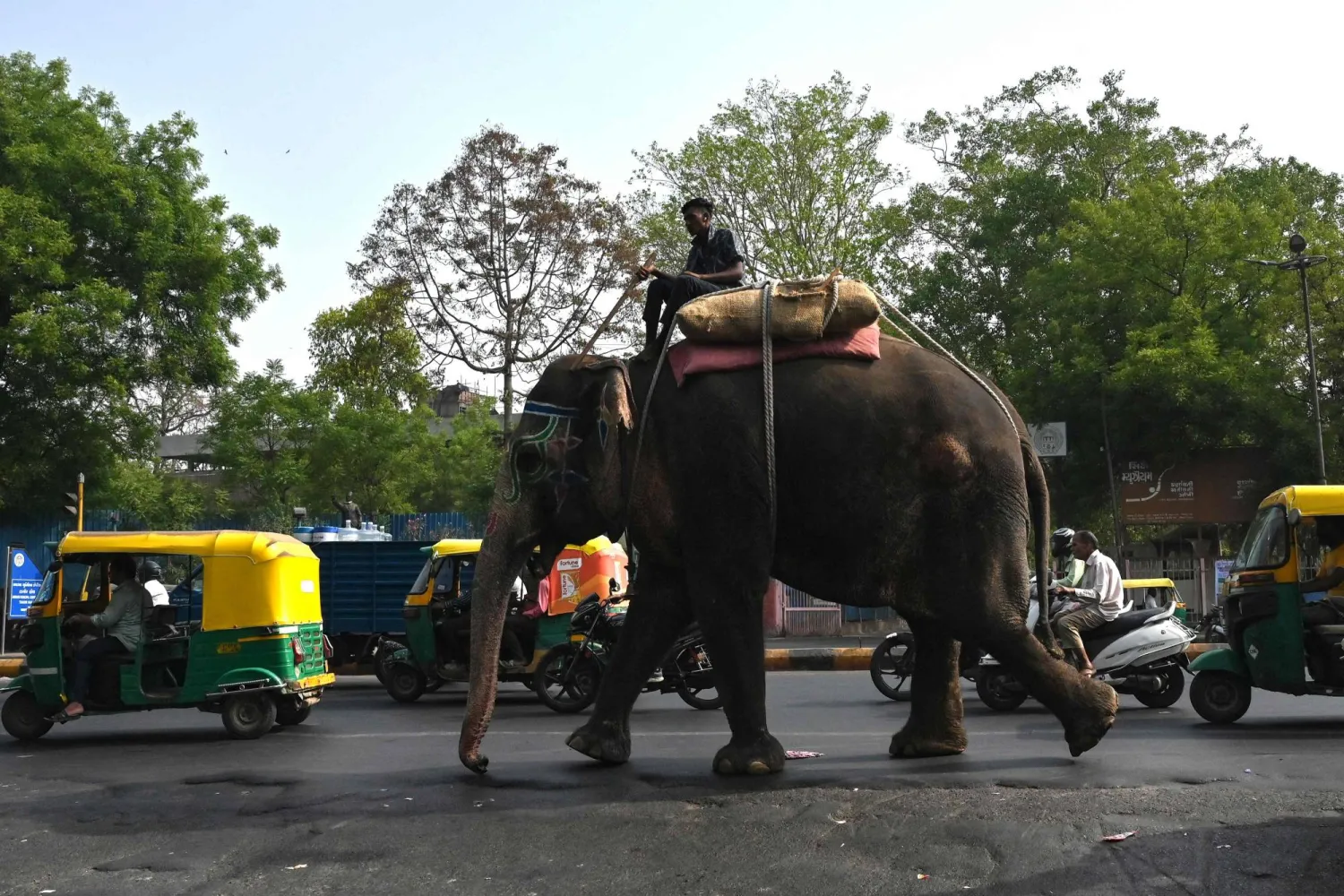
A mahout rides an elephant along a street in  Ahmedabad on May 6, 2026. (Photo by Shammi MEHRA / AFP)
A mahout rides an elephant along a street in Ahmedabad on May 6, 2026. (Photo by Shammi MEHRA / AFP)
TT

Indian Stars Push to End Elephants in Bollywood

A mahout rides an elephant along a street in  Ahmedabad on May 6, 2026. (Photo by Shammi MEHRA / AFP)
A mahout rides an elephant along a street in Ahmedabad on May 6, 2026. (Photo by Shammi MEHRA / AFP)

Bollywood stars are campaigning to end the use of elephants in Indian films, saying that life-size robot replicas and AI-generated images do the job without cruelty.

Top directors, producers and actors have backed the campaign by animal rights group PETA India, which this month highlighted how the rise of slick AI images provide even less reason to use real animals.

"Elephants shouldn't suffer for our entertainment," said A-list actor and producer John Abraham, describing why he and more than two dozen stars were supporting the campaign.

"With today's technology, we can bring elephants to life beautifully through CGI (computer-generated imagery) and mechanical artistry, without confinement or cruelty."

There are fewer than 50,000 Asian elephants in the wild, according to the World Wildlife Fund -- the majority in India, with others in Sri Lanka and Southeast Asia.

There are more than 2,600 captive elephants in India, according to environment ministry estimates. They are used for tourism, entertainment, and in temples.

PETA told AFP captive elephants are "separated from their families, kept near-constantly chained and are controlled with weapons".

India's Animal Welfare Board must give permission for elephants to be used in films.

The number of real elephants being used have dropped dramatically since its 2021 order that it was "advisable" that special effects or animatronics be prioritized "to prevent unnecessary pain and suffering to animals".

Now PETA campaigners are highlighting how AI-generated images, showcased in a social media campaign this month, provide increasingly lifelike images.

"Elephants are highly intelligent, emotional animals who require living free in lush jungle homes for their mental and physical wellbeing," it said.

"In contrast, elephants used in films, shows and advertisements face extreme loneliness and severe cruelties."

Campaigners point to the use of CGI imagery by Richie Mehta in the 2024 series "Poacher", a Malayalam-language crime drama about ivory smuggling, and to a robotic elephant with flapping ears used in a dance routine for an advertisement by clothing company Ramraj Cotton.

Other high-profile hits who used CGI for elephants include 2020 historical action movie "Tanhaji: The Unsung Warrior" and the 2006 superhero film "Krrish".

That compares to times past when movies, such as 1971 hit "Haathi Mere Saathi" used multiple real elephants -- alongside tigers and lions -- in dance scenes.

Last month, the Malayalam-language film "Kattalan" -- about ivory-smuggling gangsters -- featured real elephants, producers told Indian media.

PETA has long campaigned for the end of elephants in Hindu temple ceremonies, where the animals are paraded through packed crowds with flashing lights, thumping drums and ear-splitting music.

It has donated more than 25 life-size robot elephants -- made of fibreglass and rubber -- to temples across India.

The models are motorised, so that they flap their ears, move tails and even spray water from rubber trunks.

In May, PETA and Shriya Saran -- one of the stars of 2022 hit "RRR", which won the Oscar for best original song -- gifted one to a Hindu temple in Kanpur, in the northern state of Uttar Pradesh.

Many followers of the elephant-headed Hindu deity Ganesh see the animals as sacred, and they have traditionally played an important role in ceremonies.

Saran said the mechanical version would "allow the temple to continue age-old traditions while allowing elephants, earthly representatives of Lord Ganesha, to thrive in their natural habitats".

Other Bollywood names, on a list of more than two dozen stars, include Richa Chadha, Farah Khan and Dia Mirza.

"Good cinema requires empathy," said actor Pooja Bhatt. "We can tell wonderful stories on screen without exploiting animals."


Massive Fire Destroys 100 Homes in Norway and Forces Hundreds to Evacuate

17 July 2026, Norway, Drammen: Smoke rises from a major residential fire that destroyed row houses and forced mass evacuations in Krokstadelva, Drammen. Photo: Thomas Fure/NTB/dpa
TT

Massive Fire Destroys 100 Homes in Norway and Forces Hundreds to Evacuate

17 July 2026, Norway, Drammen: Smoke rises from a major residential fire that destroyed row houses and forced mass evacuations in Krokstadelva, Drammen. Photo: Thomas Fure/NTB/dpa

A major fire in southern Norway destroyed more than 100 homes Friday and forced hundreds of people to evacuate the area, according to police and the country's public broadcaster.

The blaze started in a townhouse in the city of Drammen around 3:30 p.m. Friday, police said.

It then spread through the area and into nearby forests.

Firefighters continued their efforts Saturday morning to bring the blaze under control.

The Associated Press quoted NRK, Norway's public broadcaster, as saying that hundreds of people went to an evacuation center.

No residents have been reported missing, police said. It was not immediately clear what caused the fire.

Drammen is roughly 34 kilometers (21 miles) southwest of Oslo.


India Successfully Launches 1st Private Orbital Rocket

Indian space startup Skyroot Aerospace launched its Vikram-1 rocket, marking the first attempt by an Indian private company to place a satellite in orbit, from the Satish Dhawan Space Center in Sriharikota, Andhra Pradesh, India, July 18, 2026. REUTERS/Priyanshu Singh
TT

India Successfully Launches 1st Private Orbital Rocket

Indian space startup Skyroot Aerospace launched its Vikram-1 rocket, marking the first attempt by an Indian private company to place a satellite in orbit, from the Satish Dhawan Space Center in Sriharikota, Andhra Pradesh, India, July 18, 2026. REUTERS/Priyanshu Singh

India's first privately built orbital rocket took its maiden flight on Saturday, its company said, marking a significant step for the South Asian giant as it eyes a bigger slice of the global space economy.

The Vikram-1 rocket, built by Skyroot Aerospace and designed to carry small satellites into low-Earth orbit, took off from the Satish Dhawan Space Center in Sriharikota amid loud cheers.

"Hello space, we have arrived!" Skyroot Aerospace said in a post on X.

"Vikram-1's Test Flight-1 has completed its mission. The first ever Indian private sector launch has been successfully completed."

Vikram-1 is about as tall as a seven-story building and capable of carrying payloads weighing up to 350 kilograms (771 pounds).

Pawan Goenka, chairman of the government's Indian National Space Promotion and Authorisation Center, said the achievement went "way beyond expectation for the very first orbital launch ever taken by an Indian private company".

Prime Minister Narendra Modi hailed the endeavor as "a defining moment in India's space journey".

"The growing participation of our private sector is opening new frontiers and accelerating innovation," AFP quoted Modi as saying.

"This achievement will encourage countless youngsters to dream bigger and innovate fearlessly."

The rocket is carrying a diverse range of payloads, including a lab-grown diamond and robotic arms capable of removing space debris.

A miniature 18-karat gold rocket that has mini sculptures of Indian physicists Vikram Sarabhai, CV Raman and former Indian president and noted aerospace engineer APJ Abdul Kalam is also aboard the vehicle.

India's space ambitions, built on decades of investment by the Indian Space Research Organization (ISRO), have gathered pace in recent years.

The country's space economy -- valued at around $8.4 billion -- has rapidly expanded since the sector opened up to private players in 2020, and is now home to more than 400 space startups.

"India's space ambitions soar to new heights!" Foreign Minister S. Jaishankar said after the successful launch.

In August 2023, India became only the fourth country to successfully land an unmanned spacecraft on the Moon, after Russia, the United States and China.

Former ISRO chairman K. Sivan hailed the work done by space startups, adding that the country was witnessing the "fruits of the seeds sown" when it opened up the sector to private players.

"With Skyroot especially, the rocket is one of the most challenging and complex technologies in the space system... It is going to motivate many people," he told AFP.

Sivan added that "there is no doubt" the launch will have a global impact.

"If an Indian startup can make one of the most challenging things in the space industry, then it gives a huge boost to India's reputation globally."


UK Sculpture Designed to Attract Visiting Insects

'Penleigh Queen Bee' will raise awareness of declining bee populations (Brendon Murless/BBC)
TT

UK Sculpture Designed to Attract Visiting Insects

'Penleigh Queen Bee' will raise awareness of declining bee populations (Brendon Murless/BBC)

A new sculpture, designed to raise awareness of the world's declining bee population, will help host visiting insects inside its structure, according to BBC.

The new piece of art will be installed at Penleigh Park in Westbury, Wiltshire.

Brendon Murless, an artist from Bridport in Dorset, will use clay, steel and logs to create a 220 cm sculpture called 'Penleigh Queen Bee' which will sit on an oak plinth and be full of holes for bees to live in.

His aim is to create a “moment of calm” for visitors to Penleigh Park but also “inspire, and offer a moment of reflection on the wonder of bees and how we are connected to them in different ways.”

His design was chosen after a public vote in Westbury, which sought to find a nature-inspired statue for Penleigh Park.

Murless said: “I was lucky enough to win and I'm on it [ the sculpture] as we speak."

“The piece is called Queen Bee to highlight the plight of these pollinators. Wild bee populations are in decline globally, which directly impacts nature as a whole and our food security,” he added.

In the back of the Queen Bee's head there will be a stack of mixed logs and stones with holes drilled into them to help encourage homes for masonry bees and solitary bees.

Murless continued: “In folklore, bees are also associated with family, protection and teamwork, which I think connect perfectly with this community project.”

Westbury Town Council has worked with Penleigh residents and local schoolchildren on the project to improve the park with additional funding from Wiltshire Council.

Benjamin Griffiths, business development manager at the Town Council, said the sculpture “will be an incredible addition to an already beautiful and much deserving space in Penleigh Park.”

He added: “The whole group have worked really hard to make this happen.”

Wiltshire Council's public art officer, Ella-mai Robey said the “brilliant” idea to transform Penleigh Park all stemmed from local people.

“Using public art developer contributions to create such a great art project for the community is really exciting,” she added.
