


Steven Spielberg on His Faith in Alien Life, the Future of the Movies and the Power of Empathy

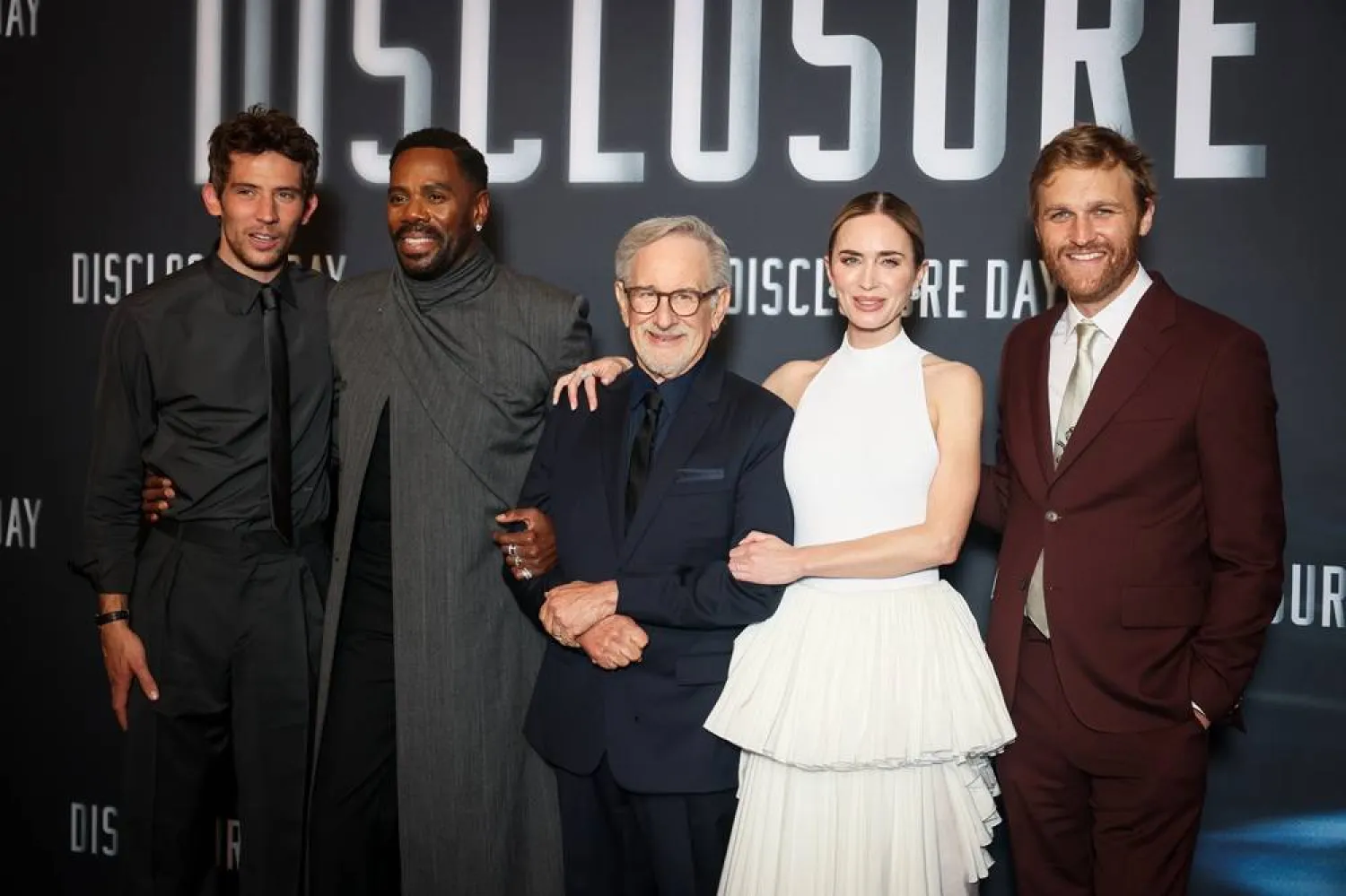
 From left, Josh O'Connor, Colman Domingo, Steven Spielberg, Emily Blunt and Wyatt Russel pose upon arrival for the premiere of the film "Disclosure Day" at the Grand Rex in Paris, Tuesday, June 2, 2026. (AP)
From left, Josh O'Connor, Colman Domingo, Steven Spielberg, Emily Blunt and Wyatt Russel pose upon arrival for the premiere of the film "Disclosure Day" at the Grand Rex in Paris, Tuesday, June 2, 2026. (AP)
TT

Steven Spielberg on His Faith in Alien Life, the Future of the Movies and the Power of Empathy

 From left, Josh O'Connor, Colman Domingo, Steven Spielberg, Emily Blunt and Wyatt Russel pose upon arrival for the premiere of the film "Disclosure Day" at the Grand Rex in Paris, Tuesday, June 2, 2026. (AP)
From left, Josh O'Connor, Colman Domingo, Steven Spielberg, Emily Blunt and Wyatt Russel pose upon arrival for the premiere of the film "Disclosure Day" at the Grand Rex in Paris, Tuesday, June 2, 2026. (AP)

A moment early on in "Disclosure Day" will instinctively feel familiar to anyone who grew up with Steven Spielberg films. A TV weather report predicts hail. The camera pans downward, from television set to kitchen table. Plinking sounds begin. Cereal falls into a bowl.

"Those were Froot Loops," Spielberg says, smiling. "My favorite."

Spielberg’s latest, like some of his earliest and most beloved films, again concerns what might fall from above. "Disclosure Day," which Universal Pictures releases June 11, returns Hollywood’s preeminent big-screen craftsman to one of his most abiding questions: Are we alone?

Coming nearly half a century after "Close Encounters of the Third Kind,Disclosure Day" is a grand bookend for one of the most cosmically-minded moviemakers of our time, whose dreams of extraterrestrial life have shaped all of ours. It’s a distant answer to the final notes of "Close Encounters." But while Spielberg grants his 1977 film was "speculative,Disclosure Day," he insists, is the real deal.

"It’s my first film that will be considered science fiction that I do not consider to be science fiction," Spielberg said in a recent interview. "It’s much more reflective of the world as it is evolving and discoveries that are being made as we speak."

Spielberg, at 79, is trying to revive and reconsider the alien wonder that’s long lingered in his mind, from "E.T." to "War of the Worlds.Disclosure Day," Spielberg’s first summer movie in a decade, is already being hailed as one of his best in years. But this time, Spielberg is testing whether he can conjure some of his trademark movie magic less with imagination than with conviction.

"I’ve been a believer since I made ‘Close Encounters’ 50 years ago," Spielberg says. "But I would always say: Until I’ve seen a UAP or a UFO with my own eyes, I’m not going to categorically state that life from out there has come here.

"But I’ve changed that," he adds. "I’m now willing to change my mind because of the circumstantial evidence which is overwhelming."

Aliens again, but different

"Disclosure Day" stars Josh O’Connor as a cybersecurity whistleblower with government evidence, long suppressed, chronicling a history of alien encounters. Guiding him in his escape from a corporate executive (Colin Firth) trying to keep it all under wraps is the disclosure movement’s leader (Colman Domingo). Meanwhile, a meteorologist named Margaret Fairchild (Emily Blunt) begins having a mysterious epiphany.

When he first began thinking about the movie, Spielberg called up the screenwriter David Koepp, a longtime collaborator who wrote "Jurassic Park" and "War of the Worlds."

"I said, ‘Sure, what’s it about?’" recalls Koepp. "And he said, ‘Oh, you know, aliens again. But different this time.’"

Spielberg was coming off an unusually long break by his breakneck standards. His 2022 film "The Fabelmans" pulled from his own childhood, dramatizing his parents’ painful divorce and his own origins as a filmmaker. Spielberg’s first gut-wrenchingly autobiographical movie left him unsure of what was next.

"It was the hardest question I ever had to ask myself because there was such completion in resolving so many personal issues that I had never aired in public before ‘The Fabelmans,’" Spielberg says.

"I didn’t care whether people thought ‘The Fabelmans’ was just a tale, a yarn, or if they cared that it was all true. I didn’t care about that. It was something I did for myself. I always used to say it was $40 million of therapy that I didn’t have to pay for. Universal did," he says, laughing.

But Spielberg, having long followed reports of alleged alien encounters, was inspired by the 2023 House Subcommittee on National Security hearing on UAPs: Unidentified Anomalous Phenomena. Among the witnesses was whistleblower and former Air Force intelligence officer David Grusch, who testified that the government concealed a program investigating UAPs.

The Pentagon then denied it. Yet in April, President Donald Trump said the Pentagon is preparing to release some "very interesting" UFO files.

Those 2023 testimonies and others so fueled Spielberg that he produced a 50-page treatment on what would become "Disclosure Day." During the writing process with Koepp, he texted him more notes, he says, "than I’ve ever sent to anyone in my life."

"There was a period in there where I believe he re-read the script every single day for a year," Koepp says. "We’d be in different time zones and I would wake up to 30 or 35 texts from his most current reading of the script. When the leader of the project has that level of commitment, it tends to bring along everyone. You up your game."

Extraterrestrial empathy

Spielberg has long considered his filmography split in two, between the filmmaker who made "Jaws" and "E.T." and "Raiders of the Lost Ark," and the one who, after 1985’s "The Color Purple," was increasingly drawn to darker and more serious material with films like "Schindler’s List,Saving Private Ryan" and "Munich."

"Disclosure Day" is a kind of bridge between both modes of Spielberg — a thrilling chase movie filled with wonderment that’s nevertheless grounded in reality and recent history. And its most ardent message is quite earthbound. Blunt’s character’s clarity comes from looking people in the eye. As much as it’s about aliens, "Disclosure Day" is about empathy.

"I think every movie should have a great emphasis on empathy because empathy sometimes feels like it’s in short supply," Spielberg says. "We have it, sometimes we can’t use it. Sometimes it’s not allowed to be used if you want to stay aligned with your friends and your belief systems. But I think empathy is there for all of us."

"Disclosure Day" opens in a much different movie world than Spielberg's earlier alien adventures. It's one of a few big, original studio movies this summer — a moviegoing season that the "Jaws" filmmaker pioneered. But neither franchise domination, AI nor streaming make Spielberg fret for the future of movies.

"The audience gives me faith in the movies," says Spielberg. "Even though the numbers are still not pre-COVID level numbers for any films being released now, it’s more robust than it has been for many years. The audience gives me belief that people still want to congregate in a dark space in the company of strangers to share an experience of a film made by storytellers. And that gives me faith to continue making films."

Spielberg will turn 80 this December. Around the same age, Martin Scorsese began to frankly ponder how many movies he had left. Spielberg doesn’t think the same way.

"I never think about how many more I have," he says. "I’m just hopeful that I will be inspired when something comes along, as I was with ‘Disclosure Day,’ as I was with ‘Fabelmans,’ as I was with ‘West Side Story.’"

More inspiration is already on the way. Spielberg hopes that his next movie will be a Western. Despite his deep fondness for the genre and an indelible encounter with John Ford, it’s one genre that’s eluded him.

"I always feel like parts of the ‘Raiders’ adventure movies are like Westerns," he says. "Whenever Harrison (Ford) was on a horse, it made me wistful for wanting to direct a full Western, a real Western."

Margaret Fairchild in "Disclosure Day" has some echoes with another Spielberg protagonist: Richard Dreyfuss’ Roy Neary in "Close Encounters." Both are compelled by a strange force beyond their control. It’s a character type that Spielberg, a compulsive movie maker, grants he connects with. "Disclosure Day" is his 35th feature film.

"I identify with characters who aren’t afraid of mysterious things happening to them," Spielberg says, "and who are fighting for their survival by trying to discover what they don’t know."



Angelina Jolie Turns Personal Pain into Performance for ‘Couture’ Film

Actress Angelina Jolie arrives for a special Maleficent Costume Display at Kensington Palace in London in ths file photo taken May 8, 2014. REUTERS/Luke MacGregor/Files
TT

Angelina Jolie Turns Personal Pain into Performance for ‘Couture’ Film

Actress Angelina Jolie arrives for a special Maleficent Costume Display at Kensington Palace in London in ths file photo taken May 8, 2014. REUTERS/Luke MacGregor/Files

Academy Award winner Angelina Jolie faced one of her deepest fears on screen for the French film "Couture" - being diagnosed with cancer.

Based on personal experiences of writer and director Alice Winocour, Jolie plays fictional American filmmaker Maxine Walker, who, while producing a film to accompany a runway show for Paris Fashion Week, discovers she has breast cancer.

Jolie's mother, Marcheline Bertrand, died of breast cancer at the age of 56, and Jolie underwent a double mastectomy in 2013 after discovering she was carrying the same genetic mutation as her mother.

"I thought often of my mother and ⁠how much I ⁠think this film would have been wonderful for her when she was going through this," she told Reuters.

But it wasn't just about her mother; Jolie also got involved to bring Walker’s experience to the world.

"You sit in that chair, and whether it's cancer or anything, whether you're male or female, we've all ⁠had that moment. We've all had that moment where we've gotten some news that has shifted our lives," the “Maria” actor said.

Jolie had to go through a scene where operation lines were placed on her chest by an oncologist.

"It felt a strange moment to have Hollywood in my hospital room," Jolie said.

"Here I am, you know, in my gown, getting my needles, doing all the stuff that I do, but now we are sharing it. And so, it felt very vulnerable,” she added.

Alongside Jolie, the ⁠cast of “Couture” ⁠includes Ada, played by Anyier Anei, who is a model struggling with the fashion industry putting her on a pedestal, and make-up artist Angele, played by Ella Rumpf, who is trying to break out of the fashion scene by becoming a writer.

Jolie hopes that each character’s story will resonate with viewers.

"I think what we found in doing this, and hopefully what the audience will feel, is that we're connected," the 51-year-old said.

"We're connected as human beings, and we all go through something... And it's very necessary to pull us all through being human,” Jolie added.

“Couture” arrives in American movie theaters on Friday.


Clive Davis, Music Industry Starmaker, Dies at 94

Legendary US record producer Clive Davis speaks during the “Recording Academy and Clive Davis' Salute To Industry Icons” pre-Grammy gala at the Beverly Hilton hotel in Beverly Hills, California on January 31, 2026. (AFP)
TT

Clive Davis, Music Industry Starmaker, Dies at 94

Legendary US record producer Clive Davis speaks during the “Recording Academy and Clive Davis' Salute To Industry Icons” pre-Grammy gala at the Beverly Hilton hotel in Beverly Hills, California on January 31, 2026. (AFP)

Clive Davis, the record company lawyer who became one of the music industry's most powerful figures, launching or resurrecting the careers of such superstars as Janis Joplin, Whitney Houston, Carlos Santana and Alicia Keys, has died, his family confirmed to the New York Times. He was 94.

Earlier this year, Davis was hospitalized following an upper respiratory issue and was released a few days later. He died in his Manhattan apartment, the Times reported. Messages sent to representatives for Davis were not immediately returned Monday.

Unlike other record moguls whose influence waned as they got older, Davis' might only seemed to grow over his career, which spanned more than five decades, various genres and multiple labels. Into his 80s, he was directing the careers of everyone from Barry Manilow to “American Idol” winners Carrie Underwood and Kelly Clarkson.

His success stories were staggering, with Houston a crowning achievement and devastating tragedy: Davis signed her to his Arista record label when she was just a teen and turned her into America's reigning pop princess: She racked up multiple No. 1 hits and became one of the top-selling artists in pop history before drug abuse hobbled her career. She died in a Los Angeles hotel room in 2012 just hours before she was to appear at the annual pre-Grammy Awards gala hosted by Davis, who had been convinced she was turning her life around.

“Maybe I should have been more skeptical,” Davis wrote in his 2013 memoir, “The Soundtrack of My Life,” “but I’ve always been optimistic, and I felt hopeful. It felt like old times.”

He also launched the career of multiplatinum, multiple Grammy winner Keys — and was quick to note other talents he signed, including Joplin and Billy Joel, Blood Sweat & Tears and other “all-timers,” as he so often put it.

“I signed Patti Smith, the great Renaissance woman ... I signed Lou Reed ... I signed the Grateful Dead,” he proudly touted in an interview with The Associated Press in 1999.

But Davis didn't simply have an eye for new talent — he also knew how to keep veterans relevant decades after their first hit. Aretha Franklin, whose legend was made at Atlantic Records, flourished in her later years at Arista Records, as did Luther Vandross, who made his last albums for another Davis label, J Records.

Davis was also responsible for conceiving of the 1999 album “Supernatural,” which paired guitar god Santana with some of the day's hottest talents. The record went on to win a record tying eight Grammys and gave Santana more success than he had ever enjoyed in his decades-long career.

He had middle aged star Rod Stewart trade in his rock hits for standards from “The Great American Songbook.” The album, released in 2003, sold millions and was so successful it spawned four titles in all.

Davis didn’t always make the right choices; he turned down a chance to sign up Meatloaf. And he and his collaborators didn’t always agree. He and producer David Foster fought bitterly over the arrangement for Houston’s all-time hit, a cover of Dolly Parton’s “I Will Always Love You.” Manilow strongly objected to recording “I Write the Songs,” noting that he didn’t even write the song, a Bruce Johnston ballad that became a signature hit for Manilow, who would have similar latter-day success mining the music of the 1950s, 60s and '70s.

“He's just brilliant at picking ideas he thinks the public will connect,” raved Manilow, who had worked with Davis since he was a budding singer at Columbia Records.

Davis also had his struggles. Though he became president of Columbia Records in 1967 after joining the label in 1960 as a lawyer, by 1973 he was gone in a bitter fallout. The label accused him of mismanagement of funds and he was fired. Although Davis says he was later cleared, it wasn't the end of his problems; he later was indicted on tax evasion charges, pleaded guilty to one count and had to pay a $10,000 fine.

However, Davis would declare victory: he says Columbia gave him the money to start Arista Records to resolve the dispute, and the label would become a huge success with artists like country superstars Brooks & Dunn, sassy R&B group TLC, Babyface, Houston, Franklin and others.

The label had huge success with a debut act — Milli Vanilli. But the male pop duo would become the embarrassment of the industry when, after winning a Grammy, it was revealed that they weren't actually singing their songs (Davis blamed the debacle on the label's European division, which he said signed them; the group was later stripped of its best new artist Grammy).

In 1999, as Arista was celebrating its 25th anniversary, Davis faced another crisis: the label's then-parent company, BMG Entertainment, a division of German media conglomerate Bertelsmann, wanted him to retire; most of its executives were eased out by 60, and Davis was in his mid-60s.

In 2000, despite support from his superstar roster, the company ousted him in favor of producer and songwriter Antonio “L.A.” Reid, who would later become chairman of Island/Def Jam.

However, instead of severing its ties with Davis, BMG helped him launch J Records in what BMG has described as the largest record company startup ever created. Vandross was one of his initial artists, along with forgettable acts like the boy-band O-Town.

J Records was a success from the start, though, and only grew in stature with the arrival of a young singer named Keys, a piano-playing singer-songwriter with powerful pipes and dramatic R&B songs. Keys' albums would go on to sell millions and win several Grammys.

His influence grew even more when Davis was tapped for BMG's US division.

He became a key backer of the careers of the winners of “American Idol,” guiding many albums to platinum status. The show's link to Sony BMG came through a deal between Davis and 19 Recordings Unlimited, the label managed by “Idol” creator Simon Fuller.

In 2007, however, Davis disagreed with the direction of Clarkson's “My December,” and she publicly criticized him. The album was a flop, and she later apologized.

In 2008, Sony BMG replaced Davis as chairman and chief executive officer of the BMG label group, giving him the title of chief creative officer.


‘Toy Story 5’ Rakes in the Biggest Box-Office Debut of the Year with a Franchise-Best $160 Million

 This image released by Disney shows characters Buzz Lightyear, voiced by Tim Allen, left, and Woody, voiced by Tom Hanks, in a scene from "Toy Story 5." (Pixar-Disney via AP)
This image released by Disney shows characters Buzz Lightyear, voiced by Tim Allen, left, and Woody, voiced by Tom Hanks, in a scene from "Toy Story 5." (Pixar-Disney via AP)
TT

‘Toy Story 5’ Rakes in the Biggest Box-Office Debut of the Year with a Franchise-Best $160 Million

 This image released by Disney shows characters Buzz Lightyear, voiced by Tim Allen, left, and Woody, voiced by Tom Hanks, in a scene from "Toy Story 5." (Pixar-Disney via AP)
This image released by Disney shows characters Buzz Lightyear, voiced by Tim Allen, left, and Woody, voiced by Tom Hanks, in a scene from "Toy Story 5." (Pixar-Disney via AP)

“Toy Story” still has a friend in moviegoers.

The fifth installment in the Pixar series debuted with $160 million in domestic ticket sales, according to studio estimates Sunday, easily setting a new franchise record and notching the biggest opening weekend of the year.

Launching 31 years after the original “Toy Story” first landed in theaters, “Toy Story 5” far surpassed the previous series-best debut: $120 million for “Toy Story 4” in 2019. Internationally, it was just as successful, with $152 million in opening-weekend sales, for a worldwide haul of $312 million.

The “Toy Story” franchise is one of the most profitable for The Walt Disney Co. Before “Toy Story 5” launched, the movies had collectively grossed more than $3 billion, while also pulling in billions from merchandising.

Though the series seemed to reach a conclusion with 2010’s “Toy Story 3,” the decision to revive the franchise almost a decade later — while controversial — has been extremely lucrative. “Toy Story 4” exceeded $1 billion in ticket sales, and “Toy Story 5” is all but certain to as well.

Among animated films, only 2018's “Incredibles 2” had a bigger opening weekend ($182.7 million) than “Toy Story 5.”

Keeping the “Toy Story” movies going has gotten more expensive, though. The fifth movie cost $250 million to make, not including marketing. It returns a voice cast led by Tom Hanks (as Woody), Tim Allen (as Buzz Lightyear) and Joan Cusack (as Jessie).

In the sequel, the toys are pushed aside when Bonnie gets a new tablet. It’s directed by Andrew Stanton, the Pixar veteran who helmed “Finding Nemo” (2003) and “WALL-E” (2008). “Toy Story 5” also features a new song by Taylor Swift, “I Knew It, I Knew You.”

Reviews have been very good and audiences gave “Toy Story 5” an “A” CinemaScore, suggesting it should remain a force in theaters for weeks.

After its chart-topping debut, Steven Spielberg’s “Disclosure Day” slipped to second place with $17 million in its second weekend. That’s not the hold that Universal Pictures was hoping for. Dropping 61% from its first weekend suggests “Disclosure Day” might not find the legs Spielberg’s sci-fi thriller needs to break out this summer.

Still, the $115 million budgeted movie, starring Emily Blunt, Josh O’Connor and Colman Domingo, has grossed $160.4 million globally in two weeks. “Disclosure Day” stands a good chance of remaining the top adult-oriented option in theaters in the coming weeks.

“Toy Story 5” faced little competition from newcomers.

‘Robin Hood’ misses the bullseye

A24’s “The Death of Robin Hood,” a violent revisionist approach to the old legend, flopped with $2.6 million on 1,762 screens. The film, starring Hugh Jackman and directed by Michael Sarnoski, was modestly budgeted at $20 million. But after finding mixed reviews, audiences didn’t go for the movie, either. It earned a “C+” CinemaScore.

The top horror choice remained “Obsession,” the microbudget phenomenon by 26-year-old Curry Barker. In its sixth weekend, it nearly equaled its $17 million opening weekend from mid-May. The Focus Features release, which cost less than $1 million to make, added $14.2 million to bring its domestic total to $215.8 million and its global haul to $333.3 million.

With “Toy Story 5” and “Obsession” driving sales, the summer box office is up 15% from the 2025 summer, according to Rentrak. More impressively, summer ticket sales are nearly equal to the 2019 summer at the same point, not accounting for inflation. The summer to date is just 1.9% down from that year.

Paul Dergarabedian, head of marketplace trends for Rentrak, expects that Hollywood is heading for its best summer since before the pandemic. And the success is coming from both expected and unexpected places.

“To me, this is a hybrid summer and this could be the new blueprint for how you build the perfect summer box-office beast,” says Dergarabedian. “You throw in a mix of very eclectic films and not just the usual suspects — the big franchise films, the known brands — but also films like ‘Backrooms’ and ‘Obsession’ and original films like ‘Disclosure Day.’”