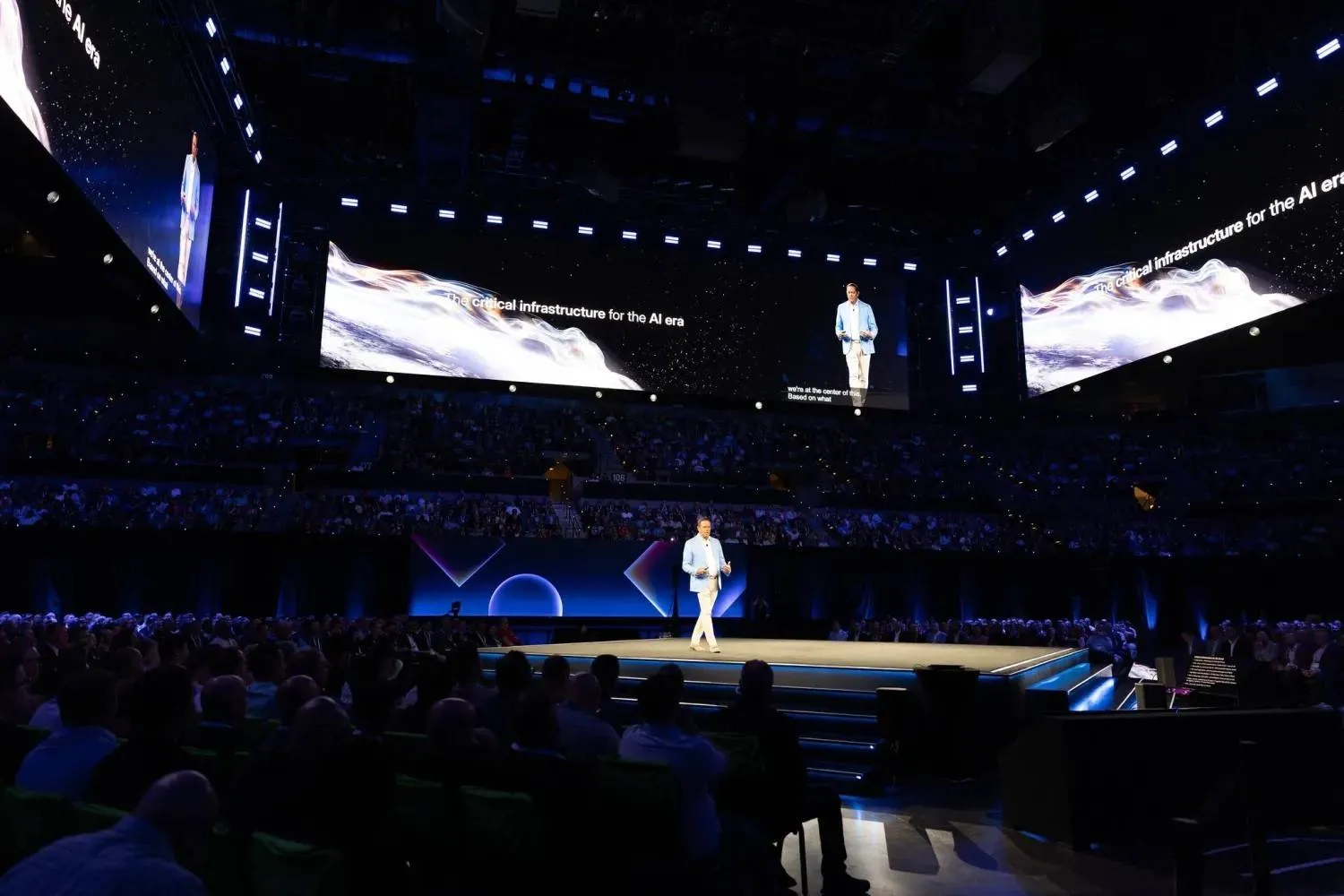

Cisco used its annual Cisco Live 2026 event to present artificial intelligence as a new test for infrastructure, not merely a software wave or a move toward smarter applications.
The main message at the event was that as organizations move from chatbots to AI agents capable of carrying out tasks, networks, security, observability, identity, and digital resilience are becoming part of one operating equation.
That idea featured strongly in the keynote speech by Cisco Chair and CEO Chuck Robbins, who returned to the company’s history in networking to explain that the power of any technological revolution is not complete unless its elements are connected to one another.
He said models, graphics processing units, applications and agents are all important, but they become more powerful when linked through a network capable of supporting and securing them.
He noted that network traffic linked to AI could triple over the next three years, as robots, manufacturing and physical AI enter operating environments.
One platform to run and defend infrastructure
The most prominent announcement at Cisco Live 2026 was the launch of Cisco Cloud Control, a unified platform to manage, monitor and secure technology infrastructure, designed so humans and AI agents can operate in the same environment and rely on the same operational data.
Cisco says the platform brings together networking, security, computing, observability and collaboration in a single interface. It allows users to build applications and agents using natural language and connect them to an ecosystem of external tools.
The company describes the platform as the operational foundation for its Agentic Ops vision, meaning infrastructure operations assisted by agents capable of detecting problems, analyzing their causes, proposing fixes, testing changes before they are implemented and then confirming that the user experience has returned to normal.
Jeetu Patel, Cisco’s President and Chief Product Officer, said AI agents reason and act continuously at software speed, and that changes everything about how we scale, manage and defend critical infrastructure.
He said the platform serves as a command center for agentic AI, where human teams and AI agents operate in the same environment and share the same information, while humans remain in control.
Saudi Arabia and the difficult readiness test
Asked by Asharq Al-Awsat about the biggest readiness gap facing Saudi organizations as they move toward agentic AI, and about the role Cisco wants to play in closing that gap, from secure connectivity and observability to identity, governance and skills, Robbins said the challenge is not limited to Saudi Arabia alone, but is linked to every organization’s effort to balance the desire to move quickly with maintaining a trusted security posture.
He said organizations are trying to understand the “fine line” between benefiting from new AI capabilities and dealing with the trust and security issues everyone knows are present.
On the same issue, Patel said the readiness gap in markets such as the Middle East is not only about the strategic decision to adopt AI, but also about the complexity of building the infrastructure itself.
These projects, he said, need time because every stage carries a level of complexity, from securing power, obtaining permits and preparing the right architecture, to managing data movement and capacity inside data centers so the infrastructure is not placed under pressure beyond its capability. Government regulatory requirements also enter the equation, making large-scale AI projects complex undertakings rather than a matter of buying ready-made technology.
Patel said, however, that the pace of movement in the Middle East has become faster than he would have expected a few years ago. He pointed to “significant momentum” in the region and said Cisco leaders had visited it several times and planned to return in the coming months, signaling continued work with its markets.
Liz Centoni, Cisco’s Executive Vice President and Chief Customer Experience Officer, linked the readiness gap in her remarks to Asharq Al-Awsat to two main areas.
The first is that organizations can no longer view infrastructure devices as ordinary operating assets, because these devices have become central to a new generation of attacks. Owning the technology is therefore not enough.
Organizations must change their internal operating model, especially how they handle vulnerabilities and security updates. Patching cycles that once took days or months are no longer suitable, and organizations may need to move toward a response measured in hours, or perhaps minutes.
The second area is quantum readiness. Centoni pointed to the risks of “harvest now, decrypt later” attacks, in which encrypted data may be collected today in the hope of decrypting it later as quantum computing advances.
She said many organizations may not even understand the level of their exposure to this type of risk and may be surprised by the results of quantum readiness assessments when they discover weaknesses in their current infrastructure.
The network is no longer a technical background
In a special interview with Asharq Al-Awsat on the sidelines of the event, Gordon Thomson, Cisco’s President for Europe, the Middle East and Africa, said the biggest change in the move from chatbots to agentic AI is that organizations are becoming more dependent on the network than ever before.
He said AI agents may not be in the same location. They may operate from desktops or small computers, inside data centers or across multiple cloud environments, making the network’s performance, reliability and security decisive factors in achieving returns from AI.
AI moves the world, but Cisco moves AI, according to Thomson, referring to the network as the layer that connects models, agents, systems and users.
Thomson added that GPUs are important, but they need a network to connect them, and that network is often built on Cisco technologies or on Ethernet. In this sense, he does not see the network as a silent technical layer, but as a foundation for operating AI itself, whether inside Saudi Arabia or beyond.
On the gaps that hinder the adoption of agentic AI, Thomson distinguished between infrastructure, trust and data, but said differences between Europe, the Gulf and Africa may not be geographical as much as sectoral. Government entities, banks, telecommunications companies and industrial sectors may approach trust, governance and security in different ways.
But he said what he sees in the Middle East and Saudi Arabia is a growing awareness of the importance of data, and clear investment in observability technologies and in understanding what is happening inside digital environments.
That point shifts the discussion from “Do we have the data?” to “Can we use it to operate AI safely?” Organizations may have vast amounts of data, but they need to link it to an operational context and understand what is happening across networks, applications, devices and agents.
Security as a layer inside the infrastructure
Cisco’s announcements in Las Vegas reflect a clear conviction that security is no longer a layer added after infrastructure is built but must be part of it from the beginning. The new platform brings together data from networking, security, observability, and collaboration, allowing humans and agents to work on the same context.
The company is also expanding Live Protect to shield its products from new vulnerabilities during operation, without rebooting, upgrading or opening a maintenance window.
According to Cisco, this approach is linked to the collapse of the time between vulnerability discovery and exploitation from weeks to minutes. The company also says reactive defense is no longer enough in an environment where attacks can accelerate with the help of advanced AI models.
The announcements also include Hybrid Mesh Firewall, which expands protection across networks, applications and firewalls from Cisco and third parties, with the aim of reducing the scope of damage when an incident occurs. On agents, Cisco speaks of protecting agents from the outside world and protecting enterprise resources from the agents themselves, through tools such as AI Defense, Zero Trust for agents and Agentic SOC.
Thomson said Cisco is not speaking only about delivering AI but about delivering “secure AI.”
He said the issue is about defining policy, enforcing it, and having the ability to mitigate the impact of any exposure or problem when it occurs. He said this is what Cisco brings to the table, drawing on its ability to capture data and use it to address customer challenges.
Is this a boardroom issue?
One notable shift in Cisco’s language this year is its move to take the network out of the category of invisible infrastructure and place it in the category of strategic risk. In his meeting with Asharq Al-Awsat, Thomson said that every company’s infrastructure has now become digital infrastructure, and that boards are beginning to understand that “the things that connect everything” are important and vital to business continuity.
He said the central issue boards must consider is digital resilience, adding that Cisco’s purchase of Splunk came in the context of using data more effectively to support it.
He said a conversation with a board 12 or 18 months ago about the importance of the network might not have received the same attention. Today, however, any board understands the importance of the network and the need to protect it, modernize it, and improve its reliability.
This point leads directly to Saudi Arabia and the Gulf, where government services, energy, transport, smart cities, health services and financial services are being transformed into interconnected digital systems. In such environments, a network outage is not a technical problem inside a server room, but a matter of service continuity, trust and operations.
From abundant data to decision-making power
Cisco places observability and data at the center of its new message. Cisco Cloud Control not only provides unified visibility, but relies on cross-domain telemetry, meaning the collection of operational data from networks, security, applications, users and agents, and linking it in one context.
The goal is for humans and agents to work on the same information to address issues such as uptime, agent behavior, and tokenomics.
In Gulf markets, this discussion does not appear theoretical. Large organizations in Saudi Arabia, especially in regulated sectors, need to link speed with control. AI agents may soon enter customer service, security, network management, data analysis, supply chains, programming, and internal operations.
But the question is not only what an agent can do, but who allowed it to do so? With what authority? Under what policy? And how can what it did be known later?
For this reason, Thomson stressed that the Zero Trust approach is essential, saying that everything starts there, with identity and privileges built on top, so that no user or agent gains access except through the required privileges and credentials.
Quantum security: Tomorrow’s threat enters today’s agenda
Cisco dedicated part of its conference announcements to the post-quantum computing track, pointing to “harvest now, decrypt later” attacks, in which encrypted data is collected today in the hope of decrypting it later as quantum capabilities develop.
The company said it is committed to enabling quantum secure communication capabilities across most of its core portfolio by December 2026, with the launch of a new series of routers, switches, and firewalls equipped with quantum safe secure boot, as well as Quantum Ready Assessments through Cisco IQ to identify the assets most exposed to these risks.
This does not mean every organization needs to change its infrastructure immediately, but it reflects a shift in thinking.
Organizations building AI infrastructure today in long-life sectors such as energy, government, telecommunications and finance cannot separate their current decisions from risks that will emerge over the coming years. Quantum readiness, therefore, becomes part of a broader concept of digital resilience.
The Middle East between speed and sovereignty
In the Middle East, three factors intersect to make Cisco’s message more relevant to the region: the speed of investment, the sensitivity of data and the need for sovereignty.
Saudi Arabia, in particular, is moving from the stage of announcing strategies to the stage of building infrastructure, operating it and linking it to sectors. But this shift raises questions about where data is operated, who has the right to access it, how agents are monitored, and which model is most appropriate for cloud, on-premises infrastructure, or hybrid environments.
In his remarks to Asharq Al-Awsat, Thomson did not see differences between the Middle East and Europe as always geographical in nature, but he acknowledged that priorities may differ.
The region is moving quickly and has clear ambition, but that increases the importance of control, resilience, and security. Sovereignty, from this perspective, becomes more than a question of where data is stored. It is also linked to control over infrastructure, operating choices, the ability to recover and trust in the support chain.
The test of the next phase
What emerged from Cisco Live 2026 is an attempt to redefine the network’s role in the age of AI. The network is no longer a silent background, nor merely a transport layer. The company says the network is becoming the place through which agents’ decisions pass, policies are enforced, data is captured and resilience is measured.
For Saudi Arabia and the Gulf, this vision carries a clear significance. The next phase of AI will not be measured only by the size of data centers, the number of processors, or the speed at which services are launched, but by institutions’ ability to operate this system securely, reliably and resiliently.
As AI systems move from answering to acting, the infrastructure that connects, protects and monitors them becomes part of strategic decision making, not merely a technical detail.