
Iraq on Verge of Restructuring Popular Mobilization Forces

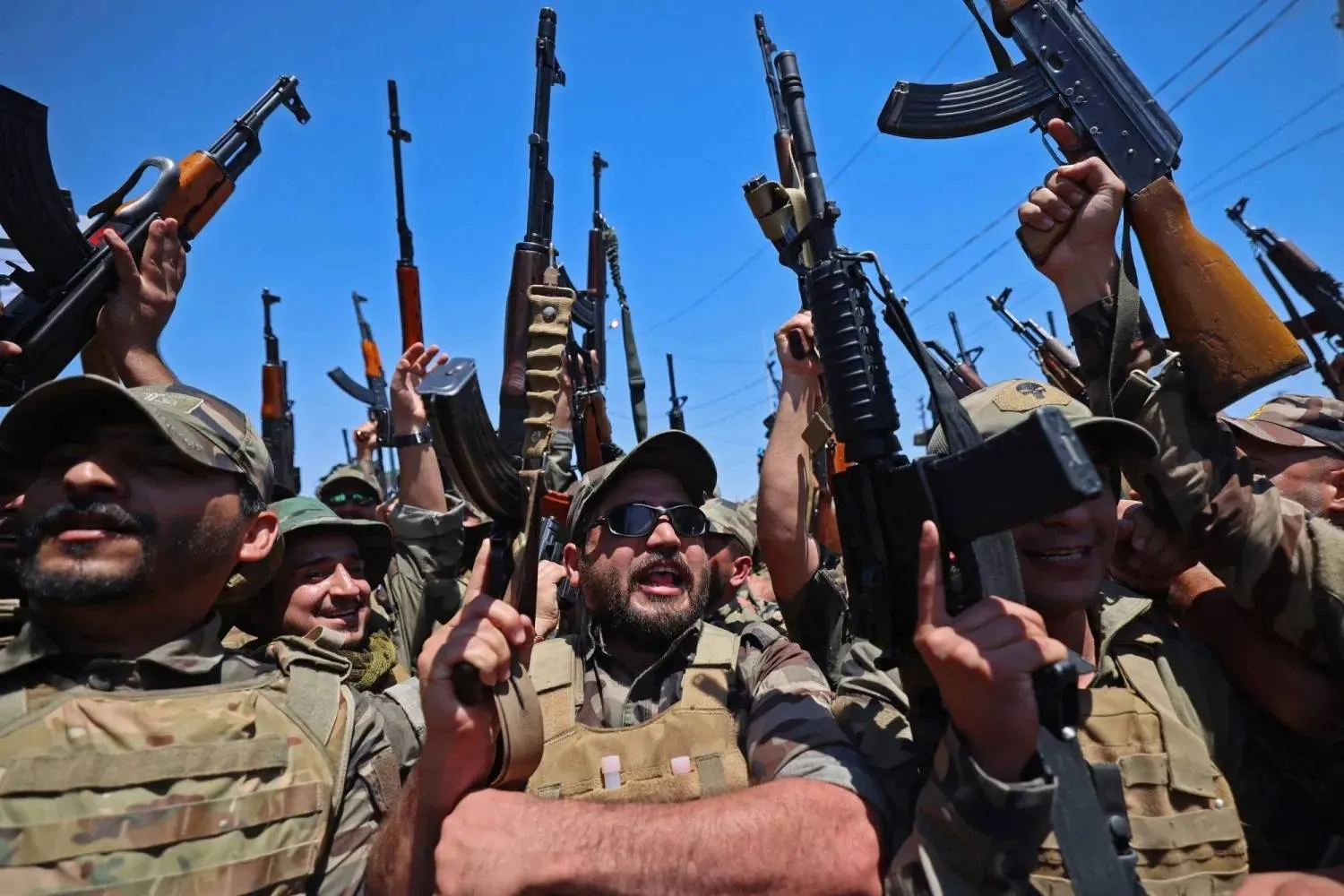
Members of Saraya al-Salam attend a ceremony in Samarra on June 4, 2026, marking their integration into Iraq’s security forces. (AFP)
TT

Iraq on Verge of Restructuring Popular Mobilization Forces

Members of Saraya al-Salam attend a ceremony in Samarra on June 4, 2026, marking their integration into Iraq’s security forces. (AFP)

The military wing loyal to Sadrist movement leader Moqtada al-Sadr handed over responsibility for security in Samarra to the Iraqi army on Thursday, in a symbolic ceremony that included lowering the faction’s flag at its operations headquarters.

The move, seen by observers as a “qualitative shift,” coincided with an announcement by the spokesman for Iraq’s armed forces that work had begun to restructure formations of the Popular Mobilization Forces and guarantee the rights of their members.

Saad Maan, head of the Security Media Cell, said all Saraya al-Salam fighters affiliated with Sadr were now under the command of the prime minister, the commander-in-chief of the armed forces.

Footage aired by state television showed Saraya al-Salam members lowering their faction’s flag outside the operations headquarters, in the presence of a military committee sent by Prime Minister Ali al-Zaydi.

Saraya al-Salam is part of the Popular Mobilization Forces through brigades 313, 314, and 315. It carries out security duties in several areas, most notably Samarra.

Sadr announced on May 27 that he was merging his military wing, Saraya al-Salam, into the state, and called on Popular Mobilization Forces factions to hand over their weapons.

Within a week, Asaib Ahl al-Haq and Kataib al-Imam Ali also announced their separation from the Popular Mobilization Forces. Kataib Hezbollah and Harakat al-Nujaba, however, have continued to reject demands to disarm and dismantle the factions.

Saraya under the commander’s authority

After the handover ceremony, Deputy Commander of Joint Operations Qais al-Mohammedawi said at a news conference that merging Saraya al-Salam meant placing it under the commander-in-chief of the armed forces.

He said, “A committee had been formed by government order to relink and redistribute armed formations so they move away from any other political title or formation.”

Saraya al-Salam brigades have been stationed in Samarra since the bombing of the Imam al-Askari shrine in June 2007. It remains unclear whether its members will leave the city for the first time in 19 years. But a military source told Asharq Al-Awsat the faction had handed over all its headquarters to the army, while its fighters now answer to the commander in chief of the armed forces.

Still, observers say the details of dismantling and disarmament remain unclear. Questions persist about the types and quantities of weapons held by the factions, whether they will hand them over to government authorities, and whether they will give them up entirely.

An Iraqi security official said the mechanism for placing all weapons under state control “remains unclear,” according to AFP. Local media, however, circulated claims that the Coordination Framework had put forward an initiative for discussion.

The proposal reportedly includes “securing tens of thousands of government jobs in official security institutions for individuals whose armed factions agreed to disengage.”

Restructuring the Popular Mobilization Forces

In a notable development, Sabah al-Numan, the spokesman for the commander in chief of the armed forces, said the committee formed at the commander in chief's direction had begun work to place all weapons under state control.

He said disengagement from the Popular Mobilization Forces included restructuring its formations and guaranteeing the rights of its members.

It is the first official reference to “restructuring the formations of the Popular Mobilization Forces” since the force was established in 2014 to fight ISIS.

Numan said the term “disengagement” involved administrative frameworks and restructuring these formations within the security services, while guaranteeing fighters’ rights and integrating them into military formations.

“The committee has been formed and has begun its work,” he said. “It will set the mechanisms for merging and incorporating the relevant formations, and for handing over weapons, equipment and camps to the Iraqi security authorities.”

Numan said “all weapons and all equipment” would be handed over to the central committee and Iraqi security authorities. A full inventory, he added, would be submitted within two days to the central committee, which is under the direct supervision, direction and follow-up of the commander in chief of the armed forces.

The committee includes several bodies, including the Defense Ministry, the Interior Ministry, the Joint Operations Command and the Popular Mobilization Forces Commission.

The Coordination Framework authorized Prime Minister and Commander in Chief Ali al-Zaydi to take the decisions and measures needed to protect the country’s higher interests.

It also backed “restricting weapons to the state and disengaging the Popular Mobilization Forces Commission from political, partisan and social frameworks.”

What comes next?

Asaib Ahl al-Haq, led by Qais al-Khazali, is expected to take a step similar to that of the Sadrist movement after agreeing with the prime minister to form a committee to separate from the Popular Mobilization Forces.

Khazali is under US sanctions and is one of the leaders of the Coordination Framework, which holds the largest parliamentary bloc. His political influence grew after his group won 27 seats in the latest parliamentary elections.

A source close to Asaib said the group “currently considers political work and presence in government more important than fighting. Therefore, it wants to give assurances to the United States.”

Kataib al-Imam Ali also said it would form a committee to “follow up the inventory, handover and transfer process under Zaydi’s supervision,” and another to “follow up the affairs of individuals and members and reintegrate them into state institutions.”

In practice, that means “all decisions related to their brigades within the Popular Mobilization Forces” will come under Zaydi’s authority “administratively,” according to a source close to the factions.

US special envoy to Syria and Iraq Tom Barrack welcomed a step that “will contribute to building order” and praised the initiative of Prime Minister Ali al-Zaydi, who, after taking office last month, pledged to restrict weapons to the state.

The move comes as Washington gains political and economic ground in Iraq, while Tehran’s regional influence has declined since the outbreak of the war in Gaza between Israel and Hamas, which is backed by Tehran, in 2023, followed by Israel’s first war against Iran in 2025, and then the second war launched by the United States and Israel in February, whose repercussions reached Iraq.

Disarmament plan

Asharq Al-Awsat revealed on May 9, 2026, that an Iraqi committee, including Prime Minister-designate Ali al-Zaydi, was working to complete an “executive project” to disarm armed factions before presenting it to Washington, amid mounting US pressure to keep militias away from the new government and key state institutions.

The committee had presented militia leaders with “ideas on how to disarm,” but some meetings “did not pass calmly,” according to informed sources.

The plan includes removing heavy and medium weapons and restructuring the Popular Mobilization Forces, alongside expected changes in sensitive security agencies, possibly including the intelligence service.

Political sources, however, questioned the government’s ability to implement the project, saying it may be aimed at “buying time.”


Washington Supports Deeper Security, Economic Cooperation with Algeria

Algerian President Abdelmadjid Tebboune (Photo: The Presidency)
TT

Washington Supports Deeper Security, Economic Cooperation with Algeria

Algerian President Abdelmadjid Tebboune (Photo: The Presidency)

Senior Adviser to the US President for Arab and African Affairs Massad Boulos has stressed that Washington “supports deeper security cooperation” with Algeria.

In a statement published by the US embassy in Algiers on its Facebook page, Boulos said he held a “productive call” with Algerian President Abdelmadjid Tebboune “to discuss the US-Algeria partnership.”

“The United States supports deeper security cooperation and expanding economic opportunities for US companies in Algeria, with our growing energy partnership paving the way for shared prosperity,” said Boulos.

He said he also expressed his condolences to the communities affected by Algeria’s recent wildfires.

Boulos held a productive meeting last April with Algerian Foreign Minister Ahmed Attaf, aimed at deepening the trade and security partnership between the two countries.

They welcomed the progress achieved in discussions concerning Algeria’s unconventional gas resources and reviewed opportunities for American companies to support the country’s critical minerals sector.

The two parties also discussed ways to expand cooperation in counterterrorism and military collaboration as part of their shared goal of strengthening regional security. In addition, they addressed regional issues of mutual interest, particularly various conflicts and humanitarian crises.


Abyan Governor to Asharq Al-Awsat: Forces Ready for ‘Zero Hour’ Against Houthis

Al-Rabash said security and development were top priorities. Photo: Turky Alagili
TT

Abyan Governor to Asharq Al-Awsat: Forces Ready for ‘Zero Hour’ Against Houthis

Al-Rabash said security and development were top priorities. Photo: Turky Alagili

Maj. Gen. Mukhtar al-Rabash al-Haythami, governor of Abyan and commander of the province’s military axis, said his forces were ready for the “zero hour” to launch an offensive against the Houthis in Yemen.

He disclosed plans and operations being coordinated with other military commands and fronts, as well as the reinforcement of the roughly 76-km (47-mile) front line between Abyan and al-Bayda with advanced weapons.

“The Abyan Military Axis is ready, both commanders and personnel, and is awaiting the zero hour,” al-Rabash told Asharq Al-Awsat in an interview.

He said the troops’ morale was “higher than ever” and that preparations were proceeding under a “carefully devised plan” in coordination with the Saudi-led coalition, Yemen’s Presidential Leadership Council and the Defense Ministry.

The Abyan governor said recent battlefield developments had demonstrated the government forces’ “fighting spirit and high morale,” adding that military commanders were united by the goal of “liberating Sanaa and Yemen from the Houthi militia and ending the Iranian project.”

Al-Rabash described cooperation with Saudi Arabia as a key pillar of plans to rehabilitate the province. He said a three-day workshop with the Saudi Development and Reconstruction Program for Yemen had identified eight priority sectors and approved 24 public-service projects.

76-km front line with the Houthis

Abyan’s fronts are spread across several military commands, al-Rabash said. The front line with the Houthis extends for about 76 km along the border with al-Bayda province and sees frequent clashes.

The governor said plans to reinforce the fronts included raising combat readiness, providing them with advanced weapons, and mobilizing local communities and tribes to support government forces.

Al-Rabash said the prospects of a decisive outcome had improved after the Houthis were “given opportunity after opportunity to pursue peace.”

Instead of taking advantage of those opportunities, he said, the group had continued to escalate domestically and threaten international shipping.

Houthi cells and assassination attempts

On security, al-Rabash said Houthi cells had been uncovered in the province, adding that security forces had arrested between 120 and 150 operatives over the past several years.

He said the latest Houthi cell to be uncovered consisted of two operatives who were arrested and four others who escaped.

According to al-Rabash, those detained confessed to preparing four explosive devices to target him personally, as well as plotting to attack Brig. Gen. Ahmed al-Damani, commander of the Nation’s Shield Forces in Abyan.

The governor said there was “collusion and coordination” between the Houthis and terrorist organizations. He added that local government officials and security and military commanders had been targeted in attempted attacks, while several security commanders had been killed in confrontations with those groups.

Al-Rabash said Abyan had paid a heavy price through a succession of conflicts, beginning with al-Qaeda’s seizure of parts of the province in 2011, followed by the Houthi advance in 2015 and the 2019 conflict between the internationally recognized government and Southern Transitional Council forces.

The fighting caused extensive damage to infrastructure, the social fabric and the local economy, he said.

Al-Qaeda’s presence in Abyan

Asked about al-Qaeda’s current presence, al-Rabash said the number of ideologically committed members of the organization had become “very small,” according to estimates by the relevant security agencies.

The threat remained, however, through clandestine cells and the recruitment of some misled young people by exploiting poverty and ignorance, he said.

Al-Rabash said some operatives came from other provinces, while others arrived “by sea from certain countries.” Abyan’s coastline, which stretches for more than 300 km (186 miles), poses a security challenge and requires significant surveillance capabilities, he added.

He stressed that security and military measures alone were insufficient and that combating extremism required a parallel approach encompassing education, public awareness, development and job creation, as well as the involvement of tribes and local communities.

“When citizens feel the state’s presence through schools, public services and job opportunities, they become less receptive to ideas that bring nothing but death and bloodshed,” he said.

24 Saudi-backed projects

On development, al-Rabash described cooperation with Saudi Arabia as a key pillar of plans to rehabilitate the province. He said a three-day workshop with the Saudi Development and Reconstruction Program for Yemen had identified eight priority sectors and approved 24 public-service projects.

The governor stated the Saudi Development and Reconstruction Program for Yemen approved 24 projects in Abyan (Local Authority)

The projects cover electricity, water, healthcare, education and roads, alongside larger strategic projects that are being developed, he said.

The governor placed the strategic Wadi Hassan dam at the top of Abyan’s priority projects, saying it would help replenish groundwater and the wells that supply Aden with water. The dam was also expected to help revive the agricultural sector.

Al-Rabash said Wadi Hassan had historically contributed to Abyan’s agricultural standing, which earned the province its reputation as “Yemen’s breadbasket.” Investment in modern agricultural technologies could restore that role and expand the province’s productive capacity, he added.

He praised Saudi support for Abyan and Yemen more broadly, particularly in hospitals, schools, electricity and roads, saying the projects “directly affect people’s lives.”

“We extend our thanks and appreciation to our brothers in the Kingdom of Saudi Arabia — its king, crown prince, government and people — for their countless efforts across various fields,” al-Rabash said.

He said Saudi support included “building hospitals and schools, rehabilitating roads, supporting the electricity sector and everything that helps improve the lives of the Yemeni people.”

The governor contrasted Saudi Arabia’s role with that of the Houthis.

“Our brothers in Saudi Arabia build hospitals, schools and roads, while the Houthis come with missiles to destroy them,” he said. “They kill and destroy but do not build, and their attacks have struck mosques, schools and hospitals.”

“Our Saudi neighbor and brother, with whom we share ties of blood, religion, tribe and geography, comes to help build and improve people’s lives,” he added. “That is the difference evident to anyone with insight.”

Al-Rabash said security and development were inseparable tracks, prompting the local authorities to adopt the slogan: “Abyan First — Authority Upheld, Development Built.” Photo: Turky Alagili

‘Abyan First’

Al-Rabash said security and development were inseparable tracks, prompting the local authorities to adopt the slogan: “Abyan First — Authority Upheld, Development Built.”

He said priorities were focused on five main sectors — electricity, water, healthcare, education and roads — alongside efforts to consolidate security, combat terrorism and crime, and raise combat readiness along the fronts.

The local authorities had also expanded outreach to tribes, religious scholars, journalists, young people, women, and social and sporting groups to build a community partnership, he said. The public’s response was among the most important factors in the success of the new phase.

Al-Rabash concluded with a message urging Abyan’s residents to “stand together and work as one,” saying the province’s stability and reconstruction “cannot be achieved without a genuine partnership between the community and the local authorities.”


Israeli Foreign Minister Says No Plans to Deport Palestinians from Gaza

Palestinians look on from the street at the damage to a house that was hit by an Israeli strike following an evacuation warning in the Al-Rimal neighborhood of Gaza City on September 8, 2026. (AFP)
TT

Israeli Foreign Minister Says No Plans to Deport Palestinians from Gaza

Palestinians look on from the street at the damage to a house that was hit by an Israeli strike following an evacuation warning in the Al-Rimal neighborhood of Gaza City on September 8, 2026. (AFP)

Israeli Foreign Minister Gideon Saar said on Wednesday that the government does not plan to deport Palestinians from Gaza, after two Israeli ministers this month floated proposals for the mass removal of Palestinians from the coastal territory.

"We are not planning to expel or ‌to deport anyone ‌from (the) Gaza Strip," ‌Saar ⁠told a press ⁠conference in Ljubljana, Slovenia.

"If someone wants to immigrate (on) his own will, and there is a country which is ready to accept him .... we will not oppose that, ⁠but we will (also) not enforce ‌anyone ‌against (their) will," he said.

Saar is in ‌Slovenia to open the ‌Israeli embassy in Ljubljana.

Defense Minister Israel Katz on Wednesday said on September 2 there was "no real solution for ‌Gaza in the end without this migration" of Palestinians.

Far-right ⁠security ⁠minister Itamar Ben-Gvir on September 3 outlined a seven-year plan for removing Gaza's population through what he described as "voluntary emigration."

The US Ambassador to Israel Mike Huckabee has said that Israel has no plans to force Palestinians to leave Gaza.

Israel is to hold a general election on October 27.