


Sadr Hands over Saraya al-Salam to Iraqi Govt as PMF to Be ‘Restructured’

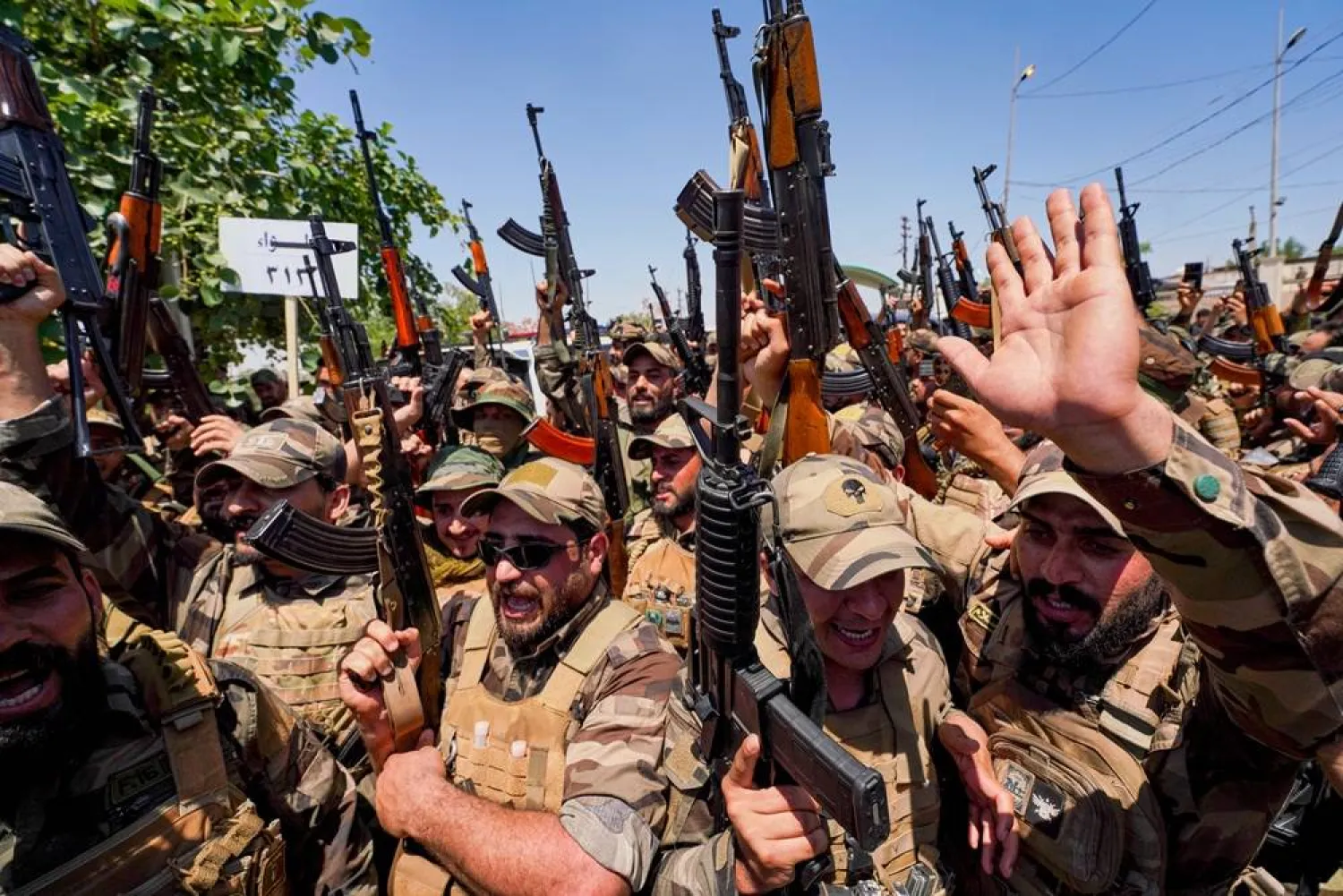
Members of Saraya al-Salam react during a ceremony in the city of Samarra on June 4, 2026, marking their separation from the Sadrist movement and their integration into the Iraqi security forces. (AP)
TT

Sadr Hands over Saraya al-Salam to Iraqi Govt as PMF to Be ‘Restructured’

Members of Saraya al-Salam react during a ceremony in the city of Samarra on June 4, 2026, marking their separation from the Sadrist movement and their integration into the Iraqi security forces. (AP)

The armed wing of influential cleric Moqtada al-Sadr's movement handed over on Thursday its security responsibilities to the Iraqi army in Samarra city.

The Saraya al-Salam are part of the pro-Iran Popular Mobilization Forces and hold security responsibilities in several regions, notably Samarra.

Sadr had announced on May 27 that he was merging the Saraya al-Salam with the state, calling on other PMF factions to follow suit.

Within a week, the Imam Ali Brigades and Asaib Ahl al-Haq factions said they were disengaging with the PMF. Other staunchly pro-Iran factions, the Kataib Hezbollah and Nujaba movement, have refused to disarm and dismantle their armed wings.

Head of Iraq's Security Media Cell Lieutenant General Saad Maan said all Saraya al-Salam fighters are now working under the orders of the prime minister, who is also commander-in-chief of the armed forces.

State media aired footage of the Saraya al-Salam members lowering their faction’s flag at their operations command center at a ceremony attended by a military delegation dispatched by PM Ali al-Zaidi.

Washington has long wanted to curtail Iran's influence in Iraq, but the start of its war with Tehran on February 28 has given it new momentum.

Iran-backed groups in Iraq have launched numerous strikes against US installations in Iraq since the start of the Middle East war at the end of February.

The strikes have been blamed on pro-Iran groups, against whom the US has retaliated, killing dozens of their fighters.
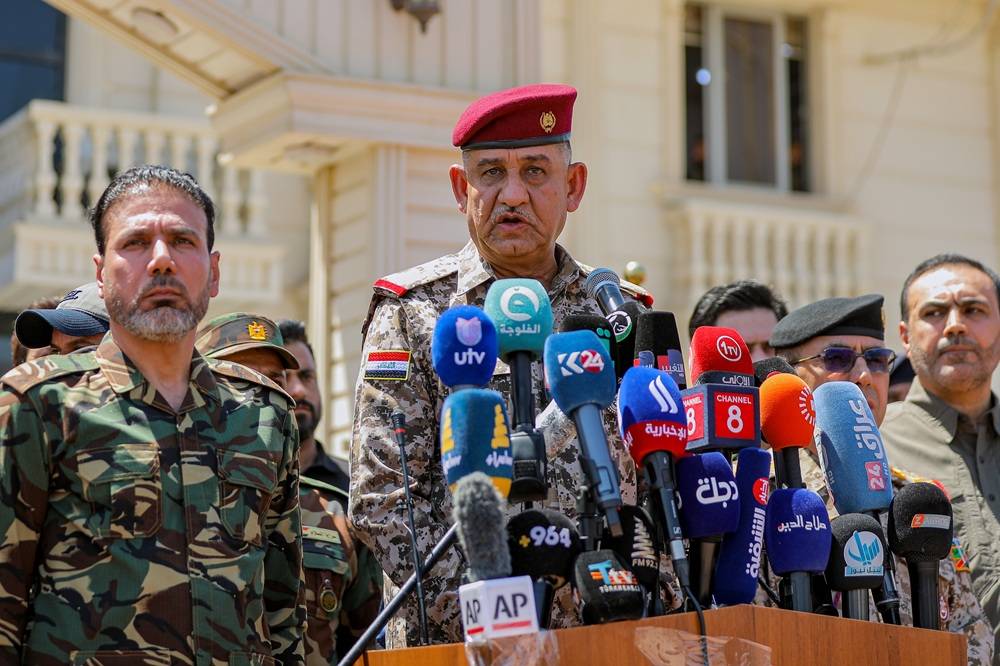
Qais al-Muhammadawi, Deputy Commander of Iraq's Joint Operations Command, speaks during a ceremony marking the start of the process of the Saraya al-Salam handing over its weapons to Iraqi state forces in Samarra, north of Baghdad, Iraq, Thursday, June 4, 2026. (AP)

Washington has in turn put pressure on Baghdad to rein in the groups by suspending security assistance and cash transfers of Iraqi oil revenues.

Qais al-Muhammadawi, Deputy Commander of Iraq's Joint Operations Command, told a press conference that the Saraya al-Salam will now be merged with the armed forces.

The faction has been deployed in Samarra since the 2007 al-Askari shrine bombing. It remains to be seen whether they will quit the city for the first time in 19 years.

A military source told Asharq Al-Awsat that the group handed over all of its headquarters to the army and its fighters are now at the command of the armed forces.

Despite these developments, the details of the dismantling of the groups and their disarmament remain vague, said observers. Questions remain over the size of their arsenal and whether they will really turn them over to the government and completely abandon them.

An Iraqi security official said the mechanism for disarmament remains “unclear”, reported AFP.

Local media said an initiative has been proposed for discussion before the ruling pro-Iran Coordination Framework. It includes securing tens of thousands of government jobs in official security institutions for members of the dismantled armed factions.
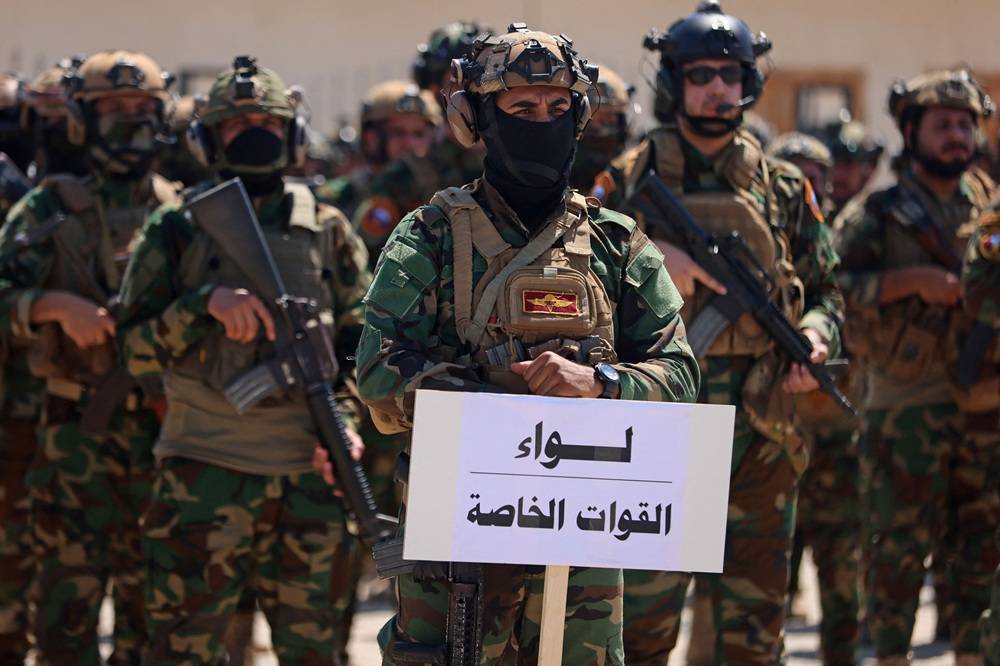
Members of Saraya al-Salam gather during a ceremony in the city of Samarra on June 4, 2026, marking their separation from the Sadrist movement and their integration into the Iraqi security forces. (AFP)

PMF ‘structuring’

Meanwhile, spokesperson for the Commander-in-Chief of the Armed Forces Sabah al-Numan announced that the committee tasked with imposing state monopoly over arms has kicked off its operations.

He said that “faction disengagement from the PMF calls for the restructuring of formations and ensuring the rights of members.”

This was the first time that the issue of structuring of the formations has been brought up since the PMF’s establishment in 2014. The group was initially set up to fight the ISIS extremist group.

Numan explained that “disengagement” entails “administrative frameworks and the restructuring of these formations within the security agencies, guaranteeing the rights of fighters and merging them with military formations.”

The committee will set up mechanisms for merges and the handover of weapons and military equipment to the official security agencies, he added.

The committee is comprised of officials from the defense and interior ministries, Joint Operations Command and PMF.

What’s next?

Qais al-Khazali's Asaib Ahl al-Haq is expected to follow in Sadr’s footsteps and handover its weapons.

The group, which the US designates a terrorist organization, also forms an important parliamentary bloc with 27 seats. Having refocused on politics, it has distanced itself from Iran and has not taken part in the current war.

A source close to the group said “being part of the government is more important that fighting. So we want to offer the US reassurances.”

The Imam Ali Brigades said it will form a committee to follow up on the disarmament and handover of weapons under the PM’s supervision.

The group has effectively put its administrative control in Zaidi’s hands, said a source close to the factions.

Washington's special envoy for Iraq and Syria, Tom Barrack, has called the disarmament efforts a "significant step forward, which represents the nascent foundation for a renewed Iraqi self-governance". He welcomed the "principled decision" of those groups that are choosing to integrate.




Tunisian Rights Activist Sentenced to 25 Years in Prison

Tunisian rights activist Sihem Bensedrine. (Getty Images)
TT

Tunisian Rights Activist Sentenced to 25 Years in Prison

Tunisian rights activist Sihem Bensedrine. (Getty Images)

Prominent Tunisian rights activist Sihem Bensedrine told AFP on Friday that she had been sentenced to 25 years in prison on charges including falsifying part of a transitional justice commission's final report.

"Of course, this is a decision that has nothing to do with justice. It has to do with a totalitarian regime that wants to erase the legacy of the IVD," Bensedrine said, referring to the Truth and Dignity Commission of which she was president.

Bensedrine, 75, said she would lodge an appeal. She had been placed in pre-trial detention for over six months following her arrest in August 2024.

Prosecutors accused Bensedrine of falsifying the commission's final report, among other charges.

Bensedrine said she had been targeted by "officials who are holding the state hostage" in order to "settle scores" and "discredit our work".

Human Rights Watch said in a statement "Bensedrine has for decades been harassed, jailed, and pushed into exile for her human rights work. Her sentence would keep her in prison until she's 100 years old."

The Paris-headquartered International Federation for Human Rights (FIDH) has said the charges against Bensedrine were "groundless".

The commission's final report, published in 2020, called for "dismantling a system of corruption, repression and dictatorship" within state institutions.


Key Points from the US-Lebanon-Israel Agreement

US Secretary of State Marco Rubio and others watch, seated from left, Israel's Ambassador to the US Yechiel Leiter, counselor Dan Holler, and Lebanon's Ambassador to the US Nada Hamadeh, sign a framework agreement, described as a first step toward peace following months of conflict between Israel and the Lebanese group Hezbollah, at the State Department, Friday, June 26, 2026, in Washington. (AP)
TT

Key Points from the US-Lebanon-Israel Agreement

US Secretary of State Marco Rubio and others watch, seated from left, Israel's Ambassador to the US Yechiel Leiter, counselor Dan Holler, and Lebanon's Ambassador to the US Nada Hamadeh, sign a framework agreement, described as a first step toward peace following months of conflict between Israel and the Lebanese group Hezbollah, at the State Department, Friday, June 26, 2026, in Washington. (AP)

Washington on Friday released text of a trilateral framework between Lebanon, Israel and the United States aimed at ending hostilities that have been a violent second front of the Middle East war.

The following are highlights of the 14-point agreement signed in the US capital:

- 'Lasting peace' -

Israel and Lebanon, with US support, "affirm their shared goal of achieving lasting peace and security," the agreement begins.

The neighboring states "declare their intent to conclusively end the conflict, address its underlying causes, and to therewith formally conclude any state of war between them."

- 'Verified disarmament' -

The framework determines to make "irreversible progress" towards resolving all issues between Israel and Lebanon, while doing so is to be achieved through "direct bilateral talks, with the mediation and support of the United States."

The Lebanese Armed Forces (LAF) "will restore effective sovereignty over all Lebanese territory, pending the verified disarmament of non-state armed groups and dismantlement of associated infrastructure."

This will enable the Israel army to "progressively redeploy out of the Lebanese territory."

The framework will set out the steps and verification mechanisms to advance this process.

- Pilot zones -

The LAF will "gradually assume full and effective security responsibility in pilot zones, which will serve as the mechanism for phased and verified redeployments of the Israeli army and the deployments of the LAF."

Two initial zones have been agreed to by both sides, and future pilot zones will be agreed by mutual consent.

Upon confirmation of the disarmament of non-state armed groups, notably the Iran-backed Hezbollah, the LAF will assume full security responsibility in these zones.

"Internationally supported reconstruction efforts will begin, and Lebanese civilians will be able to safely return to these areas under the exclusive control of Lebanese state authorities," the agreement states. "The United States intends to work closely with both countries to verify and support this process."

- Working groups -

Lebanon's government under the deal reaffirms its commitment to restoring full sovereignty over its territory.

It will "rebuild the State's monopoly on the use of force, achieve the complete and verified disarmament of all non-state armed groups, and ensure that such groups will have no military or security role and no armed capabilities anywhere in Lebanon."

Lebanon asks for the support of international and particularly Arab partners, under the leadership of the United States, to do this.

Israel and Lebanon also are to establish "working groups to draft the full comprehensive peace and security agreement" between them, the framework says, and "immediately establish complementary tracks of ongoing direct engagement, facilitated by the United States."

- 'No territorial ambitions' -

Israel for its part states that its military actions in Lebanon "are solely a consequence of the attacks, threat posed by, and hostile intent of non-state armed groups, particularly Hezbollah."

"Termination of this threat," notably through disarmament of such non-state groups and "additional security arrangements to be agreed upon between the two countries," will eliminate any future necessity for Israeli military action or presence in Lebanon, it said.

It also stressed that "the Government of Israel declares that it has no territorial ambitions in Lebanon."


Hezbollah Supporters take to streets of Beirut to protest Israel deal

Hezbollah supporters block the old airport road in the southern suburbs of Beirut, with burning tires to protest against the trilateral agreement that was signed between the US, Israel and Lebanon on June 27, 2026. (Photo by Ibrahim AMRO / AFP)
TT

Hezbollah Supporters take to streets of Beirut to protest Israel deal

Hezbollah supporters block the old airport road in the southern suburbs of Beirut, with burning tires to protest against the trilateral agreement that was signed between the US, Israel and Lebanon on June 27, 2026. (Photo by Ibrahim AMRO / AFP)

Hezbollah supporters took to the streets of Beirut late Friday to protest an agreement between Israel and Lebanon, as a lawmaker from the Iran-backed group warned enforcing the deal risked sparking civil war, AFP reported.

The state-run National News Agency (NNA) reported that "Hezbollah supporters rode motorbikes through the streets of Beirut" including central areas and along a road leading to the airport "in protest at the framework agreement announced between Lebanon and Israel".

An AFP correspondent saw people riding motorbikes and chanting slogans along one road, as well as Lebanese army temporary checkpoints set up along several streets of the capital.

Lebanese "authorities will be unable to impose the implementation of the agreement signed in Washington unless they go, with American support, to civil war," said Hezbollah lawmaker Hassan Fadlallah, whose party has long rejected the direct Israel-Lebanon talks.

He added that "what happened in Washington is an attempt to disrupt the Islamabad path, and without the resistance (Hezbollah) nothing will pass," referring to the initial agreement between the US and Iran on halting the Middle East war, which includes Lebanon.

Footage circulating on local outlets and social media showed hundreds of Hezbollah supporters on motorbikes and mopeds roaming Beirut's southern suburbs, the group's stronghold, before they headed to the heart of the capital.

Some had gathered near the seat of the government and blocked a main road nearby, while other footage showed soldiers chasing away Hezbollah supporters who blocked the main road leading to the airport with burning tyres, before the army reopened it.

The NNA had said protesters blocked at least one major road with burning tyres.