

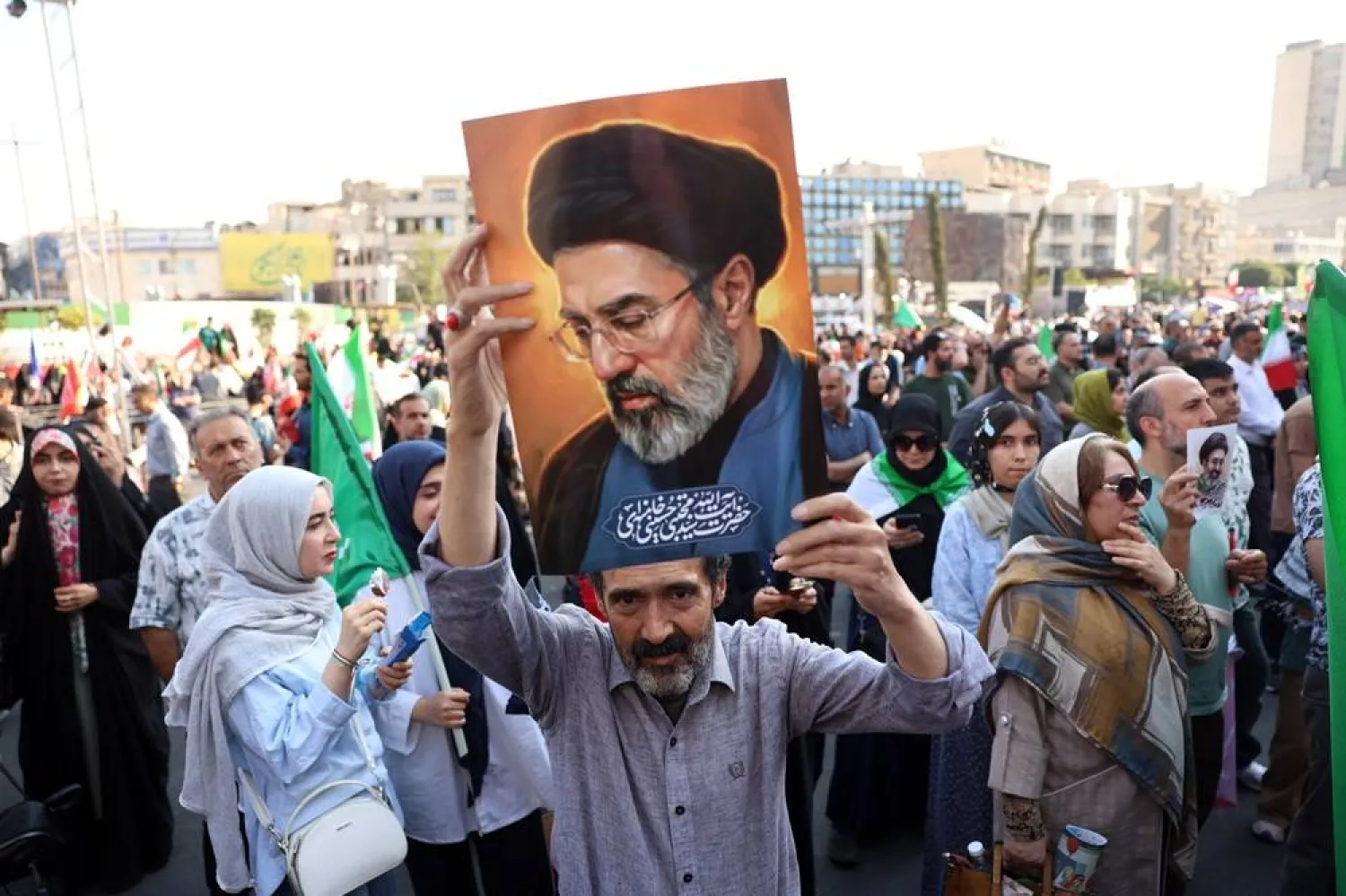

Is Iran’s New Supreme Leader Taking up the Reins of Power?

An Iranian man holds up a portrait of Supreme Leader Mojtaba Khamenei during a rally in Tehran, Iran, 4 June 2026, amid a temporary ceasefire between Iran and the United States. (EPA)
TT

Is Iran’s New Supreme Leader Taking up the Reins of Power?

An Iranian man holds up a portrait of Supreme Leader Mojtaba Khamenei during a rally in Tehran, Iran, 4 June 2026, amid a temporary ceasefire between Iran and the United States. (EPA)

Iran's new supreme leader Mojtaba Khamenei has not been seen in public since being appointed, his health condition is a mystery, and it's unclear how much power he wields.

But over three months after his father and predecessor Ali Khamenei was killed in an air strike at the start of the US-Israeli war against Iran, there are signs he is alive and involved in government affairs.

US President Donald Trump said Wednesday that Khamenei was "involved, absolutely", while Secretary of State Marco Rubio said on Tuesday "there are indications out there that he is increasingly engaging at some level".

Inside Iran, President Masoud Pezeshkian and armed forces joint operational command chief General Ali Abdollah have reported meeting Mojtaba Khamenei, even if no images ever filtered out.

He has communicated through around a dozen written statements in his name, the latest of which -- a diatribe against the "malicious enemy" -- was read out on Thursday at a ceremony commemorating the 37th anniversary of the death of revolutionary founder Khomeini.

"Mojtaba, likely with the assistance of his office, probably plays a role overseeing the general direction of policy, including topline positions for negotiations with the US," said Farzan Sabet, an Iran expert at the Geneva Graduate Institute.

"But his level of personal engagement with policy is probably far below that of his father" due to the security situation and his health.

Multiple Iranian officials have confirmed Mojtaba Khamenei was wounded in a US-Israeli strike, although there have been contradictory accounts over the extent of his wounds and if they were sustained in the very same strike that killed his father.

"As the security condition normalizes, and his health improves, I would expect him to play a bigger role," Sabet added.

- 'Close to dominant players' -

"The role of Mojtaba Khamenei is unclear. It is very unlikely at this point that he has the degree of influence that his father used to have," Thomas Juneau, professor at the University of Ottawa told AFP.

But he added it "is also known that he is close to many of the dominant players today", including key figures in the Revolutionary Guards (IRGC) ideological army.

Juneau said that power appeared to be in the hands of an "informal committee" of IRGC commanders and a handful of senior politicians including parliament speaker Mohammed Bagher Ghalibaf, himself a former IRGC commander.

The latest of Khamenei's statements was read out on Thursday at the ceremony commemorating the death of Khomeini.

Like previous messages, it echoed the vociferously anti-American and anti-Israel rhetoric of his father, accusing the United States and Israel of trying to sow "division" among Iranians after suffering a "decisive blow" during the war.

But there was no surprise appearance by Mojtaba at the commemoration, an event his father had attended every year since Khomeini's death in 1989.

This year, an empty chair bearing Ali Khamenei's portrait stood at the mausoleum.

Mojtaba Khamenei's message was read out by Tehran's Friday prayer leader Mohammad Javad Haj Ali Akbari, while his previous statements have been relayed by state television.

Despite his absence from public view, authorities have made sure that Mojtaba Khamenei is present in the minds of Iranians.

Giant billboards around Tehran showing a triple image of Khomeini, Ali Khamenei and the regime's third supreme leader have stared down at residents since March, in a clear bid to show continuity of leadership.

- 'Change and continuity' -

It remains to be seen whether Mojtaba Khamenei will replicate the rule of his father, who was all powerful during his more than three-and-a-half decades in power.

In contrast to the vertical power structure under his father, the leadership is set to be more fuzzy with Mojtaba potentially set to be just one player in a set-up where the IRGC will play a more dominant role.

"A formal hierarchy still remains in Tehran, but in practice, power and authority are likely exercised in a more fragmented and diffuse manner," said Sabet.

Juneau said he expected "change and continuity" in Iran's system, with its "core identity" unchanged but a shift in how power is wielded after the death of Ali Khamenei, who was known for managing competing power centers.

"Mojtaba does not have his father's authority," he said.

"He does not appear to have the ability to play the role of balancer-in-chief and final arbiter of the system to the extent that his father did."



France Records 1,000 Excess Deaths During Record-breaking Heatwave

Tourists with umbrellas walk in Paris during a heat wave, Saturday, June 27, 2026. (AP Photo/Aurelien Morissard)
TT

France Records 1,000 Excess Deaths During Record-breaking Heatwave

Tourists with umbrellas walk in Paris during a heat wave, Saturday, June 27, 2026. (AP Photo/Aurelien Morissard)

France has recorded 1,000 excess deaths during the blistering heatwave sweeping Europe, the public health agency said on Sunday, warning that the true figure was likely to be higher.

Detailing its preliminary count of excess deaths, Sante Publique said most of the fatalities involved older people and that it expected the mortality rate to rise as more information became available about ⁠deaths in residential ⁠care and homes.

Europeans have been enduring blistering conditions during a heatwave that has been linked to dozens of deaths - shattering records, disrupting power generation and damaging infrastructure.

Scientists have said the heatwave, which ⁠began on June 20, was the worst recorded in Europe, where the climate is changing faster than the global average.

The heatwave has been moving east. But while France's weather agency said the extreme heat had diminished in most parts of the country, some areas in the northeast were still under a ⁠heatwave ⁠advisory, Reuters reported.

Rooftops are seen during a heat wave in Lyon, central France, Saturday, June 27, 2026. (AP Photo/Laurent Cipriani)

Health Minister Stephanie Rist told La Tribune newspaper that the impact of the heatwave could linger for as long as 10 days after the weather had ebbed.

"The episode is not finished," she told broadcaster BFM.

Most of the deaths involved people aged 65 and older, though the health effects of the extreme heat affected all categories of the population, Sante Publique said.


Trump's Iran Deal Faces Wide Criticism and Some Fear it Could Cost Republicans the Midterm

A sign protesting the Iran war and its impact on gas prices is seen during a protest outside of the US Capitol (AFP)
TT

Trump's Iran Deal Faces Wide Criticism and Some Fear it Could Cost Republicans the Midterm

A sign protesting the Iran war and its impact on gas prices is seen during a protest outside of the US Capitol (AFP)

US President Donald Trump’s interim agreement to end the war with Iran has dragged down his approval rating and garnered criticism across the political spectrum — even from his own supporters.

Recent interviews with 18 Americans who voted for Trump in 2024, a group that Reuters has interviewed monthly since he returned to office, show that most have doubts about the deal, which has reopened the Strait of Hormuz while temporarily lifting US oil sanctions on Iran and authorizing a $300 billion fund for its reconstruction.

“We need to truly weaken the Iranian regime instead of this, ‘beat them up a little bit and then step back and let them rebuild’,” said Terry Alberta, 65, a pilot in Michigan.

Overall, only a quarter of Americans believe the war with Iran was worth the costs, and a majority worry that the truce with Tehran is unlikely to last, according to the latest Reuters/Ipsos poll.

Many of the Trump voters feared his unpopular concessions to Iran would make it harder for Republicans to retain control of Congress in November's midterm elections, although those most critical of the deal had already begun to lose faith in the president before the war.

Six in the group believed he still had plans to bring down the Iranian government.

The group largely supported the war during its early days, believing US strikes were necessary to deplete Iran's stockpile of long-range missiles and cripple its nuclear program.

Lack of Trust in Tehran

Nearly four months later, with Iran politically emboldened and many of its military capabilities still intact, 14 of the voters criticized some aspects of the memorandum of understanding announced on June 14.

Most were skeptical that Tehran could be trusted to honor any agreement and dismayed by the prospect of granting it billions of dollars to rebuild.

The $300 billion fund will be a private investment vehicle rather than a government-funded plan, though exact details have not been released.

Juan Rivera, 26, said Trump “criticized his predecessors about negotiating with terrorists, and he’s basically done the same exact thing.”

Trump’s Midterm Endorsement now ‘Kiss of Death?’

Rivera still plans to support mostly Republican candidates in the midterms. But he said that when he volunteered recently to canvass Latino voters in his community near San Diego, many fellow Trump supporters were so disappointed by the president's handling of the war, among other issues, that they felt unmotivated to back his party in November.

“A lot of people say: ‘Why should I vote when the president's not doing what he promised?’” Rivera recalled.

Asked for comment, a White House spokesperson told Reuters that Trump's achievement “on the battlefield and at the negotiating table is nothing short of remarkable and will strengthen American security for many years.”

Steve Egan, 65, a promotional product distributor in Tampa, soured on Trump in early 2025 after tariff-triggered price hikes hurt his business. From the outset, Egan was skeptical of the president's rationale for the war and upset that it further jacked up the price of gas and other goods.

“Right now it doesn't seem like it's been worth it to go through all that,” he said, noting that the stated goal of regime change “didn't happen.”

His opinion of the president is now so low, Egan said, that Trump's endorsement would be “the kiss of death” for him when deciding which candidates to vote for in the midterms.

Brandon Neumeister, 37, a Pennsylvania state corrections worker and former National Guardsman, said the conflict seemed only to have benefited oil companies. Even before the war, though, Neumeister said he was unlikely to vote in November because he was disgusted with politics.

Robert Billups, 35, of ⁠Washington state, was cautiously optimistic the peace deal would hold. But he believed the war had spawned more hostility toward the United States rather than making the country safer.

Vice President JD Vance, tasked with leading US negotiations with Iran, has fallen in his esteem, and Billups said he no longer feels preferential toward Republican candidates. Come November, “whoever has a better strategy this time, I'm gonna vote for them regardless of their party,” he said.

‘A Bigger Plan’

Though Trump has been adamant about wanting to end the war, six ⁠of his more loyal voters expressed hope that he still had secret plans to bring Iran to heel.

Kate Mottl, 63, a secretary at a municipal office in the Chicago suburbs, said that “destroying” the regime in Tehran seemed like the only way to avert future conflict.

It would be “very disappointing” if Trump refrained from further military intervention, Mottl said, adding that she believed “there’s a bigger plan here.”

Rich Somora, 62, an engineer in North Carolina, agreed that Trump probably had more aggressive ⁠plans up his sleeve. “I can't imagine that he would have gone through all this and not found out a way to get rid of those mullahs,” he said.

According to diplomats and analysts, however, the war has only strengthened the grip of Iran’s clerical rulers. If they remain in power for another month, Somora said, he'll start to worry.

In Prescott, Arizona, 74-year-old retiree Joyce Kenney said she supported lifting sanctions and believed restoring Iran's ability to trade with other countries would ensure its leaders honored the truce.

But the reconstruction fund was a bridge too far: “That's not our responsibility,” she said.


Iran, US Continue Escalating Attacks

This aerial photograph shows boats anchored off Oman's northern Musandam Peninsula near the Strait of Hormuz on June 27, 2026. (Photo by AFP)
TT

Iran, US Continue Escalating Attacks

This aerial photograph shows boats anchored off Oman's northern Musandam Peninsula near the Strait of Hormuz on June 27, 2026. (Photo by AFP)

Iran and the US continued their attacks in the Gulf as ​each accused the other of violating an interim deal signed less than two weeks ago to end their four-month-old war.

Shortly after President Donald Trump warned the US might "militarily complete the job", Iran early on Sunday launched missiles and drones on US military sites in Kuwait and Bahrain, continuing a series of escalating attacks.

The US military said earlier it had struck Iran again, hours after a tanker was hit in the Strait of Hormuz, the world's most important energy shipping route, which Iran had largely cut off for most of the conflict.

The 14-point US-Iran interim agreement was meant to halt the fighting, which the US and Israel started on February 28, and reopen the strait to shipping while talks began on more deep-seated issues, such as Iran's nuclear program.

One round of mediated talks, led by ‌Vice President JD Vance ‌and Iran's Parliamentary Speaker, Mohammad Baqer Qalibaf, was held in Switzerland a week ago and Washington ​then ‌waived ⁠sanctions on Tehran, ​but ⁠the fighting and recriminations have since resumed and intensified.

"There may come a point when we are no longer able to be reasonable, and will be forced to militarily complete the job that we very successfully started," Trump posted on social media. "If that happens, the Islamic Republic of Iran will no longer exist!"

About an hour after Trump's post, the Kuwaiti army said its air defenses were responding to "hostile" missile and drone attacks, while sirens sounded in Bahrain, according to that country's interior ministry.

US Central Command said earlier that its forces had carried out fresh strikes after a Panama-flagged tanker was attacked by ‌an Iranian drone on Saturday.

"Iran was given a chance to honor the ceasefire agreement but elected not to," Central Command said in a statement, adding the strikes were "in direct response to continued Iranian aggression against commercial shipping" and targeted Iranian military surveillance, communications, air defense, drone storage and mine-laying facilities.

Iranian state broadcaster IRIB said explosions were heard in Sirik in southern Iran, without providing further details.

The Guards said "America's blind shots at Sirik will not resolve our dominance over the Strait ‌of Hormuz. But our shots at violators will remind the rest of the vessels of the clear passage route."