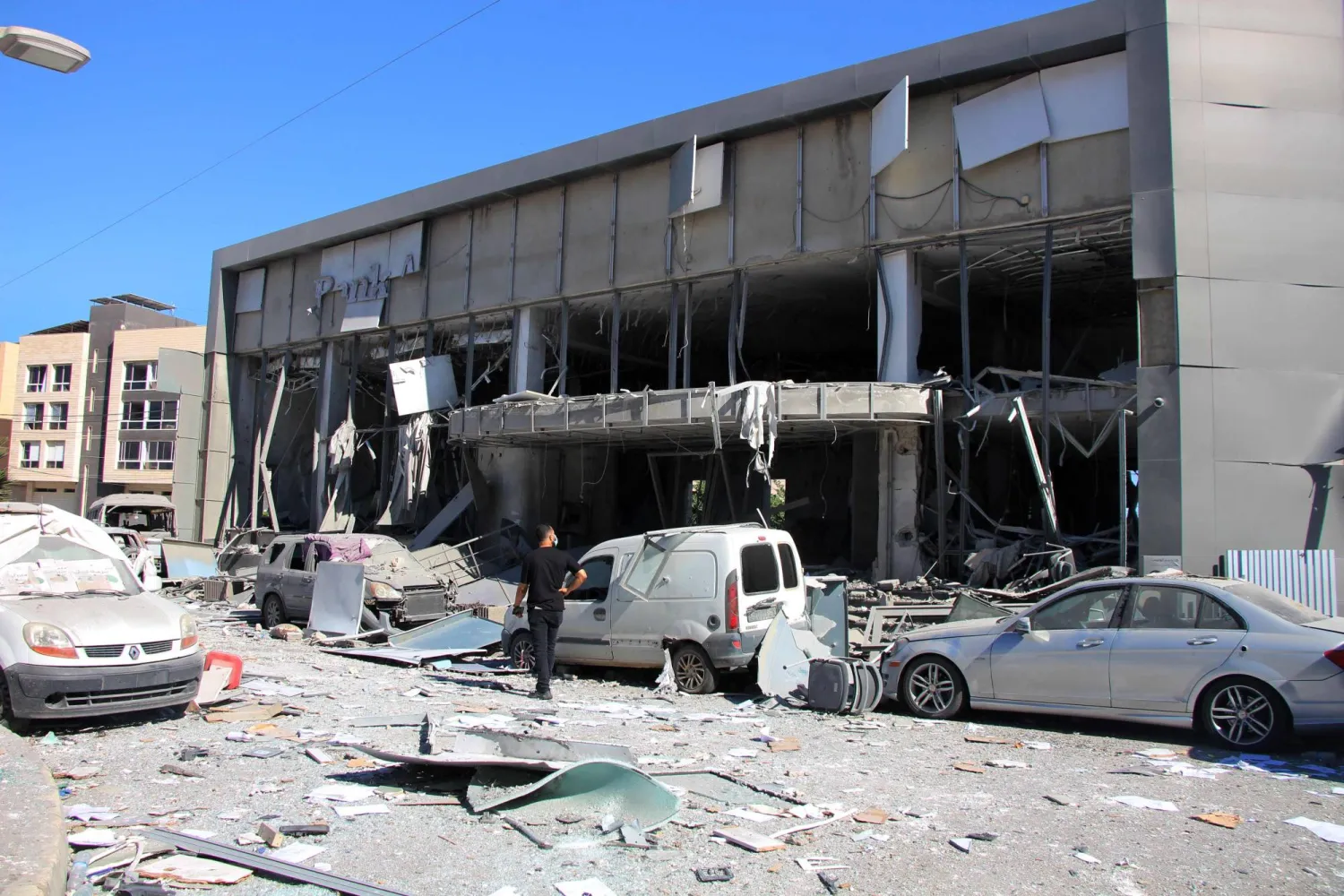
UN Doubles Appeal for Lebanon Aid to Nearly $640 Mn
A man inspects the aftermath at the site of an Israeli strike that hit the previous day in the southern Lebanese coastal city of Tyre on June 5, 2026. (Photo by Kawnat HAJU / AFP)
UN Doubles Appeal for Lebanon Aid to Nearly $640 Mn
A man inspects the aftermath at the site of an Israeli strike that hit the previous day in the southern Lebanese coastal city of Tyre on June 5, 2026. (Photo by Kawnat HAJU / AFP)
The UN on Friday more than doubled its aid appeal for Lebanon as the country reels from Israel's war against Hezbollah, saying nearly $640 million was needed over six months.
"The humanitarian crisis in Lebanon is severe and deteriorating," the UN humanitarian agency OCHA said in a revised appeal for the country.
"Repeated displacements, insufficient shelter capacity and limited prospects for safe return are deepening vulnerability," it said, warning that "affected people are rapidly exhausting their coping capacities, and essential services are under increasing strain."
The UN had appealed for $308 million in March to support a massive emergency response led by Lebanon's government through to the end of May.
On Friday it said that another $331 million would be needed through the end of August.
Only $185 million had so far been received out of the initial appeal, OCHA said, adding that that amount had helped provide assistance to around 680,000 people between March 2 and May 31.
The aim now, it said, was to more than double that number to reach all of the 1.4 million people in Lebanon -- around a quarter of the population -- estimated to need humanitarian assistance in the country.
Lebanon says Israeli attacks have killed more than 3,500 people since Hezbollah drew Lebanon into the wider Middle East war on March 2, firing rockets at Israel in retaliation for US-Israeli strikes that killed Iran's supreme leader.
Nearly one million people have fled their homes while more than 1.2 million are facing acute food insecurity, Friday's appeal showed.
Price pressure was adding to the misery, with the cost of water, fuel and electricity up more than a third nationally, and as high as 70 percent in the conflict-affected areas, AFP quoted it as saying.
It also highlighted the strain that the conflict was placing on healthcare in Lebanon, with 62 hospitals and other health facilities either damaged or closed.
OCHA said nearly 450 schools were being used to shelter displaced people, driving learning loss and drop-out risks.
Abdi, Ahmed in Damascus Hoping to Complete Integration Talks Before the End of Augusthttps://english.aawsat.com/arab-world/5310830-abdi-ahmed-damascus-hoping-complete-integration-talks-end-august
President Ahmed al-Sharaa meets with SDF commander Mazloum Abdi and top SDF official Ilham Ahmed at the People's Palace in Damascus, Aug. 4, 2026. (SANA)
Abdi, Ahmed in Damascus Hoping to Complete Integration Talks Before the End of August
President Ahmed al-Sharaa meets with SDF commander Mazloum Abdi and top SDF official Ilham Ahmed at the People's Palace in Damascus, Aug. 4, 2026. (SANA)
Syrian Democratic Forces (SDF) commander Mazloum Abdi and top SDF official Ilham Ahmed held talks with Syrian government officials in Damascus on Monday as the two sides seek to complete integration measures by the end of the month.
Sources in Damascus told Asharq Al-Awsat that education was the main issue discussed at the meeting, which was held under a media blackout.
The talks came about 20 days after Abdi and Ahmed met President Ahmed al-Sharaa in Damascus. Sources said that meeting failed to produce agreement on several disputed issues despite both sides’ commitment to implementing their January 29 accord.
Abdi has recently denied that the SDF would be dissolved, saying its integration into the Syrian army would preserve its structures within new formations, including brigades in Qamishli, al-Malikiyah and Kobani, with another planned for Afrin. He also announced plans to launch a new, non-ethnic political party in Syria.
Foreign Minister Asaad al-Shaibani said on August 18 that several issues remained unresolved, including how to integrate the Women’s Protection Units and Kurdish-language education.
Kurdish officials want school curricula translated into Kurdish, while Damascus proposed offering Kurdish language as an optional subject, arguing that separate curricula could prompt similar demands from other Syrian communities.
Before traveling to Damascus, Ahmed wrote on X that education in one’s mother tongue was “a fundamental right of every people,” adding that recognizing such rights could make Syria a model of justice, stability and peace.
Al-Sharaa issued Decree No. 13 on January 16, recognizing Syrian Kurdish citizens as an “essential and integral part of the Syrian people” and their cultural and linguistic identity as part of Syria’s national identity.
Other unresolved issues include non-Syrian Kurds, Kurdish organizations and leaders who have not joined state institutions, as well as the return of displaced people and detainees and missing persons held by the SDF.
Recent reports said that discussions will also cover Kurdish appointments within state institutions following integration, including potential senior posts for figures from the Syrian Democratic Council.
Abdi said ahead of the Damascus visit that implementation of the January agreement had entered a new phase as the integration of military, security and administrative institutions progressed.
Kurdish media reported significant advances in merging civilian and service institutions, including education, health, energy, water and agriculture, while judicial integration is expected to advance in early September.
Guarantees Demanded from Israel, Hezbollah over Proposed Int’l Force in South Lebanonhttps://english.aawsat.com/arab-world/5310828-guarantees-demanded-israel-hezbollah-over-proposed-int%E2%80%99l-force-south-lebanon
A photo taken from the southern Lebanese area of Marjeyoun, shows UNIFIL forces driving towards an Israeli army position in the southern Lebanese village of Kfar Shouba on February 15, 2025. (AFP)
Guarantees Demanded from Israel, Hezbollah over Proposed Int’l Force in South Lebanon
A photo taken from the southern Lebanese area of Marjeyoun, shows UNIFIL forces driving towards an Israeli army position in the southern Lebanese village of Kfar Shouba on February 15, 2025. (AFP)
Countries being considered for a possible international mission to replace the United Nations Interim Force in Lebanon (UNIFIL), or as members in a verification mechanisms in proposed pilot zones in South Lebanon, are seeking security guarantees from both Israel and Hezbollah, Lebanese sources familiar with discussions with European countries told Asharq Al-Awsat.
Continued Israeli attacks and military violations in the South are blocking progress on both tracks, the sources said.
Lebanese President Joseph Aoun discussed the post-UNIFIL phase with Italian Prime Minister Giorgia Meloni during a visit to Rome on Friday, including Italy’s readiness to participate in a verification mechanism in the pilot zones and provide military support to the Lebanese Army.
Lebanese Army Commander Gen. Rodolphe Haykal, who headed to Rome on Sunday, is continuing those discussions, focusing on technical and military details.
Lebanese President Joseph Aoun meets with Italian Prime Minister Giorgia Meloni in Rome on Friday, Aug. 21, 2026. (Lebanese presidency on X)
Security guarantees
Military sources told Asharq Al-Awsat that Haykal’s agenda includes support for the army, preparations for the expiration of UNIFIL’s mandate at the end of this year, a proposed joint European force to replace it and a monitoring mechanism for the pilot zones.
The details are being discussed so they would be ready for implementation if political progress is made and obstacles are removed.
“Nothing is final at this point amid the Israeli escalation,” the sources said, referring to daily strikes and violations of the ceasefire agreement.
Protecting international personnel deployed in South Lebanon remains a key concern. Lebanese sources following the talks noted that countries being considered for any mission are demanding security guarantees for their personnel from both Israel and Hezbollah.
They are seeking Hezbollah’s prior approval for their participation and assurances that the party will not oppose their deployment. They also require Israel to halt attacks on Lebanese territory within their areas of operation.
“With the attacks continuing, there is no progress on any of the proposed files,” the sources underlined, adding that UNIFIL itself is struggling with the current military escalation in the South.
Israeli armored vehicles drive through the Wadi al-Slouki area, as seen from Chaqra village, in southern Lebanon, 21 August 2026. (EPA)
Italy seen as leading candidate
The proposed monitoring mechanism for the pilot zones also remains unresolved, with Israel objecting to the participation of some countries.
Italy appears the most likely candidate to secure approval from the United States, Lebanon and Israel, although no final decision has been made. Unlike France, Italy has not faced an Israeli veto, the sources remarked.
Military sources accused Israel of obstructing proposals for a verification mechanism because “it does not want anyone monitoring it,” citing human rights violations and other actions in the South that could be documented and potentially used against the Israeli military in the future.
Italy is considered the leading candidate to undertake the verification mission once political obstacles are removed, given its active role in several missions in Lebanon. Rome is also hosting US-sponsored Lebanese-Israeli negotiations.
Italy contributes 738 troops to UNIFIL, making it the mission’s largest European contingent. UNIFIL is also currently commanded by Italian Maj. Gen. Diodato Abagnara.
Italy also leads the Military Technical Committee for Lebanon (MTC4L), an international body coordinating multinational military assistance to the Lebanese Army. The Italian Bilateral Military Mission in Lebanon (MIBIL) has also provided training to the Lebanese Army since 2015.
A photograph taken from the southern Lebanese area of Marjeyoun shows smoke as it rises from torched houses in the border village of Khiam on August 24, 2026. (AFP)
Israeli operations continue
Meanwhile, the Israeli military continued to violate the ceasefire agreement in the South, carrying out major explosions in Kfar Tebnit, Yohmor al-Shaqif, Majdal Zoun and Khiam.
Israeli forces also carried out bulldozing and demolition work on the western outskirts of Mays al-Jabal, destroying a temporary school complex built and opened by the municipality after the latest war in cooperation with the Council for South Lebanon and the Jabal Amel Union of Municipalities.
Israeli troops also brought in a truck carrying explosives and began rigging several homes for demolition.
Airstrikes targeted the outskirts of Majdal Zoun in the Tyre district, Houla in the Bint Jbeil district, and areas around Deir Seryan-al-Qusayr and Dawhet Kfar Rumman in Nabatieh.
An Israeli armored force advanced toward an area between Hadatha and Haris, where bulldozers carried out operations.
Israeli forces positioned between Beaufort Castle and Kfar Tebnit, through the towns of Arnoun and Zawtar al-Sharqiyeh, opened heavy- and medium-machine-gun fire as several explosions were heard. Israeli artillery also struck the outskirts of Mayfadoun.
The escalation followed a night of airstrikes targeting Ali al-Taher hill, Dawhet Kfar Rumman and Nabatieh al-Fawqa, accompanied by intermittent artillery fire.
China, Jordan Call for Maintaining US-Iran Ceasefirehttps://english.aawsat.com/arab-world/5310550-china-jordan-call-maintaining-us-iran-ceasefire
China's President Xi Jinping, right, and King Abdullah II of Jordan shake hands after a signing ceremony at the Great Hall of the People in Beijing, Monday, Aug. 24, 2026. (Andres Martinez Casares/Pool Photo via AP)
China, Jordan Call for Maintaining US-Iran Ceasefire
China's President Xi Jinping, right, and King Abdullah II of Jordan shake hands after a signing ceremony at the Great Hall of the People in Beijing, Monday, Aug. 24, 2026. (Andres Martinez Casares/Pool Photo via AP)
China and Jordan on Monday said the ceasefire between the US and Iran should be maintained, and that the normal passage through the Strait of Hormuz should be restored, the two countries said in a jointed statement, according to China's Xinhua news agency.
Chinese President Xi Jinping met with Jordan's King Abdullah in Beijing on Monday.
China and Jordan said "a comprehensive solution capable of eliminating the root causes" of regional tensions should be reached through dialogue and negotiations.
The two also expressed "deep concern over Israel's dangerous escalatory actions in the West Bank and East Jerusalem."
China's President Xi Jinping, left, and King Abdullah II of Jordan review the honor guard during a welcoming ceremony at the Great Hall of the People in Beijing, Monday, Aug. 24, 2026. (Andres Martinez Casares/Pool Photo via AP)
Xi told King Abdullah that China values Jordan's "unique and important role in the region,” which was thrown into crisis after the United States and Israel launched strikes against Iran on February 28.
"China has always advocated for a comprehensive ceasefire (and) resolving disputes through political and diplomatic means," Xi said, according to a Chinese foreign ministry statement.
"(China) believes the sovereignty and security of regional countries including Jordan should be respected," Xi said.
The Chinese president also urged on Monday a "comprehensive, just and lasting solution to the Palestinian issue,” the foreign ministry statement said.
China supports "promoting the resumption of Israeli-Palestinian peace talks anchored on the correct direction of the 'two-state solution'," Xi said.
The two sides also signed several agreements on diplomacy, trade and supply chains, China's foreign ministry said.
لم تشترك بعد
انشئ حساباً خاصاً بك لتحصل على أخبار مخصصة لك ولتتمتع بخاصية حفظ المقالات وتتلقى نشراتنا البريدية المتنوعة