


How Did Tehran Enter the Palestinian Arena?

The Story of the Iranian Roar, from Khomeini's Storm to Sinwar's flood (Final Part)

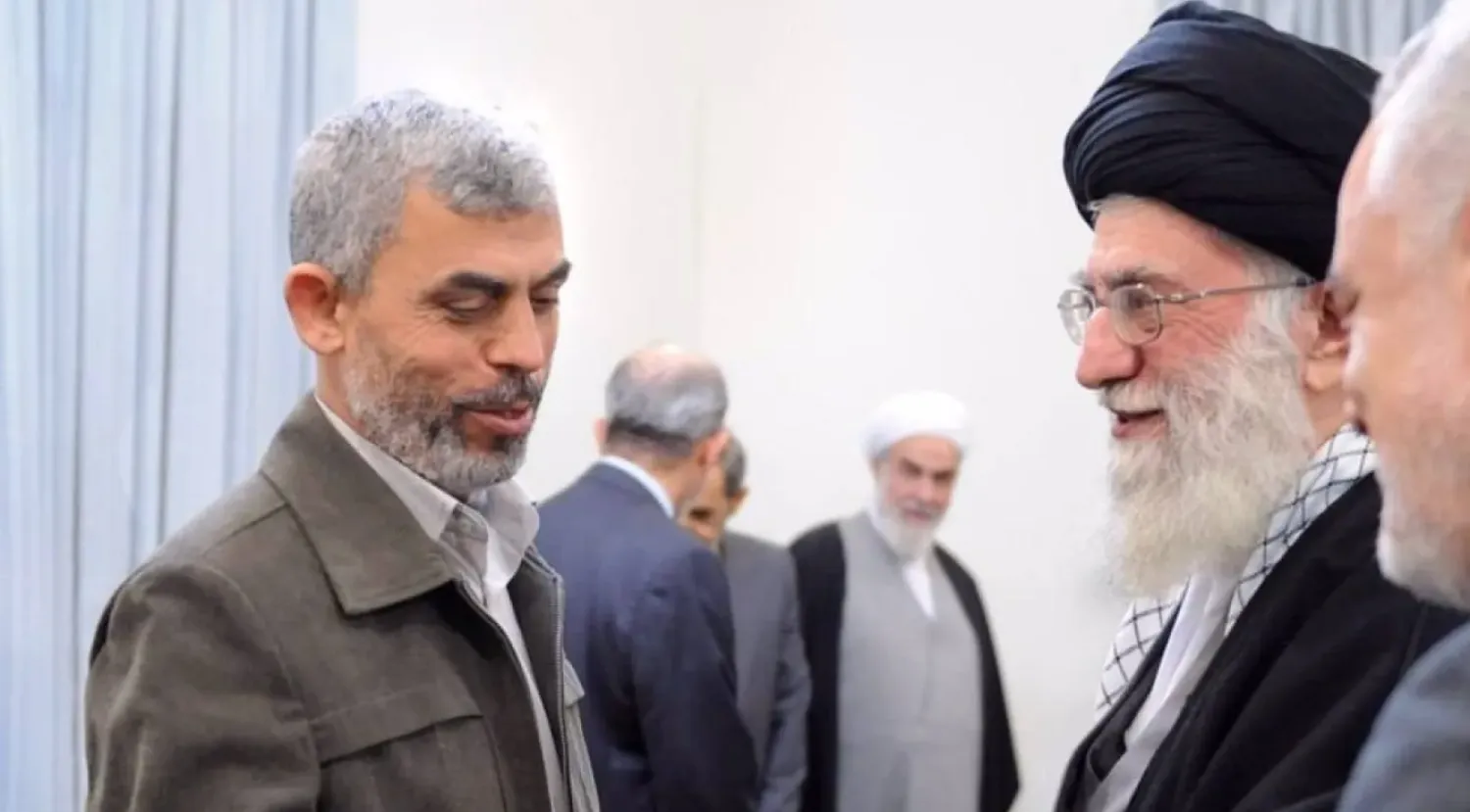
A photo released by Iran's Nour News of a previous meeting between Khamenei and Sinwar
TT

How Did Tehran Enter the Palestinian Arena?

A photo released by Iran's Nour News of a previous meeting between Khamenei and Sinwar

A compelling story is often enough to send a journalist in search of the man who carries it. The search becomes even more urgent when that man carries two. That was the case many years ago when I set out to find Anis Naccache.

As a young Lebanese activist, Naccache joined Fatah’s student battalion and later worked under the patronage of Khalil al-Wazir — better known as Abu Jihad — a member of Fatah’s Central Committee. My curiosity was piqued when I learned that Naccache had served as an aide to the famed Venezuelan militant Carlos the Jackal during the kidnapping of OPEC ministers in Vienna on December 21, 1975. The world had never witnessed an operation of that kind.

Carlos became an international celebrity, much to the annoyance of the man who had dispatched him on the mission — Wadie Haddad, the head of external operations for the Popular Front for the Liberation of Palestine. I suspected that speaking with Naccache might also open a path to Carlos himself. It did. But Vienna was only part of Naccache’s story.

When anti-Shah demonstrations erupted in Iran in 1978, Naccache obtained Abu Jihad’s permission to train Iranian opponents of the Shah in camps operated by Fatah in Lebanon. He would later go further. In an interview I conducted with him, he claimed that the idea of creating the Islamic Revolutionary Guard Corps (IRGC) was born during a meeting in a Beirut apartment attended by a handful of individuals. The idea was later conveyed to the leaders of the Iranian Revolution, who embraced it on the principle that regular armies could not be trusted.

After the revolution’s victory, Naccache traveled to Tehran.

One day, in a small gathering, participants discussed the danger posed by Shapour Bakhtiar, the Shah’s last prime minister, who was living in exile. Some feared that enemies of the revolution might rally around him to destabilize, or even overthrow the new regime.

 

Former Iranian Prime Minister Shapour Bakhtiar in Paris the day after an assassination attempt against him in 1980 (AFP)

According to Naccache, the idea of eliminating Bakhtiar was raised. He revealed that a revolutionary court had sentenced Bakhtiar to death and that Ayatollah Ruhollah Khomeini had approved the sentence without publicly announcing it, effectively transforming it into something akin to a fatwa authorizing his killing.

Bakhtiar was living in France under heavy protection. Tehran had not yet developed teams capable of conducting foreign operations. Naccache said he volunteered for the mission with a small group. He obtained Bakhtiar’s telephone number, called claiming to be a journalist seeking an interview, and was surprised to receive an appointment. He visited the residence, conducted the interview, and studied the premises and the vulnerabilities in its security arrangements.

On July 18, 1980, Naccache and his team returned to assassinate Bakhtiar. A reinforced door prevented them from reaching their target. The operation left two policemen and a French woman dead. Naccache was wounded and arrested.

Throughout the 1980s, Iran’s demand for his release overlapped with a series of kidnappings of French nationals in Lebanon by shadowy organizations seeking to exchange them for Naccache. After ten years in prison, France eventually struck a deal and released him.

When I asked who in Iran had known about the assassination plan, he replied: “I informed Mohsen Rafighdoost, who was responsible for the Guards’ administrative staff, and Mohsen Rezaei, a member of its command.”

The Lebanese-Palestinian-Iranian overlap would emerge elsewhere. Imad Mughniyeh — known as Hajj Radwan and accused of involvement in attacks against Israelis, Americans, and Arab targets — had for a time served in Yasser Arafat’s security detail before joining Hezbollah, the centerpiece of Iran’s project in Lebanon and the wider region. Naccache told me that he had personally trained Mughniyeh at the latter’s request.

Naccache spoke with fascination and confidence about the Iranian project, and I listened carefully. He said the region would undergo profound transformations and that revolutionary Iran believed its responsibility began with “liberating the Middle East from American occupation, whether direct or disguised.”

According to him, leaders of the Revolutionary Guards believed that “the American thread” was what guaranteed the stability and survival of many regimes in the region, and that cutting that thread would transform the Middle East’s map and balance of power.

When I asked whether General Qassem Soleimani belonged to this camp, Naccache replied that he was among its leading figures and was working systematically to undermine the American presence throughout the region.

“The revolution never concealed its desire to expel America from Iran and from the region,” he said. “The first message was the seizure of the Americans in their embassy in Tehran. The second was the bombing of the Marine barracks in Beirut. Hajj Imad helped deliver other messages.”

He also argued that the program of tunnels, missiles, and drones was designed to reduce the strategic value of America’s regional allies by demonstrating that their territory was vulnerable and that alliance with Washington could not guarantee their security.

“If Israel is an American aircraft carrier,” he asked, “what remains of its prestige when every inch of it can be reached by the missiles of the Axis of Resistance?”

Naccache also maintained that Hassan Nasrallah’s personality had earned him the trust of Supreme Leader Ali Khamenei and elevated him to the role of a partner in shaping Iran’s Arab policies, particularly in countries bordering Palestine.

“Nasrallah and Soleimani,” he underlined, “are closest to the Leader’s heart.”

Perhaps the most striking thing I heard from Naccache was his prediction that “the major blow” was coming. “Sooner or later,” he said, “missiles will rain down on Israel from every direction. Many who emigrated there will regret their decision, and those doubts will open the door to the end of this entity.”

What I heard from Naccache was more explicit than what I later heard in the offices of Islamic Jihad, Hamas, or Hezbollah leaders, though it pointed in the same direction.

Ramadan Abdullah Shallah, the secretary-general of Palestinian Islamic Jihad, was equally convinced that the blow was coming. Khaled Mashaal was more cautious when discussing Iran’s role. Hassan Nasrallah, by contrast, never felt the need to conceal that Iran was Hezbollah’s principal source of weapons, funding, and strategic backing.
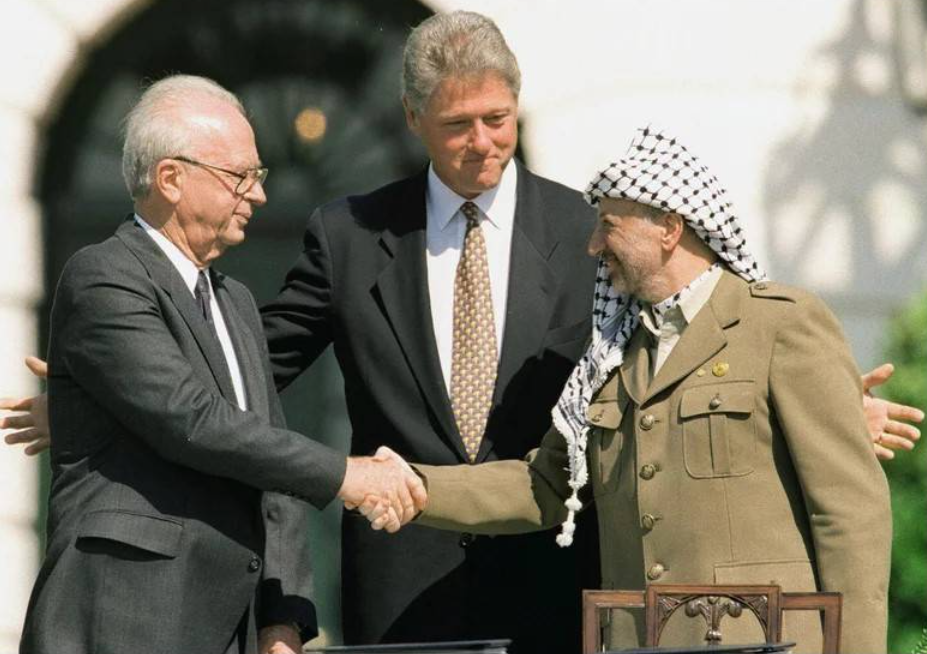
The historic handshake between Yasser Arafat and Yitzhak Rabin on the White House lawn following the signing of the Oslo Accords, under the auspices of US President Bill Clinton, in Washington in September 1993 (Getty Images)

Revolutionary Iran and the Palestinian Obsession

From the outset, Khomeini’s Iran sought influence in several regional arenas. None preoccupied it more than the Palestinian arena. Yasser Arafat, however, had no intention of placing the Palestinian cause in the custody of Iran’s revolutionary regime. Nor was he prepared to hand Palestinian decision-making to any power on earth.

To preserve the independence of that decision, he forged alliances, fought battles, and moved from one capital to another, resisting those who sought to turn Palestine into a bargaining chip in negotiations with the great powers. His long struggle with Syrian President Hafez al-Assad belonged to that category. “Palestine is a cause for me,” Arafat used to say. “For Assad, it is a card to be played.”

Arafat quickly concluded that the Iranian Revolution lacked what he described to some aides as “realism, careful calculations, and restraints.” He felt that some of its leaders were guided by illusions, particularly in their underestimation of both the United States and the Soviet Union.

Nor was he prepared to place the Palestinian revolution under the guardianship of Khomeini’s revolution. He sensed that the new Iran would soon find itself in conflict not only with its neighbors but with more distant powers as well.

Arafat’s appearance in Tehran six days after the revolution’s victory was historic, but it did not lead him to pledge allegiance to Khomeini as others did. He kept his distance.

When Iranian revolutionaries seized American hostages in the US embassy in Tehran, Arafat explored the possibility of mediation. Tehran rejected the idea. It reacted similarly when he attempted to mediate after the outbreak of the Iran-Iraq War. Iran therefore began searching for other Palestinian allies. In time, it also contributed to weakening Arafat’s authority. Then came a development larger than Khomeini’s Iran could comfortably tolerate.

On September 13, 1993, the Oslo Accords were signed. Yasser Arafat shook hands with Israeli Prime Minister Yitzhak Rabin on the White House lawn under the sponsorship of President Bill Clinton. Arafat had unleashed a second geopolitical earthquake, the first having been launched by Anwar Sadat.

His legitimacy remained intact. His image was inseparable from the first bullet fired by Fatah in the mid-1960s, an act widely credited with reviving the Palestinian cause. Iran felt threatened. It feared losing the bridge through which it hoped to reach the Sunni street and mobilize it against the “Great Satan,” not merely against Israel.

Tehran therefore intensified its investment in Palestinian Islamic Jihad and Hamas. Arafat’s calculations diverged not only from Iran’s but also from those of the so-called camp of “steadfastness and confrontation.”

The hostility directed toward him became intense.

During an interview in Damascus, Ahmed Jibril, secretary-general of the Popular Front for the Liberation of Palestine–General Command, accused Arafat of treason. I asked whether he had ever sent someone to assassinate him.

“No,” Jibril replied, “but every morning I turn on the radio hoping to hear of the birth of a Palestinian Islambouli.”

He was referring to Khalid Islambouli, the man who assassinated Egyptian President Anwar Sadat.

“I Have Lived Longer Than I Expected”

If Iran failed to draw Arafat beneath its mantle, it had greater success among Palestinian Islamists. Dr. Fathi Shiqaqi, the founder and secretary-general of Palestinian Islamic Jihad, opened the first window. The story began when Shiqaqi was a student at Zagazig University in Egypt. During the upheavals of 1978, fellow students asked him to prepare a ten-page paper on the events unfolding in Iran. The assignment captivated him.

He immersed himself in Islamic sources, Khomeini’s writings, and Muslim Brotherhood thought. He emerged convinced that the revolution in Iran was Islamic rather than sectarian.

Instead of a ten-page report, he produced a booklet titled Khomeini: The Islamic Solution and the Alternative. The booklet drew the attention of Egyptian authorities, who imprisoned him. He would later be jailed again and eventually leave Egypt secretly. He was arrested by Israeli authorities in Gaza in 1983 and again in 1986 before being deported from Palestine in August 1988.

The Israelis failed to appreciate that expelling Shiqaqi would strengthen his relationship with Iran and Hezbollah. Tehran welcomed him warmly. Khomeini received him in 1988 and pledged support for Islamic Jihad in both arms and funding. Thus Islamic Jihad became Iran’s first significant breakthrough into the Palestinian arena.

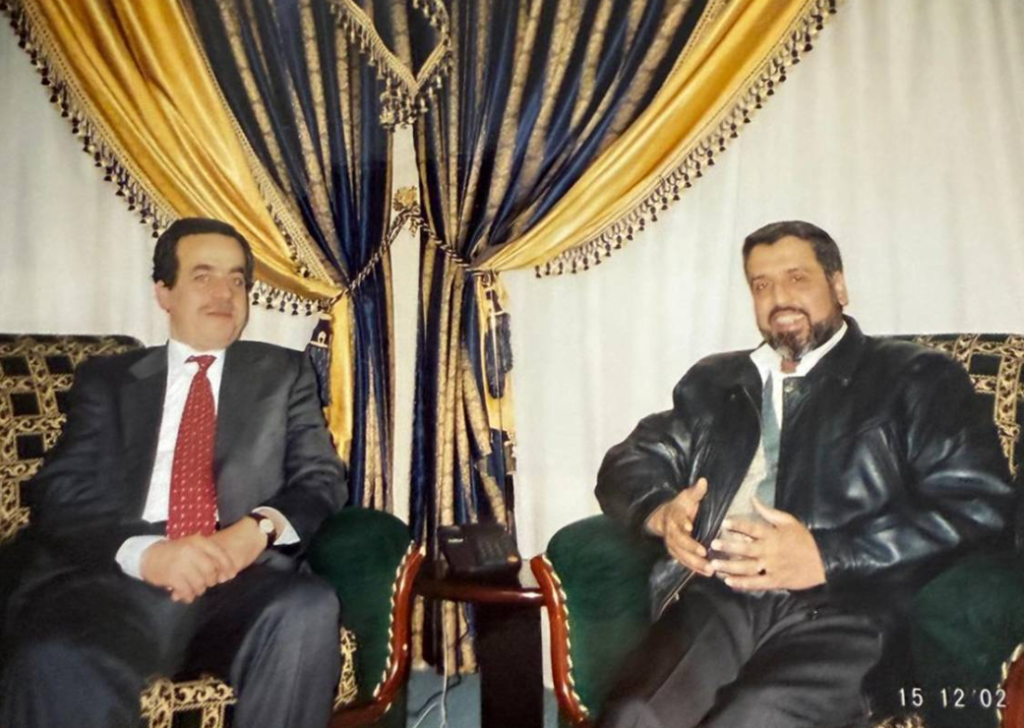
Ghassan Charbel, Editor-in-Chief of Asharq Al-Awsat, during an interview with the late Islamic Jihad leader Ramadan Shalah in December 2002 (Asharq Al-Awsat)

Following the Arafat-Rabin handshake, Shiqaqi contacted Ramadan Abdullah Shallah, who would later succeed him as leader of the movement. At the time, Shallah was living in the United States and pursuing an academic career.

“The time has come,” Shiqaqi told him. Shallah later explained to me that the phrase signaled a decision “to go further in jihadist action.” The era of suicide bombings was approaching.

On January 22, 1995, Islamic Jihad carried out a devastating double suicide attack at Beit Lid near Tel Aviv, killing 20 Israeli soldiers. Rabin vowed to punish those responsible, even if they were beyond Israel’s borders. It was widely understood that he had ordered Shiqaqi’s assassination. Only days later I visited Shiqaqi in his modest apartment in Damascus. “I am still young,” he said immediately. “It is not yet time for my memoirs. We still have much work ahead of us.”

When I asked about Rabin’s threats, he dismissed them.

“I believe I have lived longer than I expected,” he replied. “The blood of martyrs produces more fighters and escalates the confrontation. We are not concerned by such threats. In the end, as Imam Ali said, destiny is the guardian of life’s appointed term.”

The phrase stayed with me. So did the feeling that our first interview might also be our last. Israel does not easily forgive those who target its soldiers. Mossad’s reach is long, and Rabin was not a man likely to leave such a challenge unanswered.

On October 26, 1995, Mossad found Shiqaqi in Malta and killed him as he returned from Libya.

Ramadan Shallah later told me that Israeli intelligence had penetrated Libyan security and discovered the alias Shiqaqi was using: Ibrahim al-Shawish, a secret known only to Shiqaqi and Shallah.

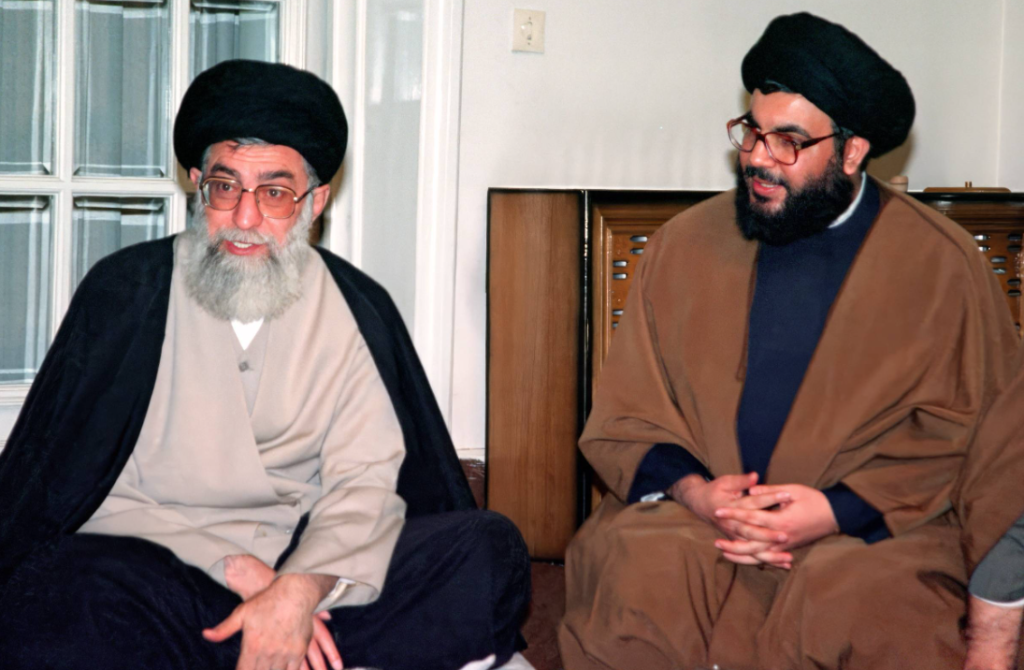
Hassan Nasrallah and Ali Khamenei (Office of the Iranian Supreme Leader)

"If He Lives, He Will Become the Khomeini of the Arabs"

In Beirut, Hezbollah Secretary-General Hassan Nasrallah learned of Shiqaqi's assassination and immediately traveled to Damascus. He met Shallah and advised the movement to select a new secretary-general, just as Hezbollah had done after Israel assassinated its secretary-general Abbas al-Musawi, and to announce the successor's name in the statement mourning the previous leader.

According to Shallah, Nasrallah argued that doing so would help preserve the morale of the resistance camp. But, he added, Nasrallah did not interfere in the selection process itself, as that was an internal Islamic Jihad matter and the movement's allies trusted its choices.

Shallah also recalled that Shiqaqi greatly admired Nasrallah: "I was visiting Beirut at the end of 1989 when Dr. Fathi, may he rest in peace, returned from a Hezbollah event at which Nasrallah had spoken. At the time, Nasrallah was not yet secretary-general but a resistance official. Dr. Fathi spoke about him with tremendous admiration. I expressed surprise at the extent of his admiration, and in the presence of several brothers he said: 'If this man lives long enough, he will become the Khomeini of the Arabs.'"

I asked Shallah which model Palestinian factions drew upon when they began carrying out suicide operations. He replied that they had been inspired by the model pioneered by the Lebanese resistance when Abu Zaynab carried out the bombing of the Marine barracks in Beirut.

Hamas and the Road to Tehran

Despite Iran’s successes with Islamic Jihad, its greatest achievement was drawing Hamas into its regional program, exploiting the movement’s need for weapons and funding. Tehran had long sought an opening. Israel inadvertently provided one.

In late 1992, after members of the Qassam Brigades kidnapped and killed an Israeli officer, Israel deported roughly 415 Palestinian activists from Gaza and the West Bank, most of them affiliated with Hamas. Among them were future leaders such as Abdel Aziz al-Rantisi and Ismail Haniyeh.

Lebanon refused to receive them, and the deportees remained for months in the border area of Marj al-Zohour, transforming their tent encampment into a center for meetings, prayers, lectures, and solidarity visits.

The Revolutionary Guards and Hezbollah quickly seized the opportunity. They supplied food, medicine, and shelter. As relationships developed, they trained some of the deportees in explosives, secure communications, and combat tactics. Iran saw in Hamas a prize far larger than Islamic Jihad because of its much broader popular base. The relationship did not begin smoothly.

Some Hamas figures remained wary of Iran because of Sunni-Shiite sensitivities. Others hesitated to accept Iranian funding for fear that it would tie the movement to a political agenda rooted in Iran’s revolutionary worldview.

Over time, those reservations faded. Iranian support became institutionalized. When Hamas seized control of Gaza in June 2007 and expelled the Palestinian Authority, Tehran and Hezbollah recognized a major opportunity.

For Soleimani and Nasrallah, an autonomous Gaza offered the possibility of integrating Hamas into the concept of the “unity of fronts” and preparing it to participate in the long-awaited “major blow.”

The relationship would face serious tests, particularly after Hamas leaders left Syria rather than support Bashar al-Assad’s campaign against the uprising. Iranian and Syrian circles attacked Khaled Mashaal, accusing him of abandoning the resistance camp.

Iran reduced its support, though it never entirely severed assistance to the Qassam Brigades. Differences also emerged over Iran’s role in Yemen and allegations of Shiite proselytization there.

Yet Soleimani and Nasrallah remained committed to preserving the Palestinian component of the Axis of Resistance.

Gradually, relations recovered. Soleimani rewarded Hamas with an extensive program of financing, weapons transfers, local arms production inside Gaza, and advanced training. In 2012, Yahya Sinwar — released from an Israeli prison the previous year — was elected to Hamas’ political leadership in Gaza. Five years later he became head of the movement in the territory.

That same year, Ismail Haniyeh succeeded Khaled Mashaal as chairman of Hamas’ Political Bureau after Mashaal had held the post for twenty-one years.

The military wing gained increasing influence, particularly through Sinwar’s close relationship with the Qassam Brigades and their commander, Mohammed Deif.

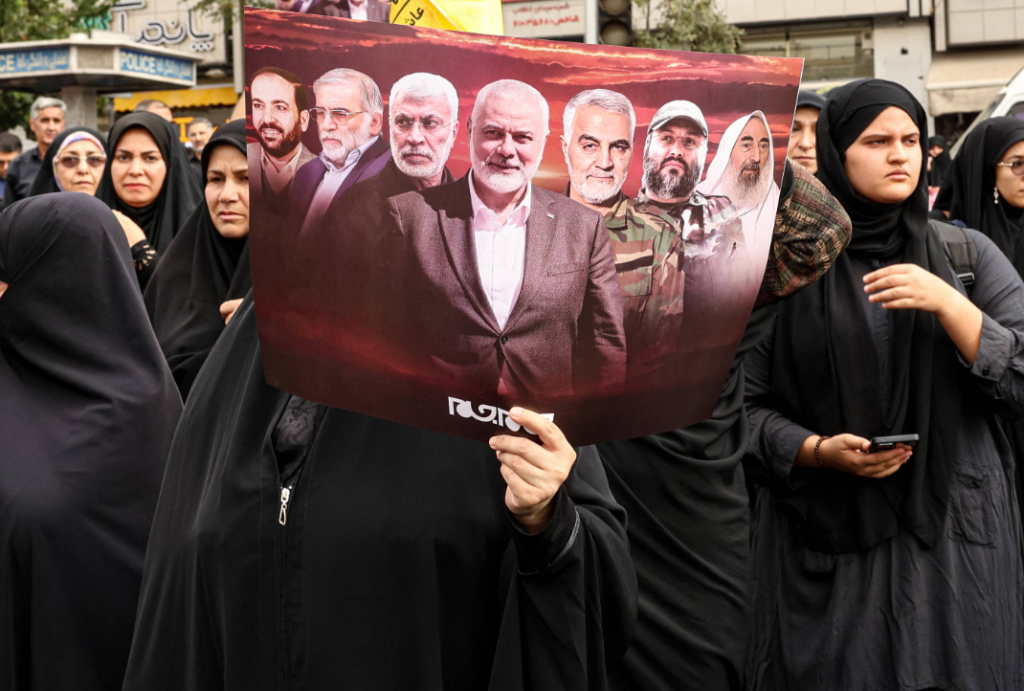
An Iranian woman holds a poster featuring Ismail Haniyeh during his funeral procession in Tehran. The poster also depicts Qassem Soleimani, Abu Mahdi al-Muhandis, Fathi Shiqaqi, Sheikh Ahmed Yassin, Imad Mughniyeh and Mohsen Fakhrizadeh (AFP).

Sinwar’s Flood

On October 7, 2023, Sinwar and Deif realized their ambition. They launched what they called “Al-Aqsa Flood.” The following day, Hezbollah found itself under pressure to respond to the message sent by the architects of the operation and joined what it termed the campaign to support Gaza.

The world was startled by Israel’s vulnerability in the opening hours, especially after it became clear that the attack had left more than a thousand Israelis dead and scores taken hostage. But after the initial shock, Israel’s war machine awakened and opened multiple fronts.

Benjamin Netanyahu viewed the operation as bearing unmistakable Iranian fingerprints. The retaliation was severe, from Hezbollah in Lebanon all the way to Iran’s Supreme Leader himself. Sinwar’s Flood altered the face of Gaza and Lebanon. It also contributed to the downfall of Bashar al-Assad’s regime.

For the first time, American strikes hit Iranian nuclear facilities. Israeli aircraft dominated the skies over Tehran, while Iranian missiles struck targets inside Israel.

The Iranian roar eventually erupted into war, one that unsettled the region, rattled the global economy, and whose consequences remain unresolved.


Floods, Drought Raise Questions over Türkiye’s Tigris, Euphrates Leverage

The Ataturk Dam on the Euphrates River sparked a Türkiye -Syria crisis in the 1990s. (Turkish State Hydraulic Works website)
TT

Floods, Drought Raise Questions over Türkiye’s Tigris, Euphrates Leverage

The Ataturk Dam on the Euphrates River sparked a Türkiye -Syria crisis in the 1990s. (Turkish State Hydraulic Works website)

Floods that swept northern and eastern Syria in early June, along with a rise in the Euphrates River after heavy rain and increased flows from Türkiye, have revived questions about the water crisis in Syria and Iraq, and whether Türkiye is using the Tigris and Euphrates as a political and security pressure card.

The crisis between Türkiye, Iraq and Syria centers on how to share the waters of the two rivers. Türkiye, the upstream state, controls the main tributaries. Its water policies and expanding dam network have sharply reduced flows, worsened drought and pushed water levels to near-catastrophic lows, especially in Iraq, which has faced its worst drought in more than 80 years.

Türkiye says the Tigris and Euphrates are transboundary rivers and that it has the right to manage them under its territorial sovereignty. Iraq and Syria want them classified as international rivers, with fair-sharing rules and international law applied under historic agreements, including the 1923 Treaty of Lausanne and joint cooperation protocols.

Mismanagement or resource depletion?

Türkiye has been accused of using water as leverage against Iraq and Syria for security reasons, mainly linked to the Kurdistan Workers Party, or PKK, and its extensions inside both countries. Those tensions later widened into Turkish air and ground operations in the two neighboring states, leaving a Turkish military presence that has long caused friction, especially between Ankara and Baghdad.

Several issues drive the crisis. The most important is Türkiye’s Southeastern Anatolia Project, designed to develop eastern and southeastern Türkiye. Under the project, Türkiye built major dams and reservoirs, including the Ataturk, Keban and Ilisu dams, to regulate irrigation and generate power. That sharply reduced the water reaching Syria and Iraq, the transit and downstream states.

The impact has been especially severe in Iraq. Water scarcity has battered agriculture, shrunk farmland, damaged the southern marshes listed as a World Heritage site and triggered repeated social and environmental crises.

Lower flows have also hit hydroelectric power generation and drinking water supplies for millions of people. In Syria, drought periods have raised the risks of pollution and disease.

Diplomatic efforts have surfaced from time to time. The countries have reached understandings, joint agreements and bilateral, and sometimes trilateral, memorandums of understanding to secure the minimum vital needs of each state. During severe droughts, Iraq and Syria have also tried to persuade Türkiye to increase flows. Türkiye insists it is a water-poor country and says Iraq’s crisis stems from local mismanagement and poor resource use, not from Turkish dams.

In Mesopotamia, water has rarely been just a natural resource. It has been a foundation of civilization, a source of conflict and, at times, a key to reconstruction and joint development. That was reflected in the Iraq-Türkiye framework agreement on water and development signed in November 2025.

What the Tigris brings together, the Euphrates drives apart

Turkish writer and water affairs researcher Bilgay Duman said the agreement, whose full terms have not been disclosed, marked an important development not only in Ankara-Baghdad relations, but also in redefining how shared resources are managed in the Middle East.

Duman said that after Türkiye, Iraq and Syria emerged as states, regulating the use of resources became a political and legal necessity. It also became a permanent source of dispute. The Euphrates turned into a three-way issue, while the Tigris became central to Turkish-Iraqi relations.

Early attempts were made to agree on water shares. The 1921 Ankara Agreement and the 1946 agreement between Türkiye and Iraq laid technical foundations for cooperation, including data sharing and flood control.

Later came the 1987 Syrian-Turkish agreement, a temporary deal to share Euphrates waters during the five-year filling of the Ataturk Dam reservoir.

Signed on July 17, 1987, the agreement committed Türkiye to provide an annual average of more than 500 cubic meters per second at the Turkish-Syrian border until a final arrangement was reached among the three Euphrates states.

On April 17, 1989, Syria and Iraq signed an agreement setting Iraq’s share at 9.106 billion cubic meters a year through the Syrian border, Syria’s share at 6.627 billion cubic meters and Türkiye’s at 15.700 billion cubic meters.

Syria registered its agreement with Türkiye at the United Nations in 1994 to secure its minimum share, and Iraq’s, of Euphrates waters. But that did not solve the problem.

Water for the PKK

As accusations grew that Türkiye was using water to pressure its neighbors, squeeze Kurds in Syria and push Iraq to act against the PKK and classify it as a terrorist organization, the 1997 UN Convention on the Law of the Non-Navigational Uses of International Watercourses set out the principles of no harm and equitable distribution.

It also required states to consider the water, economic and social needs of all riparian countries, as well as the needs of populations dependent on the watercourse and its direct and possible effects.

The convention strengthened Iraq and Syria’s legal position against Türkiye because both countries have large areas along the Tigris and Euphrates. Syria was among the first states to ratify it. Türkiye did not join, saying it harmed its interests and water rights, and voted against its adoption.

Syria, where the Euphrates irrigates more than 640,000 hectares, did not turn to international arbitration to secure its water rights from Türkiye. International law remains inconclusive in such cases, and arbitration requires both sides to agree.

Syrian support for the PKK, and its decision to allow the group’s fighters to use northern Syria as a rear base, pushed Türkiye into a harder position and led Ankara to link that support to the water dispute.

In 1993, Turkish-Syrian talks were held in Ankara to reach a final agreement on water shares. They produced nothing beyond the temporary 1987 arrangement, which was tied only to the filling of Lake Ataturk.

The same period saw Syria and Türkiye sign a joint development agreement on the Orontes River, which rises in Lebanon’s upper Bekaa Valley. Türkiye had been excluded from sharing the river with Syria and Lebanon in 1994. Giving up its share was a small price for greater benefit from the Euphrates.

Only 10% of the Orontes reached Türkiye’s Hatay province, and by then it was polluted and unusable. For decades, residents of the province bordering Syria, historically known as the Sanjak of Alexandretta, saw central government policies as unfair and blamed them for marginalizing the area and depriving it of a natural resource for political, ethnic and religious reasons.

Syrian revolution, Turkish opportunity

After the Syrian uprising against Bashar al-Assad began, Türkiye moved quickly to complete the Sanliurfa water canals project in 2012. The canals allowed water held at the Ataturk Dam to irrigate the border plains with Syria in Harran, Mardin and Ceylanpinar. The Silvan Dam was also filled in 2011. Syria took no countermeasure because Assad’s authorities were busy suppressing the uprising.

Syria’s approach to the water file showed that its main strategy against Türkiye had been to exploit internal security and the PKK threat, a strategy that ended with the Adana Agreement. Other options seemed impossible because of Türkiye’s military strength, external alliances and control of the Euphrates source.

Iraq: Drought and unrest

Iraq, which gets 60% of its water needs from Türkiye, has been the hardest hit by shortages. It faced successive severe crises across its territory, especially after the Ilisu Dam, built on the upper Tigris in Türkiye, began operating in 2020. Other dams on smaller tributaries added to the pressure. Tensions with Türkiye over water reached their peak.

Other environmental issues, including tree-cutting in northern Iraq during a Turkish military campaign against PKK militants, deepened tensions with Ankara. Pressure on the Turkish government produced little beyond a slight delay in filling Ilisu, postponing the problem rather than solving it.

In the summer of 2018, dwindling water resources and pollution caused fish to die in the Euphrates. Water shortages then became a major cause of social unrest across Iraq in the following years, culminating in the worst drought in 80 years in 2025.

The Ilisu Dam reduced Iraq’s share of Tigris waters to nearly 60% because of power generation.

In June 2025, Iraq called for water not to be used as a political pressure card and urged a joint regional vision based on fair distribution of transboundary waters. At the same time, it noted progress in negotiations and in the work of joint committees with Türkiye and Iran.

Despite this, Iraq and Türkiye kept positive relations, which expanded under Iraqi Prime Minister Mohammed Shia al-Sudani. The two sides reached understandings on security, the economy, trade, water and energy, while focusing on cooperation over the Development Road project.

Water disputes, also tied to security as in the Syrian case, became a route to cooperation after Iraq’s National Security Council declared the PKK a banned group in 2024.

Development Road runs through politics

On Nov. 2, 2025, Turkish Foreign Minister Hakan Fidan and Iraqi Foreign Minister Fuad Hussein signed a document establishing a mechanism to finance projects under a framework agreement for water cooperation. The mechanism implements the water cooperation framework agreement signed in 2024 during Turkish President Tayyip Erdogan’s visit to Iraq.

The agreement set a framework for water projects worth billions of dollars. Turkish companies will build new infrastructure to improve water-use efficiency and storage in Iraq. The projects will be financed from Iraqi oil revenues, in an attempt to turn crude exports into water security.

According to details that have emerged but have not been formally announced by either side, the first projects include water-collection dams and land-reclamation initiatives.

Ankara described the initiative as mutually beneficial for regional stability and economic cooperation.

“We in Türkiye are keen to support Iraq’s security, development and safety, and our support in this regard is absolute,” Fidan said at the signing ceremony.

Hussein said the agreement was needed to protect water security, food production and economic stability. He said Baghdad had long suffered from a weak position because of the absence of formal treaties regulating the use of Tigris and Euphrates waters.

Securing Erdogan’s presidency in 2028?

The agreement stirred doubts and fears among some Iraqi politicians and water experts. Some said it serves Türkiye more than Iraq and supports Erdogan’s effort to remain president after 2028.

Some Iraqi political forces reject the agreements with Türkiye, including those linked to the Development Road project and water cooperation. They say the deals could make Iraq dependent on Türkiye.

Allocating oil revenues to contracts with Turkish companies also raises legal and constitutional questions, along with concerns about corruption, weak transparency and possible obstacles caused by relying on one funding source, oil, which is exposed to global price swings.

Some opponents point to the absence of a final, binding legal framework agreed by both sides that defines the water share Türkiye must release to Iraq from the Tigris and Euphrates.

Although Türkiye and the PKK have begun a process to end the group’s activity, the PKK file and the presence of its members in northern Iraq, in areas beyond Baghdad’s control, could still obstruct implementation of the agreement.

The issue is not limited to Iraq’s domestic situation. It also touches the regional balance, with some parties seeing stronger Iraq-Türkiye ties as a source of pressure. That could turn Iraq into an arena for regional competition and influence struggles.

The Ottoman legacy

Duman said the agreement serves the interests of both Türkiye and Iraq. He said the water problem between the two countries did not emerge in recent decades, but dates back to the collapse of the Ottoman Empire, when the Tigris and Euphrates changed from internal rivers inside one political entity into transboundary rivers between independent states.

What marks the current phase in Turkish-Iraqi relations, he said, is the gradual shift from conflict over water shares to managing mutual benefit, and a broader rethinking of transboundary resources as a driver of integration, not a permanent source of tension.

He said the agreement’s most important new feature is the direct link between water and energy. Revenues from oil Türkiye imports from Iraq will finance water projects inside Iraq.

Turkish companies specializing in dams, modern irrigation networks, water treatment and waste reduction will carry them out. That bypasses one of Iraq’s biggest development obstacles, lack of funding, without turning to foreign loans or the conditions of international financial institutions.

In an article on the Turkish platform Fikir Turu, Duman said the model gives Türkiye a new role, not just as a state that controls water sources but as a partner in rebuilding Iraq’s infrastructure. That strengthens Türkiye’s regional influence through economic and development tools rather than hard-power tools.

The model could also expand regionally and become a practical reference for future cooperation with Syria, especially on Euphrates water management, if the right political conditions emerge.

Water diplomacy in the Levant could then shift from a source of fragility and chronic conflict into a platform for trust-building and regional integration, by linking natural resources to economic development rather than reducing them to sovereignty and conflict.

Prominent Turkish transboundary water researcher Dr. Tugba Evrim Maden told Asharq Al-Awsat that shared water resources need joint management based on technological solutions, not conflict or legal disputes.

She said the problems of downstream countries mostly stem from political instability, destroyed infrastructure, poor resource use and waste.

Türkiye is not rich in water

Contrary to common belief, Türkiye is not rich in water resources. It is not water-abundant compared with its region. It lies in a semi-arid climate zone and has less annual water per person than its neighbors, North America and water-rich northern Europe.

In water-rich countries, the annual per capita share of usable water exceeds 10,000 cubic meters. In Türkiye, it is about 1,350 cubic meters, according to Turkish Foreign Ministry data.

If the population reaches 100 million in 2030, Türkiye’s per capita water share is expected to fall to about 1,000 cubic meters. Because Türkiye’s water resources vary by region and season, they cannot meet current and expected needs everywhere. Some areas have abundant water that is not suitable for use, while densely populated industrial areas lack enough water.

Türkiye’s arid and semi-arid regions receive rain for only four or five months a year. That makes water development projects, including dams and reservoirs that store rainwater for year-round use, vital to sustainable social and economic development.

At the same time, Türkiye’s energy consumption is rising because of rapid urbanization and industrialization. Its per capita energy use is only one-sixth of the European Union average. Türkiye has no major oil or natural gas resources, so it is pursuing domestic resources to meet rising energy needs, including renewable, cheap and environmentally friendly hydropower.

The UN Convention to Combat Desertification’s report, “Global Drought Hotspots 2023-2025,” placed Türkiye among critical areas in the drought belt stretching from southern Europe to the Middle East.

The report warned that current trends could push Türkiye into severe water scarcity by 2030, with nearly 80% of its farmland potentially exposed to repeated and severe drought waves over the next decade.

As climate change intensifies, Türkiye is nearing a crisis that threatens its water security. Turkish and international experts say it is approaching the critical threshold of water poverty and could be officially classified as water-poor by 2030 if current conditions continue.

Türkiye’s per capita share of renewable water has fallen from about 1,650 cubic meters at the start of the millennium to below 1,300 cubic meters now, nearing the UN red line of 1,000 cubic meters a year.

The 19% decline in two decades reflects not only a resource crisis, but also an unsustainable consumption pattern and a water management system facing a serious structural challenge, water experts say.

Türkiye suffered severe drought in 2025, marked by scarce rain, record temperatures and dried-up lakes and water bodies. It recorded its hottest December in more than half a century, with rainfall more than 50% below seasonal averages, according to the Turkish State Meteorological Service.

Lack of response

Experts say that despite growing warnings about water poverty, the authorities’ response remains below the scale of the challenge.

Mustafa Chashmaz, a climate professor at Karadeniz Technical University, warned that evaporation caused by rising temperatures has become one of the main drivers of water loss. He said that storing water in broad-surface dams without accounting for climate conditions makes reservoirs more vulnerable to evaporation as heat waves intensify.

He called for urgent technical solutions, including deeper reservoirs less exposed to sunlight, covered basins in sensitive areas, and a ban on the use of freshwater in private swimming pools at coastal resorts, replacing it with treated saltwater.

He also said state institutions are part of the problem because public facilities consume large amounts of water without effective conservation systems or modern saving technologies.

Türkiye faces one of the most complex environmental challenges in its modern history: widening desertification, worsening drought and rising environmental stress. Recent years have brought repeated severe heat waves and forest fires, including about 3,000 fires in the summer of 2025.

Türkiye’s water crisis extends beyond its borders and affects regional water security, especially in Syria and Iraq. Türkiye controls about 90% of Euphrates waters and a large share of Tigris waters.

At the opening of water projects in October 2025, Erdogan said Türkiye was not water-rich, as some believe. Annual average rainfall does not exceed 574 millimeters, he said, far below the global average.

Experts say agriculture consumes 70% to 75% of total water withdrawals, while cities lose 20% to 35% through leaking networks. Dam efficiency is also weakened by evaporation and sediment buildup.

The Turkish government recently announced a program to restore shrinking or dried-up lakes, including Lake Marmara in western Türkiye. It also plans to invest in wastewater recycling plants for irrigation, agriculture and industry, and to build new desalination plants in areas with chronic freshwater shortages, especially western Anatolia and the Mediterranean coast.

Urgent priorities include cutting urban water losses to below 15%, expanding high-efficiency irrigation systems to save up to 30% of agricultural consumption, reducing evaporation by improving reservoir design and expanding underground storage, raising treated-water reuse to 20% of urban demand, adjusting water tariffs, shifting to less water-intensive crops and adopting mandatory drought management plans.


Sudan’s Muslim Brotherhood at a Crossroads

Ali Ahmed Karti, Secretary General of the Sudanese Islamic Movement. (Facebook)
TT

Sudan’s Muslim Brotherhood at a Crossroads

Ali Ahmed Karti, Secretary General of the Sudanese Islamic Movement. (Facebook)

Sudan is passing through an exceptionally complex phase as the war enters its fourth year and military and political alliances continue to shift at a rapid pace. With factions that have defected from the Rapid Support Forces (RSF) joining the Sudanese Armed Forces, alongside the Joint Forces of Darfur’s armed movements, the Sudan Shield Forces, and formations linked to the Islamist movement, a new balance of power is gradually emerging within the anti-RSF camp.

This evolving landscape reflects a temporary convergence of interests among actors that differ sharply in their backgrounds, objectives, and visions for Sudan’s future. While confronting the RSF remains the primary factor uniting these forces, underlying political and military differences raise serious questions about the durability of their alliance.

Sudan’s history suggests that wartime coalitions do not necessarily evolve into stable partnerships in peacetime. Instead, they often become arenas for new struggles over influence, power, and postwar arrangements. Understanding the emerging balance of forces is therefore crucial to assessing whether cooperation or confrontation will define the next phase.

In recent months, the Sudanese army has become the principal military umbrella under which a range of disparate groups operate.

The Joint Forces drawn from Darfur’s armed movements bring battlefield experience and significant combat capability. The Sudan Shield Forces have emerged as a growing tribal and military force, while former RSF members are seeking to secure a place within the new order.

Necessary alliance

This configuration has created what amounts to an “alliance of necessity.” Its members are united by a common objective — defeating the RSF — but not by a shared political project. Each faction has its own calculations regarding future power-sharing arrangements and influence.

Within this context, a central question concerns the place of Sudan’s Islamist movement in the postwar landscape.

For decades, Islamists constituted one of the most influential forces within the Sudanese state through their political, organizational, and security networks. Today, however, they no longer monopolize the instruments of power.

Many of the groups that have risen during the conflict do not subscribe to the Islamist project. Some also carry a long history of political rivalry with Islamists dating back to the era of the National Salvation regime led by ousted former President Omar al-Bashir.

This has produced a striking paradox: the broader the coalition supporting the army becomes, the smaller the Islamists’ relative weight within it. They are no longer the sole source of political backing, military support, or social mobilization. Instead, they have become one actor among several competing centers of influence, each pursuing its own interests.

Sudanese army soldiers parade in the streets of eastern Sudan's city of Gedaref on August 14, 2025 to mark the 71st anniversary of the formation of the Sudanese army. (AFP)

Mounting pressure

Signs are growing that the Islamist movement is facing increasing political pressure, both domestically and internationally.

Retired Maj. Gen. Abdel-Hadi Abdel-Basit, a strategic analyst close to Islamist circles, said the movement is confronting unprecedented challenges.

Calls have intensified for Islamists to be excluded from post-war arrangements and even held accountable for their role during decades of rule and the allegations associated with that period.

In recent months, several prominent Islamist figures were detained and later released, while National Congress Party leader Al-Numan Abdel Halim remains in custody.

These developments coincided with what many Islamists believe were externally driven pressures, including the US State Department’s designation of Sudan’s Islamist movement, the National Congress Party, and the Al-Baraa ibn Malik Battalion as terrorist organizations.

Regional and international actors have likewise called for Islamists to be excluded from any future political process.

Such positions have surfaced in consultations involving both the Quad mechanism — comprising Saudi Arabia, Egypt, the United Arab Emirates, and United States — and the Quintet mechanism, which includes the United Nations, the European Union, the African Union, the Arab League, and Intergovernmental Authority on Development (IGAD).

Civilian political forces, however, view the decline of Islamist influence primarily as a consequence of Sudan’s democratic transition rather than the war itself.

Bakri Eljack, spokesman for the democratic civilian coalition Somoud (Resilience), argued that army commander Abdel Fattah al-Burhan may be able to distance himself from the Islamists, but their influence within state institutions remains significant.

Any effort to remove them would require a broad political alliance capable of managing the next phase, he explained.

Sharif Mohamed Osman, of the Sudanese Congress Party, said the Islamist project and National Congress Party rule were rejected by the people will during the December 2018 revolution.

He noted that efforts associated with prolonging the conflict have further weakened the movement, while international pressure and sanctions have deepened its political isolation.

Yet, predictions of the Islamists’ complete demise may be premature. The movement still possesses extensive organizational networks, decades of political experience, and influence within parts of the state and society.

Even so, current trends suggest that regaining the dominant position it enjoyed during the Bashir era may be more difficult than ever before.


Can Iran Maintain its Influence in Iraq?

Iraqi Prime Minister Ali al-Zaidi meets Iranian Ambassador Mohammad Kazem Al Sadeq in Baghdad. (Government media)
TT

Can Iran Maintain its Influence in Iraq?

Iraqi Prime Minister Ali al-Zaidi meets Iranian Ambassador Mohammad Kazem Al Sadeq in Baghdad. (Government media)

Iraqi politicians are closely watching what they describe as the potential “side effects” of any future US-Iran agreement and how it could reshape the balance of power inside Iraq.

Some observers argue that a deal would likely strengthen Washington’s influence while diminishing Tehran’s leverage. Others contend that Iran could emerge from the process with a renewed and possibly more durable form of dominance in Iraq over the coming months and years.

With significant ambiguity still surrounding the US-Iran memorandum of understanding - particularly regarding Tehran’s regional proxies and allied armed groups - signals from both capitals have done little to clarify Iraq’s future position within the competing spheres of influence of the two longtime adversaries.

The US Position

Despite repeated American warnings to Baghdad against bringing factions designated on the US terrorism list into government, Washington’s broader position remains unclear.

Asked by Alhurra, the US-funded Arabic-language broadcaster, whether a US-Iran agreement would affect Iraq and whether it might weaken or strengthen armed factions, Joshua Harris, the chargé d’affaires at the US Embassy in Baghdad, declined to speculate on the outcome.
Instead, he said the priority should be an Iraqi government that places the interests of its citizens first, noting that the United States approaches foreign policy by prioritizing its own national interests.

Harris added that the foundation of a mutually beneficial partnership between Washington and Baghdad depends on the Iraqi state confronting the challenge posed by militias and ensuring that weapons remain exclusively under state control. He described this as the essential benchmark that Iraq must meet in order to deepen its partnership with the United States.

A handout photo made available by the Iraqi Prime Minister's Media Office on 17 June 2026 shows Iraqi Prime Minister Ali al-Zaidi (L) meeting with US Special Presidential Envoy for Syria and Iraq Tom Barrack (R) in Baghdad, Iraq, 15 June 2026. EPA/IRAQI PRIME MINISTER'S MEDIA OFFICE

Iran Regains Momentum

At the same time, the Iranian role appears to be returning to the level seen before the war that erupted at the end of February.

Media outlets close to Tehran report that Iranian Foreign Minister Abbas Araghchi plans to visit Baghdad soon to discuss the talks held in Switzerland and preparations for the funeral procession of Iran’s former Supreme Leader Ali Khamenei.

Earlier, Tehran Mayor Alireza Zakani announced that Khamenei’s body would be transferred in early July as part of the funeral arrangements preceding burial ceremonies.

Even amid uncertainty surrounding those plans, some observers argue that the announcement itself underscores the extent of Iran’s influence in Iraq.

The Militias Question

Although Iran-aligned factions created security challenges through their involvement in the war on Tehran’s side, Iran’s ambassador to Iraq, Mohammad Kazem Al Sadeq, recently insisted that Iran “has not asked any party to intervene because it did not need such intervention.”

The remark suggested that Iraqi armed factions volunteered to support Iran rather than acting at Tehran’s request.

On the issue of restricting weapons to state control - a matter on which Washington has adopted a notably firm position - the Iranian ambassador said it was an internal Iraqi matter and that Tehran would respect any decision taken by the Iraqi government.

At the same time, he stressed the need to understand why armed factions wish to retain their weapons and to address what he described as their concerns and fears.

The source argued that Iran has demonstrated over the past two decades that it knows precisely what it wants from Iraq, unlike what he characterized as inconsistent American policy. He predicted that this situation would continue even after any US-Iran agreement is signed.

According to the source, who requested anonymity, Iran is likely to adopt a less visible approach after an agreement, one that avoids provoking Washington while preserving its traditional influence through allied political parties and figures.

Mourners attend the funeral of members of the Iraqi armed group Kataib Hezbollah who were killed in an airstrike that targeted a PMF headquarters near the western al‑Qaim district on the Syrian border, amid the US-Israel conflict with Iran, in Baghdad, Iraq, March 2, 2026. REUTERS/Thaier Al-Suda

The Oil Card

Opponents of Iranian influence take a different view. They believe the administration of President Donald Trump is both willing and able to curb Tehran’s reach through mounting pressure on Iran and sustained influence over decision-making in Baghdad.

These groups argue that the threat of economic sanctions alone could prompt Iraqi leaders - particularly Shiite political parties - to reconsider the risks associated with continued Iranian influence.

A key factor is Iraq’s dependence on the US-controlled financial system. Revenues from Iraqi oil sales are deposited with the US Federal Reserve before being transferred back to Iraqi banks, giving Washington a powerful source of leverage over Baghdad.
