


Houthis Use ‘Espionage’ Charges against Relief Agencies to Cripple Humanitarian Aid in Yemen

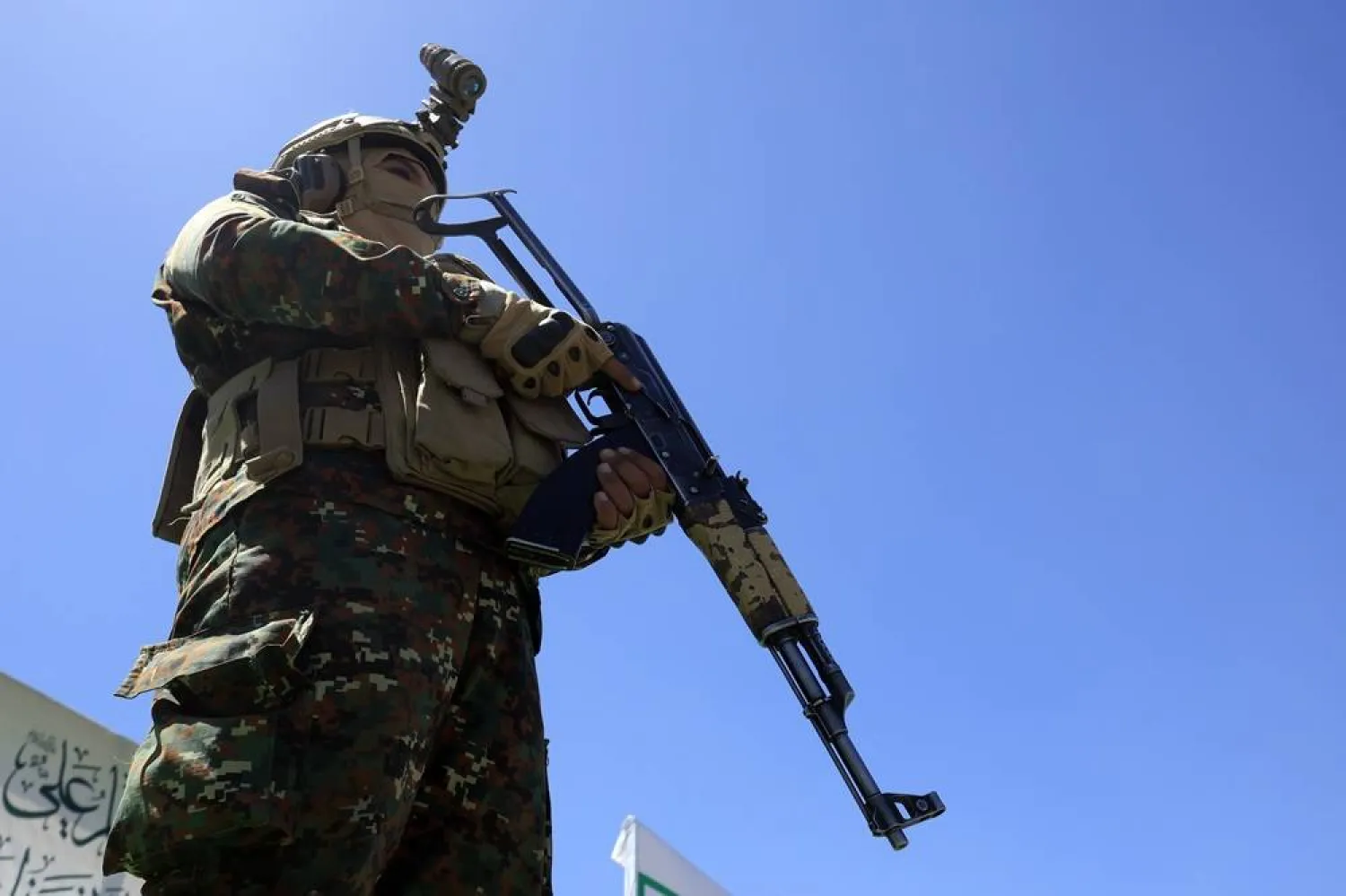
A Houthi fighter stands guard during a sectarian rally in Sanaa, Yemen, 04 June 2026. (EPA)
TT

Houthis Use ‘Espionage’ Charges against Relief Agencies to Cripple Humanitarian Aid in Yemen

A Houthi fighter stands guard during a sectarian rally in Sanaa, Yemen, 04 June 2026. (EPA)

The Iran-backed Houthi group’s campaign against United Nations personnel and aid workers has become a major factor deepening Yemen’s humanitarian crisis and hindering relief efforts even as Houthi-controlled parts of the country edge toward catastrophic levels of hunger and millions rely on humanitarian assistance to survive.

After years of war and economic collapse, humanitarian operations in Houthi-held areas face mounting challenges. Increasing restrictions and persistent interference in the work of international and local organizations have culminated in a sweeping crackdown that has seen dozens of aid workers detained on alleged security-related charges, including espionage.

For years, humanitarian aid has served as a lifeline for millions of people in northern Yemen. Yet the arrests and restrictions have disrupted large segments of relief operations, worsening food insecurity in regions already burdened by poverty, collapsing livelihoods and growing humanitarian needs.

Before the latest escalation, three million people in Houthi-controlled areas were receiving regular food aid despite a sharp decline in international funding for Yemen. However, disputes over aid-distribution mechanisms and Houthi interference in humanitarian programs had already forced many organizations to scale back their activities.

The situation worsened following raids on UN offices and several international and local organizations in Sanaa and other areas under Houthi control. In response, many agencies reduced their operations or suspended them altogether, depriving millions of vulnerable Yemenis of life-saving help.

Humanitarian workers say the restrictions have made it increasingly difficult to reach the most vulnerable communities at a time when living conditions continue to deteriorate and food insecurity is spreading.

Aid workers under pressure

International human rights organizations, including Amnesty International, Human Rights Watch and the Cairo Institute for Human Rights Studies, said that the Houthis have weaponized espionage allegations to suppress humanitarian workers and justify the detention of more than 100 aid personnel over the past two years.

According to these groups, the continued detention of humanitarian staff has affected not only the detainees and their families but also the ability of aid agencies to deliver assistance and maintain essential programs, further exacerbating the crisis.

Only a handful of detainees have been released, while dozens of UN employees and humanitarian workers are still in custody amid growing concerns about their welfare and the future of aid operations in Houthi-held territories.

Rights groups have linked the arrest campaign to worsening food insecurity in northern Yemen, citing repeated warnings from UN agencies about rising levels of acute hunger.

Humanitarian organizations have reported pockets of famine-like conditions in some areas, while millions of families face mounting difficulties accessing food and basic services, raising the risk of more severe hunger and malnutrition.

Fears for detainees

Concerns over the fate of the detained aid workers have intensified given the Houthis’ record of human rights abuses against detainees, particularly after a World Food Program employee died in Houthi custody in February 2025.

Human rights organizations said many detainees have been subjected to prolonged enforced disappearance and held without due process. Some have been denied medical care and prevented from communicating with lawyers or family members.

The groups have called on the United Nations and the international community to take a firmer stance, pressing the Houthis to immediately release all detainees, ensure access to medical care and legal representation, and lift restrictions on humanitarian organizations so assistance can reach those in need.



Attacks on Gulf States...an Obstacle to Egypt-Iran Rapprochement

Egyptian President Abdel Fattah el-Sisi during his meeting with his Iranian counterpart in Cairo in December 2024 (Egyptian Presidency)
TT

Attacks on Gulf States...an Obstacle to Egypt-Iran Rapprochement

Egyptian President Abdel Fattah el-Sisi during his meeting with his Iranian counterpart in Cairo in December 2024 (Egyptian Presidency)

After two years of steadily improving ties that appeared to be moving toward the restoration of full diplomatic relations, Egypt and Iran now seem to be facing a major setback. Egypt views Iran's current war and the subsequent attacks it carried out against Gulf states as a violation of one of its key conditions for fully normalizing relations: that Iran must not threaten the security of the Gulf or the wider region.

In a series of official statements and comments, Egypt has strongly condemned the Iranian attacks targeting Gulf Arab states, describing them as a dangerous escalation, a blatant violation of national sovereignty, and a direct threat to regional security and stability.

In its latest position, Egypt on Wednesday condemned "in the strongest terms" what it described as Iran's attacks on Jordan, Bahrain and Kuwait, saying they constituted "a flagrant violation of the sovereignty and territorial integrity of these sisterly states and a highly dangerous escalation that threatens the security and stability of the entire region," according to a Foreign Ministry statement.

Egypt stressed that "the security and stability of sisterly Arab states are an integral part of Egyptian and Arab national security," reiterating its categorical rejection of any actions or practices that undermine state sovereignty or threaten territorial integrity and security. It also underscored the importance of de-escalation and respect for international law in order to preserve regional security and stability.

For its part, Iran has been seeking to restore momentum in its relationship with Egypt. On Monday, Iran's mission in Cairo announced that Foreign Minister Abbas Araghchi had met in Tehran with Mojtaba Ferdowsi, head of Iran's Interests Section in Cairo, to discuss the course of bilateral relations.

According to the mission, Ferdowsi briefed Araghchi on the latest developments in relations between the two countries, as well as ongoing political contacts and cooperation in several fields.

The mission said Araghchi emphasized the importance of continuing bilateral consultations, adding that Egypt-Iran relations had made notable progress in recent years and that "continuous dialogue and consultation between Cairo and Tehran constitute an important pillar in supporting efforts for peace and stability in the Middle East."

Egyptian and Iranian presidents and their delegations on the sidelines of the BRICS summit in Russia in October 2024 (Egyptian Presidency)

Bare Minimum

Diplomatic relations between Egypt and Iran were severed in 1979 before being resumed 11 years later at the chargé d'affaires level.

Over the past two years, Egyptian and Iranian officials have held a series of meetings to discuss the possibility of developing relations further. Progress gained momentum in May 2023 following a presidential directive in Iran instructing the Foreign Ministry to take the necessary steps to strengthen relations with Egypt.

The period also saw meetings between the two countries' foreign ministers, as well as encounters between Egyptian President Abdel Fattah el-Sisi and both Iran's late president Ebrahim Raisi and current President Masoud Pezeshkian.

Asked about the prospects for advancing bilateral ties under current circumstances, former Egyptian Foreign Minister Mohamed El-Orabi said there was little room at present to speak of further development in Egypt-Iran relations.

"The region is experiencing turmoil that requires maintaining only the minimum level of relations necessary to manage the situation, reduce tensions and prevent further escalation," he told Asharq Al-Awsat.

He added: "The situation is not as dynamic as Tehran portrays it. There are certainly contacts and consultations, but they are aimed at addressing concerns that could further destabilize the region, not at deepening relations. Egypt rejects Iran's attacks on Gulf states and has strongly condemned them. That message has reached Iran, which is now trying to restore the level of rapprochement that existed before the current war."

File: The Egyptian Foreign Minister and his Iranian counterpart in Cairo (Egyptian Foreign Ministry)

Tarek Fahmy, professor of political science and international relations at Cairo University, said Egypt had approached Iran cautiously even before the war because of a longstanding lack of trust.

"Even when Iran responded by changing the name of Islambouli Street, named after the assassin of President Anwar Sadat, Egyptian officials stressed that this was not the basis of Egypt's demands for restoring relations with Iran," Fahmy said.

"There were broader political and security requirements related to regional security, foremost among them the security of the Gulf states and non-interference in Arab affairs."

He added that despite Iranian assurances intended to demonstrate goodwill and meet Egypt's requirements, which helped advance relations to some extent, Iran's current war and the subsequent attacks directed at Gulf states prompted Egypt to stand firmly behind Gulf security.

The Message Was Received

During two phone calls with the Iranian president in March and May, Sisi stressed Egypt's categorical rejection of any violation of Gulf states' sovereignty.

"The message has reached Iran, and Tehran has taken notice of it," Fahmy said. "It is now working to address the issue in an effort to restore the trajectory of relations with Cairo."

According to Fahmy, Iran wants Egypt to be one of the principal parties involved in any current or future negotiations with the United States, Israel or the International Atomic Energy Agency because of Egypt's credibility and its ability to maintain channels of communication with all sides.

"Tehran understands that its negotiations cannot rely on Pakistan alone," he said, adding that Iran also views Egypt as a key stabilizing force for regional security and stability.

Nevertheless, Fahmy does not expect Cairo to restore full diplomatic relations with Tehran unless Iran fulfills Egypt's conditions and requirements.

"Egypt will not take that step unless stability and balance are restored in the Gulf and the region as a whole," he said.


UN Rights Chief Sending Lebanon Mission to Collect Evidence on Abuses since War Erupted

A French peacekeeper with the UN Interim Force in Lebanon (UNIFIL) stands on a hill overlooking Kfarkela, a Lebanese border village near Israel in southern Lebanon, on August 20, 2025. (AP)
TT

UN Rights Chief Sending Lebanon Mission to Collect Evidence on Abuses since War Erupted

A French peacekeeper with the UN Interim Force in Lebanon (UNIFIL) stands on a hill overlooking Kfarkela, a Lebanese border village near Israel in southern Lebanon, on August 20, 2025. (AP)

The UN rights chief said Wednesday he would send a mission to Lebanon to collect evidence on alleged rights abuses since the war began between Hezbollah and Israel.

"I have agreed with the government of Lebanon to conduct an impartial and independent assessment mission in the country," Volker Turk told journalists.

"I will soon be deploying a team to collect information and evidence on alleged violations and abuses of international human rights law, and violations of international humanitarian law and related law committed by the parties to the armed conflict in the country since March 2."


Egypt Moves to Postpone African Summit in El Alamein Over Ebola Concerns

Egyptian Foreign Minister Badr Abdelatty during his participation in the Korea-Africa Summit earlier this month (Egyptian Ministry of Foreign Affairs).
TT

Egypt Moves to Postpone African Summit in El Alamein Over Ebola Concerns

Egyptian Foreign Minister Badr Abdelatty during his participation in the Korea-Africa Summit earlier this month (Egyptian Ministry of Foreign Affairs).

An Egyptian official source said there is a move toward postponing the African Union's Mid-Year Coordination Summit, which had been scheduled for the end of this month, due to the widespread spread of the Ebola virus in several African countries.

The source told Asharq Al-Awsat that the outbreak has prompted the Egyptian government, in coordination with the African Union, to review plans for holding the summit and its accompanying events, including the El Alamein-Africa Business Forum. The summit and related activities are expected to be rescheduled for later this year.

The African Union Commission had been preparing to hold the summit on June 27. The gathering brings together the African Union and regional economic communities with the aim of accelerating economic integration across the continent.

The Egyptian government had also been preparing to host the inaugural El Alamein-Africa Forum from June 25 to 27, with the participation of government representatives, private-sector leaders and entrepreneurs from across Africa.

According to Egyptian sources, an announcement postponing the summit is expected until the health situation related to the spread of Ebola stabilizes.

The World Health Organization has expressed growing concern over the spread of Ebola following the rise in infections in Central Africa.

The organization previously raised its assessment of the outbreak risk in the Democratic Republic of the Congo and Uganda from "high" to "very high." WHO Director-General Tedros Adhanom Ghebreyesus said that the risk level "remains high at the regional level."

The US Centers for Disease Control and Prevention (CDC) recently warned that the current outbreak identified by the World Health Organization could reach a scale similar to the record outbreak between 2014 and 2016, which claimed the lives of more than 11,000 people in West Africa, if strict containment measures are not implemented.

Egypt's Foreign Ministry previously announced the establishment of the El Alamein-Africa Forum as a permanent African business forum to be held every two years in Egypt. It said the inaugural edition, scheduled for this year, would bring together more than 20 heads of state and government, along with prominent leaders from international and regional financial institutions and key figures from Africa's business community.