

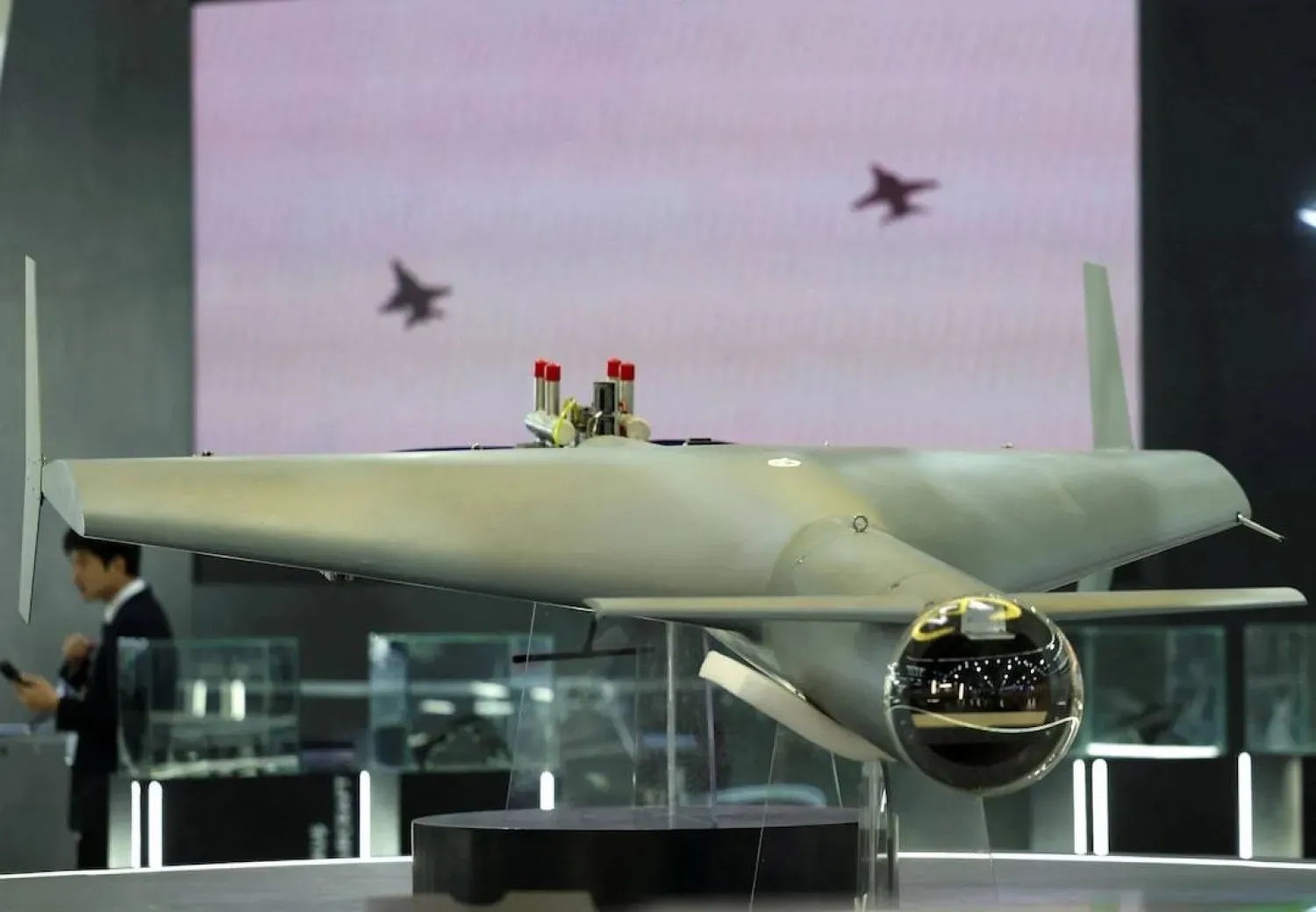

Israeli Concerns over Egypt’s Jabbar 150 Drone

The Egyptian-made Jabbar 150 drone, produced by Amstone International Group, on display at the EDEX defense exhibition on Dec. 3, 2025 (Reuters)
TT

Israeli Concerns over Egypt’s Jabbar 150 Drone

The Egyptian-made Jabbar 150 drone, produced by Amstone International Group, on display at the EDEX defense exhibition on Dec. 3, 2025 (Reuters)

Israeli media has recently raised concern over the Jabbar 150 drone, the latest Egyptian weapons system, despite having been unveiled nearly six months ago.

Israeli news platform Natziv Net reported Tuesday that the unveiling of the domestically produced drone at the Egypt Defense Expo (EDEX) in Cairo in December 2025 has become a growing source of concern within Israel’s security establishment.

According to the report, Israeli concerns center on the drone’s operational capabilities rather than the origins of its technology.

The Jabbar 150 reportedly has a range of up to 1,500 kilometers, can carry a warhead weighing about 50 kilograms, and may be powered by either a piston or jet engine, giving Egypt a long-range strike capability.

The platform also highlighted the integration of real-time targeting systems in some variants through onboard cameras, allowing operators to identify and engage targets during flight rather than relying solely on satellite navigation.

Egyptian authorities have not officially commented on the reports. Egyptian media, however, previously described the Jabbar 150 as a high-performance attack drone capable of flying at speeds of up to 200 kilometers per hour and remaining airborne for nearly 10 hours. The aircraft is also said to be the first in a family of drones that will include the Jabbar 200 and Jabbar 250.

Retired Maj. Gen. Samir Farag, an Egyptian military and strategic affairs expert, said Egypt has every right to develop its armed forces and that its advanced military capabilities are intended to protect national security.

Ahmed Fouad Anwar, a member of the Egyptian Council for Foreign Affairs and an expert in Israeli affairs, said Egypt’s military strength has steadily grown since President Abdel Fattah el-Sisi has taken office in 2014.

“That is what concerns Israel,” Anwar said. “Egypt’s priority is its own security, and it will continue to maintain credible deterrent capabilities.”

Israeli scrutiny of Egypt’s military modernization has intensified since the outbreak of the Gaza war. Israeli newspaper Maariv recently claimed that US intelligence had detected signs of expanding military cooperation between Egypt and Türkiye that could affect regional power balances.

Farag expects such rhetoric to increase ahead of Israeli elections, arguing that some political figures, including Prime Minister Benjamin Netanyahu, may seek to portray Egypt as a potential threat for domestic political gain.

Anwar believes Israeli pressure campaigns will continue, particularly as Egypt hosts Gaza ceasefire negotiations, warning that such reports risk unnecessarily heightening tensions between the two countries.


Israeli Strikes Kill Three People in Gaza, Medics Say

Palestinian casualties are transported by paramedics after arriving from Gaza at the Egyptian side of the Rafah border crossing (File/AFP).
TT

Israeli Strikes Kill Three People in Gaza, Medics Say

Palestinian casualties are transported by paramedics after arriving from Gaza at the Egyptian side of the Rafah border crossing (File/AFP).

Israeli strikes killed at least three Palestinians in the Gaza Strip on Tuesday, the territory's health officials said.

Medics said an Israeli airstrike had killed a man and wounded two children in the Mawasi area of Khan Younis in southern Gaza. The Israeli military told Reuters they had targeted a Hamas militant.

Later on Tuesday, another Israeli airstrike hit near a tent encampment housing displaced families in western Gaza City, killing one person and wounding five others, medics said, while a third airstrike in Khan Younis killed one person and wounded three others.

Israel has repeatedly carried out strikes in Gaza since a US-mediated ceasefire with Hamas was reached last October, saying it is targeting militants who threaten its forces or who took part in the October 2023 attack on Israel.

Hamas has accused Israel of violating the ceasefire. Nikolay Mladenov, US President Donald Trump's appointed Board of Peace envoy to Gaza, has said both sides have violated the agreement.

Since the ceasefire took effect eight months ago, more than 1,070 Palestinians, many of them civilians, and four Israeli soldiers have been killed in Gaza, according to figures released by the two sides. Hamas does not disclose the number of its fighters killed.

Israeli troops control more than 60% of Gaza, patrolling what Prime Minister Benjamin Netanyahu describes as a buffer zone to deter Hamas attacks. Netanyahu says Israel will not withdraw from the territory.

Israel's devastating aerial and ground bombardment of Gaza displaced nearly the entire population of 2 million people, most of whom now live in tents or damaged buildings in a narrow coastal strip of territory governed by Hamas.


Syria President Says Relying on French Help to Stop Israeli Escalations

French President Emmanuel Macron and Syrian President Ahmed al-Sharaa (AFP)
TT

Syria President Says Relying on French Help to Stop Israeli Escalations

French President Emmanuel Macron and Syrian President Ahmed al-Sharaa (AFP)

Syria's President Ahmed al-Sharaa said Tuesday that he is counting on an "active French role" to halt Israeli escalations against his country.

During a joint press conference with his French counterpart Emmanuel Macron in Damascus, Sharaa condemned "systematic Israeli attacks", saying "we are counting on an active French role to stop this escalation and ensure respect for international agreements".

Al-Sharaa also announced an agreement with Macron to install ambassadors, with the French embassy in Damascus closed since 2012 during the country's bloody civil war.

"I am pleased to announce today our agreement to begin the process of exchanging resident ambassadors between Damascus and Paris as soon as possible, signaling the return of diplomatic relations to their normal state," Sharaa said.

For his part, Macron said Syria should not let the blasts that wounded 18 people during his landmark visit to Damascus on Tuesday affect the country's stability.

In a joint press conference with Syrian counterpart Ahmed al-Sharaa, Macron called to "not let ourselves be destabilised" after the attacks, while Sharaa saluted Macron's "courage" for continuing his visit after the bombings.


Syria President Says Wants France to Be 'Primary Partner'

France's President Emmanuel Macron (L) and Syria's President Ahmed al-Sharaa attend a meeting at the People's Palace in Damascus on July 7, 2026. (Photo by Ludovic MARIN / POOL / AFP)
TT

Syria President Says Wants France to Be 'Primary Partner'

France's President Emmanuel Macron (L) and Syria's President Ahmed al-Sharaa attend a meeting at the People's Palace in Damascus on July 7, 2026. (Photo by Ludovic MARIN / POOL / AFP)

Syrian President Ahmed al-Sharaa said Tuesday that he wants France to be a primary partner for Damascus, which he said has regained its role as a transit hub after the Strait of Hormuz closure.

"After the Strait of Hormuz crisis, the world realized the value of safe and stable corridors... here the importance of Syrian geography is highlighted, which today has regained its vital role as an indispensable link in the global corridors market, and we want France to be our primary partner in this path," Sharaa said in an economic forum with his French counterpart Emmanuel Macron and representatives from both countries.
