
Amnesty Accuses Israel of ‘Ethnic Cleansing’ of West Bank Bedouins

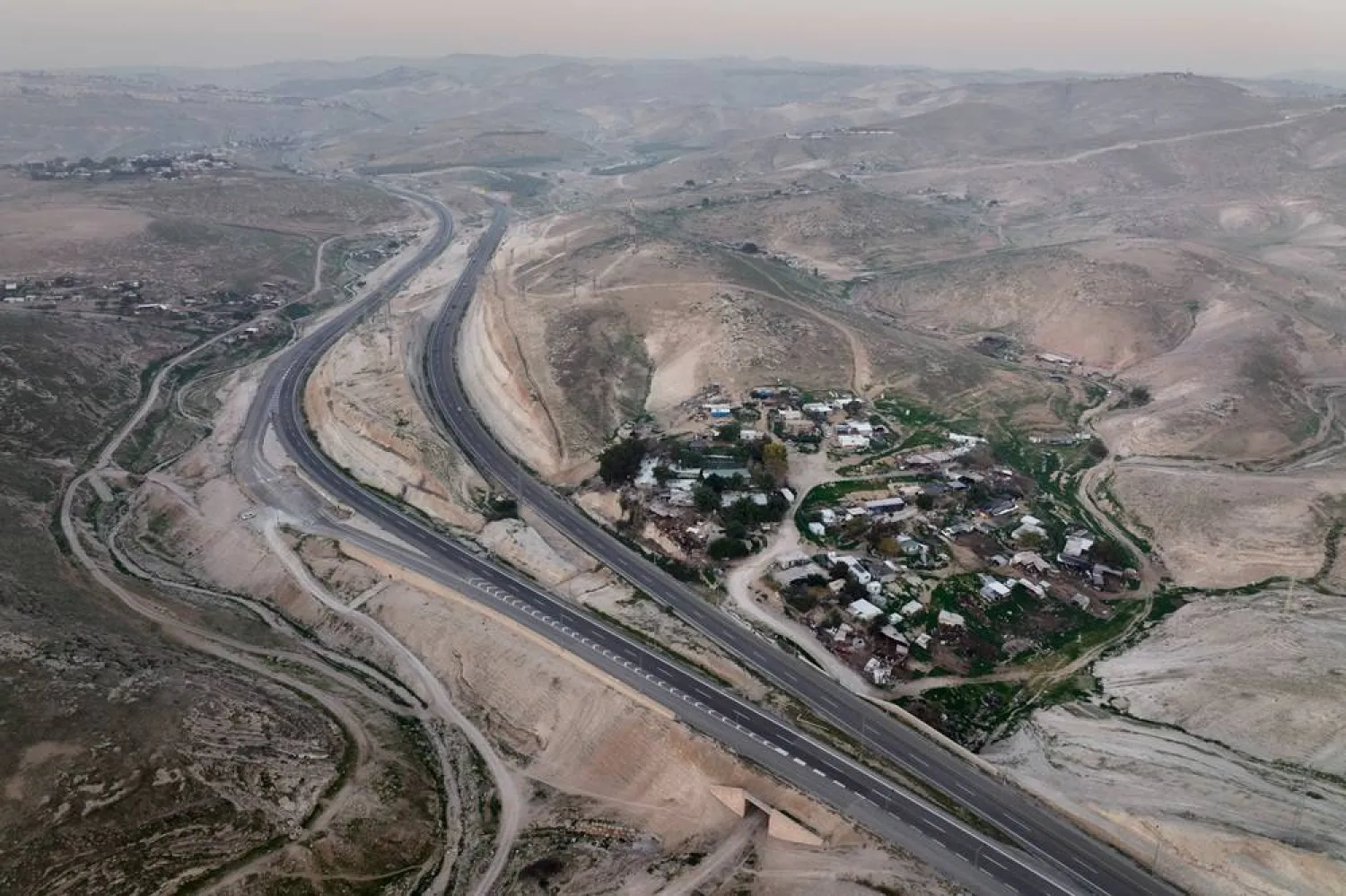
An aerial view shows the Bedouin hamlet of Khan al-Ahmar in the West Bank, Jan. 24, 2023. (AP)
TT

Amnesty Accuses Israel of ‘Ethnic Cleansing’ of West Bank Bedouins

An aerial view shows the Bedouin hamlet of Khan al-Ahmar in the West Bank, Jan. 24, 2023. (AP)

Amnesty International accused Israel on Wednesday of conducting an "ethnic cleansing" campaign against Bedouin and herding communities in the occupied West Bank, saying the measures were designed to accelerate the annexation of the Palestinian territory.

A new report by the rights group found that these rural Palestinian communities are bearing the brunt of Israeli settler violence and forced displacement.

"Israeli authorities are accelerating annexation through a state-driven campaign of ethnic cleansing targeting Palestinian Bedouin and herding communities" of the West Bank, said the report released on Wednesday.

Amnesty said its research showed that 27 Bedouin and herding communities comprising hundreds of Palestinians were forcibly displaced between 2023 and 2025 or were at risk of displacement in the West Bank's Area C, which encompasses 60 percent of the territory and is under Israeli control under the 1990s Oslo agreements.

In the report titled "Erasing anything Palestinian: Israel's ethnic cleansing of West Bank Bedouin and herding communities", Amnesty accused Prime Minister Benjamin Netanyahu's government, one of Israel's most right-wing to date, of catering to the settler movement's religious nationalist agenda.

"It has accelerated settlement expansion and land grabs, increased financial and logistical support to settlements, and it has armed settlers, thereby enabling a brutal state-sanctioned campaign of settler violence," the report said.

In an apparent effort to counter arguments by Israeli officials that settler violence is caused by bad actors in that community, Amnesty pointed to "explicit calls by Israeli officials for settlement expansion" and "measures aimed at minimizing Palestinian presence in Area C".

The "ethnic cleansing campaign is state-led, and state-sponsored, not driven by rogue settlers or so-called extremist ministers", the report concluded.

- 'Unlawful deportation' -

Far-right Finance Minister Bezalel Smotrich, who himself lives in a settlement, is a vocal proponent of West Bank's annexation and on Tuesday was banned from France for actively promoting it.

In May 2026, the UN rights office had also decried indications of "ethnic cleansing" in Gaza and the West Bank.

Amnesty pointed to Israel's legal responsibilities as an occupying power in the West Bank, and its violations of international humanitarian law.

"These violations include the war crime of unlawful deportation and transfer and the crime against humanity of deportation or forcible transfer of population," the report said.

Bedouin and herders' communities, often isolated and without security services, are particularly vulnerable to the threat of violence or displacement.

Since 2023, AFP reporters have witnessed the departure of several Bedouin communities of the West Bank under pressure from settler groups, including the community of Ras Ein al-Auja in early 2026.

"What is happening today is the complete collapse of the community as a result of the settlers' continuous and repeated attacks," Farhan Jahaleen, a Bedouin from the village, told AFP in January.

Since Netanyahu's government came to power in late 2022, it has greenlighted the creation of 102 settlements in the West Bank, according to settlement watchdog Peace Now.

Excluding east Jerusalem, more than 500,000 Israelis live in settlements in the West Bank, which Israel has occupied since 1967, among some three million Palestinians.

All Israeli settlements are considered illegal under international law.

Some settlers have engaged in arson, vandalism, theft of private property in Palestinian communities, as well as physical assaults and sometimes murder, according to rights groups.

The number of such incidents steadily increased after the start of the war in Gaza in 2023, reaching an average of six per day in the West Bank in 2026, according to the UN humanitarian agency OCHA.


Attacks on Gulf States...an Obstacle to Egypt-Iran Rapprochement

Egyptian President Abdel Fattah el-Sisi during his meeting with his Iranian counterpart in Cairo in December 2024 (Egyptian Presidency)
TT

Attacks on Gulf States...an Obstacle to Egypt-Iran Rapprochement

Egyptian President Abdel Fattah el-Sisi during his meeting with his Iranian counterpart in Cairo in December 2024 (Egyptian Presidency)

After two years of steadily improving ties that appeared to be moving toward the restoration of full diplomatic relations, Egypt and Iran now seem to be facing a major setback. Egypt views Iran's current war and the subsequent attacks it carried out against Gulf states as a violation of one of its key conditions for fully normalizing relations: that Iran must not threaten the security of the Gulf or the wider region.

In a series of official statements and comments, Egypt has strongly condemned the Iranian attacks targeting Gulf Arab states, describing them as a dangerous escalation, a blatant violation of national sovereignty, and a direct threat to regional security and stability.

In its latest position, Egypt on Wednesday condemned "in the strongest terms" what it described as Iran's attacks on Jordan, Bahrain and Kuwait, saying they constituted "a flagrant violation of the sovereignty and territorial integrity of these sisterly states and a highly dangerous escalation that threatens the security and stability of the entire region," according to a Foreign Ministry statement.

Egypt stressed that "the security and stability of sisterly Arab states are an integral part of Egyptian and Arab national security," reiterating its categorical rejection of any actions or practices that undermine state sovereignty or threaten territorial integrity and security. It also underscored the importance of de-escalation and respect for international law in order to preserve regional security and stability.

For its part, Iran has been seeking to restore momentum in its relationship with Egypt. On Monday, Iran's mission in Cairo announced that Foreign Minister Abbas Araghchi had met in Tehran with Mojtaba Ferdowsi, head of Iran's Interests Section in Cairo, to discuss the course of bilateral relations.

According to the mission, Ferdowsi briefed Araghchi on the latest developments in relations between the two countries, as well as ongoing political contacts and cooperation in several fields.

The mission said Araghchi emphasized the importance of continuing bilateral consultations, adding that Egypt-Iran relations had made notable progress in recent years and that "continuous dialogue and consultation between Cairo and Tehran constitute an important pillar in supporting efforts for peace and stability in the Middle East."

Egyptian and Iranian presidents and their delegations on the sidelines of the BRICS summit in Russia in October 2024 (Egyptian Presidency)

Bare Minimum

Diplomatic relations between Egypt and Iran were severed in 1979 before being resumed 11 years later at the chargé d'affaires level.

Over the past two years, Egyptian and Iranian officials have held a series of meetings to discuss the possibility of developing relations further. Progress gained momentum in May 2023 following a presidential directive in Iran instructing the Foreign Ministry to take the necessary steps to strengthen relations with Egypt.

The period also saw meetings between the two countries' foreign ministers, as well as encounters between Egyptian President Abdel Fattah el-Sisi and both Iran's late president Ebrahim Raisi and current President Masoud Pezeshkian.

Asked about the prospects for advancing bilateral ties under current circumstances, former Egyptian Foreign Minister Mohamed El-Orabi said there was little room at present to speak of further development in Egypt-Iran relations.

"The region is experiencing turmoil that requires maintaining only the minimum level of relations necessary to manage the situation, reduce tensions and prevent further escalation," he told Asharq Al-Awsat.

He added: "The situation is not as dynamic as Tehran portrays it. There are certainly contacts and consultations, but they are aimed at addressing concerns that could further destabilize the region, not at deepening relations. Egypt rejects Iran's attacks on Gulf states and has strongly condemned them. That message has reached Iran, which is now trying to restore the level of rapprochement that existed before the current war."

File: The Egyptian Foreign Minister and his Iranian counterpart in Cairo (Egyptian Foreign Ministry)

Tarek Fahmy, professor of political science and international relations at Cairo University, said Egypt had approached Iran cautiously even before the war because of a longstanding lack of trust.

"Even when Iran responded by changing the name of Islambouli Street, named after the assassin of President Anwar Sadat, Egyptian officials stressed that this was not the basis of Egypt's demands for restoring relations with Iran," Fahmy said.

"There were broader political and security requirements related to regional security, foremost among them the security of the Gulf states and non-interference in Arab affairs."

He added that despite Iranian assurances intended to demonstrate goodwill and meet Egypt's requirements, which helped advance relations to some extent, Iran's current war and the subsequent attacks directed at Gulf states prompted Egypt to stand firmly behind Gulf security.

The Message Was Received

During two phone calls with the Iranian president in March and May, Sisi stressed Egypt's categorical rejection of any violation of Gulf states' sovereignty.

"The message has reached Iran, and Tehran has taken notice of it," Fahmy said. "It is now working to address the issue in an effort to restore the trajectory of relations with Cairo."

According to Fahmy, Iran wants Egypt to be one of the principal parties involved in any current or future negotiations with the United States, Israel or the International Atomic Energy Agency because of Egypt's credibility and its ability to maintain channels of communication with all sides.

"Tehran understands that its negotiations cannot rely on Pakistan alone," he said, adding that Iran also views Egypt as a key stabilizing force for regional security and stability.

Nevertheless, Fahmy does not expect Cairo to restore full diplomatic relations with Tehran unless Iran fulfills Egypt's conditions and requirements.

"Egypt will not take that step unless stability and balance are restored in the Gulf and the region as a whole," he said.


UN Rights Chief Sending Lebanon Mission to Collect Evidence on Abuses since War Erupted

A French peacekeeper with the UN Interim Force in Lebanon (UNIFIL) stands on a hill overlooking Kfarkela, a Lebanese border village near Israel in southern Lebanon, on August 20, 2025. (AP)
TT

UN Rights Chief Sending Lebanon Mission to Collect Evidence on Abuses since War Erupted

A French peacekeeper with the UN Interim Force in Lebanon (UNIFIL) stands on a hill overlooking Kfarkela, a Lebanese border village near Israel in southern Lebanon, on August 20, 2025. (AP)

The UN rights chief said Wednesday he would send a mission to Lebanon to collect evidence on alleged rights abuses since the war began between Hezbollah and Israel.

"I have agreed with the government of Lebanon to conduct an impartial and independent assessment mission in the country," Volker Turk told journalists.

"I will soon be deploying a team to collect information and evidence on alleged violations and abuses of international human rights law, and violations of international humanitarian law and related law committed by the parties to the armed conflict in the country since March 2."


Egypt Moves to Postpone African Summit in El Alamein Over Ebola Concerns

Egyptian Foreign Minister Badr Abdelatty during his participation in the Korea-Africa Summit earlier this month (Egyptian Ministry of Foreign Affairs).
TT

Egypt Moves to Postpone African Summit in El Alamein Over Ebola Concerns

Egyptian Foreign Minister Badr Abdelatty during his participation in the Korea-Africa Summit earlier this month (Egyptian Ministry of Foreign Affairs).

An Egyptian official source said there is a move toward postponing the African Union's Mid-Year Coordination Summit, which had been scheduled for the end of this month, due to the widespread spread of the Ebola virus in several African countries.

The source told Asharq Al-Awsat that the outbreak has prompted the Egyptian government, in coordination with the African Union, to review plans for holding the summit and its accompanying events, including the El Alamein-Africa Business Forum. The summit and related activities are expected to be rescheduled for later this year.

The African Union Commission had been preparing to hold the summit on June 27. The gathering brings together the African Union and regional economic communities with the aim of accelerating economic integration across the continent.

The Egyptian government had also been preparing to host the inaugural El Alamein-Africa Forum from June 25 to 27, with the participation of government representatives, private-sector leaders and entrepreneurs from across Africa.

According to Egyptian sources, an announcement postponing the summit is expected until the health situation related to the spread of Ebola stabilizes.

The World Health Organization has expressed growing concern over the spread of Ebola following the rise in infections in Central Africa.

The organization previously raised its assessment of the outbreak risk in the Democratic Republic of the Congo and Uganda from "high" to "very high." WHO Director-General Tedros Adhanom Ghebreyesus said that the risk level "remains high at the regional level."

The US Centers for Disease Control and Prevention (CDC) recently warned that the current outbreak identified by the World Health Organization could reach a scale similar to the record outbreak between 2014 and 2016, which claimed the lives of more than 11,000 people in West Africa, if strict containment measures are not implemented.

Egypt's Foreign Ministry previously announced the establishment of the El Alamein-Africa Forum as a permanent African business forum to be held every two years in Egypt. It said the inaugural edition, scheduled for this year, would bring together more than 20 heads of state and government, along with prominent leaders from international and regional financial institutions and key figures from Africa's business community.