


Embraer Presses Ahead with Saudi Aviation, Defense Partnerships

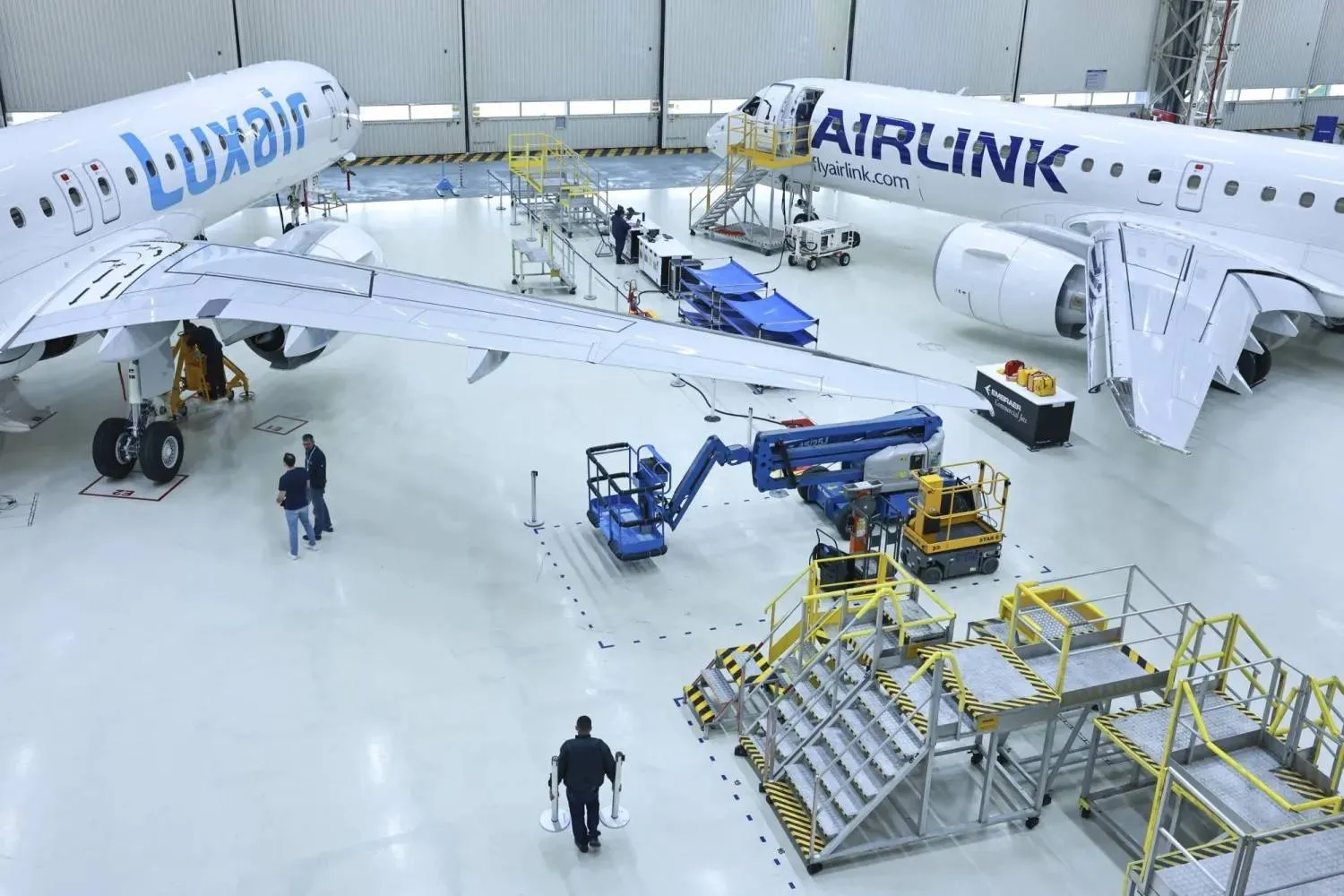
Embraer E195-E2 aircraft parked at the company’s headquarters (EPA)
TT

Embraer Presses Ahead with Saudi Aviation, Defense Partnerships

Embraer E195-E2 aircraft parked at the company’s headquarters (EPA)

Brazilian aircraft manufacturer Embraer is pressing ahead with strategic memoranda of understanding signed with Saudi Arabia in 2023, company officials said, underscoring the kingdom’s growing weight in the global aviation market.

Speaking to Asharq Al-Awsat during a tour and media briefing at Embraer’s main plant in Sao Paulo, the officials said the agreements remain active and are moving forward at a pace.

The understandings cover civil aviation, military and defense applications, and urban air mobility.

The remarks come as Saudi Arabia pushes through a sweeping expansion of its aviation and air transport sector under Vision 2030.

The program includes new national carriers, expanded regional and international air links, and efforts to localize aircraft maintenance and parts assembly.

That has made the Saudi market one of the most attractive and strategic destinations for the Brazilian aerospace group.

Embraer is the world’s third-largest commercial aircraft manufacturer after Boeing and Airbus. It has a commanding position in regional aviation through its E-Jets family, which seats between 70 and 150 passengers.

Through its electric aviation company Eve, Embraer is also developing electric vertical takeoff and landing aircraft, or eVTOLs, widely known as flying air taxis.

The field has opened the door to promising strategic partnerships with future transport projects in Saudi Arabia.

Cutting production time and tackling supply chains

At the factory briefing, held after the International Air Transport Association's annual general meeting in Rio de Janeiro, Embraer Chief Executive Francisco Gomes Neto said the company was confident it could meet its operating targets for the year.

He expects Embraer to deliver between 80 and 85 commercial aircraft in 2026, out of a total group delivery target of 255 aircraft, including executive jets and defense aircraft.

Neto said total revenue is expected to reach between $8.2 billion and $8.5 billion this year, a sharp rise from about $3.8 billion in 2020, when the company was hit hard by the COVID-19 pandemic. The group aims to surpass $10 billion in revenue by 2030, or earlier, supported by growth in future businesses, led by Eve’s electric vertical aircraft program.

He said Embraer had cut factory production time by 28% between 2021 and 2026 through operational efficiency measures. Production of the E1 now takes less than a year, down from about 18 months previously. A shift he linked to closer work with suppliers as global supply-chain bottlenecks gradually ease.

The company’s backlog has also reached a record $32.1 billion, driven by strong demand across its main business units. Commercial aviation accounts for $14.5 billion of the backlog, alongside executive aviation, defense, services and logistics solutions.

Neto said the figure does not include several major strategic deals announced recently. When purchase options and future acquisition rights agreed with global airlines are included, Embraer’s potential order book could rise to about $52 billion.

On the sidelines of the IATA conference, Neto said Eve could eventually add about $1 billion to $1.5 billion a year to group revenue once production expands and manufacturing accelerates. He expects eVTOL vehicles to receive official certification and enter service in 2028.

He also said Embraer is awaiting a major Indian government military tender in the coming months for the purchase of 60 to 80 military transport aircraft. The company sees its C-390 Millennium as a leading contender against the US-made C-130 Hercules, particularly after Embraer’s alliance with India’s Mahindra Group.

Market dominance and moving past the engine crisis

Arjan Meijer, chief executive of Embraer Commercial Aviation, said the company’s new E2 aircraft family is gaining strong traction in the market.

He said demand is rising sharply and that Embraer has captured 76% of the global market share in its category, competing against Airbus’s A220. The E2 has attracted 24 customers worldwide, with 202 aircraft delivered and about 1.25 million flight hours logged.

Meijer also said the Pratt & Whitney geared turbofan engine crisis has largely receded. Only one or two aircraft are now grounded worldwide, he said, compared with about 22% of the global fleet in March 2025. He described the technical issue as effectively behind the company.

On China, Meijer said Embraer remains optimistic about gaining ground in the country’s aviation market through a dedicated team working there daily. He said the locally certified E2 family complements Chinese-made aircraft by offering capacity between the smaller C909 and the larger C919, giving Chinese airlines more flexibility to connect cities and reduce operating losses.

He acknowledged continuing structural challenges in China since the closure of Embraer’s Harbin joint venture in 2016, but said discussions remain active.

Meijer said Embraer has no current plans to develop aircraft larger than 150 seats, despite repeated customer interest. The company will instead focus on its core segment, where it sees the strongest prospects for profitability and efficiency.



India Says Will Keep Expanding Oil Refining Capacity

File photo: Storage tanks of an oil refinery of Essar Oil, which runs India's second biggest private sector refinery, are pictured in Vadinar in the western state of Gujarat, India, October 4, 2016. REUTERS/Amit Dave/File photo
TT

India Says Will Keep Expanding Oil Refining Capacity

File photo: Storage tanks of an oil refinery of Essar Oil, which runs India's second biggest private sector refinery, are pictured in Vadinar in the western state of Gujarat, India, October 4, 2016. REUTERS/Amit Dave/File photo

India will continue to build new crude oil refineries in order to ensure supply chain security even as Western nations shut processing units, Prime Minister Narendra Modi said.

“No new refinery has come up in the US in the last five decades and capacity in Europe has also been constantly declining,” Bloomberg quoted Modi as saying on Saturday, as he inaugurated the country’s first new refinery in a decade. He said India will continue to expand capacity.

The 180,000-barrels-a-day greenfield refinery in the heart of Rajasthan’s Thar desert, which has 2.4 million tons a year of petrochemical capacity and was built at a cost of $8.3 billion, is likely to be the only new refinery commissioned globally this year, according to BloombergNEF analysts.

The facility expands India’s refining capacity at a time when much of the West is shutting plants and investment elsewhere has slowed, highlighting New Delhi’s strategy of betting that robust domestic fuel demand, slower-than-expected electric-vehicle adoption and exports of refined products will continue to justify billions of dollars in new oil-processing infrastructure.

Meanwhile, traders have sold gasoline produced by Indian refiner Nayara Energy to Russia, which is grappling with fuel shortages triggered by Ukrainian attacks on its energy infrastructure, two sources with direct knowledge of the matter said on Thursday.

Reuters reported on Wednesday that Russia had begun seaborne imports of gasoline from India, without naming the supplier.

Reuters said that at least ⁠60,000 ⁠metric tons of gasoline had been dispatched from India to Russia, citing an industry source, with another source saying that two tankers, carrying 30,000 to 40,000 tons each, had been sent.


Egypt Expects €1.5 billion from EU Assistance Package in Coming Days

The Central Bank of Egypt in downtown Cairo (Asharq Al-Awsat)
TT

Egypt Expects €1.5 billion from EU Assistance Package in Coming Days

The Central Bank of Egypt in downtown Cairo (Asharq Al-Awsat)

Egypt expects to receive €1.5 billion ($1.72 billion) from the European Union in the coming days, the first of two remaining tranches of a €5 billion macro-financial assistance package, Foreign Minister Badr Abdelatty said on Saturday.

Speaking at a press conference in Egypt's new administrative capital alongside European Commissioner for the Mediterranean Dubravka Suica, Abdelatty said the outstanding €3 billion would be disbursed in two equal tranches of €1.5 billion each, Reuters reported.

He said Cairo hoped the last payment would be transferred by the start of the autumn.

The EU has so far disbursed €2 billion of the package, having transferred an initial €1 billion tranche in January 2025 and a second €1 billion earlier this year.

The macro-financial assistance forms part of a broader €7.4 billion funding deal the EU announced in 2024, which also includes €5 billion in concessional loans.


Saudi Hospitality Boom: 50 Global Brands Race Ahead with $120 Billion in Investments

Jeddah Corniche stands out as one of the Kingdom's premier destinations for landmark tourism and hospitality developments (SPA).
TT

Saudi Hospitality Boom: 50 Global Brands Race Ahead with $120 Billion in Investments

Jeddah Corniche stands out as one of the Kingdom's premier destinations for landmark tourism and hospitality developments (SPA).

Saudi Arabia continues to cement its position as one of the fastest-growing hospitality markets in the region and the world, driven by the rapid expansion of mega tourism projects and emerging destinations. This momentum is prompting the world's leading hotel companies to accelerate their investments and launch unprecedented projects across the Kingdom.

During the first half of this year, Saudi Arabia's hospitality sector continued to attract major investments, with leading international hotel groups announcing new hotel openings and signing record expansion agreements across the Kingdom's cities and flagship developments.

This activity coincides with Saudi Arabia maintaining the largest hotel pipeline in the Middle East, driven by pioneering destinations such as NEOM, the Red Sea, Qiddiya, and Diriyah, alongside continued growth in Riyadh, Makkah, and Madinah.

An Asharq Al-Awsat review found strong alignment between the expansion plans of these hospitality brands and the objectives of Saudi Vision 2030. According to the latest Ministry of Tourism data, more than 50 global hospitality brands are expanding in the Kingdom through investments exceeding $120 billion, with plans to add more than 200,000 new hotel rooms. The private sector plays a pivotal role, contributing around 50 percent of these investments to meet growing demand and cater to the diverse preferences of travelers, from luxury hotels and coastal resorts to heritage and rural accommodations.

In this context, investors and tourism industry experts said the momentum reflects a qualitative transformation that is enhancing service standards and strengthening competitiveness, supported by an attractive investment environment and flexible regulatory frameworks that have successfully streamlined the investment journey for both foreign and domestic investors.

Global Investments

At the beginning of 2026, Marriott announced an agreement to add five new hotels in Jeddah, Makkah, and Madinah, providing more than 2,700 rooms.

Sofitel, the French luxury hospitality brand owned by Accor, also announced the official opening of the Sofitel Riyadh Hotel & Convention Center.

Knowledge Economic City also announced a DoubleTree by Hilton hotel, the first property within the city's master plan. Designed to offer a new level of comfort and connectivity in Madinah, the project comes as Red Sea Global recently officially opened the SLS Red Sea Resort on Shura Island, marking the brand's first property in the Kingdom. The resort features 150 luxury accommodations, including guestrooms, suites, and private pool villas, in addition to a full-service spa, a cinema, and a range of vibrant leisure facilities.

Meanwhile, Saudi-based Blacksand and Marriott International signed an agreement to develop 10 new hotels across the Kingdom, adding more than 1,300 hotel rooms over the next four years. The deal reflects the strong momentum in Saudi Arabia's hospitality and tourism sectors in line with the objectives of Saudi Vision 2030.

In April, the King Abdullah Financial District Development and Management Company (KAFD DMC), the entity responsible for managing and operating the district, opened W Riyadh – KAFD, marking the debut of the W Hotels brand in Saudi Arabia.

In the latest of these developments, The Ascott Limited recently announced plans to open Ascott Villas Riyadh in the fourth quarter of 2026. The project will be the company's first villa community in the Kingdom and will comprise 86 villas in Riyadh's Hittin district.

The announcement also reflects The Ascott Limited's broader expansion strategy, as the company seeks to strengthen its presence in the Saudi market as part of its plan to reach 15,000 units across the Kingdom by 2030, capitalizing on the continued growth of the tourism and business sectors in Riyadh and other major cities.

Reflecting the growing appeal of the Saudi market to leading international investors, Dar Global announced a strategic partnership with The Trump Organization to develop Trump International Tower Jeddah. The landmark luxury project, which will feature a five-star hotel and high-end branded residences, underscores the transformation of the Red Sea coastline into a magnet for some of the world's most prestigious hospitality and luxury brands.

A rendering of the new Ascott Villas Riyadh project (Asharq Al-Awsat).

Investor Confidence

Majed Al Hokair, a businessman and investor in the tourism and entertainment sector, told Asharq Al-Awsat that the Kingdom's growing success in attracting global hotel brands reflects a qualitative transformation in its tourism sector.

"The focus is no longer simply on increasing the number of hotels. It is now about building an integrated tourism ecosystem that caters to a wide range of visitor segments," he said.

Al Hokair said the entry and expansion of prestigious international brands in cities such as Riyadh, Jeddah, Makkah, and Madinah reflects investors' confidence in the future of the Saudi market. It also enhances service quality and raises the level of competition, ultimately improving the visitor experience.

He added that tourists' preferences have evolved in recent years, and the Kingdom is increasingly able to meet those changing expectations through a diverse portfolio of hospitality offerings, including luxury hotels, boutique hotels, resorts, rural accommodations, and heritage accommodations, all distinguished by high standards of quality.

National Talent

For his part, tourism investor Nasser Abdulaziz Al Ghaylan told Asharq Al-Awsat that the continued momentum in the entry and expansion of global hotel brands will position Saudi Arabia among the region's leading tourism and investment destinations in the years ahead, particularly with the rollout of major developments such as NEOM, the Red Sea, Qiddiya, and Diriyah, alongside the objectives of Saudi Vision 2030.

Al Ghaylan said the long-term success of these investments will depend on continued investment in developing Saudi talent, enhancing the visitor experience, and providing a diverse and sustainable range of tourism offerings, ensuring balanced growth that further strengthens the Kingdom's position on the global tourism map.

The Ministry of Tourism recently released a report titled Global Investments in Saudi Tourism to coincide with its participation in the Future Hospitality Summit, held in Riyadh from June 22 to 24. The report highlighted the growing interest among international investors in entering the Saudi tourism market and expanding their presence in the Kingdom.

Mövenpick Resort Al Khobar enhances the appeal of tourism destinations along the Eastern Province's coastline (SPA).

The report notes that more than 50 global hospitality brands are expanding across the Kingdom, supported by growing tourism demand and a comprehensive investment environment that has positioned Saudi Arabia as the Middle East's largest tourism market in terms of tourism development projects.

It highlights key indicators reflecting the sector's accelerating momentum, including investments exceeding $120 billion and the addition of more than 200,000 new hotel rooms by 2030, with around 50 percent of those projects expected to be financed by the private sector.

The report also highlights the investment environment underpinning the sector's growth, pointing to significant improvements in the tourism sector's regulatory framework, streamlined licensing procedures, investment incentives, digital services, and business centers that help shorten the investor journey, enhance clarity around regulatory requirements, and facilitate access to the relevant government entities.
