

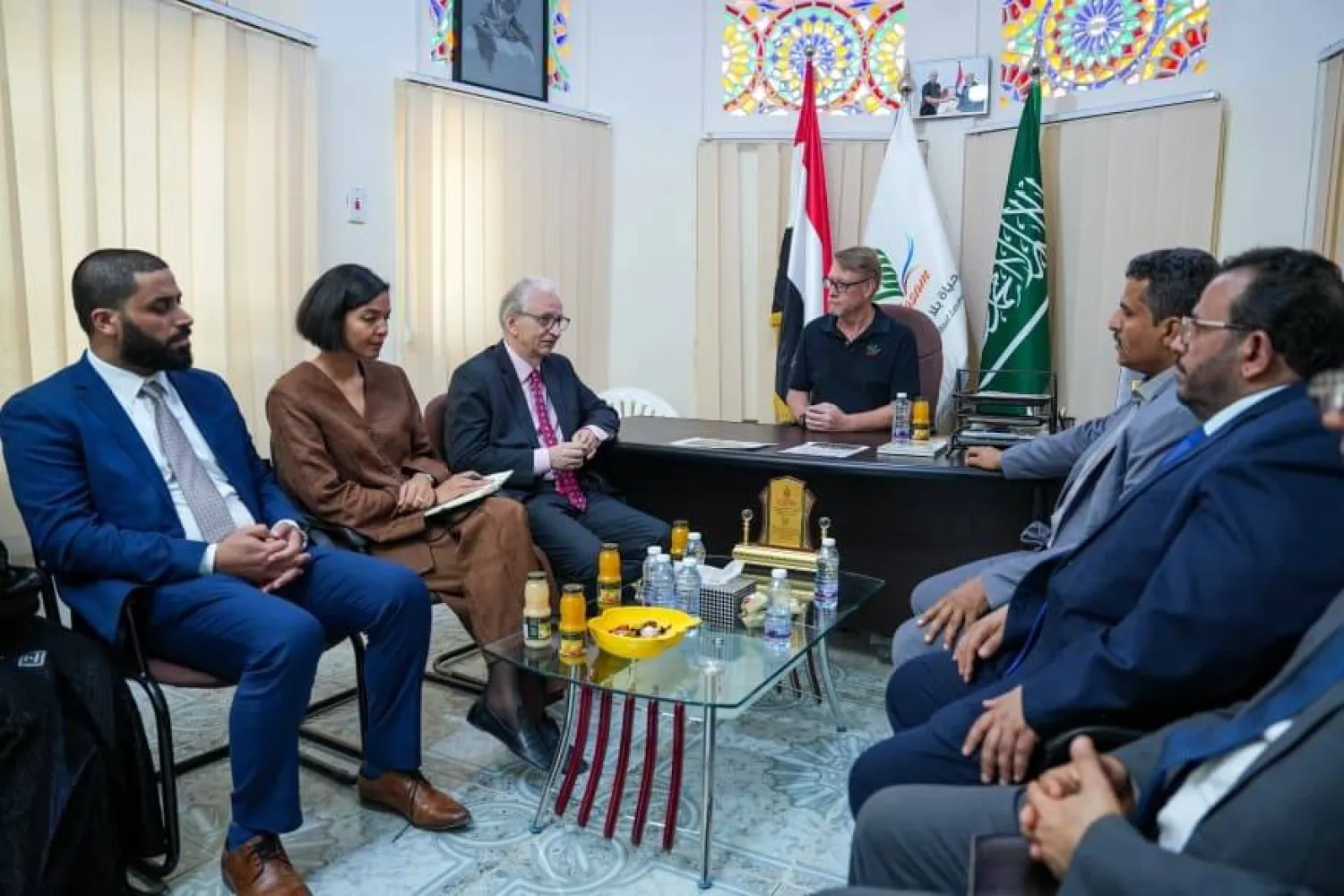

German Ambassador: MASAM Plays Vital Role in Protecting People from Mine Risks in Yemen

The German Ambassador expressed his support for the project's activities due to their paramount importance in protecting the population and mitigating the risks that threaten their lives daily. (MASAM)
TT

German Ambassador: MASAM Plays Vital Role in Protecting People from Mine Risks in Yemen

The German Ambassador expressed his support for the project's activities due to their paramount importance in protecting the population and mitigating the risks that threaten their lives daily. (MASAM)

The German Ambassador to Yemen, Thomas Schneider, has stressed the importance of the MASAM Project for Landmine Clearance in Yemen, commending its efforts to protect civilians and mitigate daily life-threatening risks.

Schneider expressed his support for the project's activities due to their paramount importance in protecting the population and mitigating the risks that threaten lives on a daily basis.

This comes as the MASAM Project has succeeded in clearing over half a million mines and various ordnance in Yemeni governorates during the past period.

The diplomat's statements came during a visit he made on Wednesday to the headquarters of the MASAM Project for Landmine Clearance in Marib, accompanied by a delegation, to learn about the humanitarian efforts undertaken by the project in clearing mine-contaminated areas and war remnants, and reducing risks threatening civilian lives.

Schneider emphasized that demining operations represent highly important humanitarian and charitable work, pointing to their vital role in protecting civilians, especially women and children, from the dangers caused by mines, unexploded ordnance, and war remnants.

He also expressed his aspiration to expand demining efforts, and to strengthen awareness programs about their dangers among the community, thereby contributing to reducing their humanitarian impact and saving lives.

He thanked the leadership of the MASAM Project for its invitation to observe its humanitarian activities up close and praised its efforts and the demining teams operating in various Yemeni regions.

During the visit, MASAM Operations Manager in Marib Sean Wells presented the German Ambassador and the accompanying delegation with a photo exhibition featuring samples of mines and unexploded ordnance cleared from several Yemeni areas, along with photos documenting the suffering of mine victims, particularly children and women, as well as the efforts exerted by the project's experts and engineers working in the field.

The diplomat and the delegation also learned about the nature of the project's work, the mechanisms for implementing its humanitarian operations, and the challenges faced by demining teams while performing their tasks of clearing land and securing local communities from the dangers of mines and war remnants.

The project is carried out by Saudi cadres and international experts, through trained Yemeni teams, to remove mines of all types and forms indiscriminately planted in Yemeni lands. It also includes training and capacity building activities for Yemenis in the field.



Makkah Agreement: Strategic Political and Defense Committee Holds First Meeting in Istanbul

Saudi Crown Prince Mohammed bin Salman, Turkish President Recep Tayyip Erdogan and Pakistani Prime Minister Shehbaz Sharif during the signing of the Makkah Joint Defense Agreement on Aug. 7 (Turkish Presidency) 
TT

Makkah Agreement: Strategic Political and Defense Committee Holds First Meeting in Istanbul

Saudi Crown Prince Mohammed bin Salman, Turkish President Recep Tayyip Erdogan and Pakistani Prime Minister Shehbaz Sharif during the signing of the Makkah Joint Defense Agreement on Aug. 7 (Turkish Presidency) 

Istanbul will host on Monday the first meeting of the Strategic Political and Defense Committee established under the Makkah Joint Defense Agreement.

Turkish Foreign Ministry sources said Sunday that the meeting would bring together the foreign and defense ministers and chiefs of general staff of the three countries.

The Saudi delegation includes Foreign Minister Prince Faisal bin Farhan, Defense Minister Prince Khalid bin Salman and Chief of General Staff Gen. Fayyadh bin Hamed Al-Ruwaili. Türkiye will be represented by Foreign Minister Hakan Fidan, Defense Minister Yasar Guler and Chief of General Staff Gen. Selcuk Bayraktaroglu.

Pakistan, for its part, will be represented by Foreign Minister Mohammad Ishaq Dar, Defense Minister Khawaja Muhammad Asif and Chief of Army Staff Field Marshal Asim Munir.

Meeting Agenda

According to the sources, the meeting aims to discuss international security issues, develop defense capabilities, enhance operational interoperability among the armed forces of the three countries and deepen cooperation in the defense industry, including joint production and research and development. It will also seek to strengthen joint counterterrorism efforts.

The sources added that the meeting is expected to establish a framework for the secretariat and other relevant mechanisms that will guide work in areas of joint activity to be identified by the Strategic Political and Defense Committee, as well as draw up a road map for future steps.

The sources told the official Anadolu Agency that the meeting would provide an opportunity to reaffirm that the Makkah Joint Defense Agreement offers significant opportunities for all countries in the region, with the aim of strengthening security, peace and stability, addressing issues in a spirit of security cooperation and prioritizing peace and prosperity over conflict.

Saudi Arabia, Türkiye and Pakistan signed the Makkah Joint Defense Agreement in Makkah on Aug. 7, marking a pivotal step toward a long-term partnership based on the principles of deterrence, coordination and defense integration among the three countries, contributing to security and stability in the region and the world.

The deal aims to strengthen security, peace, stability and prosperity in the region and the world and bolster collective deterrence. It stipulates that any attack on one of the signatory countries will be considered an attack on all parties.

It further seeks to foster a new culture of cooperation in the region, is open to all parties that respect international law and share a vision of peaceful cooperation.

US Welcome

US President Donald Trump expressed his strong support for the signing of the Makkah Joint Defense Agreement between the three countries, describing it as a “big, bold, and important first step.”

Writing on his Truth Social platform on Aug. 16, Trump said he was “very happy to see that Saudi Arabia, Türkiye and Pakistan have recently, and finally, signed the Makkah Joint Defense Agreement,” adding that it showed “how the Middle East is coming together, and how countries will finally be able to defend themselves in a more meaningful way.”


Iran Says It Downed US Drone and Attacked an Air Base in the UAE

A US MQ-9 drone (archive)
TT

Iran Says It Downed US Drone and Attacked an Air Base in the UAE

A US MQ-9 drone (archive)

Iran’s Mehr news agency reported on Monday, citing a statement by the Iranian Revolutionary Guard Corps, that Iran had shot down a US MQ-9 drone over the Strait of Hormuz using air defense missiles, causing it to crash into Gulf waters.

Iranian state TV, meanwhile, cited a statement by the Iranian army as saying that the military attacked the United Arab Emirates' Al Minhad Air Base with drones early ‌on Monday.


Report: GCC Countries Provided $6.1 Billion in Aid in 2025

Report: GCC Countries Provided $6.1 Billion in Aid in 2025
TT

Report: GCC Countries Provided $6.1 Billion in Aid in 2025

Report: GCC Countries Provided $6.1 Billion in Aid in 2025

A GCC statistical report revealed that the six Gulf Cooperation Council countries provided $6.1 billion in relief aid in 2025, accounting for around 21.7 percent of the world's total relief assistance.

In a report to mark World Humanitarian Day, which falls on August 19, the GCC Statistical Center said that "this indicator reflects the growing Gulf role in the humanitarian and relief work system at the international level."

It explained that this also comes within the framework of the importance the GCC countries place on protecting humanitarian workers and individuals who depend on aid for food, healthcare, and protection, as well as enhancing humanitarian solidarity in the face of crises.

Relief aid provided by the GCC countries is not limited to responding to immediate needs during emergencies, but rather extends to a number of vital sectors aimed at supporting the recovery of affected communities, boosting stability, and achieving sustainable development.

The report said "basic services" sectors accounted for 77.8 percent of total Gulf aid during 2025. This encompassed a wide range of fields, led by health, early recovery, services, water, governance, the environment, and reintegration of displaced persons, alongside other essential sectors, such as education and food security.

The report said that the health field accounted for 33.4 percent of aid, followed by early recovery with 23.2 percent, food security with 15.3 percent, education with 7 percent, and the contribution of other sectors amounted to 22.1 percent.

It noted that these figures "confirm the broad scope of the Gulf contribution to humanitarian work, combining urgent relief with supporting recovery, capacity building, and basic services, thereby strengthening the ability of affected communities to overcome crises and restore long-term stability."

It stressed that the GCC countries are among the most prominent international actors in the field of humanitarian and relief work, and that their development policies and rapid response to crises have contributed to consolidating their position as one of the world's largest donors of official and voluntary humanitarian aid.

The GCC Statistical Center was formed in 2011 and is based in Oman. It was established to be the official approved source for data, information, and statistics related to the GCC countries.