


UNHCR Says Fewer People Displaced Worldwide in 2025 but Long-term Refugee Crisis Persists

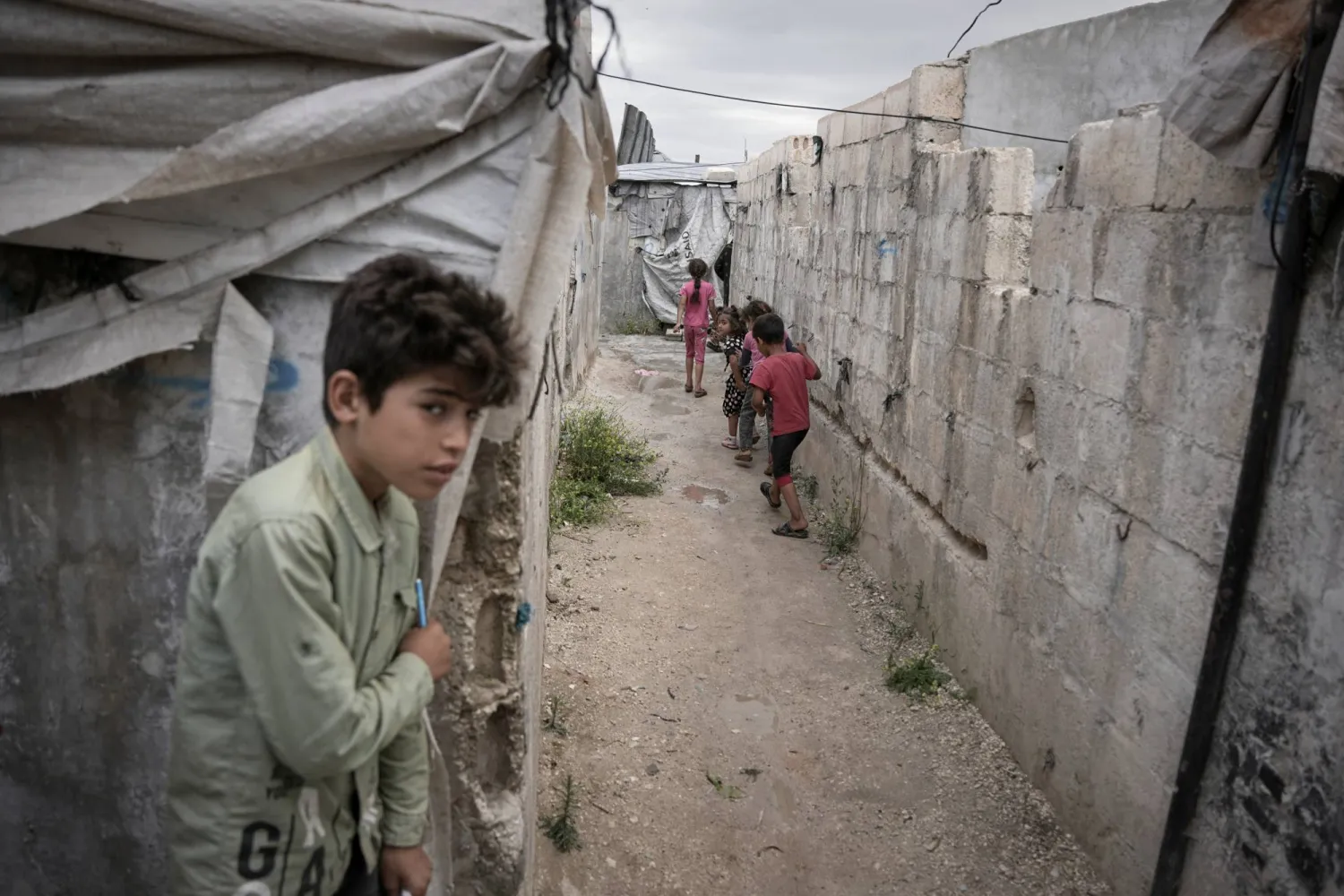
FILE - Children play through al-Karama camp, established in the early years of the Syrian conflict and built from scratch with light-brick structures covered with fabric to house internally displaced Syrians near the village of Atmeh, Idlib province, Syria, May 19, 2026. (AP Photo/Omar Albam, File)
TT

UNHCR Says Fewer People Displaced Worldwide in 2025 but Long-term Refugee Crisis Persists

FILE - Children play through al-Karama camp, established in the early years of the Syrian conflict and built from scratch with light-brick structures covered with fabric to house internally displaced Syrians near the village of Atmeh, Idlib province, Syria, May 19, 2026. (AP Photo/Omar Albam, File)

The number of people displaced worldwide by conflict and persecution fell in 2025 for the first time in a decade, but levels of refugees facing long-term displacement remain unacceptably high, a UN refugee agency report said on Thursday.

Last year, 5.4 million people fled their homes, bringing the total number of refugees or people in refugee-like situations worldwide to 41.6 million, including 6 million Palestinian refugees, UNHCR said.

At the same time, around 14.7 million refugees and internally displaced people returned home, a 50% increase on the previous year and the second-highest figure recorded since 1965, the agency found.

Most returns were to six countries: the Democratic ‌Republic of the Congo, ‌Sudan, Syria, Afghanistan, Ukraine and Myanmar, Reuters said.

However, many returned to difficult ‌conditions ⁠marked by limited access ⁠to basic services, widespread infrastructure damage and ongoing insecurity, raising concerns over the sustainability and safety of their return, UNHCR said. About 2.9 million Afghans returned in 2025, including 1.9 million refugees - five times higher than the previous year - driven mainly by stricter policies in neighboring Iran and Pakistan, with many reporting they had little choice but to leave, UNHCR found.

This sharp rise reduced the global Afghan refugee population from 5.8 million in 2024 to 3.7 million in 2025, ⁠the report said. Syria, which had been one of the world’s largest ‌displacement crises for more than a decade, saw around ‌1.3 million people return in 2025 - nearly triple the previous year - following the fall of Bashar al-Assad’s ‌government in December 2024. This reduced the global Syrian refugee population from 6 million ‌to 4.9 million by the end of 2025.

“However, many returnees face serious challenges, including insecurity, widespread destruction, weak economic conditions, limited services and jobs, and continued sporadic violence in parts of the country,” the report said. The report noted that the crisis in the Middle East has already shaped global displacement trends ‌in 2026. Around 3.2 million people have been temporarily displaced in Iran since joint US-Israeli strikes at the end of February, while ⁠about one million people ⁠have been forced from their homes in Lebanon since the start of the war on March 2, amid Israeli strikes and evacuation orders, UNHCR said.

HALVING REFUGEE NUMBERS

UNHCR says it aims to halve the number of refugees and others in protracted displacement requiring humanitarian assistance by 2035, by supporting job creation and education opportunities, particularly in low- and middle-income countries where most refugees are hosted.

Globally, 70% of refugees have been in exile for five years or more, often in countries such as Lebanon, Jordan, Türkiye and Iran.

“Asylum and protection are life-saving and not up for debate, but we cannot accept a future in which millions of refugees remain trapped for years or decades without realistic prospects of rebuilding their lives,” said UNHCR High Commissioner Barham Salih.

Part of the initiative includes promoting voluntary returns, as well as enabling refugees to access education and employment in host countries so they can financially support themselves and become less aid-dependent.



Iran Says US Strikes Render Ceasefire 'Meaningless,' Talks on Funds Mechanism Still on Track

A banner with a picture of Iran's Supreme Leader, Mojtaba Khamenei and the late senior Iranian military commander, General Qassem Soleimani, on a building in Tehran, Iran, June 11, 2026. Majid Asgaripour/WANA (West Asia News Agency) via REUTERS
TT

Iran Says US Strikes Render Ceasefire 'Meaningless,' Talks on Funds Mechanism Still on Track

A banner with a picture of Iran's Supreme Leader, Mojtaba Khamenei and the late senior Iranian military commander, General Qassem Soleimani, on a building in Tehran, Iran, June 11, 2026. Majid Asgaripour/WANA (West Asia News Agency) via REUTERS

Iran's foreign ministry condemned on Thursday the latest US strikes on the country, saying the attacks rendered the nearly two-month ceasefire "practically meaningless.”

In a statement, the ministry said "the illegal and criminal attacks perpetrated by the United States in recent hours not only constitute a flagrant violation... but also render the ceasefire practically meaningless.”

It added that the "responsibility for the extremely serious consequences of this criminal act lies with the leaders of the United States.”

Despite the foreign ministry statement, three Iranian sources told ⁠Reuters that efforts to reach a preliminary deal between Iran and the ⁠US have intensified, as they discuss a ⁠mechanism ⁠over releasing frozen Iranian funds.

The sources said Iran and the US were still exchanging ⁠messages over details ⁠of a memorandum of understanding.

The Iranian sources said a political understanding had been reached, but some issues remained to ⁠be discussed in detail, including a mechanism for the release of tens of billions of dollars of Iranian oil revenues frozen in foreign banks.

"Iran wants $6 billion to $12 billion of its frozen funds to be released to Tehran, while Washington wants to release funds in stages for ⁠humanitarian ⁠goods and rejects returning funds to Iran outright," said one of the Iranian sources.

CNN also reported, citing a ⁠diplomatic source, that talks to reach a deal are still on track after overnight negotiations.

The US and Iran traded air attacks for a second straight day on Thursday, with President Donald Trump vowing ⁠further strikes ⁠if Tehran does not immediately agree to a peace deal.

Qatari negotiators have departed Tehran following discussions on the war, a diplomat told AFP on Thursday.

"The Qatari delegation departed from Tehran this morning following talks with Iranian officials... that lasted into the early hours of this morning," the diplomat said on condition of anonymity, adding the discussions were "conducted in coordination with the United States.”

The US strikes overnight Thursday on Iran wounded at least three people at sites in Tehran province, Iranian media reported.

"Three people were injured in incidents related to the brutal US attacks in Tehran province," said head of the province's emergency services Mohammad Esmail Tavakoli, according to the Fars news agency.

The strikes were largely focused on southern Iran but the country's Revolutionary Guards said other sites near the capital were hit including in Karaj, Nazarabad and Pishva.


Pakistan Calls for US-Iran 'Negotiated Settlement' after Escalation

A woman walks past a banner bearing images of the members of Iranian national volleyball team, erected along a street at the Vanak Square in Tehran on June 10, 2026. (Photo by ATTA KENARE / AFP)
TT

Pakistan Calls for US-Iran 'Negotiated Settlement' after Escalation

A woman walks past a banner bearing images of the members of Iranian national volleyball team, erected along a street at the Vanak Square in Tehran on June 10, 2026. (Photo by ATTA KENARE / AFP)

Pakistan's foreign ministry said on Thursday the country's leaders would continue mediation efforts to end war between the United States and Iran despite a surge in conflict, calling for a "negotiated settlement.”

"Pakistan remains deeply concerned at the situation in the region marked by recent escalation... we are of the view that diplomacy and dialogue should be the guiding principles for achieving a negotiated settlement of all contentious issues," foreign ministry spokesman Tahir Andrabi told journalists.

The United States and Iran traded air attacks for a second straight day on Thursday, with President Donald Trump vowing further strikes if Tehran does not immediately agree to a peace deal.

The escalation in hostilities began this week with Monday's downing of a US Apache helicopter near the Strait of Hormuz, which sparked a series of tit-for-tat attacks across Iran and on Gulf countries.


Russia's Conscripts Recount Pressure to Fight in Ukraine

Russia's has hardened its once-avoidable conscription system amid the war. Alexander NEMENOV / AFP
TT

Russia's Conscripts Recount Pressure to Fight in Ukraine

Russia's has hardened its once-avoidable conscription system amid the war. Alexander NEMENOV / AFP

After Russian police started using facial-recognition cameras to identify men wanted by military authorities, a young bank worker spent weeks avoiding the Moscow metro.

But on snowy Friday evening in late 2024, heavy traffic pushed him underground to visit his mother. At the next station, two officers entered the carriage and detained him for draft evasion.

Within three days, he was sent to a military unit near Moscow for year-long mandatory service.

Like other Russian conscripts who described their experiences to AFP, he spoke on condition of anonymity for security reasons.

The cases show how, amid the war with Ukraine, Russia has hardened its once-avoidable conscription system and the pressure draftees -- officially not sent to war -- come under to sign contracts to fight in Ukraine once inside the military machine.

"Before 2022, there were many ways to avoid the draft without doing anything illegal," said Artyom Klyga, a lawyer with the Movement of Conscientious Objectors.

"Now very few legal ways remain."

- 'Record numbers' -

It used to be relatively easy to secure a medical exemption, perform alternative civilian service, or avoid the draft by staying in education.

Since invading Ukraine, Russia has made conscription year-round, raised the upper age limit from 27 to 30, tightened medical exemptions and introduced an online summons system.

Timofey Vaskin of Shkola Prizyvnika, or the School of Conscripts, said the demand to find ways out of service had "risen sharply".

In Moscow, facial-recognition cameras and a unified recruitment system have made men easier to find and faster to process.

Once conscripted, the pressure to sign a fully-fledged army contract often starts within days.

"They are without means of communication, without access to parents, right groups or journalists," Klyga said.

One common tactic is to present a military contract as a normal job, Vaskin said.

Conscripts are told they can work "from nine to six", earn far more and avoid routine duties.

Others are promised roles as drivers or clerks, or that the contract will last "just one year".

In fact, army contracts are effectively open-ended.

"It is a major success of the Russian authorities that they have convinced many people that conscripts simply serve for a year," Klyga said.

"As a result, conscripts are now ending up in the war in record numbers."

- 'People like you' -

Last year, 422,000 Russians signed voluntary contracts to fight in Ukraine, according to ex-president Dmitry Medvedev -- six per cent down on 2024.

At the same time, some 295,000 people were called up for military service.

If conscripts sign a contract to fight, they can end up on the front "within a month," Klyga said.

After being caught on the metro, the former bank worker was held for three days in a detention center without a shower or change of clothes.

No one forced him to sign-up, he said, but the idea was constantly present.

"You're a good fit, we need people like you," he was told.

"You could get a decent role, earn money and not do the usual duties," he recalled his superiors saying.

Some in his unit agreed immediately. For a while, he considered it.

A DJ from Moscow who tried to avoid service told AFP he could not obtain a driving license or international passport without proper military papers.

He gave in and was assigned to an army medical unit for a year -- where he met contract soldiers trying to find a way out.

"None of them want to serve," he said. "They all want out."

He recalled some commanders telling him: "Don't sign anything. Don't ruin your life."

- 'Break a person' -

In one case, Vaskin reported a prohibited phone was planted on a conscript, who was told to choose between detention or signing a combat contract.

Klyga's organization has documented complaints from conscripts being kept awake all night in heavy chemical protection suits, forced to dig holes and then refill them, and others who said their signatures were forged on enlistment documents.

"Under constant pressure they break a person," he said.

One conscript told AFP that a man in his unit swallowed a needle in an attempt to get discharged.

"He was covered in blood when they brought him in," he said.

He survived and was eventually discharged.

Those that end up fighting -- through pressure or coercion -- often do not tell their relatives.

"They simply leave, and the family only finds out later," Klyga said.

In some cases, parents only discover what happened after their son has been killed at the front.