


Kharg... A Pivotal Island for Iran

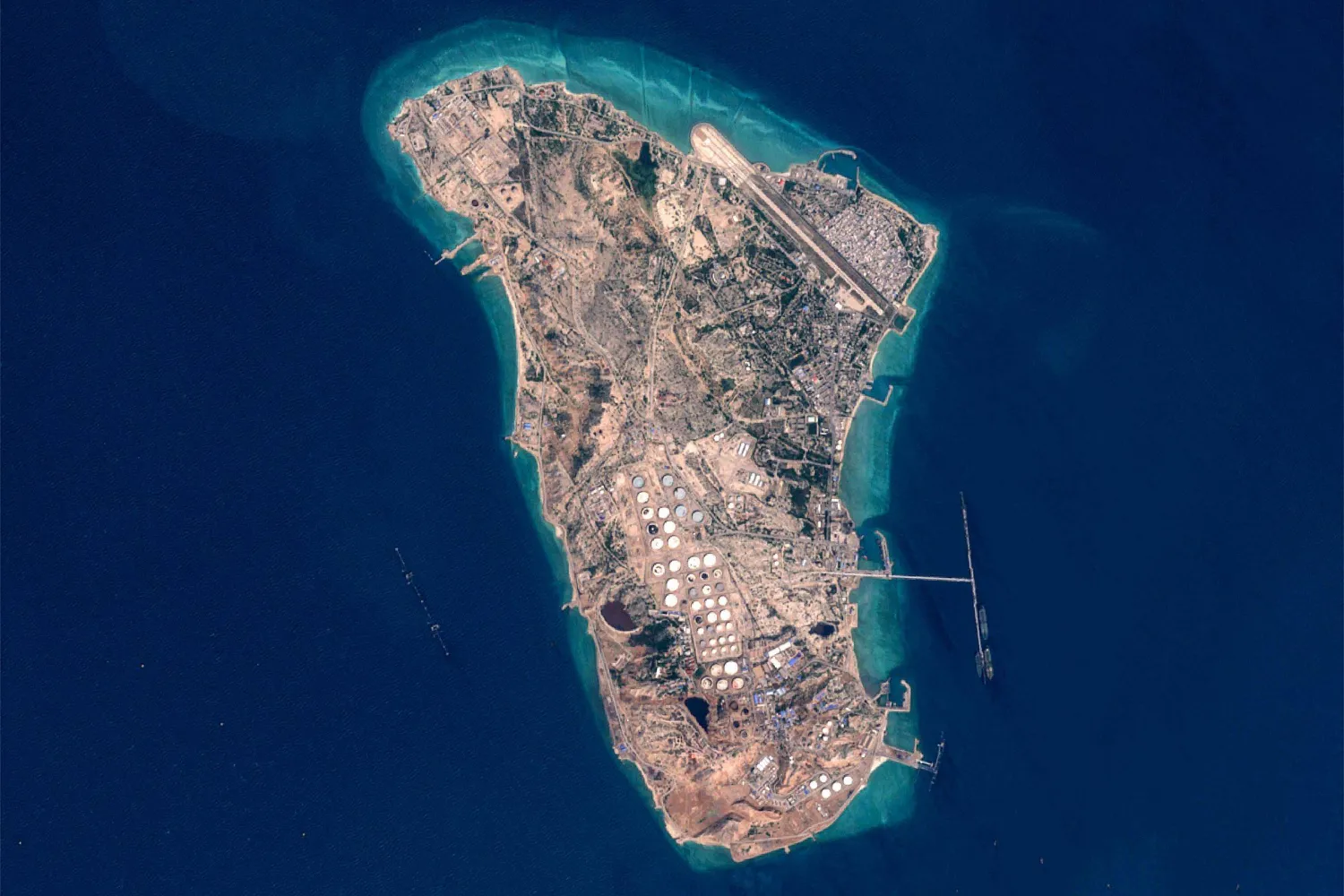
This handout image taken by the European Space Agency (ESA) captured by the Copernicus Sentinel-2 satellite shows a view of Iran's Kharg Island. (Photo by EUROPEAN SPACE AGENCY / AFP)
TT

Kharg... A Pivotal Island for Iran

This handout image taken by the European Space Agency (ESA) captured by the Copernicus Sentinel-2 satellite shows a view of Iran's Kharg Island. (Photo by EUROPEAN SPACE AGENCY / AFP)

Islands under Iran's control, spanning from the northern Arabian Gulf to the entrance of the Strait of Hormuz, have returned to the forefront of the war as part of direct military calculations.

These islands gain additional importance as potential points for engagement in a new phase of the war, shifting the battlefield to energy warfare and transit control.

At the heart of this map stands Kharg Island, which US President Donald Trump had threatened to seize, considering it the lifeline for Iranian oil exports. Meanwhile, other islands serve functions of controlling transit, military fortification, and advanced strategic positioning on one of the world's most sensitive maritime passages.

Kharg Island is an 8-kilometer-long coral island in the Arabian Gulf, located approximately 43 kilometers off the mainland and about 500 kilometers northwest of the Strait of Hormuz. It is the terminus for pipelines coming from Iran's oil fields in the central and western parts of the country. It was established by the giant American oil company Amoco and seized by Iran during the 1979 revolution.

Kharg Island occupies an exceptional position in Iran's strategic structure, serving as the lifeline for the majority of Iranian crude exports. It is located in the northern Gulf off the Iranian coast, making it close enough to the Iranian mainland to remain under the umbrella of its fires, missile, and drone capabilities.

Its importance stems primarily from its direct economic function. The island houses the terminal through which almost all of Iran's oil exports pass, securing the largest share of the state's crude revenues. During the ongoing war, it quickly became a prominent target in military discussions, as striking it would impact one of the state's most vital funding sources.

The Most Important Gateway

The island developed during Iran's oil boom in the 1960s and 1970s because large parts of the Iranian coast were too shallow to allow supertankers to dock. Hence, with its deep harbors and terminals, the island became the most important gateway for Iranian oil exports, especially to Asian markets, particularly China.

Theoretically, any American control could choke a vital financial artery for the regime and give Washington leverage to compel Tehran to keep the Strait of Hormuz open. Moreover, due to its location, the island could, in such a scenario, turn into an advanced platform for military pressure on the Iranian mainland. However, this temptation is met with significant obstacles.

Seizure would require stationing American forces on a small island very close to the Iranian coast, meaning within range of Iranian drones, missiles, and mobile artillery, and the potential use of mines and fast boats. Thus, an attacking force could quickly become a fixed target vulnerable to attrition.

Furthermore, retaining the island after forces enter it would require constant air cover, advanced air defense systems, and protected supply lines by sea and air. Tehran has increased its fortifications on Kharg in recent weeks, sending additional personnel and deploying air defense assets, alongside reports of mines around the island.

Significant Strategic Advantages

It also threatened to target American forces if they attempted to enter the island, and to strike the energy infrastructure of companies dealing with the United States if its oil facilities were targeted.

The island includes storage tanks, housing for thousands of workers, and has a clear civilian presence. It also contains an old Portuguese fortress and the ruins of an early Christian monastery in the Gulf.

The Washington Post said on Thursday that for the US, capturing the island would give the United States significant strategic advantages, including potentially choking off Tehran’s ability to pay its military.

Despite intensive strikes launched by the United States and Israel against targets inside Iran, Kharg Island, the most important center for Iranian oil exports, has remained off the list of these strikes so far; experts warn that striking it could cause a catastrophic collapse in global markets.

Threat to Strike the Island

Trump had repeatedly threatened to launch strikes on the island's oil infrastructure if Tehran did not stop its attacks on ships in the Strait of Hormuz, a warning observers said could heighten market tensions already suffering unprecedented supply disruptions.

Trump had stated during the bombing of Iran that the United States had completely destroyed military targets on the island. He added that the American strikes had not targeted the oil infrastructure on Kharg Island, but he wrote that if Iran or anyone else does anything to interfere with the free and safe passage of ships through the Strait of Hormuz, he will immediately reconsider this decision.

Centcom said US forces had struck more than 90 Iranian military targets on the island, “while preserving the oil infrastructure.”

The regional military command unit said it had destroyed naval mine storage facilities, missile storage bunkers and numerous other military sites.



The 60-day Deadline for an Iran Peace Deal is Expiring. Here's Where Things Stand

A woman holds an Iranian flag as part of a pro-government campaign in downtown Tehran, Iran, Monday, Aug. 17, 2026. (AP Photo/Vahid Salemi)
TT

The 60-day Deadline for an Iran Peace Deal is Expiring. Here's Where Things Stand

A woman holds an Iranian flag as part of a pro-government campaign in downtown Tehran, Iran, Monday, Aug. 17, 2026. (AP Photo/Vahid Salemi)

The deal that US President Donald Trump signed at Versailles in June set an ambitious 60-day deadline for ending the war with Iran and reaching an accord on its nuclear program.

The deadline was Monday, and the two sides are further apart than they were then, The Associated Press said.

Talks, such as they are, have focused on reopening the Strait of Hormuz and lifting a US blockade on Iran, both of which were supposed to have happened under the interim deal. There has been no sign of any compromise on the strait, or that detailed nuclear talks have even begun.

The US, meanwhile, has no good options for getting out of the war it started alongside Israel.

Acceding to Iran's latest demands would mean giving it control over a critical international waterway that carried a fifth of the world's traded oil and gas before the war — and would be tantamount to admitting defeat. Escalating the deeply unpopular war would further draw down US supplies of advanced missile interceptors, jolt the world economy, and drive up gas prices ahead of US congressional elections.

So both sides have dug in, hoping the other will blink first. So far, neither has.

The interim deal collapsed weeks later

The June deal, known as the Memorandum of Understanding, called for a halt to all military operations and set a 60-day deadline for an agreement to permanently end the war and resolve the longstanding dispute over Iran's nuclear activities.

It called for the Strait of Hormuz to be reopened but gave Iran a vaguely defined role in facilitating traffic, leaving open the possibility it could charge fees after the 60-day deadline. Iran has seized on that clause to claim control over the waterway.

A week after the deal was signed, Iran began firing on vessels using a route along the coast of Oman, on the other side of the strait, that is overseen by the US military and intended to bypass Tehran's control.

The US responded by striking Iran, which retaliated by attacking Arab countries hosting American forces, like Jordan, Kuwait and Bahrain. The US canceled waivers issued as part of the deal that had allowed Iran to sell its oil internationally and Trump restored a blockade of Iran's ports.

Each side accused the other of violating the June agreement, of which almost nothing remains.

The fighting eventually died down. A related truce in Lebanon between Israel and the Iran-backed Hezbollah has mostly held, even as Israeli troops occupy large areas in the country's south. Lebanon's "territorial integrity and sovereignty" were to have been ensured under the June deal.

Iranian officials say they stopped negotiating with the US in June, while acknowledging that messages have been relayed by intermediaries. Trump says the talks have continued, occasionally claiming progress after pulling back from threatening major strikes.

Pakistan, which played a key role in brokering the June agreement, noted last week that the deadline was Monday while expressing hope it would be extended.

“We are not closing the chapter,” Foreign Ministry spokesman Tahir Andrabi said. “Pakistan is making all-out efforts to bring the two parties to the negotiating table.”

Iran's leaders think they can force Trump to give up the strait

Earlier this month, Iran issued a list of demands for reopening the strait, including the lifting of the American blockade, the withdrawal of US forces from around Iran and the payment of reparations for damage inflicted in the war started by the US and Israel on Feb. 28.

Even then, Iran has said it would control the strait — and potentially charge fees — through an agreement it is negotiating with Oman, and that the strait will not go back to being an open, toll-free waterway as it was before the war.

Iran-backed Houthis in Yemen have meanwhile begun attacking oil tankers in the Red Sea, threatening another crucial trade route that had been used to relieve some of the pressure from the strait being closed.

Trump has rejected Iran's demands — saying it's Tehran that should pay war reparations and claiming the US controls the strait. He appears to be banking on economic pressure — in the form of the blockade and longstanding sanctions — to bring Iran's rulers to their knees.

Iran's economy has been battered by the war and isolation, and inflation has soared. The crisis could stoke renewed anti-government protests, like those that were brutally crushed in January.

Traffic through the Strait of Hormuz, which rose immediately after the interim deal, is back to a small fraction of what it was before the war. Rising prices of fuel and other goods are expected to climb further the longer this continues with effects far beyond the Middle East.

The clock is still ticking for both sides.


Battered by War, Iran’s Rulers Wary of More Economic Pain and Unrest if US Tightens Pressure

People walk in the Grand Bazaar in Tehran, Iran, August 17, 2026. Majid Asgaripour/WANA (West Asia News Agency) via Reuters
TT

Battered by War, Iran’s Rulers Wary of More Economic Pain and Unrest if US Tightens Pressure

People walk in the Grand Bazaar in Tehran, Iran, August 17, 2026. Majid Asgaripour/WANA (West Asia News Agency) via Reuters

Even as Iran projects resilience in the war with the United States, its leaders are worried that a threat of more economic punishment by Donald Trump could increase hardships, reignite unrest and further erode the regime’s legitimacy.

The US president vowed on Friday to hit Iran hard economically, a day after Treasury Secretary Scott Bessent said Washington would impose measures on Tehran that have "never been seen" as early as next week. Washington has not said what those measures will entail.

For all the bravado of Iran's leaders after holding out in nearly six months of conflict and effectively closing the Strait of Hormuz, a vital global oil supply route, they face mounting pressure at home that could result in nationwide unrest, according to three Iranian officials.

The officials, two political insiders, a former Iranian official and a dozen ordinary Iranians spoke to Reuters for this story on condition of anonymity, either for fear of retribution or because they are not authorized to speak to media.

Iran entered the war with high inflation, a weakening currency, energy shortages, sanctions and deep structural weaknesses, and must now contend with damaged infrastructure, disrupted trade, lost production and the cost of rebuilding.

Arshia, a civil engineer, spent a decade working in Iran’s construction industry before the war that began with US and Israeli attacks on February 28 brought projects largely to a standstill.

He is now struggling ‌to find work as ‌projects are delayed or cancelled and costs soar, with little prospect of a rapid recovery.

"I’m worried. If Trump imposes ‌more sanctions, ⁠how will ordinary ⁠people survive? I don’t want my country to be punished militarily or economically. We’re already struggling,” said the father of two from the central city of Isfahan.

His plight reflects a broader reality across Iran, where US strikes damaged factories, power plants, transport networks and other critical infrastructure, adding to pressure on an already strained economy.

Mohsen, 53, was forced to shut his small import-export business with Gulf countries after Iran retaliated against US strikes by targeting American bases and assets in the region.

"I had to lay off 10 employees. It was painful, but I had no choice. I could no longer afford to pay their salaries, and now I’m relying on my savings to support my family," he said from the southern port city of Bandar Abbas.

INFLATION, UNCERTAINTY HIT HOUSEHOLDS

Iran’s annual inflation rate reached 66% in July, while consumer prices were 87.9% higher than a year earlier, according to Iran’s Statistical ⁠Center. Food inflation hit 128% year-on-year.

For Iran’s rulers, the greater threat may be not economic pain itself, but the risk ‌that worsening hardship reignites mass unrest, said the two insiders and one official.

The appointment of Hossein Taeb ‌last week, a key architect of past crackdowns, to lead Iran’s Basij militia is one of the clearest signs yet of growing concern over a resurgence of unrest, a former reformist ‌official said.

The Basij, a paramilitary volunteer militia, is affiliated with Iran's powerful Revolutionary Guards, which have both been used by the clerical rulers to quell protests.

Economic ‌grievances have repeatedly spilled into nationwide protests in Iran in recent years.

In January, nationwide protests over economic hardships were crushed by the IRGC and the Basij force, with thousands killed.

In recent months, Iran’s clerical rulers have responded to fears of renewed unrest with executions, arrests, summonses and lengthy prison sentences targeting journalists, lawyers, activists, human rights advocates and students, rights groups say.

Officials say the measures are needed to maintain stability during wartime. Critics say they could deepen the divide between the clerical establishment and a public frustrated by rising economic pressures.

SALARY 'GONE WITHIN DAYS'

Families are cutting ‌back on meat and other staples, opting for cheaper alternatives.

"I’m ashamed in front of my children. My salary is gone within days. Meat and chicken have disappeared from our table. I have no idea how we’re going to ⁠get by," said Hossein, a government employee in ⁠the central city of Yazd.

Rents rose 31% year-on-year in March, according to the Statistical Centre, while state media reported Tehran housing prices at roughly 50% above last year.

Iran’s minimum wage was raised by about 60% this year, but continued rial depreciation has eroded purchasing power, with the dollar value of the minimum wage falling from about $105 to $86 since late March.

Bijan, 40, earned about $1,000 a month as an engineer when he entered the job market 15 years ago. He has since turned to online tutoring to make ends meet. Now, he and his wife struggle to make about $400 a month and have left Tehran for a cheaper province.

"I used to work maybe five or six hours a day ... Now, it’s all work or looking for work, or feeling anxious about not having enough work," said Bijan.

For many Iranians, fear of renewed conflict has made planning for the future increasingly difficult.

US NAVAL BLOCKADE RATCHETS UP COSTS

Iran has sought to keep essential goods moving through alternative routes, including land corridors and the Caspian Sea, but those alternatives are also coming under strain.

Strikes on bridges have disrupted overland transport, increasing the cost and time needed to move goods into Iran.

President Masoud Pezeshkian last week acknowledged the squeeze, saying: “Our problems have multiplied several times over, while our income has also fallen.”

Goods that once arrived by ship now take longer routes into Iran, driving up prices, he said, adding that Iran is selling less oil and collecting less tax revenue from damaged or struggling businesses.

The blockade has also effectively cut off Iran’s gasoline imports, lawmaker Reza Sepahvand told Iran's ILNA news agency on Saturday, adding that Iran’s daily gasoline output had reached its limit at about 130 million liters, compared with consumption of 137 million liters.


Trump Wants More Economic Pressure on Iran. What Are his Options?

US President Donald Trump arrives to deliver remarks at the Nassau County Police Academy Center for Training and Intelligence in Garden City, New York, on August 14, 2026. (Photo by Kent NISHIMURA / AFP)
TT

Trump Wants More Economic Pressure on Iran. What Are his Options?

US President Donald Trump arrives to deliver remarks at the Nassau County Police Academy Center for Training and Intelligence in Garden City, New York, on August 14, 2026. (Photo by Kent NISHIMURA / AFP)

US President Donald Trump on Friday vowed to hit Iran hard economically, a day after Treasury Secretary Scott Bessent said that Washington would impose measures on Tehran that have "never been seen" as soon as next week.

The United States, United Nations and European Union have applied sanctions, implemented trade embargoes and frozen assets since the late 1970s over Iran's nuclear program, human rights violations and support for militant groups.

Since the Iran war began in February, Washington has levied additional maritime, energy and financial sanctions and started a naval blockade.

Data from the US Treasury Department's Office of Foreign Assets Control (OFAC) shows the agency has imposed sanctions on more than 1,000 people, vessels and aircraft since Trump began his second term.

Recent measures have targeted Iran's shadow oil fleet; shipping insurers; entities and people enabling Iran's acquisition of weapons; and digital exchanges, freezing an estimated $500 billion in Iran-linked cryptocurrency.

According to Reuters, experts say the Trump administration also can try these options:

SANCTIONS ON CHINESE 'TEAPOT' REFINERS

Chinese independent refineries known as "teapots" account for a quarter of Chinese refinery capacity. They operate with narrow and sometimes negative profit margins.

China buys more than 80% of Iran's shipped oil, according to 2025 data from analytics firm Kpler. Independent refiners absorb much of this trade, exposing them to so-called secondary measures that penalize entities helping a primary sanctions target.

Past ⁠US sanctions have ⁠deterred larger independent refiners from buying Iranian oil. But the independent refineries are somewhat immune since they have little exposure to the US financial system, sanctions experts say.

SANCTIONS ON CHINESE BANKS

OFAC has imposed secondary sanctions on smaller China- and Hong Kong-based entities accused of processing billions of dollars in Iranian oil and helping to fund weapons procurement.

Treasury has warned two larger Chinese banks they could face secondary sanctions if Iranian funds were found moving through their systems, but has stopped short of designating them.

Hitting those two banks, which US officials have not publicly identified, or imposing other sanctions could have a chilling effect on bigger financial institutions, sanctions experts said, although they warned it could ⁠also trigger retaliatory actions by Beijing.

Trump administration officials have sought to play down tensions between Washington and Beijing ahead of an expected meeting between Trump and President Xi Jinping later this year.

They worry that China could curtail exports of critical minerals that are essential to advanced technology production at a time when the US and Western allies are still trying to develop their own supplies.

'WHACK-A-MOLE'

The United States could continue targeting Iranian individuals and entities, as well as others in China and the Gulf, that are helping Tehran evade sanctions to collect revenues for its war effort.

Treasury recently issued sanctions against firms that are springing up to facilitate Iran's trading of oil revenue for imports. But such measures amount to a "whack-a-mole" approach that has not altered Iran's behavior, said Brett Erickson, managing principal of Obsidian Risk Advisors, noting that Tehran simply creates new entities to replace them.

Miad Maleki, a sanctions expert with the Foundation for Defense of Democracies, said Bessent was likely signaling a sharpened enforcement push against oil shippers, purchasers and currency exchangers who help Iran pay for ⁠its imports.

Further aviation sanctions were ⁠also possible, aimed at degrading Iran's ability to move trade now that the US has blockaded shipping via the Strait of Hormuz, he added.

LAND BLOCKADE

Some US and Israeli officials have floated the prospect of a land blockade, which would require assistance from Iran's neighbors: Iraq, Türkiye, Pakistan, Afghanistan, Turkmenistan, Azerbaijan and Armenia.

The Trump administration has varying degrees of closeness with all those countries except Afghanistan, but that border is mountainous and extremely difficult to patrol anyway.

SECONDARY TARIFFS

Trump has repeatedly threatened tariffs on goods from countries that do business with Iran, although the Supreme Court struck down the legal basis for such taxes.

The Senate passed a sweeping Russia sanctions bill last week that included new Iran sanctions and would give Trump new tariff powers that he could potentially use against countries that aid Iran's commerce and weapons procurement. That legislation must still pass the US House of Representatives, which could prove challenging given widespread concerns among Democrats and some Republicans about the tariff measures.