


Egypt Banks on Domestic Defense Manufacturing to Curb Military Spending

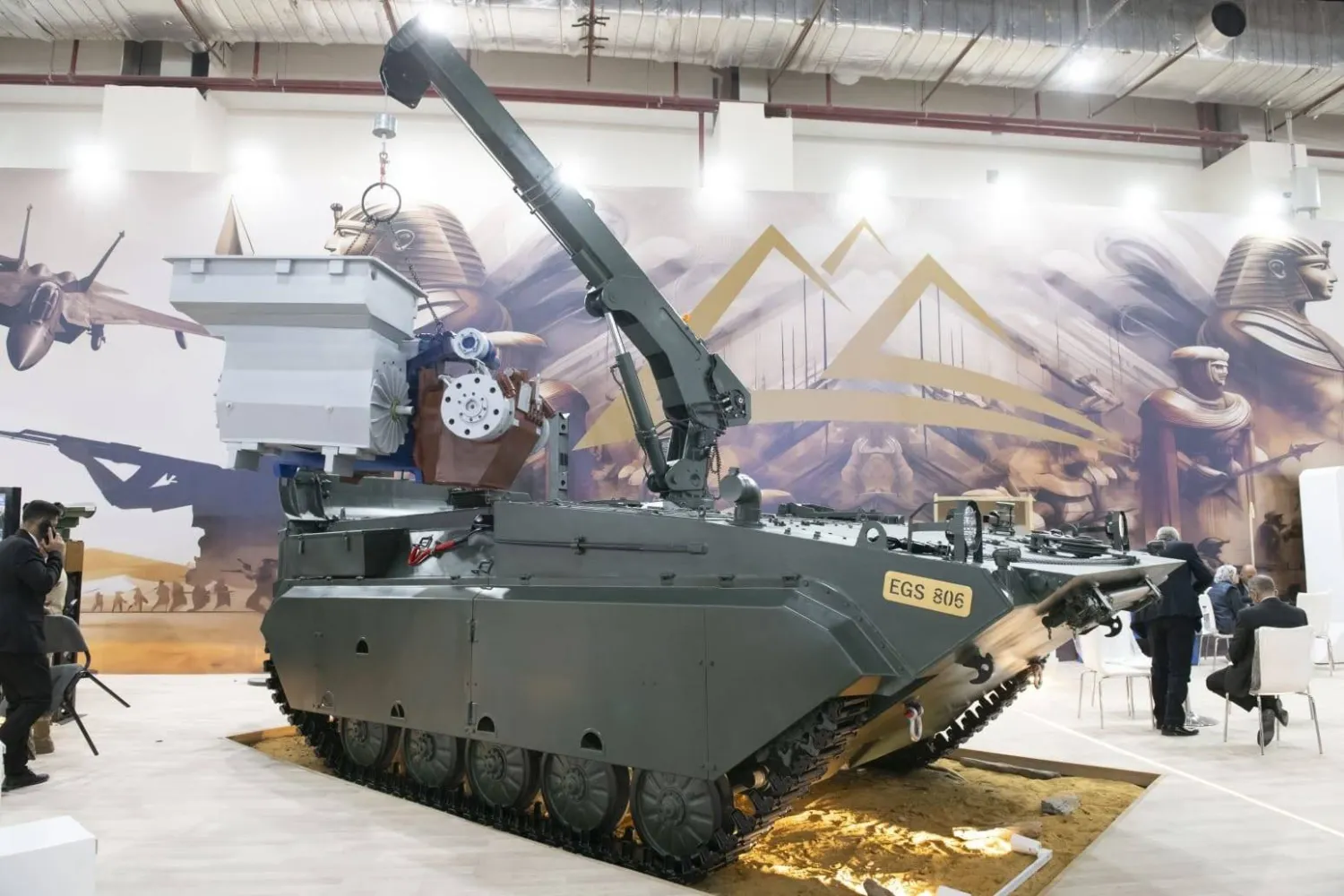
A military vehicle manufactured in Egypt. (Egyptian Ministry of Military Production)
TT

Egypt Banks on Domestic Defense Manufacturing to Curb Military Spending

A military vehicle manufactured in Egypt. (Egyptian Ministry of Military Production)

Egypt is increasingly relying on domestic defense manufacturing to curb military spending, expanding local production of armored vehicles, drones and air defense systems while continuing to diversify its foreign arms suppliers and pursue joint-production partnerships with other countries.

The strategy comes as the country posted the lowest military spending among Arab states last year, with defense expenditure accounting for 0.61% of gross domestic product, according to figures released by the Stockholm International Peace Research Institute (SIPRI).

Military experts told Asharq Al-Awsat that local arms production helps ease pressure on foreign-currency reserves required for imports while ensuring a more secure supply chain. They explained that modern warfare is characterized by the heavy consumption of weapons and ammunition, making uninterrupted access to military supplies a strategic necessity.

Egypt’s armed forces have pursued a comprehensive modernization program in recent years, including diversifying sources of weaponry and forging partnerships with major defense-producing countries, according to Egypt’s State Information Service.

The government is also pushing to expand reliance on locally manufactured defense products.

Minister of State for Military Production Salah Mostafa Gomblat said the current phase focuses on localizing advanced industrial technologies to improve production efficiency and enhance the competitiveness of Egyptian-made products.

He added that the strategy includes forging new partnerships with the private sector to reduce import costs and support the national economy.

According to SIPRI, Egypt recorded the lowest military spending among Arab countries in 2025 even as global military expenditure rose 2.9% from the previous year to $2.887 trillion. Algeria recorded the highest military-spending among Arab countries, at 8.83% of GDP.

Egypt has recently showcased a range of domestically produced defense systems, including armored vehicles, drones and air defense platforms displayed at the EDEX 2025 defense exhibition held in Cairo last December.

Among the systems highlighted were the Raad 300, a multiple-caliber guided rocket launcher capable of striking targets at ranges of up to 300 kilometers, and the Jabbar 150 unmanned aerial vehicle, which Egyptian officials describe as possessing advanced offensive capabilities.

The unveiling of the Jabbar 150 attracted attention in Israel. In a report published on June 8, Israeli website Natziv.net said Israeli security agencies were monitoring advances in Egyptian military technology and assessing their strategic implications.

Major General Nasr Salem, a military analyst, noted that Egypt’s drive to deepen domestic weapons production is intended both to secure military supply lines and reduce the cost of importing arms.

“Part of Egypt’s strategy to diversify its sources of armaments is based on localizing military industries,” Salem told Asharq Al-Awsat.

He stressed that the prolonged nature of modern conflicts requires armies to maintain a continuous flow of weapons and ammunition, adding that some military estimates suggest the cost of a single day of combat can equal a year’s defense procurement budget for some armed forces.

“For that reason, the best option for countries is to manufacture their own weapons,” he said.

Salem cautioned, however, that building a domestic defense industry is itself costly and requires access to advanced technologies capable of competing with foreign systems.

He added that local production offers another advantage: the ability to design weapons tailored to a country’s operational environment and the needs of its armed forces.

Major General Samir Ragab said expanding local defense production also helps reduce pressure on foreign-currency resources.

“No country in the world can achieve complete self-sufficiency in armaments,” Ragab told Asharq Al-Awsat, noting that certain categories of advanced weapons will continue to be imported from countries with more sophisticated defense-industrial capabilities.

Nevertheless, he said, a strong domestic defense-industrial base enhances the Egyptian military’s capabilities and provides Cairo with greater flexibility to develop weapons systems suited to its own requirements.



Syrian Authorities Say Killed Assad-Era Officer After Clash

A member of Syria's internal security forces in Tartus city. (SANA)
TT

Syrian Authorities Say Killed Assad-Era Officer After Clash

A member of Syria's internal security forces in Tartus city. (SANA)

Syrian security forces said on Sunday that they killed an army commander who served under ousted ruler Bashar al-Assad, after he opened fire on them as they tried to arrest him.

In a statement, the forces accused Firas Abdul Karim Hammoud of having taken part in anti-government insurrections that killed security personnel.

Since Assad's fall in December 2024, Syria's new authorities have arrested dozens of security officials from his rule, and trials began in April.

The security forces said they "neutralized Firas Abdul Karim Hammoud... following an armed clash and a raid on his hideout in the town of Safita" in Tartus province in the coastal Alawite heartland.

Hammoud had previously "opened fire on security personnel during an attempt to arrest him", they added.

"During the recent operation, he again opened fire and initiated a firefight with the security forces... necessitating their response."

They said Hammoud served as a commander of the special forces in the so-called "25th Division" under Assad's rule.

They accused him of working under Assad-era general Ghiath Dalla in leading pro-Assad groups on the coast after the former president's fall.

They added that he was involved in "armed insurrection operations" against state institutions that killed security personnel.

Dalla, a former officer in the much-feared Fourth Brigade, had announced on social media last year the formation of a "military council for the liberation of Syria".

The announcement came shortly before deadly violence targeting the Alawite minority, to which Assad's family belongs, erupted on the Syrian coast in March 2025.

Authorities accused armed Assad supporters of sparking the violence by attacking security forces in an ambush.


Iraq Sentences US-Sanctioned Oil Official to Prison

The sun sets behind apartment buildings in Baghdad, Iraq, Friday, Aug. 28, 2026. (AP)
TT

Iraq Sentences US-Sanctioned Oil Official to Prison

The sun sets behind apartment buildings in Baghdad, Iraq, Friday, Aug. 28, 2026. (AP)

Iraq sentenced a US-sanctioned oil official to seven years in prison after he was arrested as part of a government-led anti-corruption campaign, the country's anti-graft body said on Sunday.

Deputy oil minister for distribution affairs Ali al-Bahadli is among dozens of officials who were detained in June during anti-graft raids that took place in several areas, mostly in Baghdad's fortified Green Zone.

The Commission of Integrity said in a statement that an anti-corruption court sentenced Bahadli to seven years in prison for "illicit gains".

The ruling requires Bahadli to return to the state an amount equivalent to more than $20 million in ill-gotten gains, in addition to paying a fine of the same amount.

The United States imposed sanctions on Bahadli in May, accusing him of fraudulently mixing Iraqi and Iranian oil as part of a scheme to help Iran avoid sanctions.

At the time, Iraq's oil ministry denied the accusations against Bahadli, who was then arrested during the anti-graft raids.

Iraqi authorities said that the raids were part of new Prime Minister Ali al-Zaidi's campaign to fight the corruption that has plagued Iraq for decades.

But several Iraqi officials told AFP that the raids were also part of al-Zaidi's campaign against funding for pro-Iran armed groups and the smuggling of Iranian oil.

Iraq has been under mounting pressure from the United States to curb Tehran's influence and rein in Iran-backed armed factions, which Washington designates as terrorist groups.

Al-Zaidi, who took office this year with the blessing of the United States, has pledged to ensure the armed factions that emerged after the US-led invasion hand over their weapons to the state.

In Iraq, corruption is especially rampant across public institutions, but convictions typically target mid-level officials or minor players and rarely those at the top of the power hierarchy.


US News Agency Says Crew Attacked by Israeli Settlers in West Bank

 Israeli settlers look out through a metal fence, as an Israeli flag flutters nearby, on the day of their weekly tour in Hebron, in the Israeli-occupied West Bank, August 29, 2026. (Reuters)
Israeli settlers look out through a metal fence, as an Israeli flag flutters nearby, on the day of their weekly tour in Hebron, in the Israeli-occupied West Bank, August 29, 2026. (Reuters)
TT

US News Agency Says Crew Attacked by Israeli Settlers in West Bank

 Israeli settlers look out through a metal fence, as an Israeli flag flutters nearby, on the day of their weekly tour in Hebron, in the Israeli-occupied West Bank, August 29, 2026. (Reuters)
Israeli settlers look out through a metal fence, as an Israeli flag flutters nearby, on the day of their weekly tour in Hebron, in the Israeli-occupied West Bank, August 29, 2026. (Reuters)

Israeli settlers attacked an NBC crew in the central West Bank Saturday, as they were interviewing a Palestinian woman who said she’d been driven out of her house by settlers, the network said.

NBC’s American correspondent Matt Bradley, two other crew members and the woman they were interviewing were all treated for injuries sustained during the attack, NBC said. There were no further details on their injuries.

The assault was caught on video and shared by NBC, with footage showing masked settlers approaching the crew with sticks and beating the crew’s vehicles.

Israel’s military said it was “aware of reports of Palestinian injuries, including a Palestinian woman who sustained non-life-threatening injuries and was evacuated by the Red Crescent for medical treatment.” It did not comment on the attack on the NBC crew.

It was the latest in a growing wave of violence by West Bank settlers. Prime Minister Benjamin Netanyahu issued a rare condemnation of the violence on Saturday. The Israeli leader has come under heavy US criticism for the settler attacks.

Settlers seized British activist and held him locked in shed

Israeli settlers seized a British activist from a Palestinian village in the West Bank and locked him in a shed before turning him over to police, his lawyer said Sunday.

The lawyer, Inbar Shaked Vardi, said settlers held her client, Finn Joughin, for half an hour Saturday before turning him over to Israeli police. Joughin was set to appear before a Jerusalem court later Sunday, she said.

Video showed two settlers, one armed, restraining Joughin and marching him away from the village.

It was not immediately clear what led to his capture. Settlers say he assaulted a child, accusations Vardi vehemently denied.

Settlers point to a video where the activist uses his body in an apparent attempt to block a settler boy from passing through a fence. Vardi said the video shows he was trying to protect the village.

Police said they were investigating and holding Joughin in custody on suspicion of committing an indecent act against a minor.