

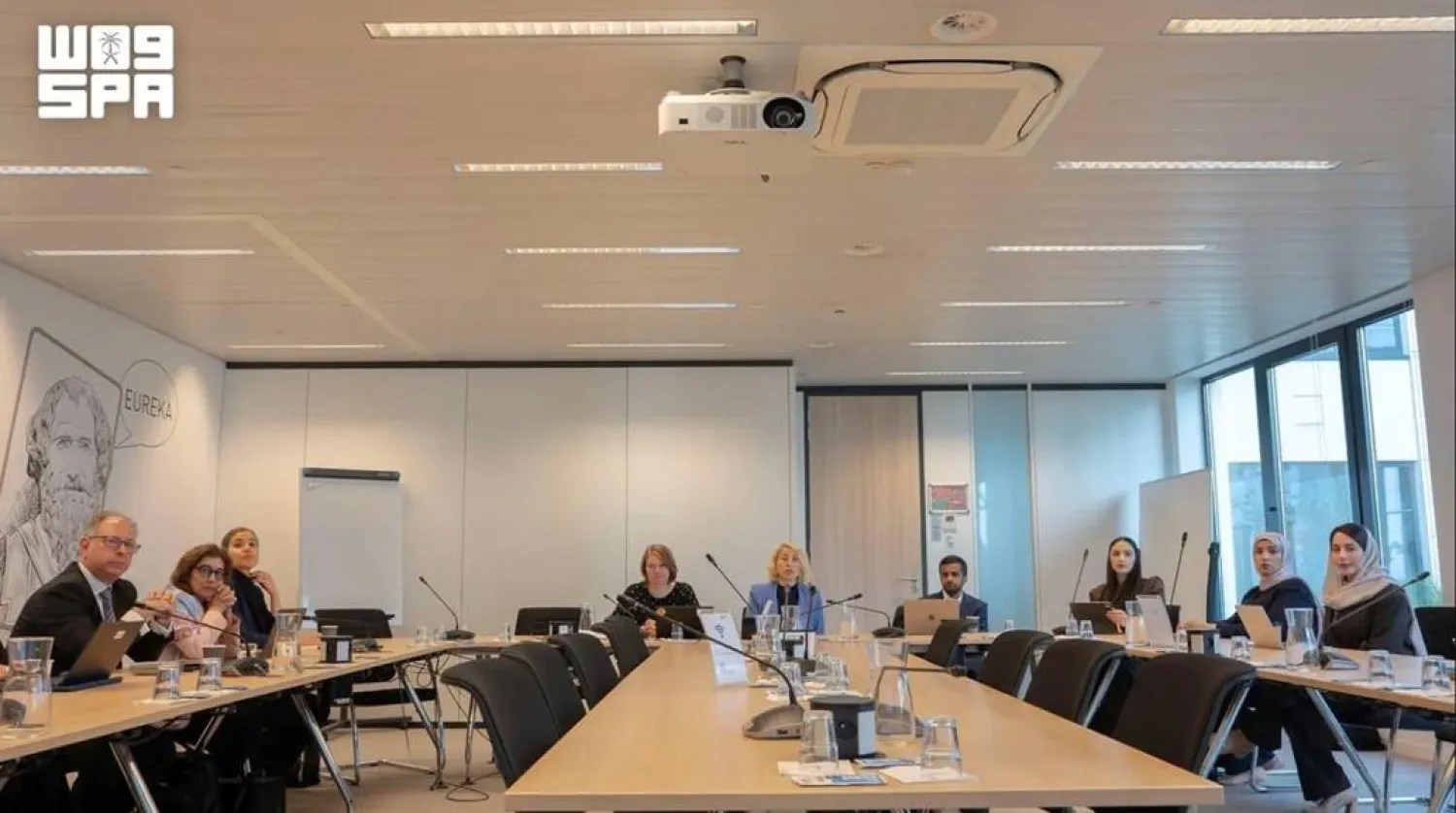

SDAIA, World Bank Conclude Int’l Consultations on Data Governance and AI in Belgium and Germany

The program aimed to review leading international experiences in data governance, AI, and digital policy frameworks. SPA
TT

SDAIA, World Bank Conclude Int’l Consultations on Data Governance and AI in Belgium and Germany

The program aimed to review leading international experiences in data governance, AI, and digital policy frameworks. SPA

The Saudi Data and Artificial Intelligence Authority (SDAIA), in partnership with the World Bank, has concluded an international program held from June 8 to 12 in Belgium and Germany.

The program aimed to review leading international experiences in data governance, artificial intelligence (AI), and digital policy frameworks. It also included consultations with experts in both countries to exchange knowledge and expertise.

During the program, participants reviewed the Kingdom's experience in building a national ecosystem for data and AI. They also highlighted achievements in data governance, digital policy, and regulatory frameworks, as well as Saudi efforts to promote the responsible use of advanced technologies.

The program included a series of meetings and specialized sessions in Brussels and Berlin involving European and international entities, government and non-profit organizations, and think tanks focused on digital policy and AI governance.

Discussions covered international cooperation in AI, regulatory frameworks, data governance and privacy, and cross-border challenges associated with emerging technologies. Participants also examined frameworks that support responsible innovation and digital transformation.

SDAIA and World Bank teams reviewed advanced practices in digital policy development and the design of regulatory frameworks for data and AI. They also discussed mechanisms for strengthening international cooperation and knowledge exchange to support the development of a sustainable national ecosystem for data and AI.

The program is part of SDAIA's efforts to strengthen international cooperation and build partnerships with leading global organizations and institutions. It also seeks to benefit from international expertise and best practices in support of the Kingdom's objectives to strengthen its global position in data and AI.

The initiative aligns with the goals of Saudi Vision 2030 and the Year of AI 2026 and supports efforts to transfer knowledge and expertise to the Kingdom.



China's Tencent Says AI Agents Showed Unintended Browsing Behavior

FILE PHOTO: The Tencent logo at the company's headquarters during a government‑organised media trip in Shenzhen, Guangdong province, China, April 17, 2026.  REUTERS/Go Nakamura/File Photo
FILE PHOTO: The Tencent logo at the company's headquarters during a government‑organised media trip in Shenzhen, Guangdong province, China, April 17, 2026. REUTERS/Go Nakamura/File Photo
TT

China's Tencent Says AI Agents Showed Unintended Browsing Behavior

FILE PHOTO: The Tencent logo at the company's headquarters during a government‑organised media trip in Shenzhen, Guangdong province, China, April 17, 2026.  REUTERS/Go Nakamura/File Photo
FILE PHOTO: The Tencent logo at the company's headquarters during a government‑organised media trip in Shenzhen, Guangdong province, China, April 17, 2026. REUTERS/Go Nakamura/File Photo

Tencent said on Friday that AI agents used to evaluate third-party models displayed web-browsing behavior not intended by the tech giant, in what appears to be the first known incident of rogue agent actions acknowledged by a major Chinese company.

The statement followed a report by AI-safety research group Swarmchasers on Wednesday, which said "rogue" agents running on infrastructure it linked to Tencent Cloud made repeated attempts between September 28 and October 8 to retrieve information from Alibaba's Amap, China's equivalent to Google Maps.

Tencent Hunyuan, the company's artificial ⁠intelligence unit, said in ⁠a post on X that the activity did not originate from its Hunyuan models. Its review found no evidence of deliberate targeting or coordination, Reuters quoted it as saying.

The Swarmchasers researchers said the agents sought information such as the commonly used entrances at Chinese parks, museums and zoos.

The actions are not as egregious as those disclosed by US AI companies which include the hack of ⁠open-source platform Hugging Face by an OpenAI agent and the lodging of a fake homicide tip by an Anthropic agent.

But the disclosure underscores research that shows Chinese AI agents can also misrepresent their identity, conceal failures and try to circumvent testing controls.

Tencent said it took the findings very seriously and was strengthening network access controls and agent monitoring.

Hunyuan is one of China's leading AI model developers, competing with in-house teams at rivals such as Alibaba and ByteDance. ByteDance this week announced the creation of a new unit focused on AI model and agent safety.

Swarmchasers said it used the ⁠word "rogue" to ⁠describe agents taking actions outside their intended scope or completing a task in unintended ways.

After routine automated requests were blocked, the agents tried other methods, including public web tools that could open pages and run code, routing requests through other websites and using Amap keys and security codes found in publicly available software code.

Swarmchasers said it found no evidence that the agents breached Amap's main anti-bot safeguards. Most of the 2,818 attempts it recorded either failed or returned anti-bot pages, login screens or blank results.

Some requests returned information through cached pages and intermediary services, including data on visitor arrivals at Chengdu Zoo, Swarmchasers said. The researchers said they could not determine whether an agent read the result or completed its task.


Anthropic Co-founder Renews Call for Robust Regulation of Frontier AI

AI Research Company Anthropic's Co-Founder and Head of Public Benefit Jack Clark speaks during the Artificial Intelligence and the Global Economy From Risk to Opportunity event of the 2026 Annual Meetings of the IMF and the World Bank Group in Bangkok, Thailand, 16 October 2026. EPA/RUNGROJ YONGRIT
TT

Anthropic Co-founder Renews Call for Robust Regulation of Frontier AI

AI Research Company Anthropic's Co-Founder and Head of Public Benefit Jack Clark speaks during the Artificial Intelligence and the Global Economy From Risk to Opportunity event of the 2026 Annual Meetings of the IMF and the World Bank Group in Bangkok, Thailand, 16 October 2026. EPA/RUNGROJ YONGRIT

Anthropic co-founder Jack Clark renewed calls on Friday for regulating artificial intelligence, saying that allowing companies to continue to operate without robust legislation was like letting a race car loose on the streets at night without brakes.

"It's remarkable to me that the toys I buy for my children are regulated more than the literal super intelligence I work on at my day job," he told an event at the IMF-World Bank's Annual Meetings in Bangkok.

Clark said that US President Donald Trump, whose administration has called for the industry to police itself, was against the idea of regulation but that China was not, said AFP.

"I think it's Formula One at night without maybe brakes in the cars," he said.

He said the lack of clarity around the will for regulation meant "the Formula One car is roaring round and nobody seems to want to put up a guardrail?"

At an industry summit in Dublin on Wednesday, calls to prioritize safety in the development of powerful AI technology dominated the conversation.

Concerns about AI guardrails have soared after models developed by OpenAI and Anthropic were involved in security incidents during testing, piling on pressure to regulate the technology.

A recent Anthropic report suggested small AI models may be only months away from behaving like computer worms, copying themselves from one internet-connected device to the next.

Anthropic has been among those companies calling for governments to step in, even suggesting international coordination to slow down the whole industry -- including Chinese rivals.

That initiative has so far failed to materialize, with companies involved in a hyper-competitive race to attract as much investment as possible.


Meta Releases Open-Weight Muse Spark Model for Coding, Agentic Tasks

The logo of Meta is seen at the entrance of the company's temporary stand ahead of the World Economic Forum (WEF) in Davos, Switzerland January 18, 2025. (Reuters)
TT

Meta Releases Open-Weight Muse Spark Model for Coding, Agentic Tasks

The logo of Meta is seen at the entrance of the company's temporary stand ahead of the World Economic Forum (WEF) in Davos, Switzerland January 18, 2025. (Reuters)

Meta ‌Platforms on Thursday released an open-weight version of its Muse Spark artificial intelligence model for coding and AI agents, expanding developers' ability to download and adapt the technology.

Open-weight models make trained parameters available for developers to modify, unlike proprietary models ‌that remain under ‌their creators' control. ‌They ⁠can offer businesses ⁠a lower-cost alternative to closed systems.

Meta said Muse Spark has 816 billion total parameters, with 42 billion active at a time, and ⁠can handle a context window ‌of up ‌to 1 million tokens.

The ‌model can run locally on ‌two Apple M5 Ultra Mac Studio computers and is also available through some API providers.

CEO ‌Mark Zuckerberg has argued that advanced AI should ⁠not be ⁠concentrated among a small number of companies.

While open-weight models can give companies greater control over their data, they can require significant computing resources and technical expertise to operate at scale.

In August, Meta released Muse Glimmer, a smaller open-weight model.