


Iraq Says Saddam Son-in-Law Plotted to Kill Security Chief

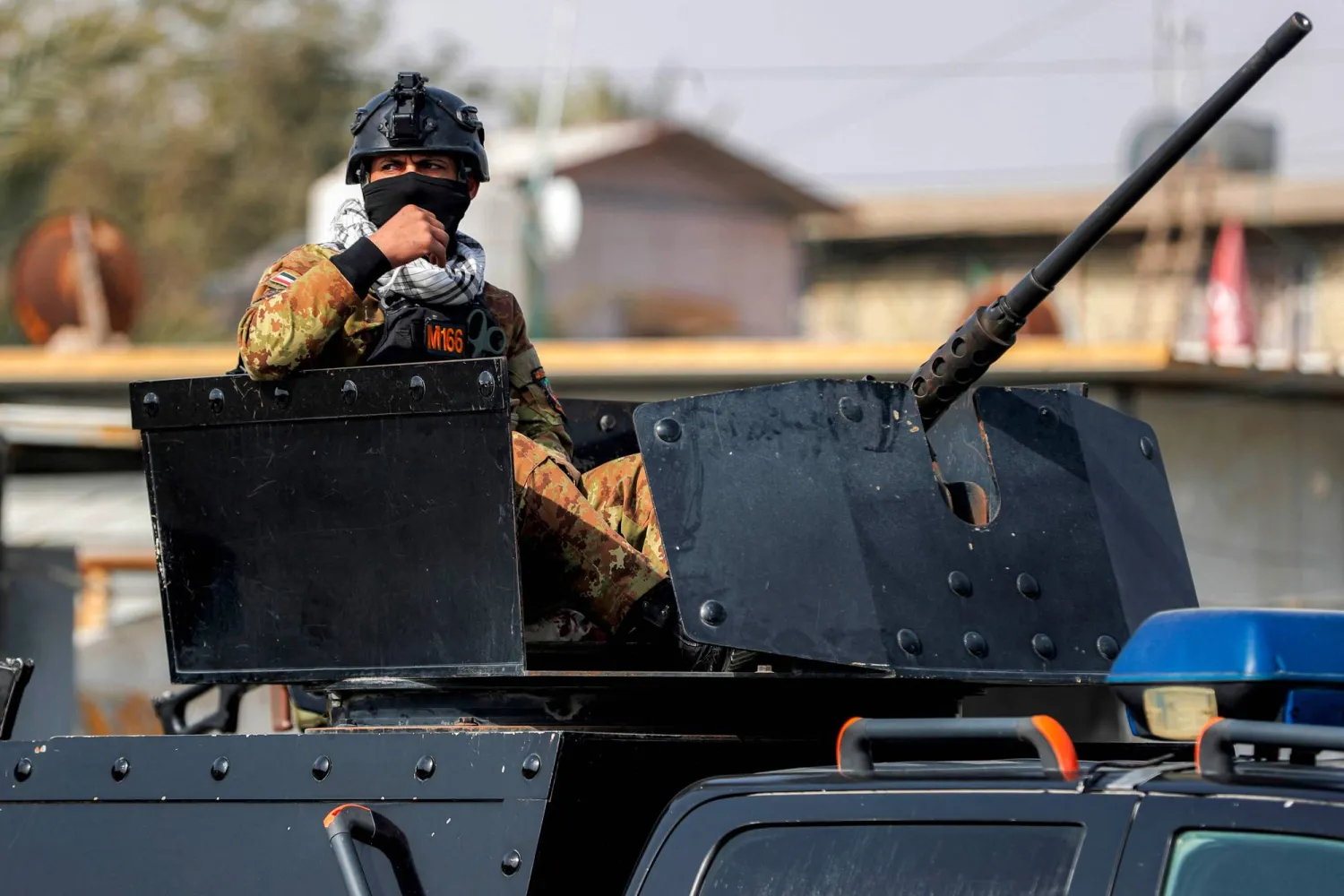
A member of the Iraqi security forces mans a turret while on guard. (Photo by AHMAD AL-RUBAYE / AFP)
TT

Iraq Says Saddam Son-in-Law Plotted to Kill Security Chief

A member of the Iraqi security forces mans a turret while on guard. (Photo by AHMAD AL-RUBAYE / AFP)

Iraq’s National Security Service said it had thwarted a plot by an “opposition cell” linked to Jamal Mustafa, the son-in-law of late president Saddam Hussein, to assassinate its chief.

But one member of the three-man cell questioned whether it could target a heavily protected senior security official.

The service said in a statement late Friday that its units in Baghdad, under the direct supervision of its head, Abdul Karim al-Basri, had “managed to foil a dangerous criminal plot” by a cell linked to the so-called Iraqi National Gathering for Liberation and Change, which it described as one of the banned Baath Party’s fronts, after intelligence work that included surveillance, tracking and infiltration.

Jamal Mustafa founded the National Gathering, which seeks to change the political system, a few years ago after he was released from custody and left Iraq for a regional country.

US forces arrested Mustafa on April 20, 2003, just 11 days after the fall of Saddam Hussein’s government. He remained in detention until mid-2021, before Iraqi authorities decided to release him in June that year because of insufficient evidence over the charges against him.

The National Security Service statement said “investigations and interrogations revealed that the cell members had moved beyond the stage of incitement and threats to the stage of assignment, target selection and weapons preparation ahead of carrying out assassination operations targeting National Security Service chief Abdul Karim al-Basri, the service’s official spokesman, the Baghdad security director and a number of officers.”

It said that “through a preemptive effort and based on judicial approvals, the service’s units were able to uncover the plot, track its members, arrest those involved and seize evidence and materials linked to the case before it reached the execution stage.”

Image taken from a video distributed by Iraqi security forces showing a light weapon allegedly used to assassinate the head of the National Security Service

The statement concluded by saying that “the report presented will include part of the suspects’ confessions, the mechanism of assignment and the planning stages that preceded the foiling of the plot.”

Audio and video recordings released by the service showed calls between the alleged plotters, in which one person speaks about an attempt to assassinate the service chief, while another, who was tasked with carrying it out, denies owning even a single firearm.

In another exchange between the two men, one of them questions whether “only a few people” could carry out a major operation of this kind against “the huge security convoys used by the service commander, Abu Ali al-Basri, and the other targeted officers.”

But in one video clip, one of the men is seen threatening the service’s leaders and declaring his absolute loyalty to Jamal Mustafa.

Image taken from a video distributed by Iraqi security forces showing the arrest of a cell member who claimed the cell was linked to the Baath Party.

Drug gang brought down

Alongside the arrest of the “Baathist cell,” the National Security Service announced that two of the most dangerous drug traffickers in the southern province of Maysan had been killed in a special security operation that involved an armed clash with a security force.

The service said in a statement on Saturday that “the operation came as part of continuing efforts to pursue organized crime gangs and drug traffickers. It was carried out in the al-Uzair area of Maysan province and resulted in the killing of two of the most prominent wanted men in this file.”

The statement said one of the men killed was considered the main crystal meth trafficker in Iraq. Known as Abu Fatim, he was wanted by the judiciary under Article 27 of the Anti-Narcotics Law and was classified as one of the country’s most prominent drug distributors.

30 Million Sudanese Historical Documents at Risk of Deterioration

 Effects of the war on the National Records Office building. (Asharq Al-Awsat)
Effects of the war on the National Records Office building. (Asharq Al-Awsat)
TT

30 Million Sudanese Historical Documents at Risk of Deterioration

 Effects of the war on the National Records Office building. (Asharq Al-Awsat)
Effects of the war on the National Records Office building. (Asharq Al-Awsat)

Near the Sudanese army’s general command in Khartoum, millions of documents chronicling more than five centuries of Sudanese history sit inside the National Records Office, exposed to harsh wartime conditions.

Rubble and dust surround the building, which now faces the risk of further damage after sustaining extensive destruction.

The National Records Office fell under the control of the Rapid Support Forces in the first hours of the war in April 2023. Fierce fighting around the site left visible scars on the four-story building, including fire damage, destruction and structural harm that still reflect the intensity of the battles in the area.

The office holds more than 30 million historical documents collected since 1505, forming a comprehensive record of Sudan’s political, administrative and social history.

Although most of the documents survived fires that swept through large parts of the building, their continued storage in a damaged and unsuitable environment threatens their long-term survival.

Dr. Nagwa Mahmoud, director of the National Records Office, told Asharq Al-Awsat that most of its contents had survived the wartime fires. But she warned that keeping them in a damaged building could destroy old documents and manuscripts, especially those already weakened by age and fragility.

She said the office’s electronic archive had been lost, adding that the administration had prepared a digital transformation plan to begin once the documents are organized.

“We have contacted the Ministry of Communications and relevant government bodies to provide the necessary support to implement the plan, ensuring that this national heritage is protected from future risks,” she said.

After the Sudanese army regained control of Khartoum state in March 2025, the government issued a decision to relocate several state institutions from the capital's center. The decision included the National Records Office.

Mahmoud said the office had asked the Council of Ministers to exempt it from the relocation decision, stressing that the current building had been constructed in accordance with special standards for preserving historical documents and the national archive.

She said moving more than 30 million documents would pose a major logistical challenge and require an alternative site with the same technical specifications to protect them from damage and environmental factors.

Mohamed Youssef, director of the office’s General Documentation Department, voiced concern about the risks facing the documents as the rainy season approaches. He said shells that struck the building had left large openings in the ceilings, which could allow rainwater to leak into halls and storage rooms.

He said the office had memorandums of understanding with archival institutions in several Arab and African countries. He noted that important Sudanese documents were preserved at Egypt’s National Archives, along with other archives at the Arab League, particularly in documentation and archiving departments.

Documents on the floor

Inside the building, the traces of war are visible in every corner. Old manuscripts lie scattered across the floor, documenting different stages of Sudan’s history. Nearby are images of leaders who ruled the country since independence, along with documents from the Mahdist state and the Anglo-Egyptian period.

The building also contains a vast archive of Sudanese journalism spanning decades.

The ground floor, which once housed specialized laboratories and dozens of computers, was completely looted, according to officials at the office. Yet the last book digitized just days before the war began remains in place, capturing the contrast between what survived and what was lost from the country’s memory.

Despite the scale of the challenges facing the institution, officials are holding on to hopes of securing government approval to remain in the current headquarters, rehabilitate the building and restore its role in preserving Sudan’s national memory.

The roots of the National Records Office date back to 1916, when official documents were managed through the office of Sudan’s governor-general, with the participation of the financial, judicial and administrative secretaries, who preserved documents issued by state institutions at the time.

In 1965, the National Records Office Law granted the institution national status and independent legal personality. It gave the office responsibility for preserving and managing official documents produced by state institutions, as well as civil and private documents of historical value, making it the official guardian of Sudan’s national memory.


June 26 Revolution: Calls for Gaza Protests Against Hamas

Palestinians walk past the rubble of residential buildings destroyed during the war, at the Jabalia refugee camp in the northern Gaza Strip, June 12, 2026. REUTERS/Mahmoud Issa
TT

June 26 Revolution: Calls for Gaza Protests Against Hamas

Palestinians walk past the rubble of residential buildings destroyed during the war, at the Jabalia refugee camp in the northern Gaza Strip, June 12, 2026. REUTERS/Mahmoud Issa

Palestinian activists have called on social media for mass protests against Hamas and its continued rule over the Gaza Strip, setting June 26 as a day of demonstrations across the enclave, in a repeat of earlier movements that were suppressed in past years.

The activists have named the campaign the “June 26 Revolution,” calling on people to take to the streets to demand a dignified life under the slogan: “For a better life and a promising future ... the people’s right to decide their fate.”

Facebook debate

Journalist and activist Abdul Hamid Abdul Ati was the first to call for and adopt the movement. A Gaza resident, he left for Egypt with his family during the war after a previous bombardment killed and wounded many of his relatives.

In a series of posts and tweets to his thousands of followers, Abdul Ati said: “The movement is not against anyone. It is for the public interest and to save what can be saved from a reality that weighs heavily on the people of Gaza ... We are one people, bound by pain and a shared fate. Our aim is to extend a helping hand to our people and search for a way out of this harsh predicament. Difference of opinion does not justify threats, and unity remains the shortest path to protecting everyone.”

Activists known for opposing Hamas, including some who joined or called for similar movements years ago, backed Abdul Ati’s call and urged Gazans to take part. The appeal triggered a storm of reactions, some critical and others supportive.

Most of those calling for participation are now outside the strip, having left during the war or, in some cases, years earlier, after being detained by the Hamas government over similar events. Fewer voices inside Gaza have backed the movement, most of them less influential than other figures who remain in the enclave and have stayed silent.

Accusations and intimidation

As public debate widened, Hamas-affiliated media kept trying to discredit the movement and those behind it. Hamas controls part of the Gaza Strip after Israel seized more than 60% of the territory.

Activists aligned with the group mounted similar campaigns, accusing the organizers of serving foreign agendas and exploiting Israel’s escalation to launch the movement. They said those outside the strip had no right to speak for people living in displacement tents, shelters and other sites while they themselves lived abroad.

Abdul Ati said the accusations by Hamas and its supporters against him and other organizers abroad were an attempt to dodge the core issue.

“A Palestinian remains Palestinian wherever he is, whether in Gaza, the West Bank or the diaspora, and he has the right to speak about his people’s suffering and express his opinion freely,” he told Asharq Al-Awsat.

He said, “The movement has no foreign agendas and does not seek to serve one side at the expense of another. It is born of a reality people live every day and of clear popular demands everyone knows: dignity, justice, genuine representation and an end to collapse. It is not a conspiracy, but a natural right of any people.”

He said Gaza’s accumulated crises had pushed him and many journalists, activists and others to raise their voices. He strongly denied that they were trying to exploit the current situation in the strip as Israeli escalation continues.

“What is needed is not to exploit anyone, but to listen to people and respect their right to express their opinions and legitimate demands,” he said.

Abdul Ati added: “The goal of the movement at this stage is to carry the voice of the people and their real suffering to the world, and to demand their right to a dignified life, security and stability. We believe confronting Israeli aggression is a national priority, but that does not cancel citizens’ right to express their pain and legitimate demands after long years of war, poverty, displacement and suffering ... The revolution is not against the people or their steadfastness. It is a movement for the Palestinian person and his right to a better future, for strong national institutions, sound political life, and a popular will that is heard and respected.”

Abdul Ati and other activists played down threats they said had targeted their families, saying they would press ahead with the movement.

Right to protest

Activists rejected claims that the movement betrayed the sacrifices of Palestinians killed during the war. They said residents had the right to protest and demand a dignified life, adding that those expected to take to the streets were the same people who had lost children and homes, were living in tents, and were queuing for water and charity kitchens.

Dr. Jamil Abdul-Nabi, a leader in Islamic Jihad in northern Gaza, said in a Facebook post that residents had the right to express their anger after disasters that words could not describe. He has repeatedly said his positions represent him personally.

“The least we can do is give them the right to scream from the intensity of the pain,” he said, describing accusations of “treason” against such a movement as part of dictatorship and a justification for repression.

Hamas anger

The movement’s reverberations appear to have moved beyond exchanges of accusations between activists on both sides, and even beyond interventions by activists affiliated with other factions such as Fatah. They have reached the official level inside Hamas, where the group has shown anger.

Hamas spokesman Hazem Qassem said in a press statement: “There are those who are rushing the fall of our great movement, relying on the promises of a stupid enemy. All of them will wait a long time, then be surprised by a movement that is more deeply rooted in its people and more present. These are authentic people who always stand with their blessed sons who are sincere in their love for their homeland. They will remain so, and these great people will remain loyal to them.”

A day later, Qassem said Hamas places the higher interest of the Palestinian people at the heart of its political and diplomatic activity, in a way that would allow the war to stop, open a new horizon for reconstruction, and enable the national committee for Gaza to be managed professionally to launch a real relief operation easing the scale of the catastrophe in the enclave.

That appeared to be an indirect reference to the movement’s demands for a better life, especially an end to the suffering of people living in displacement tents.

Analysts and media figures aligned with Hamas and factions close to it, including Hassan Lafi, said the movement could harm efforts to pull Gaza out of its crises and could create “major internal strife in Gaza under the title of undermining what remains of civil and social peace.”

Asharq Al-Awsat has learned that the security services of the Hamas government have been ordered to remain on alert on the day set for the protests and to intervene only when necessary, in a way that protects personnel from Israeli attacks.

Israeli forces have frequently targeted police officers and government security personnel recently as they tried to control security and resolve disputes between families, killing and wounding many of them.


2 Drones from Lebanon Strike Israel as Smotrich, Ben Gvir Hold Onto ‘Dahiyeh Doctrine’

Lebanese security officers gather at the site where an Israeli airstrike hit a building in Dahiyeh, Beirut's southern suburb, Lebanon, Sunday, June 7, 2026. (AP Photo/Hassan Ammar)
TT

2 Drones from Lebanon Strike Israel as Smotrich, Ben Gvir Hold Onto ‘Dahiyeh Doctrine’

Lebanese security officers gather at the site where an Israeli airstrike hit a building in Dahiyeh, Beirut's southern suburb, Lebanon, Sunday, June 7, 2026. (AP Photo/Hassan Ammar)

The Israeli military said two drones, suspected to have been launched by Hezbollah from Lebanon, struck northern Israel on Sunday but caused no casualties.

"Two impacts of suspicious aerial targets in Israeli territory were identified near the Israel-Lebanon border. No injuries were reported," AFP quoted the military as saying.

In the wake of the strikes, two far-right Israeli ministers called for retaliatory strikes on Beirut's southern suburbs, a Hezbollah stronghold known as Dahiyeh.

"The shooting at northern communities is a test of the Dahiyeh Doctrine that the prime minister declared. I call on him to implement it decisively and firmly, and to bring down buildings in Dahiyeh," Finance Minister Bezalel Smotrich said on X.

"For every drone -- a missile; for every violation -- fire; for every UAV -- Dahiyeh must tremble," wrote National Security Minister Itamar Ben Gvir on X.

Israeli officials including Prime Minister Benjamin Netanyahu have previously warned that Israel would strike Dahiyeh should Hezbollah target northern Israeli communities, a position they say has the backing of Washington.
