
After 'Blank Ballot' Round, Hamas Resumes Vote for New Leader

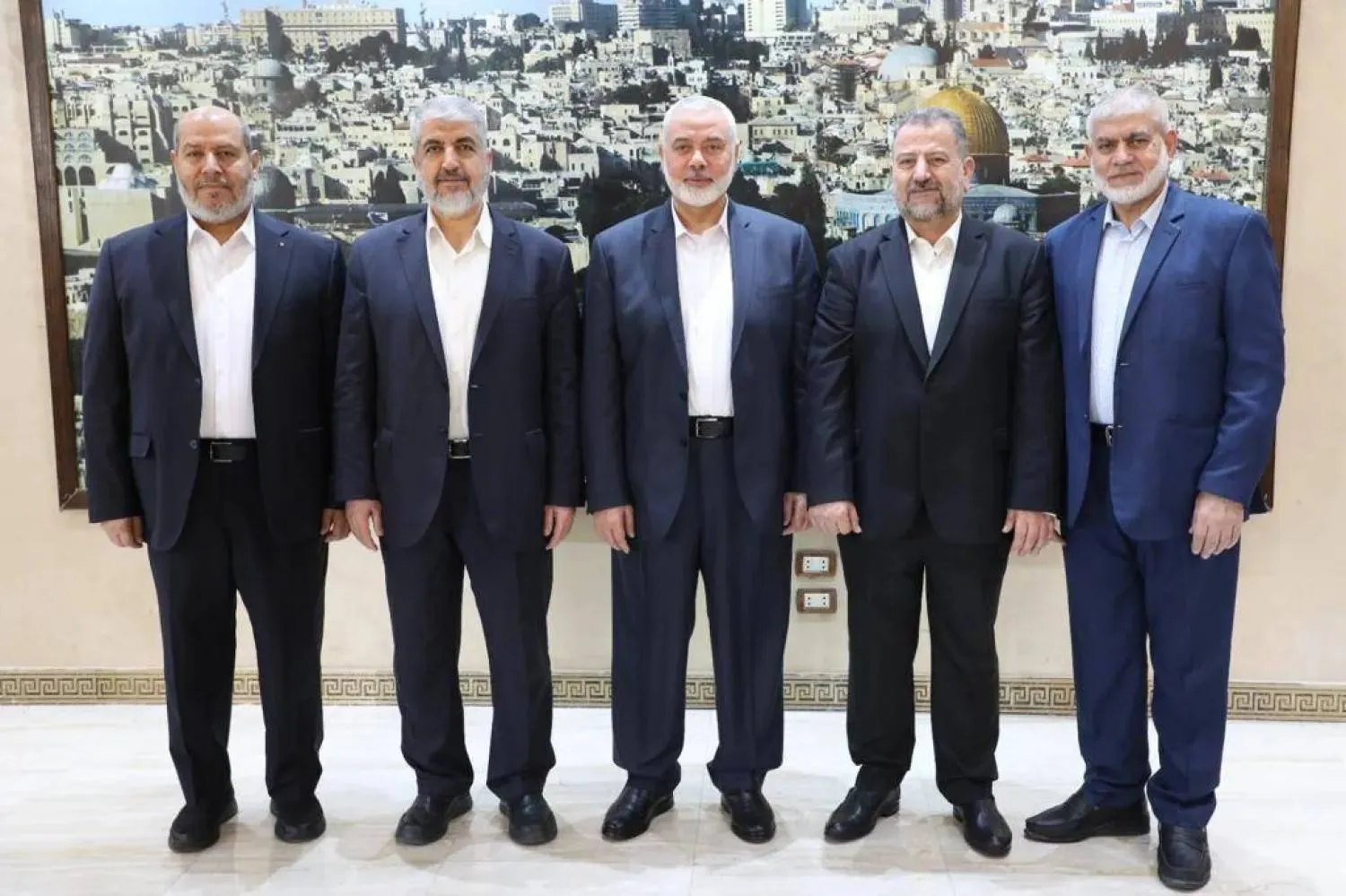
Hamas leaders, from right: Rawhi Mushtaha, Saleh al-Arouri and Ismail Haniyeh (all of whom were killed), alongside Khaled Meshaal and Khalil al-Hayya (file photo - Hamas-affiliated media).
TT

After 'Blank Ballot' Round, Hamas Resumes Vote for New Leader

Hamas leaders, from right: Rawhi Mushtaha, Saleh al-Arouri and Ismail Haniyeh (all of whom were killed), alongside Khaled Meshaal and Khalil al-Hayya (file photo - Hamas-affiliated media).

Hamas has resumed voting to elect the head of its political bureau, the movement’s highest leadership position, after an initial round last month failed to produce a winner. The process was delayed after some voters submitted blank ballots rather than backing any candidate.

Former political bureau chief Khaled Meshaal and Khalil al-Hayya, the movement’s chief in Gaza and head of its negotiating team in ceasefire talks, are competing for the post.

Two Hamas sources in Gaza told Asharq Al-Awsat that voting in the runoff round has begun in the enclave. One source said eligible voters are participating through a more secretive and complex process because of difficult security conditions and ongoing targeted killings.

Hamas is facing its most severe crisis since its founding in 1987. Israeli operations launched after the October 7, 2023 attack have targeted the movement across multiple levels and branches, creating significant organizational and financial challenges.

The two sources, speaking separately, said ballots are being delivered to eligible voters in sealed envelopes. After selecting a candidate, voters return their ballots through channels governed by strict security procedures designed to protect both participants and those overseeing the election process.

The political bureau chief is elected by the movement’s Shura Council, a 71-member body representing Hamas’s three main constituencies: Gaza, the West Bank, and the external leadership. The council had 50 members about a decade ago, but its size was later expanded following amendments to the movement’s internal regulations.

The sources said voting is also expected to take place in the West Bank and among Hamas officials abroad, although neither could confirm whether the process has already begun in those arenas.
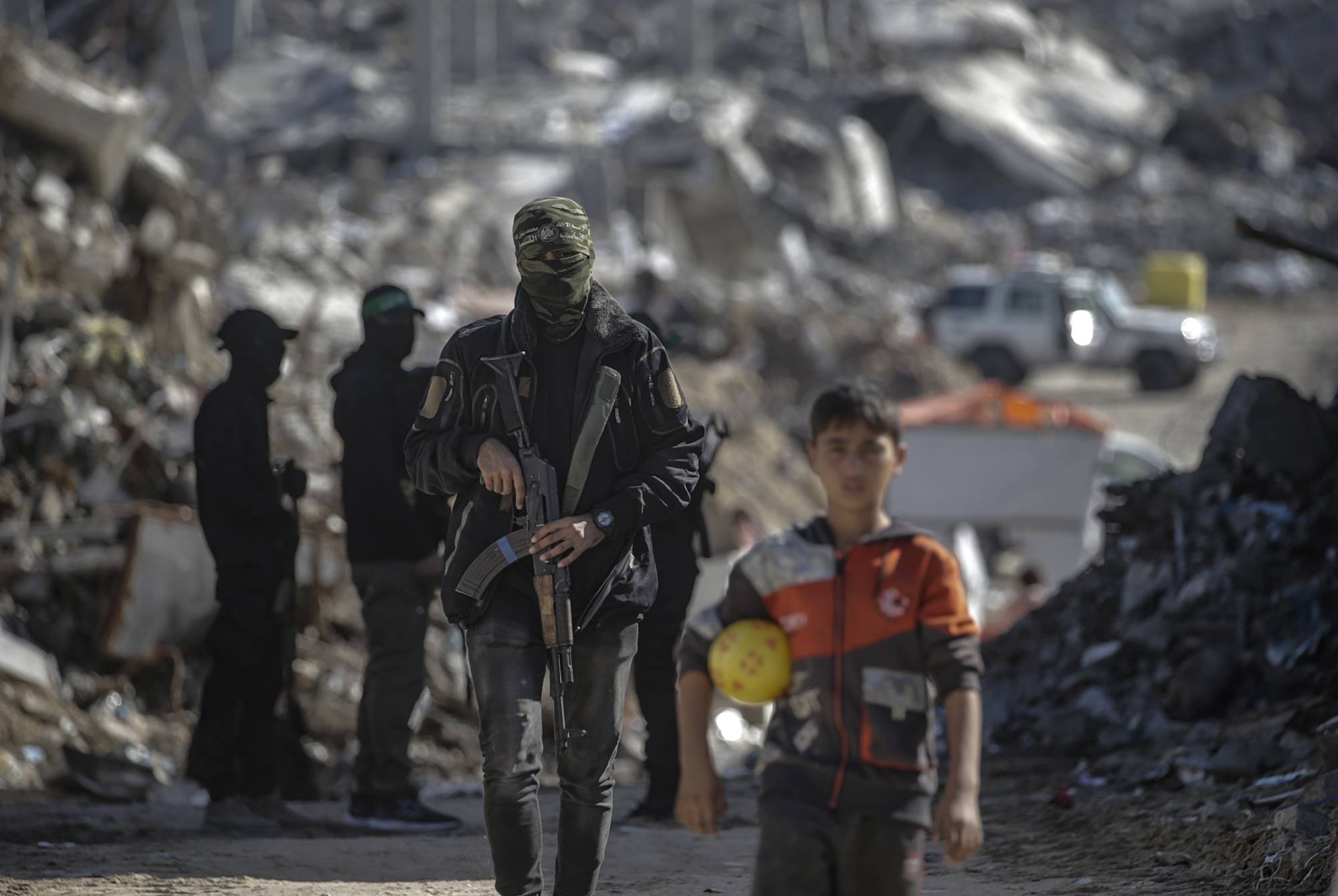
Fighters of the Al-Qassam Brigades, the military wing of the Hamas movement, stand guard as they search for the bodies of Israeli hostages alongside Red Cross workers in Jabaliya refugee camp in the northern Gaza Strip, 01 December 2025. EPA/MOHAMMED SABER

A More Secretive Runoff

On May 16, Hamas announced that the first round of voting had failed to determine a winner and said a second round would be held in accordance with the movement’s internal rules.

Under Hamas regulations, the runoff was expected to take place within 20 days. However, sources within the movement said security and political developments, including assassinations in Gaza and meetings between Hamas leaders abroad and regional mediators, delayed the process. They said the new round is being conducted under tighter secrecy than the first to prevent security breaches or media leaks.

Hamas leaders agreed to elect only a political bureau chief for now, postponing broader elections for the political bureau, the Shura Council, and other administrative bodies until early next year.

Israel killed Hamas political bureau chief Ismail Haniyeh in Tehran in July 2024. He was succeeded by Yahya Sinwar, who was killed in Gaza in October of the same year.

For roughly the past year and a half, Hamas has been run by a collective leadership council. Earlier this year, the movement launched a new effort to elect a leader to serve out the remainder of the current political bureau’s term, which was due to end in 2025 but was extended by an additional year, pending broader elections expected late this year or early next year.

Sources told Asharq Al-Awsat on May 21 that some voters had cast blank ballots as a way of declining to endorse either candidate, al-Hayya or Meshaal. According to the sources, this was the first known instance of blank ballots being used in a vote for the movement’s top leadership post.

At the time, some sources interpreted the blank ballots as a sign of dissatisfaction with both candidates and possibly with the movement’s handling of certain issues, as well as an effort to encourage the emergence of a younger generation of leaders. Others said the move was not necessarily directed at the candidates themselves but reflected broader objections to some existing policies, or a preference for postponing the election of an interim leader until comprehensive elections are held and the current leadership council remains in place.

Israeli Drone Strikes Kill at Least 4 in Southern Lebanon

A photograph shows destroyed buildings in the southern village of Srifa on June 16, 2026. (AFP)
TT

Israeli Drone Strikes Kill at Least 4 in Southern Lebanon

A photograph shows destroyed buildings in the southern village of Srifa on June 16, 2026. (AFP)

Israeli drone strikes targeted three vehicles in southern Lebanon on Tuesday, killing at least four people and wounding ‌others, Lebanon's ‌National News ‌Agency reported.

Two ⁠people were killed ⁠in a double-tap strike, with a drone hitting a car ⁠in the village ‌of ‌Mayfadoun followed ‌by a second strike ‌after people had gathered at the scene.

Another drone ‌strike on the town of ⁠Shoukin ⁠killed two other people, the agency said.

There was no immediate comment from the Israeli military on the reported strikes.


Türkiye Opposes Iraq Pipeline Deal Extension under Current Conditions, Official Says

A general view of oil tanks at Türkiye's Mediterranean port of Ceyhan, which is run by state-owned Petroleum Pipeline Corporation (BOTAS), some 70 km (43.5 miles) from Adana February 19, 2014. . REUTERS/Umit Bektas
TT

Türkiye Opposes Iraq Pipeline Deal Extension under Current Conditions, Official Says

A general view of oil tanks at Türkiye's Mediterranean port of Ceyhan, which is run by state-owned Petroleum Pipeline Corporation (BOTAS), some 70 km (43.5 miles) from Adana February 19, 2014. . REUTERS/Umit Bektas

Türkiye does not want an extension of the existing Kirkuk-Ceyhan oil pipeline agreement under current conditions, a senior Turkish official said, after Baghdad asked Ankara to extend it for at least a year to allow time for more talks.

The decades-old Türkiye-Iraq Crude Oil Pipeline Agreement, which governs exports through the pipeline, is due to expire on July 27. Baghdad and Ankara are still discussing a new draft agreement.

"There is no point in extending an agreement that has been subject to arbitration," the Turkish official, speaking on condition of anonymity, said when asked about Iraq's extension request.

Ceyhan is a crucial export outlet for Iraqi oil, with the state's main export terminal in Basra suffering from the closure of the Strait of Hormuz since US-Israeli strikes on Iran in late February.

Türkiye last year announced the end of the accord covering the pipeline and asked to renew it under new conditions. Türkiye's proposal included a mechanism to ensure the full use of the pipeline and options, such as extending the pipeline to the south of Iraq. The pipeline had remained offline for 2-1/2 years after an arbitration court ruled for Ankara to pay $1.5 billion in damages for unauthorized Iraqi exports Türkiye received between 2014 and 2018. Flows began late last year.

There is also a second arbitration case that covers a period from 2018 onwards and an award enforcement case running in a US court. The pipeline has a capacity of almost 1.5 million barrels per day but has been working significantly below capacity due to security and other issues. Crude exports from Kirkuk to Türkiye were at 177,000 barrels per day in April, according to shipping data reviewed by Reuters.


Israel Seizes Powers over Hebron Shrine from Palestinian Authority

Israeli flags flutter on the Ibrahimi mosque, also known as the Cave of the Patriarchs, in Hebron, in the Israeli-occupied West Bank April 21, 2026. REUTERS/Yosri Aljamal/File Photo
TT

Israel Seizes Powers over Hebron Shrine from Palestinian Authority

Israeli flags flutter on the Ibrahimi mosque, also known as the Cave of the Patriarchs, in Hebron, in the Israeli-occupied West Bank April 21, 2026. REUTERS/Yosri Aljamal/File Photo

Israel has seized planning and construction powers at a Jewish and Muslim shrine in the occupied West Bank from the Palestinian Authority, scrapping an agreement in place since the 1990s, Finance Minister Bezalel Smotrich said on Tuesday.

Under the 1997 Hebron Agreement, Palestinians controlled planning and construction in the entire city, including the Jewish Tomb of the Patriarchs and the adjoining Muslim Ibrahimi Mosque.

The far-right minister said he had given the final sign-off late on Monday to the transfer of those powers as they affected the religious site and the nearby Jewish settlement to Israeli authorities.

Israel's right to control the West Bank, which it captured in the 1967 Middle East War, is not recognized internationally. Palestinian President Mahmoud Abbas's office called the seizure of powers an "infringement upon the political and legal status of Hebron", and a violation of international law.

In a speech marking the establishment of a new Israeli settlement near Hebron, Smotrich said the "historic step" would deepen "Israeli sovereignty" in the West Bank, which Palestinians seek as the heart of a future independent state.

Israel is due to call an election by the end of October, ahead of which Smotrich is struggling in the polls. A settler himself, he has long pushed for the annexation of the West Bank and his party draws much of its support from ideologically motivated settlers who view the West Bank as their biblical heartland.

Hebron has at times been a flashpoint for Israeli-Palestinian violence. In 1994, a Jewish settler killed 29 Muslims praying at the shrine.

The decision to transfer the powers was taken by Prime Minister Benjamin Netanyahu's security cabinet in February, one of a series of measures meant to make it easier for settlers to buy land and give Israeli authorities more enforcement powers in the territory.

Smotrich has been key to a rapid expansion of Israeli settlements in the West Bank, which has been accompanied by a rise in violence.

UN bodies and most countries have found Israel's settlements in the West Bank to be illegal. Israel disputes this view, citing biblical and historical ties, as well as security needs.

Settlers have killed 13 Palestinians this year, according to UN data.