


Gold Steady as Investors Await Details of US-Iran Deal, Fed Verdict

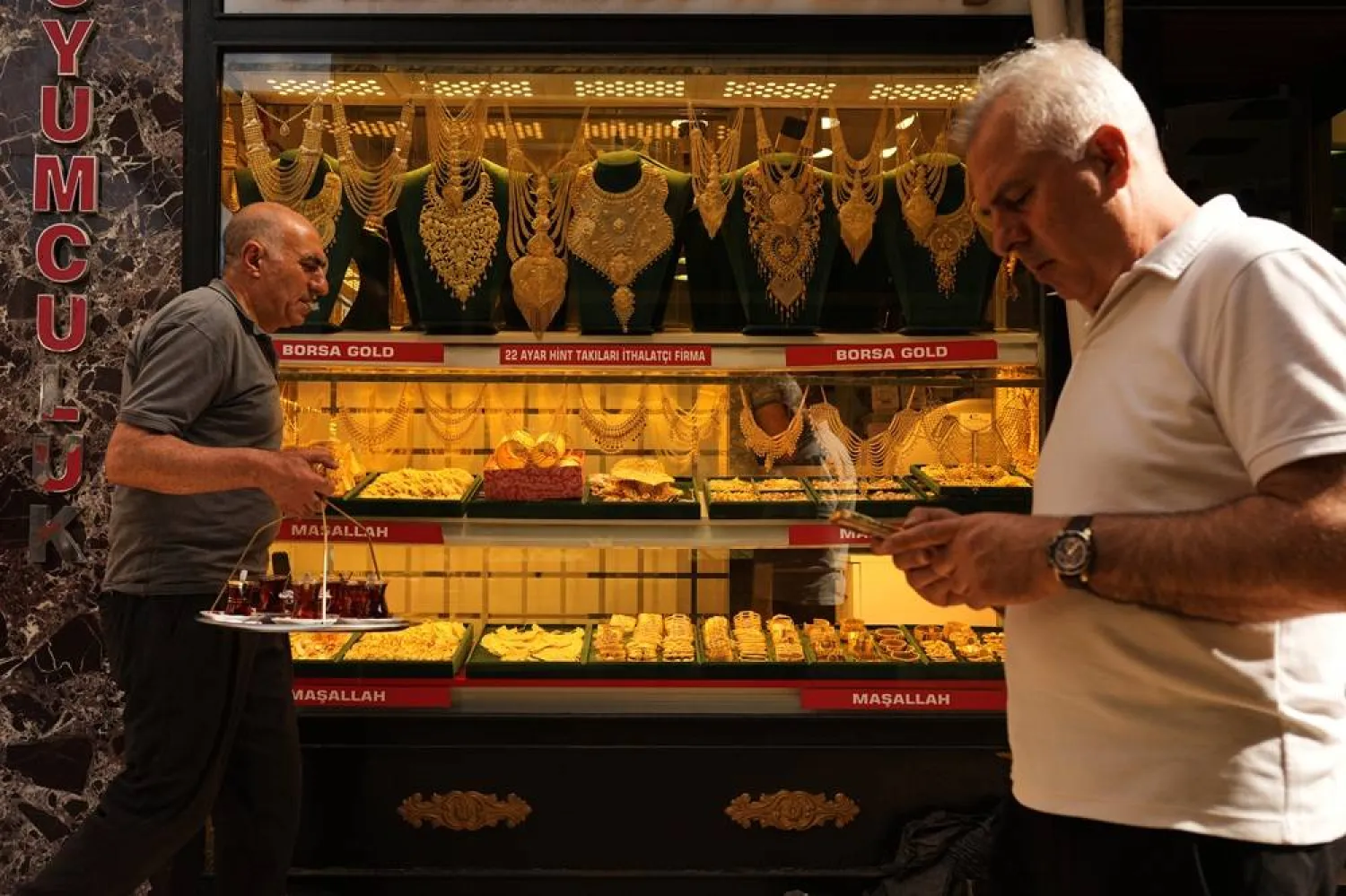
People walk past a gold business shop at the Grand Bazaar in Istanbul, Türkiye, Tuesday, June 16, 2026. (AP)
TT

Gold Steady as Investors Await Details of US-Iran Deal, Fed Verdict

People walk past a gold business shop at the Grand Bazaar in Istanbul, Türkiye, Tuesday, June 16, 2026. (AP)

Gold prices were steady on Wednesday, near a one-week high, as investors awaited further details on the US-Iran agreement and the Federal Reserve's policy decision from Kevin Warsh's debut meeting as Chair.

Spot gold was flat at $4,331.29 per ounce, as of 0420 GMT. U.S. gold futures for August delivery was down 0.1% at $4,351.40.

Bullion touched an ‌over one-week ‌high of $4,370.82 on Monday.

Details of a US-Iran interim deal ‌to ⁠end the conflict ⁠are emerging, with President Donald Trump saying it would rule out a nuclear weapon for Tehran and a US official saying it would allow Iran to sell oil once signed.

Oil prices hovered near a three-month low on expectations of Iranian supply, easing inflation concerns.

"The rally (in gold) is losing some steam as all eyes turn to the ⁠monetary policy announcement from the Fed," said Ilya Spivak, ‌head of global macro at ‌Tastylive.

"This marks the first FOMC meeting to be chaired by Kevin Warsh and ‌traders still seem unsure about how he will reconcile a ‌hawkish record, rising inflation, and pressure from a White House demanding a dovish pivot," Spivak said.

Most Fed policymakers now feel they will need to keep US short-term borrowing costs on hold all year, projections due out later ‌in the day are expected to show, with a small number seen penciling in a rate ⁠hike to ⁠stop a spike in inflation from getting entrenched in the economy.

Traders see a 59% chance of a US rate hike in December, down from about 70% last week before the US-Iran peace deal announcement, according to the CME FedWatch tool.

Gold tends to lose appeal when rates are high, as it does not yield interest.

"Over the longer term, structural support (for gold) is expected to persist, driven by ongoing Asian demand and continued central bank purchases as a hedge against geopolitical and policy risks," Westpac analysts wrote in a research note.

Spot silver fell 0.2% to $70.05 per ounce, platinum lost 0.7% to $1,792.05, and palladium was down 0.8% at $1,341.23.



OPEC+ Countries Reaffirm Commitment to Market Stability

FILE PHOTO: OPEC logo is seen in this illustration taken, October 8, 2023. REUTERS/Dado Ruvic/Illustration/File Photo
TT

OPEC+ Countries Reaffirm Commitment to Market Stability

FILE PHOTO: OPEC logo is seen in this illustration taken, October 8, 2023. REUTERS/Dado Ruvic/Illustration/File Photo

The seven OPEC+ countries, which previously announced additional voluntary adjustments in April and November 2023, namely Saudi Arabia, Russia, Iraq, Kuwait, Kazakhstan, Algeria, and Oman met virtually on November 29, 2026, to review global market conditions and outlook.

The seven countries reviewed current market conditions and emphasized the essential role of the Declaration of Cooperation (DoC) in supporting the stability of global energy markets. In this context, the seven countries highlighted the critical importance of safeguarding international maritime routes to ensure the uninterrupted flow of energy.

The countries also expressed concern regarding attacks on energy infrastructure, noting that restoring damaged energy assets to full capacity is both costly and takes a long time, thereby affecting overall supply availability.

Accordingly, the seven countries stressed that any actions undermining energy supply security, whether through attacks on infrastructure or disruption of international maritime routes, increase market volatility and weaken the collective efforts under the DoC to support market stability for the benefit of producers, consumers, and the global economy.

The seven countries will continue consultations and review market conditions through the Joint Ministerial Monitoring Committee (JMMC).


Syria’s Finance Ministry: 2026 Budget Deficit Estimated at $1.8 Billion, Not $2.8 Billion

Syrian Finance Minister Mohammed Yisr Barnieh meets with a World Bank mission for the Public Financial Management Modernization Project on November 28 (Finance Ministry).
TT

Syria’s Finance Ministry: 2026 Budget Deficit Estimated at $1.8 Billion, Not $2.8 Billion

Syrian Finance Minister Mohammed Yisr Barnieh meets with a World Bank mission for the Public Financial Management Modernization Project on November 28 (Finance Ministry).

Syria’s Ministry of Finance has dismissed reports that the country’s 2026 budget deficit is expected to reach $2.8 billion, clarifying that the estimated shortfall stands at approximately $1.8 billion based on conservative projections.

The ministry also said that figures circulating about salaries, pensions and development loans were not all based on official announcements or sources.

In a statement, the ministry stressed that the deficit outlined in the published 2026 budget was based on conservative estimates and did not represent the final fiscal outcome, which would depend on actual budget execution through the end of the financial year.

The budget projected revenues of approximately $8.716 billion and expenditures of $10.516 billion, resulting in an estimated deficit of $1.8 billion.

The ministry explained that its published financial performance report for the first half of 2026 showed a deficit of around $1 billion. However, it noted that government revenues are not evenly distributed between the two halves of the year.

Based on revenue collection patterns in previous years, approximately 30% to 35% of annual revenues are typically collected in the first half, compared with 65% to 70% in the second half.

The ministry attributed its expectation that the year-end deficit would be lower than initially budgeted to improving revenues and government measures to control and rationalize spending.

It emphasized that these projections remain estimates based on specific assumptions and sources and should not be treated as official or final fiscal results.

Regarding reports of salary and pension increases and a new minimum wage, the ministry said the figures and percentages being circulated had not been officially announced by either the ministry or the government.

It confirmed, however, that options for improving salaries and pensions remain under review in coordination with the Ministry of Administrative Development and other relevant authorities, taking into account the direct impact of these measures on the living conditions of employees and retirees.

Ministry Denies Annual Interest on Development Fund Loans

Regarding loans signed with the Saudi Fund for Development, the ministry denied reports circulating on some platforms that the agreements carry annual interest of 3%.

It clarified that the financing consists of concessional development loans that bear no interest and are subject only to modest administrative fees.

The ministry described the arrangements as similar to qard hasan, or interest-free loans, because they do not impose interest charges.

It stressed that the government's policy focuses on controlling public debt, avoiding unjustified borrowing and limiting loans to development purposes under highly concessional terms.

The ministry added that the loan agreements would be submitted to the People's Assembly for approval in accordance with established procedures.


Saudi Stock Market Closes 0.9% Higher, Above 10,000 Points

A man monitors stock prices in Saudi Arabia (AFP)
TT

Saudi Stock Market Closes 0.9% Higher, Above 10,000 Points

A man monitors stock prices in Saudi Arabia (AFP)

The Saudi stock market ended Sunday's session higher, with the Tadawul All Share Index (TASI) rising 0.9% to close at 10,009 points, gaining 86 points. This marked its first close above the 10,000-point threshold since falling below it last week.

The gains came amid improved performance by heavyweight stocks, while trading liquidity fell to its lowest level since January 2026, with turnover reaching approximately SAR 2 billion ($533 million), indicating continued investor caution despite the market's advance.

Al Rajhi Bank shares rose 1.1%, Saudi National Bank gained 1%, and Saudi Aramco advanced 0.4%.

Amana Insurance topped the gainers with a 7.8% increase, followed by Wataniya Insurance at 7.6% and Gulf Insurance Group (GIG) at 6.3%.

Shares of Petro Rabigh, Al Jouf, BCI, Banan, Salama and Gulf General Insurance also rose between 5% and 6%.

Conversely, Budget Saudi, Jahez, SACO and Saudi Ceramics declined between 2% and 4%.