


Israel Launches Fresh Airstrikes in Lebanon; Trump Says He Could Still Restart War

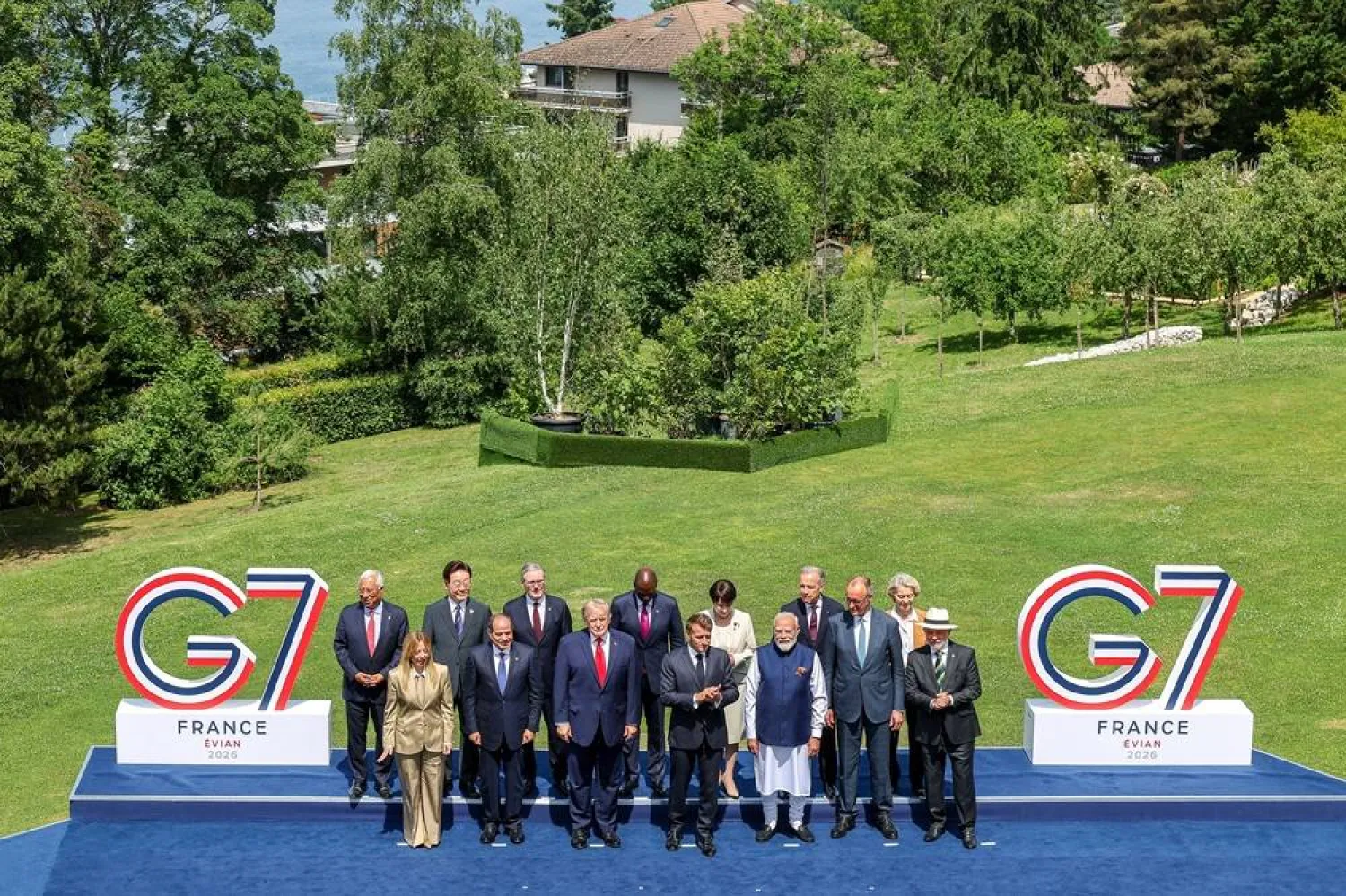
US President Donald Trump, French President Emmanuel Macron, Canadian Prime Minister Mark Carney, Italian Prime Minister Giorgia Meloni, Japanese Prime Minister Sanae Takaichi, European Commission President Ursula von der Leyen, European Council President Antonio Costa, German Chancellor Friedrich Merz, Egyptian President Abdel Fattah al-Sisi, South Korea's President Lee Jae Myung, India's Prime Minister Narendra Modi, Brazilian President Luiz Inacio Lula da Silva, Kenya's President William Ruto and British Prime Minister Keir Starmer pose during a family photo at the G7 summit in Evian, France, on Tuesday June 16, 2026. (Pool via Reuters)
TT

Israel Launches Fresh Airstrikes in Lebanon; Trump Says He Could Still Restart War

US President Donald Trump, French President Emmanuel Macron, Canadian Prime Minister Mark Carney, Italian Prime Minister Giorgia Meloni, Japanese Prime Minister Sanae Takaichi, European Commission President Ursula von der Leyen, European Council President Antonio Costa, German Chancellor Friedrich Merz, Egyptian President Abdel Fattah al-Sisi, South Korea's President Lee Jae Myung, India's Prime Minister Narendra Modi, Brazilian President Luiz Inacio Lula da Silva, Kenya's President William Ruto and British Prime Minister Keir Starmer pose during a family photo at the G7 summit in Evian, France, on Tuesday June 16, 2026. (Pool via Reuters)

US President Donald Trump said on Wednesday his new ceasefire agreement with Iran was not final and he could resume the war if he is unsatisfied, even as Israel launched fresh airstrikes in Lebanon where fighting threatens the wider truce. 

"It's a memorandum of understanding. And if I don't like it, we'll go back to shooting at them, dropping bombs on their head," Trump said at a G7 summit in France of the agreement, reached three days ago. 

"If I don't like it, if they don't behave, we'll go right back to dropping bombs right smack in the middle of their head, OK?" 

Leaders hailed the agreement at the summit, held in the French town of Evian-les-Bains, an hour's drive along the shore of Lake Geneva from where the Iran ceasefire memorandum is due to be signed at a ceremony across the Swiss border on ‌Friday. 

The leaders also demanded ‌an immediate ceasefire in Lebanon, where the memorandum calls for a halt to hostilities between Israel and ‌the ⁠Iran-backed Hezbollah group ⁠that have displaced more than a million people. 

Fighting there has abated but not ceased since the agreement was reached on Sunday, and Israel, which was not part of the negotiations, says it retains the right to use force. 

Lebanese state media reported fresh Israeli air strikes and artillery fire in several southern towns throughout Wednesday. Lebanese security sources said Hezbollah had also launched two drone attacks on Israeli forces in the south. The group did not publicly claim the attacks. 

Israel later said five of its soldiers had been injured in two Hezbollah drone attacks in southern Lebanon. 

Inside the southern Lebanese city of Nabatieh, below a mediaeval castle seized by Israeli forces, buildings had been blasted to ruins resembling the Gaza Strip. 

Khodr Kodeih, a member of the town council, told Reuters that some ⁠displaced residents had come back to check on their homes in recent days, but that the fresh ‌strikes were again keeping them away. 

"The city of Nabatieh emptied out again. We hope that ‌a safe environment can be secured so people can return, because the basic necessities of life are still not available," Kodeih said. 

The memorandum of understanding, yet ‌to be made public three days after it was signed by Washington and Tehran, extends a ceasefire announced in April by another 60 ‌days to allow them to negotiate a permanent truce. 

G7 LEADERS BACK DEAL 

The G7 summit gave Trump a chance to present his deal with Iran to allies Britain, Canada, France, Germany, Italy and Japan. 

They share Washington's concerns about Iran's nuclear program and other issues, but never endorsed his decision to go to war, and worry Tehran has gained leverage by withstanding the onslaught and asserting control over the strait. 

"We underline the need for the negotiation ... to address the threats posed by Iran in ‌the region and beyond and ensure that they never obtain a nuclear weapon," the G7 leaders said in a statement. 

They said they were ready to contribute to implementing the accord, with a coalition led ⁠by Britain and France set ⁠to help secure shipping once the Strait of Hormuz reopens. 

Oil prices fell again on Wednesday on prospects for the reopening of the Strait of Hormuz, with Brent crude futures below $80, at their lowest level since the opening salvos of the US-Iran conflict. 

MOST IRANIANS 'ARE IN SURVIVAL MODE' 

Trump appears to have achieved little of what he said he wanted at the outset of the war. Iran's theocratic government remains in place, its stockpile of highly enriched uranium has not been surrendered, its ballistic missile capabilities have not been destroyed and it has not ended its support for anti-Israel armed groups like Hezbollah in Lebanon. 

Trump says the agreement states that Iran will not have a nuclear weapon - a restatement of Iran's official position since the 1970s. US officials say further discussions will lead to the removal or destruction of its enriched uranium stockpile. 

But ending the war on such terms could still expose Trump to criticism, including from hawks within his own Republican party, ahead of midterm elections in November. 

The mood among ordinary Iranians, grappling with economic woes further exacerbated by months of war, remained grim, even as their leaders declared this week's interim deal a diplomatic victory for Tehran over Washington. 

"I think 99% of people are in survival mode and just living day by day," said Amir, 34, a media production company owner in Isfahan in central Iran, who declined to give his surname. 

"I don’t think anybody has any hopes anymore. I don’t think anybody has any visions of what the future might look like." 


US Lawmaker Says He Was ‘Detained’ by Israeli Settlers in West Bank

US Representative Ro Khanna (D-CA) speaks with a Palestinian resident of Turmus Ayya, near Ramallah, during a visit in the Israeli-occupied West Bank, July 9, 2026. (Reuters)
TT

US Lawmaker Says He Was ‘Detained’ by Israeli Settlers in West Bank

US Representative Ro Khanna (D-CA) speaks with a Palestinian resident of Turmus Ayya, near Ramallah, during a visit in the Israeli-occupied West Bank, July 9, 2026. (Reuters)

A prominent Democratic US lawmaker from California, Ro Khanna, said Saturday he was "detained" by armed Israeli settlers along with other Americans during a visit to the Israeli-occupied West Bank and said the military was complicit in the incident.

"Israeli settlers, brandishing American made M4s, detained me & other Americans on my trip to Palestine," Khanna said in a post on X.

When the Israeli military arrived at the scene, he added, "they sided with the settlers & continued our detention. They made a huge mistake."

Footage and accounts provided to The New York Times by Khanna and his team shows a group of armed men blocking the road outside a small village in the southern West Bank and swearing at them in Hebrew and Arabic.

Khanna told the Times that when the Israeli troops arrived at the scene, the soldiers spoke to the settlers and subsequently blocked the road themselves when the settlers left.

After calls to the US embassy and Israeli police, Khanna said he was allowed to pass.

The Israeli army did not immediately respond to an AFP request for comment.

The United States is a staunch ally of Israel, but some lawmakers, especially Democrats, have vehemently criticized Israel's military offensive in Gaza, and more generally the treatment of Palestinians in the occupied territories.


Floods in Bangladesh Kill 44, Leave Over a Million Stranded

11 July 2026, Bangladesh, Dhaka: People wade through floodwaters in Dhaka, after torrential rain caused severe flooding and waterlogging across parts of the country. (dpa)
TT

Floods in Bangladesh Kill 44, Leave Over a Million Stranded

11 July 2026, Bangladesh, Dhaka: People wade through floodwaters in Dhaka, after torrential rain caused severe flooding and waterlogging across parts of the country. (dpa)

Floods and landslides triggered by days of torrential monsoon rain have killed at least 44 people in southeastern Bangladesh and left over a million stranded as authorities raced on Saturday to deliver aid to devastated communities.

The disaster management ministry said on Saturday that flooding across seven districts — Chattogram, Cox’s Bazar, Bandarban, Rangamati, Khagrachhari, Moulvibazar and Habiganj — has disrupted daily life, isolated thousands of families, and stranded 267,918 households.

Power outages, damaged roads and broken communication ‌links have slowed ‌rescue and relief efforts. Many residents have been unable ‌to ⁠cook for days ⁠as flood waters submerged their homes, while others are struggling after thick layers of mud covered kitchens and living spaces.

“There is still water inside our home and we have no way to cook. The dry food we had has run out, and we spend the nights in the dark with our children because there is no ⁠electricity,” said Nurul Islam, a resident of a flood-hit ‌area in Chattogram.

Thousands of families are ‌relying on dry food — flattened rice, puffed rice or biscuits that do ‌not require cooking — and emergency relief. Washed-out roads and damaged bridges, ‌however, have made it difficult for aid workers to reach some of the hardest-hit communities.

Army and navy personnel are ferrying food, drinking water, medicines and other essential supplies by boat to isolated communities, as authorities step up relief ‌efforts.

"The government is doing everything possible to support flood victims. Relief, safe drinking water and medical supplies are ⁠being distributed, ⁠and we urge people whose homes have been inundated to move to the nearest shelter," Disaster Management and Relief Minister Iqbal Hossain said during a visit to affected areas in Chattogram.

The heavy rain also triggered landslides in Rohingya refugee camps in Cox’s Bazar earlier this week, killing 16 refugees, including women and children. More than one million Rohingya refugees live in the camps, where makeshift shelters on steep, deforested hillsides are especially vulnerable during the monsoon season.

Bangladesh is one of the world’s most disaster-prone countries, with seasonal monsoon rains regularly causing floods, river erosion and landslides. Scientists say climate change is making extreme rainfall more frequent and intense, increasing the scale and severity of such disasters.


Iran Warns It Will Not Be Bound by Deal with US if Violations Continue

An Iranian woman walks near an anti-US mural in a street in Tehran, Iran, 09 July 2026. (EPA)
TT

Iran Warns It Will Not Be Bound by Deal with US if Violations Continue

An Iranian woman walks near an anti-US mural in a street in Tehran, Iran, 09 July 2026. (EPA)

Iran warned that it would no longer be bound by a deal with the US aimed at ending the Middle East war if Washington's violations of the agreement continued, state TV reported on Saturday.

Referring to the deal struck with the help of Pakistani mediation, Tehran's UN ambassador said in remarks in New York on Friday "that if the United States continues to violate its obligations under the Islamabad Understanding, Iran will no longer consider itself bound by its commitments under that understanding", according to a statement carried by state broadcaster IRIB.

The Iran-US deal was preceded by an April ceasefire, but the two sides have exchanged significant fire in recent days over the Strait of Hormuz, threatening talks laid out under the deal aimed at finding a permanent resolution to the war.

Following the exchanges, US President Donald Trump declared the ceasefire over, but said talks with Iran would continue.

In his remarks to reporters on Friday, Iranian UN representative Amir Saeid Iravani said Washington had "violated its obligation by launching and continuing large-scale military attacks against Iran's sovereignty and territorial integrity".

"Iran remains committed to the faithful implementation of (the) Memorandum of Understanding provided that the United States fully and faithfully complies with its own obligations," he added.
