
Israeli Military Strikes Southern Lebanon in Intense Fighting, At Least 18 Dead

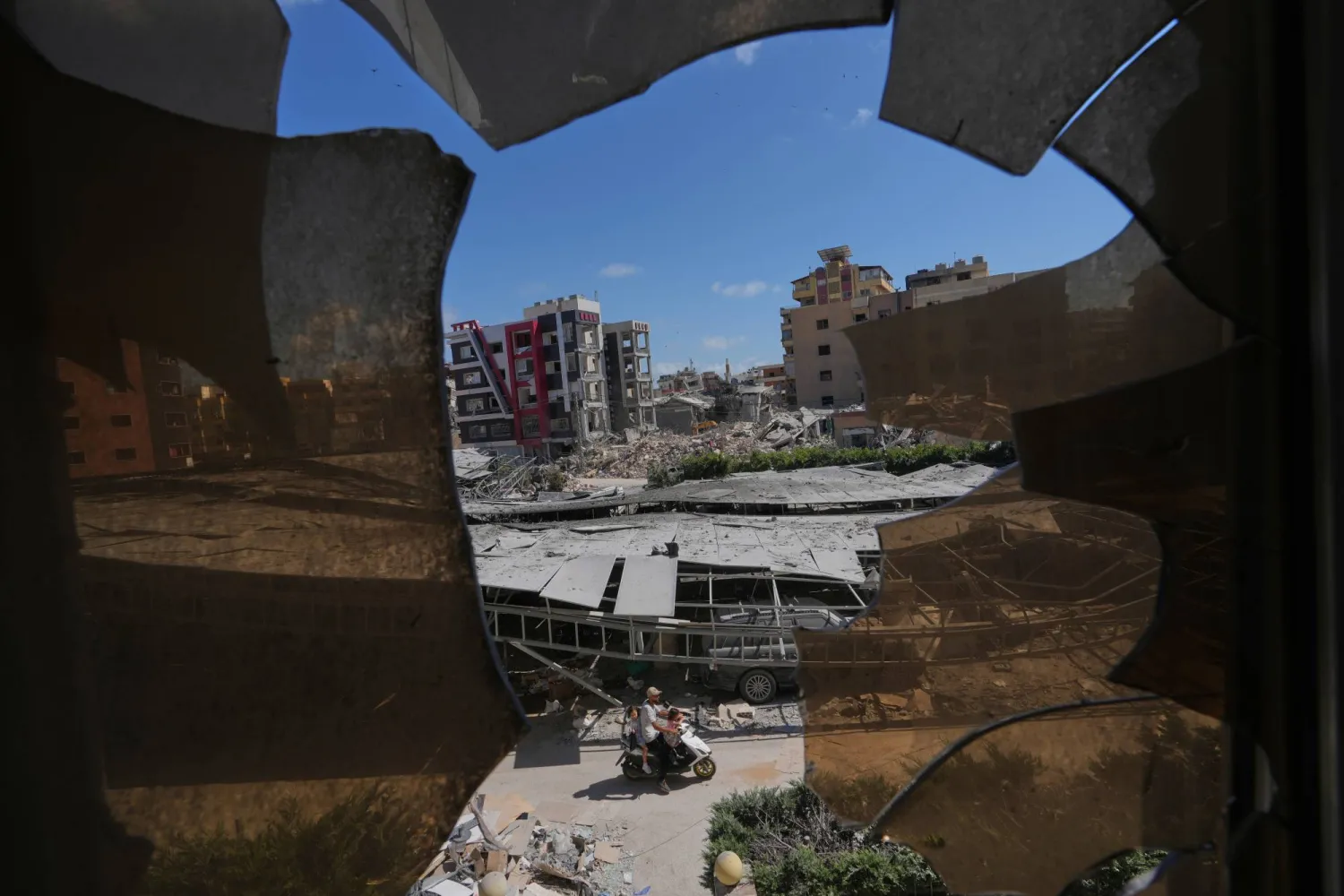
Buildings damaged by Israeli strikes are seen through shattered glass from the Jabal Amel Hospital in the southern port city of Tyre, Lebanon, Thursday, June 18, 2026. (AP Photo/Hassan Ammar)
TT

Israeli Military Strikes Southern Lebanon in Intense Fighting, At Least 18 Dead

Buildings damaged by Israeli strikes are seen through shattered glass from the Jabal Amel Hospital in the southern port city of Tyre, Lebanon, Thursday, June 18, 2026. (AP Photo/Hassan Ammar)

Israel’s military said Friday its forces struck targets throughout southern Lebanon overnight as Hezbollah reported intense fighting in the area, threatening the nascent agreement between Iran and the United States to end their war.

"During the night, the army struck and continues to strike Hezbollah terrorists and infrastructure in several areas in southern Lebanon," the Israeli military said in a statement.

"The intensive Israeli airstrikes carried out from midnight until this morning have prevented the evacuation of the martyrs and wounded, and have resulted in a preliminary toll of 18 martyrs and 33 wounded" in at least 10 villages and towns, the Lebanese health ministry said.

Israeli military vehicles and an Israeli flag, seen in a village inside south Lebanon close to the border as seen from northern Israel, June 18, 2026. REUTERS/Gil Eliyahu


Hezbollah said its fighters had targeted "three Merkava tanks with guided missiles, which led to their destruction.”

The group said Israeli forces "consisting of an armored platoon and an infantry platoon (tried) to infiltrate towards the northern side of the Ali al-Taher hills" -- a strategic site overlooking the key town of Nabatieh.

"The clashes are still ongoing," Hezbollah said in the statement released in the early hours of Friday.

Continued fighting in Lebanon could unravel the newly signed deal, which calls for an immediate halt to military operations “on all fronts, including in Lebanon,” where Israel has been battling Hezbollah, and for ensuring Lebanon’s “territorial integrity and sovereignty.”

Israeli Prime Minister Benjamin Netanyahu has refused to withdraw, saying Israeli forces will remain in Lebanon until the threat from Hezbollah has been eliminated.

The attacks came as planned talks in Switzerland between Iran and the United States over their efforts to reach a permanent end to the Iran war were delayed.

US Vice President JD Vance on Thursday put off his trip to Switzerland where he had been set to lead the talks.

The White House blamed logistical issues.

US President Donald Trump signed the initial pact with Iran on Wednesday while dining with French President Emmanuel Macron at the Palace of Versailles, which took immediate effect.

In comments following the signing, Vance offered a blunt warning to Israel, saying Trump was “the only head of state in the entire world who is sympathetic to the nation of Israel at this moment in time.”


Hamas Pushes to Elect Leader to Demonstrate Unity, Heed ‘External Advice’

Palestinian women mourn during the funeral of a man killed in an Israeli strike in Gaza City on Thursday. (AFP)
TT

Hamas Pushes to Elect Leader to Demonstrate Unity, Heed ‘External Advice’

Palestinian women mourn during the funeral of a man killed in an Israeli strike in Gaza City on Thursday. (AFP)

Hamas is pressing ahead with efforts to elect a new political bureau chief despite ongoing Gaza ceasefire negotiations and continued Israeli military operations, a move that officials say is intended to project internal unity and respond to recommendations from outside parties close to the movement.

The push comes after a first round of voting in May failed to produce a winner between the two leading contenders: Khalil al-Hayya, a member of Hamas’s leadership council, and Khaled Meshaal, the veteran leader of the movement’s overseas branch.

Sources within Hamas said the accelerated election process is driven by several factors, including a desire to project internal consensus and recommendations from outside parties close to the movement.

Under Hamas regulations, the new leader would initially serve a short term lasting until early next year, with the possibility of an extension until broader internal elections are completed.

A senior Hamas official based outside the Palestinian territories said electing a political bureau chief is necessary to ensure stability within the movement. He noted that the leadership council had originally been expected to continue managing Hamas’s affairs until the next internal elections, but several developments prompted a decision to fast-track the selection of a new leader.

Among those factors, the official said, is the need to make both internal and external decisions while demonstrating unity to observers, supporters and Hamas’ broader constituency. “There is a need to show that capable leaders are in place to guide the movement through this critical period,” he said.

The official added that several outside actors with close ties to Hamas have encouraged the movement to appoint a clearly identifiable leader, arguing that such a step is politically important. He declined to identify those parties.

For roughly the past year and a half, Hamas has been run by a leadership council headed by Mohammed Darwish, chairman of the movement’s Shura Council. The body includes leaders representing Gaza, the West Bank and Hamas’s overseas branches, as well as the movement’s secretary-general.

Another source said Darwish himself pushed for the election process to resume in order to fill the leadership vacancy. While he has effectively represented the movement through the leadership council, he is expected to return to his previous role as head of the Shura Council once a new chief is chosen.

The source noted that a combination of personal considerations and organizational concerns, both internal and external, contributed to Darwish’s support for holding the election.

Asked whether Darwish may be seeking to avoid responsibility for major decisions expected in the coming months — particularly as ceasefire negotiations enter a sensitive phase involving the future of Hamas’s weapons — the source rejected the notion.

“Such decisions are not made by one person, even if that person is the head of the political bureau,” the source underlined. “All major decisions are reached through consensus within the political bureau and the movement’s executive bodies.”

While emphasizing that responsibility for consequential decisions is collective, the source acknowledged that the movement’s leader still plays an important role during pivotal moments.

Military Wing Backed Vote

Three Hamas sources in Gaza said the push to elect a political bureau chief was strongly supported by both the movement’s Gaza leadership and its military wing, the Izz al-Din al-Qassam Brigades, even before the killings of senior commanders Izz al-Din al-Haddad and Mohammed Awda.

One source said al-Haddad believed Hamas needed a clearly defined leader under current circumstances and that other Qassam commanders shared that view. He also participated in the most recent round of voting.

The assassination campaign targeting Hamas and Qassam leaders in Gaza temporarily interrupted the election process. According to one source, the vote was postponed to allow the military wing to reorganize its leadership structure and ensure that both military and political leaders in Gaza could participate securely.

The sources said electing an overall movement leader would also give Hamas’ three regional branches — Gaza, the West Bank and the external leadership — greater flexibility in managing their own affairs. The winner of the race, either al-Hayya or Meshaal, would vacate his current regional leadership post, creating an opportunity for a new figure to assume responsibility for either Gaza or Hamas’ overseas organization.


Lebanon Detains Suspect Accused of Importing Equipment for Hezbollah Drone Production

Two Israeli soldiers take cover from a Hezbollah drone near the Lebanon border. (AFP) 
TT

Lebanon Detains Suspect Accused of Importing Equipment for Hezbollah Drone Production

Two Israeli soldiers take cover from a Hezbollah drone near the Lebanon border. (AFP) 

Lebanese authorities have detained a Lebanese national at the request of French judicial authorities on suspicion of importing electrical equipment from France for Hezbollah, allegedly for use in military activities, particularly the manufacture of drones.

The Internal Security Forces’ Information Branch arrested the suspect, identified as Rabih T., and launched an investigation under the direction of Prosecutor General Ahmad Rami al-Hajj, who is personally overseeing the case.

A senior judicial source said the arrest followed a French judicial request seeking the suspect’s detention and extradition for questioning in connection with a network dismantled in France that is suspected of exporting equipment and devices to Hezbollah.

According to the source, who requested anonymity, the suspect underwent preliminary questioning by the Information Branch under the direct supervision of Prosecutor General al-Hajj and Military Court Commissioner Judge Claude Ghanem.

During the interrogation, he acknowledged importing three shipments of electrical equipment and devices, which he later handed over to an individual he said he knew only by a nickname and who is believed to be affiliated with Hezbollah.

The suspect reportedly told investigators he was unaware that the equipment could be used for military manufacturing purposes.

The case comes amid growing international scrutiny of Hezbollah’s financing channels and its military and technological capabilities, particularly programs linked to the development of unmanned aerial vehicles.

The judicial source said the suspect admitted importing the equipment through maritime shipping as part of larger consignments of electrical supplies for his company.

He told investigators that he owns a business operating in the electrical equipment sector and that the imports were conducted as part of his normal commercial activities.

He denied any knowledge of the equipment’s ultimate use or the purpose for which it had been imported.

The statements are considered significant because investigators suspect the imported devices may have been used in the production of motors or other technical components for Hezbollah drones, a key focus of ongoing investigations in both Lebanon and France.

Alongside the security and judicial inquiries, Lebanese authorities have formally notified France of the suspect’s arrest.

The source said the Public Prosecution Office has requested a complete copy of the French investigation and supporting documents to assist Lebanese authorities in assessing the evidence underlying the French judicial request and determining the accuracy of the allegations.

The Information Branch has completed its preliminary investigation and referred the case to the military prosecutor’s office. Judge Ghanem subsequently filed charges against the suspect and transferred the case to a military investigating judge.

Authorities have also issued a search order aimed at identifying and apprehending a second individual believed to be involved.

Although the military judiciary has formally taken up the case, judicial officials say the investigation remains in its early stages.

The significance of the case, the source said, will largely depend on the evidence provided by French authorities, including details about the imported equipment, its actual end use, and the identities of members of the suspected network in both France and Lebanon.

Investigators are seeking to determine whether the imports were legitimate commercial transactions later diverted to unauthorized uses without the importer’s knowledge, or whether they formed part of a broader network involved in procuring technical components for Hezbollah’s military-development programs — a scenario that would give the case security implications extending well beyond Lebanon.


Israeli Minister Says 'All of Lebanon Must Burn' after 4 Soldiers Killed

A photograph taken from the southern Lebanese region of Marjayoun shows smoke rising following an Israeli airstrike on the village of Choukine on June 19, 2026. (Photo by AFP)
TT

Israeli Minister Says 'All of Lebanon Must Burn' after 4 Soldiers Killed

A photograph taken from the southern Lebanese region of Marjayoun shows smoke rising following an Israeli airstrike on the village of Choukine on June 19, 2026. (Photo by AFP)

Far-right Israeli National Security Minister Itamar Ben Gvir said Friday that "all of Lebanon must burn" after Israel's military announced the deaths of four soldiers there.

"With all due respect to the Americans, Israel must make it clear to the entire world that the blood of our sons and the security of our citizens are not up for bargaining. All of Lebanon must burn," Ben Gvir said in a statement.

Lebanon said 18 people were killed Friday in Israeli airstrikes in the south.

Israel had said it was striking Hezbollah targets overnight and into the morning, while the Iran-backed militant group said it was attacking Israeli forces around the southern town of Nabatieh.

The strikes were the deadliest since Iran and the United States agreed to halt the wider Middle East war on Monday.

The Israeli military, meanwhile, said Lieutenant Colonel Dor Gedalia Ben Simhon had "fallen in combat" along with three other soldiers it did not immediately identify.

In a separate statement it reported a reserve officer was severely wounded "as a result of an explosive drone impact in southern Lebanon,” with four other soldiers lightly injured in the incident.