


Lebanon Detains Suspect Accused of Importing Equipment for Hezbollah Drone Production

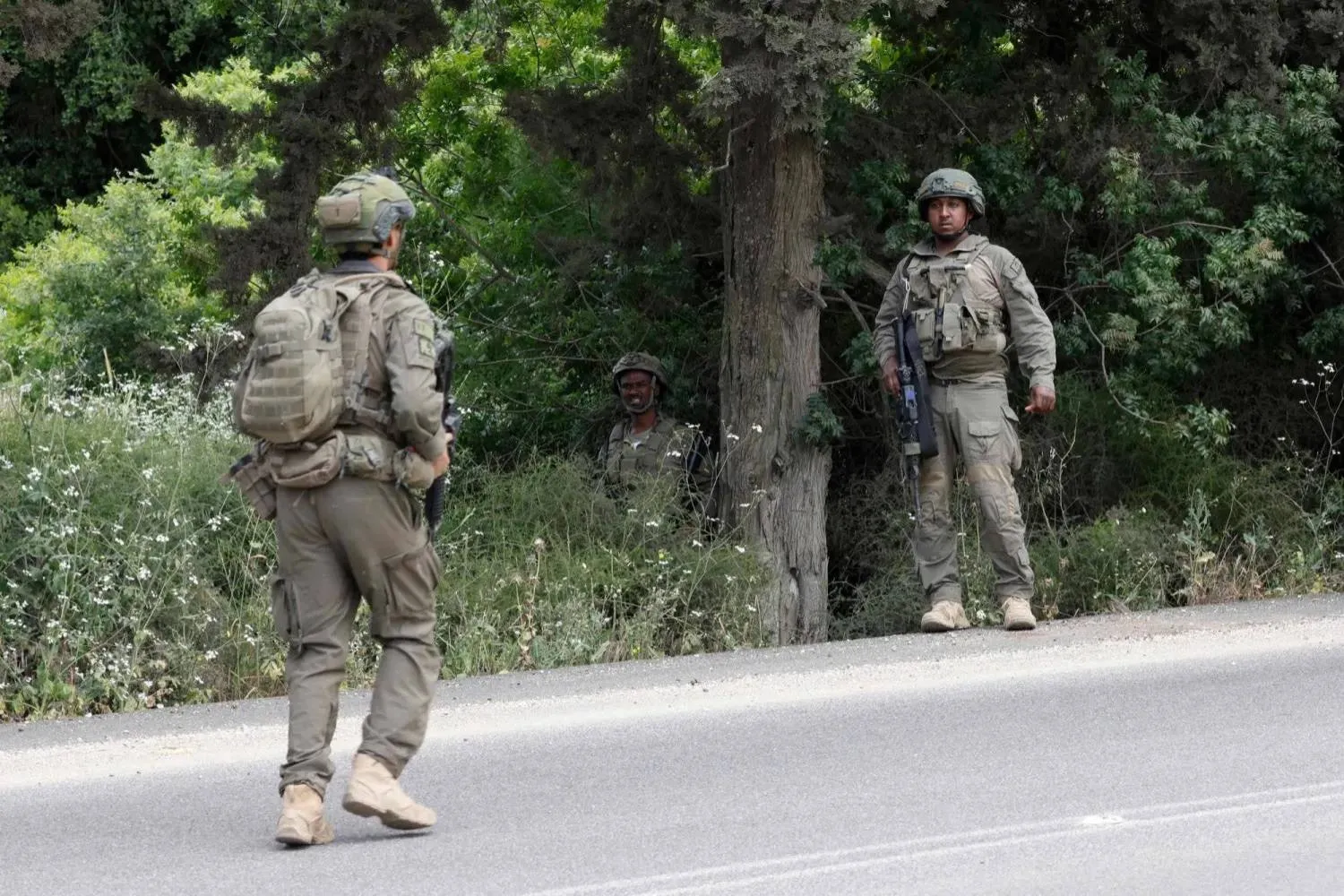
Two Israeli soldiers take cover from a Hezbollah drone near the Lebanon border. (AFP) 
TT

Lebanon Detains Suspect Accused of Importing Equipment for Hezbollah Drone Production

Two Israeli soldiers take cover from a Hezbollah drone near the Lebanon border. (AFP) 

Lebanese authorities have detained a Lebanese national at the request of French judicial authorities on suspicion of importing electrical equipment from France for Hezbollah, allegedly for use in military activities, particularly the manufacture of drones.

The Internal Security Forces’ Information Branch arrested the suspect, identified as Rabih T., and launched an investigation under the direction of Prosecutor General Ahmad Rami al-Hajj, who is personally overseeing the case.

A senior judicial source said the arrest followed a French judicial request seeking the suspect’s detention and extradition for questioning in connection with a network dismantled in France that is suspected of exporting equipment and devices to Hezbollah.

According to the source, who requested anonymity, the suspect underwent preliminary questioning by the Information Branch under the direct supervision of Prosecutor General al-Hajj and Military Court Commissioner Judge Claude Ghanem.

During the interrogation, he acknowledged importing three shipments of electrical equipment and devices, which he later handed over to an individual he said he knew only by a nickname and who is believed to be affiliated with Hezbollah.

The suspect reportedly told investigators he was unaware that the equipment could be used for military manufacturing purposes.

The case comes amid growing international scrutiny of Hezbollah’s financing channels and its military and technological capabilities, particularly programs linked to the development of unmanned aerial vehicles.

The judicial source said the suspect admitted importing the equipment through maritime shipping as part of larger consignments of electrical supplies for his company.

He told investigators that he owns a business operating in the electrical equipment sector and that the imports were conducted as part of his normal commercial activities.

He denied any knowledge of the equipment’s ultimate use or the purpose for which it had been imported.

The statements are considered significant because investigators suspect the imported devices may have been used in the production of motors or other technical components for Hezbollah drones, a key focus of ongoing investigations in both Lebanon and France.

Alongside the security and judicial inquiries, Lebanese authorities have formally notified France of the suspect’s arrest.

The source said the Public Prosecution Office has requested a complete copy of the French investigation and supporting documents to assist Lebanese authorities in assessing the evidence underlying the French judicial request and determining the accuracy of the allegations.

The Information Branch has completed its preliminary investigation and referred the case to the military prosecutor’s office. Judge Ghanem subsequently filed charges against the suspect and transferred the case to a military investigating judge.

Authorities have also issued a search order aimed at identifying and apprehending a second individual believed to be involved.

Although the military judiciary has formally taken up the case, judicial officials say the investigation remains in its early stages.

The significance of the case, the source said, will largely depend on the evidence provided by French authorities, including details about the imported equipment, its actual end use, and the identities of members of the suspected network in both France and Lebanon.

Investigators are seeking to determine whether the imports were legitimate commercial transactions later diverted to unauthorized uses without the importer’s knowledge, or whether they formed part of a broader network involved in procuring technical components for Hezbollah’s military-development programs — a scenario that would give the case security implications extending well beyond Lebanon.


Blast Targets Security Forces’ Bus Near Damascus, Causing Injuries

Injuries were reported among the passengers. (SANA)
TT

Blast Targets Security Forces’ Bus Near Damascus, Causing Injuries

Injuries were reported among the passengers. (SANA)

An explosive device targeted a bus carrying security forces near the Syrian capital Damascus on Saturday, resulting in injuries among the passengers, state media reported.

"An explosive device targeted a bus carrying Internal Security Forces personnel on the Maarounah-al-Tal road in Damascus countryside, leaving several personnel injured," state news agency SANA reported.

"Authorities are investigating the attack and working to identify those responsible," the news agency added, without immediately providing further details.

It published pictures showing a badly damaged bus at the side of a road, with its windows and one of its doors blown out, with glass scattered on the front seat.

Syria's authorities have faced significant security challenges since overthrowing longtime ruler Bashar al-Assad in late 2024, with Damascus and its suburbs the site of multiple attacks.

Earlier in August, a bus blast wounded 14 people in Jaramana, a town near Damascus.

In July, two blasts went off near a hotel where visiting French President Emmanuel Macron had been staying, though he was not in the facility at the time.

That blast killed one person and wounded 36 others, with authorities later saying they had arrested those responsible, adding that they were part of the ISIS group.


Israel Says It Has Serious Concerns with Hamas Disarmament Deal

Mourners carry flag-draped body bags containing the remains of Palestinians killed in Israeli strikes during the war with Hamas and recently recovered from the rubble, during a mass funeral in Gaza City on August 20, 2026. (AFP)
TT

Israel Says It Has Serious Concerns with Hamas Disarmament Deal

Mourners carry flag-draped body bags containing the remains of Palestinians killed in Israeli strikes during the war with Hamas and recently recovered from the rubble, during a mass funeral in Gaza City on August 20, 2026. (AFP)

Israel has shared “serious security concerns” with the White House regarding the proposed disarmament deal with Hamas, an Israeli official said as Israeli strikes overnight and into Sunday evening killed at least 17 people, including children, in Gaza.

The remarks by Doron Spielman, spokesperson for Israeli Prime Minister Benjamin Netanyahu's office, were some of the first public comments since US President Donald Trump announced the agreement.

Spielman told The Associated Press that Israel's intelligence assessment is that Hamas remains committed to rebuilding its military rather than genuinely demilitarizing. He said the Israeli military would not withdraw from Gaza — where it controls more than 60% of the territory — before Hamas disarms.

“Our assessment is that if we redeploy before Hamas is truly disarmed, it will quickly expand its presence throughout Gaza, rebuild its terrorist infrastructure, once again threaten Israeli communities, and seek to carry out another Oct. 7-style attack,” he said, referring to the Hamas attack on Israel in 2023 that triggered the war in the Gaza Strip.

“Disarming means physically giving up the weapons. Nothing less,” Spielman said.

His comments come days after Hamas said that it would begin disarming as part of the US-brokered ceasefire signed nine months ago to end the nearly three-year-long conflict. It marks a potential breakthrough in ending the conflict, but many hurdles, conditions and long timelines remain.

Hamas says it's agreed to disarm but the process has obstacles

Trump’s 20-point ceasefire plan calls on the militant group to surrender its weapons and destroy its vast network of tunnels. It also envisions Israeli forces withdrawing from Gaza, the arrival of a new technocratic Palestinian government, deployment of an international security force and the rebuilding of the battered Palestinian enclave.

Hamas disarming has been a sticking point and has deadlocked negotiations for months. In announcing the deal on social media on Thursday, Trump said it would be carried out in “carefully structured phases.”

A copy of the agreement obtained and verified by the AP said that all weapons held by the Hamas-run police will be transferred to the US-backed Palestinian technocratic committee, known as the National Committee for the Administration of Gaza, upon its arrival in the enclave. It’s not clear when that would happen since it is contingent on other steps.

A process to decommission and store heavy weapons and to dismantle military production sites and tunnels will begin after the arrival of the Palestinian committee and the deployment of international forces. The process will be linked to a phased Israeli withdrawal, according to the agreement.

The areas Israel controls in Gaza have been mostly destroyed and depopulated. Most of the territory’s 2 million Palestinians are in the other part, where hundreds of thousands live in squalid tent camps and destroyed neighborhoods.

Israel appears unlikely to pull back significant forces or make other concessions ahead of its October elections. Prime Minister Benjamin Netanyahu faces a tough reelection battle, with his far-right coalition partners urging him to keep up the pressure on Hamas and leave forces in Gaza, and opponents accusing him of failing to prevent the Oct. 7, 2023, attack.

Hamas-led fighters attacked Israeli communities then, killing around 1,200 people, mostly civilians, and taking 251 others hostage. Israel responded with a punishing military offensive that has killed more than 73,000 people, according to the Gaza Health Ministry.

The ministry, part of the Hamas-run government, maintains detailed records viewed as generally reliable by UN agencies and international organizations. It does not distinguish between civilians and fighters but says women and children make up around half of all fatalities.

Israel warns that Hamas is rearming

While Spielman said Israel greatly appreciates Trump’s commitment to its security and to finding a durable resolution, the government's position on disarmament is based on detailed intelligence saying that Hamas continues to rearm, recruit fighters, and rebuild its military capabilities.

The White House did not provide additional comments on Sunday, when asked specifically about Israel’s assessment that Hamas remains committed to rebuilding its military.

US officials, who briefed reporters on the disarmament agreement last week, said that Israel had been consulted at every step of the negotiations and was not being asked to do anything more than what it had committed to as part of the ceasefire and hostage release agreement signed last October.

It's unclear what exactly Israel conveyed to the White House. Two people with knowledge of the deal told the AP that Israel had communicated its issues with it to former British Prime Minister Tony Blair, who's part of the Trump-led Board of Peace. One of them said that among the points Israel wanted was freedom to conduct military operations in Gaza. They spoke anonymously because they were not authorized to speak to the media.

According to another person familiar with the deal, the Israelis raised two other issues: that Qatar and Türkiye not be involved in verifying the stages of the agreement, and that Hamas’ weapons be destroyed after confiscation. The person spoke on condition of anonymity because they were not authorized to speak to the media.

Israel continues to strike Gaza

Since the ceasefire was signed last October, Israel has continued striking Gaza, saying it’s targeting Hamas and its infrastructure.

Local Gaza hospitals said at least 17 were killed in the latest Israeli strikes, including children. A strike on a residential apartment in southern Gaza killed three family members, including their 4-year-old child, according to Nasser hospital, where the bodies arrived.

The Israeli military said the strikes had targeted militant operatives.


Israel’s Deadly Gaza Strikes Cast Doubt on Ceasefire Progress Days After Kushner Visit

The Israeli army demolishes buildings east of Deir al-Balah, central Gaza Strip, Saturday, Aug. 22, 2026. (AP)
TT

Israel’s Deadly Gaza Strikes Cast Doubt on Ceasefire Progress Days After Kushner Visit

The Israeli army demolishes buildings east of Deir al-Balah, central Gaza Strip, Saturday, Aug. 22, 2026. (AP)

Deadly airstrikes in Gaza on Wednesday cast more doubt on whether new US efforts can advance a tenuous ceasefire in the Palestinian territory.

Just two days after US negotiators reportedly asked Israel to draw down attacks in the Gaza Strip, at least 10 people were killed Wednesday in two strikes, according to local hospitals and the Palestinian Red Crescent. Israeli troops also crossed the ceasefire line in southern Gaza and detained a Hamas police colonel at dawn Wednesday, two witnesses and a Hamas official said.

Israel's military said one of the strikes on Wednesday, in the area of Nuseirat refugee camp, struck a Hamas commander who had participated in the Hamas-led attack in southern Israel on Oct. 7, 2023, in which 1,200 people, mostly civilians, were killed and 251 abducted.

A second strike in the Tuffah area of Gaza City struck four Hamas militants gathering in a police station, the military said, claiming they were planning to carry out attacks against Israeli troops.

Israel's military said a strike the day before targeted a meeting of four Hamas commanders and additional militants.

The commanders killed included Mohammad Hamdi Ahmad Al-Masri, Mohammad Attar and Mohammad Fathi Hussein Nasser, all accused of carrying out terrorist attacks against Israeli troops, and Samed Samir Harb Abu Habal, who infiltrated Israeli territory during the Oct. 7, 2023, Hamas attack, according to a statement from Israel's military.

The Hamas-run Interior Ministry said the Wednesday Gaza City strike on the police station killed eight police officers and a 13-year-old girl. Two officers were women, it said. One person was killed in Nuseirat. On Tuesday evening, an Israeli strike on a busy seaside cafe killed seven Palestinians, including a child, according to Gaza’s Health Ministry.

Jared Kushner, a US negotiator and President Donald Trump's son-in-law, held a marathon meeting with Israeli Prime Minister Benjamin Netanyahu on Monday, in which he asked Israel's leader to draw down attacks on Gaza, a person familiar with the meeting said. The person spoke on condition of anonymity because they weren't authorized to brief journalists.

Also on Wednesday, Israel's military said it had completed reviews of 150 incidents of troop conduct during the war in Gaza and would launch criminal investigations into the 2024 killings of a 5-year-old girl and her family, as well as of 15 Palestinian paramedics in 2025.

At least 17 killed in Israeli strikes

The deadly strikes in Gaza on Tuesday and Wednesday exacted more casualties even as a ceasefire that’s been in place since October has significantly diminished the fighting in the tiny enclave where more than 2 million Palestinians live. Since the ceasefire, Israeli strikes have killed at least 1,273 people, according to health officials in Gaza.

The nearly three-year Israel-Hamas war has killed more than 73,400 Palestinians, according to Gaza's Health Ministry. The ministry, part of the Hamas-run government, maintains detailed records viewed as generally reliable by UN agencies and international organizations. It doesn't distinguish between civilians and fighters, but says women and children make up around half of the toll.

In the early hours of Wednesday, at least 15 Israeli troops entered the Muwasi coastal area, west of the city of Khan Younis, two residents and a Hamas official said.

Accompanied by armed men, the troops stormed the tent of Sabri Abdel-All, a colonel for the Hamas-led Blue Police in Khan Younis. They also detained another resident identified as Nashat Ezzat Zaarab, they said.

The two residents and the Hamas official spoke on condition of anonymity for their safety.

Latest ceasefire negotiations offer few concrete commitments

On the diplomatic front, the ceasefire also appears stalled. Trump's initial ceasefire plan laid out a broad vision for ending Hamas’ rule in Gaza and rebuilding the territory, much of which was reduced to rubble during the war.

But since last fall, major sticking points have emerged on the conditions of Hamas' disarmament and Israel's withdrawal — and which should come first.

Earlier this month, Trump announced that Hamas had agreed to disarm. But Hamas said it would begin to disarm if Israel halts strikes and withdraws, adding that laying down its heavy weapons would come later and be contingent on the creation of a Palestinian state — something Israel’s government rejects.

Netanyahu also pushed back on the deal, saying Israel won't withdraw from its current lines in Gaza until Hamas has completely disarmed.

After Wednesday's strikes, Hamas spokesperson Hazem Qassem lashed out at the Board of Peace — the body Trump established to oversee the ceasefire — saying it has provided a "cover” for Israel to escalate its attacks in Gaza instead of pressuring it to abide by the ceasefire agreement.
