
Vance Meets Top Iranian Officials as US Looks to Get Negotiations Back on Track

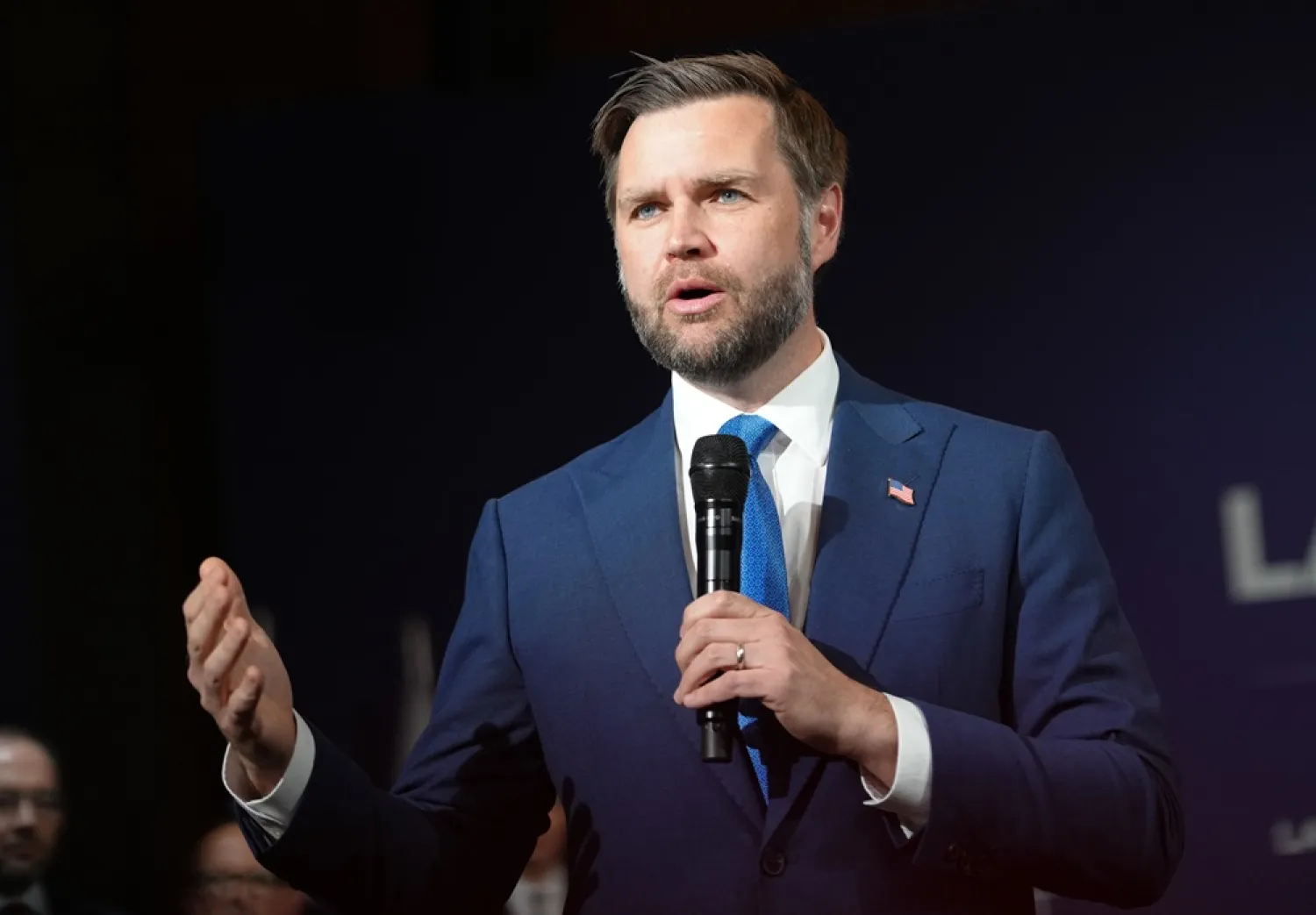
US Vice President JD Vance makes an opening statement at the start of a quadrilateral meeting between the US, Iran, Pakistan, and Qatar at the Bürgenstock Resort Lake Lucerne, near Stansstad, Switzerland, Sunday, June 21, 2026. (AP)
TT

Vance Meets Top Iranian Officials as US Looks to Get Negotiations Back on Track

US Vice President JD Vance makes an opening statement at the start of a quadrilateral meeting between the US, Iran, Pakistan, and Qatar at the Bürgenstock Resort Lake Lucerne, near Stansstad, Switzerland, Sunday, June 21, 2026. (AP)

US Vice President JD Vance said Sunday there was an opportunity to “turn over a new leaf” with Iran as the sides launched talks aimed at building out the interim deal to end the war in Iran reached by the two sides last week. 

Vance is holding talks with Iran's parliamentary speaker, Mohammad Bagher Qalibaf, and Foreign Minister Abbas Araghchi, at a Swiss mountainside resort near Lake Lucerne. Mediators from Pakistan and Qatar were also in the room for the direct engagement. 

The US is looking to get Iran locked into negotiations over its nuclear program amid concerns it may be used for military purposes, which Iran denies. Vance also wants to push Tehran to commit to keeping open the Strait of Hormuz, the critical waterway through which about a fifth of world traded oil passes. 

But the on-again, off-again conflict in Lebanon, between Israel and Iranian-backed Hezbollah, continues to threaten to derail the effort for the US to win concessions from Tehran on its nuclear program and keep the Strait of Hormuz open. 

“The question before us now is how much more can we accomplish together? Can we turn over a new leaf?” Vance said in brief comments as the talks, dubbed the “Lake Lucerne Summit,” got underway. 

“Can we change relations in the Middle East permanently, or do we go back to doing things the old way, which is not our preference, but is certainly very much something that can happen.” 

Iran first wants to focus on Israeli strikes in Lebanon  

Iran’s main focus during negotiations on Sunday would be the ongoing war between Israel and Hezbollah in Lebanon, Iranian Foreign Ministry spokesman Esmail Baghaei told Iran’s state news agency ahead of the meeting with Vance. 

The interim agreement was signed last week, and now top American and Iranian negotiators are in a 60-day sprint to reach an agreement on the technical details that hold massive implications for the world economy and global security. 

Yet only days after signing the agreement, it is being stress-tested after fighting escalated in Lebanon between Israel and Hezbollah — and by the subsequent announcement by Iran’s military that it had again closed the vital waterway that transits one-fifth of the world’s traded oil and natural gas. A renewed ceasefire in Lebanon, brokered on Saturday, appeared to be holding. 

Vance stressed that “great progress” had been made on Lebanon. But minutes after he was finished speaking, President Donald Trump took to social media to threaten Iran if it didn't rein in Hezbollah. 

"If they don’t, we’ll hit Iran very hard again, just like we did last week, only harder!!!” Trump wrote. 

Iran is cautiously approaching the talks given its previous experience with the US negotiations on the nuclear issue, which twice in the past year have been interrupted by massive military strikes against the country.  

“The implementation of any document is more important than its signing,” Baghaei said Sunday. 

Iran’s president added that Iran will maintain its right to a nuclear program. 

“What is certain is that we will never back down from the right to enrich uranium, and the other side is also forced to accept it,” Iranian President Masoud Pezeshkian said Sunday, according to Iran’s state media. 

A delayed meeting is now back on  

Vance had originally been slated to be on the ground at the Bürgenstock resort near Lucerne on Friday, but his departure from the United States was delayed after fighting escalated in Lebanon and Iranian officials canceled plans to attend the talks. 

US Central Command disputed Iran’s claim that it had once again shuttered the strait and said US forces continued to monitor the situation to ensure traffic continues to flow through the waterway. Vance has said that millions of barrels of oil have moved through the strait in recent days. 

Vance departed the US just after Iranian state TV said Iran’s negotiators had arrived in Switzerland. 

The vice president was joined by special envoy Steve Witkoff and Jared Kushner, Trump's son-in-law, for Sunday's talks. Witkoff and Kushner were on the ground in Switzerland ahead of Vance to begin sifting through the technical details of the nuclear talks. 

Vance and his wife, second lady Usha Vance, arrived at Emmen Air Base outside Lucerne just before 6 a.m. local time, according to his office. 

While Vance said he planned to be in Switzerland for just “a day or two,” leaving much of the detailed negotiations to be spearheaded by Witkoff and Kushner, his role in the talks has heightened scrutiny of the vice president at a time when he’s actively considering a 2028 presidential campaign. 

The deal has stirred much controversy  

Trump and Vance have come under searing criticism from parts of their own party for the deal, with Republican hard-liners unfavorably likening it to a nuclear agreement signed by the Obama administration that Trump and the GOP have insisted did nothing to actually terminate Iran’s nuclear program. 

The agreement signed by Trump and Iranian President Pezeshkian immediately allows Tehran to sell its oil freely and paves the way for Iran to tap into billions of dollars in assets that are currently frozen. It also calls for Iran to dilute its stockpile of highly enriched uranium, believed to be buried under nuclear sites that were targeted in US strikes last summer. 

The agreement says commercial vessels can pass through the Strait of Hormuz for 60 days without a charge, but does not preclude future fees imposed by Iran. Trump made his own threat on Saturday to levy US tolls on the strait if there is no deal with Iran in 60 days, insisting in a social media post that the money would be for “services rendered as the Guardian Angel to the countries of the Middle East.” 

The Trump administration has been working to reassure global markets that the Iran war has been merely a blip on oil prices, as Americans complain the conflict resulted in hiking gasoline prices ahead of peak summer travel months. After the White House announced the deal a week ago, oil futures dropped almost 8% — and markets are expected to closely track the progress of talks when they open for trading on Sunday evening. 

Further complicating matters, neither Israel nor Hezbollah is a signatory to the deal between the US and Iran, and Israeli Prime Minister Benjamin Netanyahu has vowed to keep his forces in southern Lebanon until any threat to Israel is eliminated. Hezbollah has refused to halt its attacks unless Israel commits to withdrawing from Lebanon. 


Iran Insists on Diplomatic Solution after Trump Rejects Peace Plan

Iranians walk near an anti-Trump billboard in Tehran, Iran, 19 August 2026. EPA/ABEDIN TAHERKENAREH
TT

Iran Insists on Diplomatic Solution after Trump Rejects Peace Plan

Iranians walk near an anti-Trump billboard in Tehran, Iran, 19 August 2026. EPA/ABEDIN TAHERKENAREH

Iran on Sunday insisted that only diplomacy can solve its conflict with the United States and Israel after US President Donald Trump said he rejected an Iranian proposal to reopen the Strait of Hormuz and end fighting.

"Our conditions are clear, and any move toward reopening the Strait of Hormuz is contingent on these conditions being met," Iranian Foreign Minister Abbas Araghchi posted on social media. "Only a negotiated solution can get them out of this deadlock."

Iran announced a peace proposal last week at the UN General Assembly in New York, saying it had been transmitted to the Americans via Qatari mediators. Trump said on Saturday he rejected the plan and argued that desperation was driving the Iranians’ push for an agreement on the key waterway.

"They want to make a deal to open ‌the Hormuz Strait immediately ‌because they're losing so badly," Trump told reporters at the White House.

Despite Trump's public ‌statements, ⁠mediators facilitating Iran's talks ⁠with the United States have not officially relayed a US rejection of the plan, according to Araghchi.

"We are waiting for the mediators to convey the definitive views to us, and we will make a decision based on them," Araghchi posted.

The US has imposed an economic blockade on Iran to put pressure on Tehran to stop Iranian attacks on vessels in the Strait of Hormuz, which have drastically reduced shipping through the area even as Trump repeatedly asserts that the US controls the waterway.

The Wall Street Journal first reported that Trump had rejected the Iranian proposal, citing unnamed US officials.

It said Trump was privately skeptical that Iran ⁠would meet his demands and had told his staff that he sees a renewed bombing campaign ‌as likely after the November US midterm elections.

A US official had said ‌earlier that discussions with Iran through mediators were "positive and constructive".

CONFLICT HAS DISRUPTED OIL FLOWS, HARMED GLOBAL ECONOMY

Araghchi told reporters at the United Nations on Friday the proposed deal would trigger a seven-day countdown to reopening the strait and a pause in regional fighting.

"If there is seriousness on the US side to come to a deal and reopen the Strait of Hormuz, everything is now prepared," Araghchi said. If the US were to agree, ‌the warring parties could start wider talks "on mutually agreed subjects."

That could potentially include discussions of Iran's nuclear program. Trump has said Tehran must never acquire a nuclear bomb, while ⁠a senior Iranian official ⁠told Reuters that Iran would show no flexibility over its nuclear program even if the US accepted its peace deal.

Iran would grant no concessions over its rights, including enriching uranium or shipping its highly enriched uranium out of the country, the official said.

Iranian President Masoud Pezeshkian, in an interview with the CBS show "Face the Nation", said Tehran was ready for talks on its nuclear program and other issues, but would not accept "bullying or coercion".

"Iran is not seeking war, but will defend itself against pressure, threats and attacks,” Pezeshkian said, adding that it had already agreed that "we're not supposed to develop nuclear weapons".

Previous attempts at diplomacy have failed to end the war, which began on February 28 with US and Israeli attacks.

Since then the war has alternated between pauses and renewed strikes, killing thousands while degrading the conventional forces of Iran and damaging its already ailing economy.


Russia Says It Struck Military Infrastructure, Vessel in Ukraine

In this photo provided by the Ukrainian Emergency Service, an emergency services personnel works to extinguish a fire following a Russian air attack in Odesa, Ukraine, Thursday, Sept. 17, 2026. (Ukrainian Emergency Service via AP)
TT

Russia Says It Struck Military Infrastructure, Vessel in Ukraine

In this photo provided by the Ukrainian Emergency Service, an emergency services personnel works to extinguish a fire following a Russian air attack in Odesa, Ukraine, Thursday, Sept. 17, 2026. (Ukrainian Emergency Service via AP)

The Russian defense ministry said on Sunday its forces had carried out overnight drone strikes on logistics centers, port and transport infrastructure, as well as ‌communications centers ‌and vessels ‌that ⁠Moscow said were linked to ⁠the Ukrainian military.

The ministry said the strikes hit a data center in ⁠Kyiv, logistic hubs in the ‌Kyiv ‌and Odesa regions, ‌two drone storages in ‌Mykolaiv, headquarters of a naval base as well as of ‌the State Border Guard Service of Ukraine and ⁠four ⁠military storages in the Kiliya port, and a cargo ship carrying military and dual-use goods to the port of Odesa.

Reuters could not independently verify the claims.


Separate Mass Shootings in South Africa Townships Leave at Least 27 People Dead

South African police officers during a raid in Johannesburg (Archive - Reuters)
TT

Separate Mass Shootings in South Africa Townships Leave at Least 27 People Dead

South African police officers during a raid in Johannesburg (Archive - Reuters)

Two separate mass shootings near South Africa’s two biggest cities killed at least 27 people, police said Sunday.

The South African Police Service said 17 people were killed Saturday night when eight suspects armed with AK-47 rifles and pistols opened fire at a bar in Wedela township, southwest of Johannesburg. At least 15 others sustained gunshot injuries in that attack, police said.

In a separate statement, police said 10 people were killed in a mass shooting at a store in Lwandle, near Cape Town, around 1 a.m. Sunday. Another 11 were wounded in that shooting. Police said they were searching for multiple suspects in that case also, though they didn't give an exact number, The Associated Press said.

The two shootings come just days after a mass shooting by three gunmen at a house party near the east coast city of Durban killed 11 people, including a pregnant woman.

No arrests had been made in the two latest mass shootings, police said.

South Africa has struggled with high rates of violent crime for years, but the series of mass shootings this week were shocking even to a country used to some of the highest violent crime rates in the world.