
Israel PM Says Troops to Stay in South Lebanon ‘as Long as Necessary’

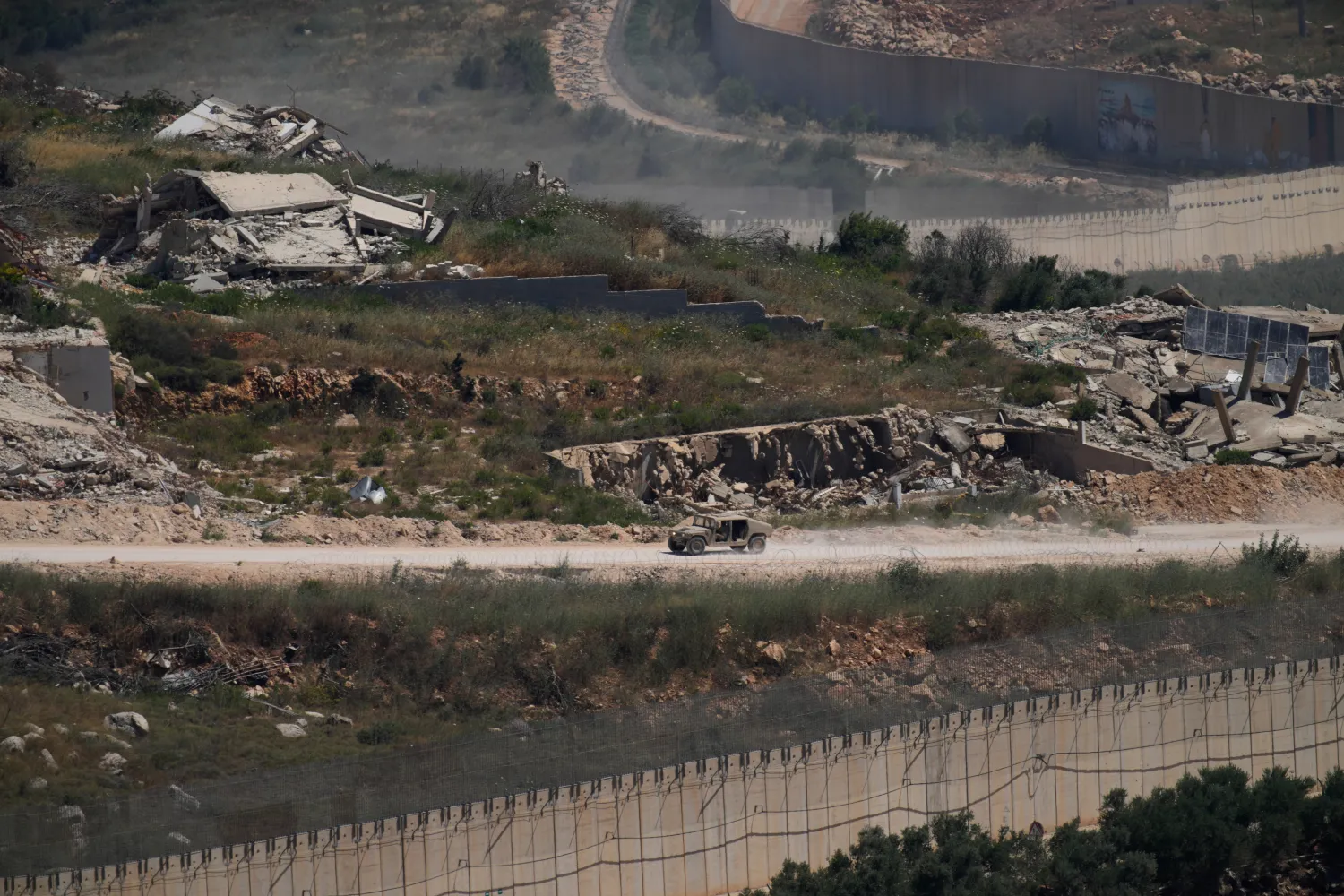
 An Israeli military vehicle moves past destroyed buildings in southern Lebanon as seen from northern Israel, Sunday, June 21, 2026. (AP)
An Israeli military vehicle moves past destroyed buildings in southern Lebanon as seen from northern Israel, Sunday, June 21, 2026. (AP)
TT

Israel PM Says Troops to Stay in South Lebanon ‘as Long as Necessary’

 An Israeli military vehicle moves past destroyed buildings in southern Lebanon as seen from northern Israel, Sunday, June 21, 2026. (AP)
An Israeli military vehicle moves past destroyed buildings in southern Lebanon as seen from northern Israel, Sunday, June 21, 2026. (AP)

Israeli Prime Minister Benjamin Netanyahu said on Sunday that Israeli forces would remain in occupied regions of southern Lebanon "as long as necessary", while also vowing to prevent Iran from acquiring nuclear weapons. 

"We will remain in the security zone in southern Lebanon for as long as necessary to protect the cherished residents of the north and all the citizens of Israel... Nothing will alter that commitment," Netanyahu said. 

"And with regard to Iran: whatever political developments may unfold, I will not allow Iran to acquire nuclear weapons. As long as I serve as prime minister of Israel, that will not happen." 

Israel's military chief said on Sunday that Hezbollah had suffered a severe blow fighting Israeli forces and was now in a "very difficult position", as he met with troops in southern Lebanon. 

He spoke as the United States and Iran held talks in Switzerland after signing a preliminary agreement to end the broader Middle East war, with the conflict in Lebanon threatening to derail the deal. 

"Hezbollah has suffered a severe and significant blow, and we are committed to remaining prepared to continue operating and prevent its rebuilding," Lieutenant General Eyal Zamir said, according to a military statement. 

"Hezbollah is in a very difficult position," he added. 

Hezbollah had pulled Lebanon into the Middle East war in early March when the Iran-backed Lebanese group fired rockets at Israel in retaliation for the killing of Iran's supreme leader in US-Israeli strikes. 

Despite a new ceasefire announcement on Friday as part of the memorandum of understanding signed by Tehran and Washington, Israel and Hezbollah had continued to clash. 

However, there were no reports of fresh strikes in Lebanon since Saturday evening. 

Zamir vowed to defend the communities of northern Israel from Hezbollah rockets. 

"This is the purpose guiding all our efforts... The ceasefire that has been declared is fragile, and we must maintain a high level of readiness for the renewal of combat operations," Zamir said. 

- Qassem - 

Hezbollah chief Naim Qassem on Sunday rejected any Israeli security zone in Lebanon. 

Israeli troops "remaining on Lebanese land is impossible. There are no security zones for Israel... we have a national army which deploys, and it is responsible for preserving sovereignty, and it is who we cooperate with," Qassem said in a televised address. 

"Israel is an aggressor and must leave. America bears full responsibility," he said, adding that "Israel will not remain in Lebanon, even if it increases its crimes, and we will defend ourselves." 

Qassem's address came as Washington and Tehran held talks in Switzerland after this week signing a preliminary agreement to end the broader Middle East war, which includes a halt to the hostilities in Lebanon. 

Ongoing Israeli strikes in recent days have threatened to derail the deal, but fighting in Lebanon has paused since Saturday evening, after Iran again closed the strategic Strait of Hormuz in response to Israel's attacks on Lebanon. 

"Any ceasefire under the banner of a comprehensive cessation of hostilities -- we have already committed to this if it happens, but we will not accept any violation. We will confront any violation... we will deal with it as we see fit," Qassem said. 

He urged Lebanese authorities to "take advantage of the path of the memorandum of understanding." 

"Look at the great Iran, closing the Strait of Hormuz for the sake of Lebanon. This is a weapon in your hands," he said, addressing the Lebanese authorities, adding, "Take up this weapon and use it." 

Under US pressure, Lebanon in April began direct talks with Israel in Washington aimed at ending the hostilities and separating the Israel-Hezbollah conflict.

Hezbollah has firmly rejected the direct talks, a fifth round of which is due to begin next week. 

Earlier on Sunday, Defense Minister Israel Katz said Israeli forces had standing orders to act against any threat inside Lebanon and insisted they would remain in the so-called security zone established within occupied Lebanese territory. 

"There has never been, and there is currently no restriction on Israeli soldiers in Lebanon from acting to eliminate threats... As Prime Minister Benjamin Netanyahu and I have made clear: Israel will not withdraw from the security zone in Lebanon," Israel Katz said in a statement, referring to an area extending roughly 10 kilometers (six miles) into Lebanese territory that Israel is occupying. 

Israeli forces and Hezbollah fighters engaged in fierce clashes this week, with Lebanese officials reporting dozens of people killed and the Israeli military reporting five of its own soldiers dead. 


Plans for Post-War Gaza Face Challenges on the Ground

11 July 2026, Palestinian Territories, Nuseirat: A vehicle damaged in an Israeli strike is seen at the scene in the Nuseirat refugee camp in the central Gaza Strip, where a Palestinian was killed and others were wounded. (dpa)
TT

Plans for Post-War Gaza Face Challenges on the Ground

11 July 2026, Palestinian Territories, Nuseirat: A vehicle damaged in an Israeli strike is seen at the scene in the Nuseirat refugee camp in the central Gaza Strip, where a Palestinian was killed and others were wounded. (dpa)

In spite of the ongoing risk of renewed fighting in Gaza, stakeholders have spent months preparing for the post-war phase.

Plans for governance, security and humanitarian relief have begun to take shape, but remain largely theoretical in the absence of a political agreement, credible security guarantees and sustained funding.

Below are some of the key challenges facing local and international players as they seek to rebuild the devastated territory home to more than two million Palestinians.

- Security concerns -

Security remains the cornerstone of every post-war scenario under discussion.

Israel insists Hamas must disarm before any progress can be made, while the Palestinian movement refuses to surrender its weapons before Israeli troops withdraw and a Palestinian governing authority is established.

However, an official from the Board of Peace established by US President Donald Trump to help prepare for post-war Gaza told AFP that Hamas's disarmament was no longer being treated as a precondition for advancing plans on the ground.

"The entire planning is around worst case scenario," he said, referring to a planned pilot "humanitarian zone" in Rafah, in the south.

"We get nothing in the negotiation, but we move forward anyhow."

Among the proposals is an International Stabilization Force (ISF) tasked with helping maintain order in Gaza.

According to the same source, four countries -- Morocco, Kosovo, Albania and Kazakhstan -- are "really engaged" in the initiative.

A logistical base on the Israeli side of the Kerem Shalom crossing is "close to complete" and would be able to host an initial rotation of around 500 troops before any deployment into Gaza, the official said.

Preparations are also continuing for a Palestinian police force, with around 20,000 applications already received, the official added.

But several diplomats and security sources interviewed by AFP described a process that remains deadlocked.

According to one diplomatic source, training has yet to begin and Israel has rejected the current list of recruits following its vetting process, arguing in particular that a proposed force of 5,000 police officers would be too large for Gaza.

Despite a ceasefire in place since October 2025, daily violence grips the territory as Israeli strikes continue targeting what the military says are violations of the truce by fighters from Hamas and other Palestinian groups.

- Little reconstruction -

The humanitarian needs of Gaza remain overwhelming.

The United Nations estimates reconstruction will take years and require tens of billions of dollars, as construction materials and debris-clearing equipment remain in critically short supply.

Despite substantial donor pledges, much of the expected funding has yet to be disbursed, according to the Board of Peace.

"We're working with an amount that for now meets our needs," the board official said, adding that if several humanitarian zones have to be established then "we obviously need more funding".

The board is currently planning a pilot humanitarian zone in Rafah which would accommodate tens of thousands of vetted Palestinians, the official said earlier this week.

- No governing institutions -

Hamas announced recently it intends to hand over administrative responsibilities to the National Committee for the Administration of Gaza (NCAG), a body set up by the Board of Peace comprising Palestinian technocrats tasked with overseeing day-to-day governance during a transitional period.

But the NCAG has still not even managed to enter Gaza, with several Palestinian and diplomatic sources saying Israel has barred the committee from entering.

For Israel, dismantling Hamas's administrative apparatus falls short of its longstanding demand that the group disarm.

The future role of the Palestinian Authority (PA) also remains unresolved.

Based in Ramallah in the occupied West Bank -- a separate Palestinian territory from the Gaza Strip -- the PA remains the international community's officially recognized Palestinian interlocutor.

The NCAG is intended as a temporary body implementing basic services across the strip, with European officials expecting it to work in coordination with the PA.

Several observers, however, warn that the result could be an administration responsible for delivering public services but lacking authority over security forces or border crossings -- leaving it dependent on its international backers while remaining vulnerable to Hamas should the group retain all or part of its military arsenal.


US Delegation in Lebanon to Discuss Israel ‘Pilot Zone’ Withdrawal, Says Official

A vehicle that was reportedly damaged by an Israeli strike is pictured in the southern Lebanese village of Kfar Rumman on July 10, 2026. (AFP)
TT

US Delegation in Lebanon to Discuss Israel ‘Pilot Zone’ Withdrawal, Says Official

A vehicle that was reportedly damaged by an Israeli strike is pictured in the southern Lebanese village of Kfar Rumman on July 10, 2026. (AFP)

A US military delegation met with Lebanon's army in Beirut to discuss the implementation of Israel's withdrawal from a "pilot zone" in occupied territory, a Lebanese military official told AFP on Saturday.

Under a framework agreement reached on June 26, Israel will gradually withdraw from areas of southern Lebanon where it has deployed troops to fight the Iran-backed Hezbollah party.

As part of the agreement, the long-disempowered Lebanese military will take full control of two small areas dubbed pilot zones.

"The American military delegation arrived and began meetings with the Lebanese army command to discuss the mechanisms for implementing the first pilot zone from which the Israelis will withdraw, allowing the Lebanese army to deploy," the official said, requesting anonymity.

"This is the main objective the American military delegation is bringing to Lebanon... it is the translation and implementation of the framework agreement."

US Ambassador Michel Issa told President Joseph Aoun on Thursday that the American delegation was coming to "determine the mechanism" for the deal's implementation.

In Washington, a US official had said on condition of anonymity that "the first pilot zone will launch in a matter of days, and further pilot zones are being mapped out and planned".

US Central Command will coordinate on the zones with both countries, he said.

The agreement -- rejected by Hezbollah -- does not set a timetable for Israel's withdrawal, and Israeli officials have also vowed that their forces will remain in a "security zone" 10 kilometers (six miles) deep as long as Hezbollah remains armed.

The war, which began in early March when Hezbollah entered the wider Middle East conflict on the side of its backer Iran, displaced more than a million people in Lebanon, according to the UN's humanitarian agency OCHA.

On Saturday, the agency said more than 732,000 people had now returned home, up from 640,000 a week before.

That leaves more than 430,000 still displaced, it added.

Israel has pursued intermittent strikes despite a truce in its war with Hezbollah, with Lebanon's state-run National News Agency reporting several in the south on Saturday.

The latest talks between Lebanon and Israel, which have no formal relations but have met for five rounds of negotiations since the start of the war, will take place in Rome next Wednesday and Thursday.

Lebanon conditions its participation on Israel withdrawing from two pilot zones.

The talks precede Aoun's expected visit to Washington later this month at the invitation of his American counterpart Donald Trump.


Iraqis Protest Over Power Cuts in Sweltering Summer Heat

Demonstrators gather as they take part in a protest over unemployment, corruption and poor public services, in Baghdad, Iraq October 2, 2019. (Reuters)
TT

Iraqis Protest Over Power Cuts in Sweltering Summer Heat

Demonstrators gather as they take part in a protest over unemployment, corruption and poor public services, in Baghdad, Iraq October 2, 2019. (Reuters)

Hundreds of residents of an eastern Iraqi city protested on Saturday against power cuts during extreme summer heat, an AFP correspondent said.

Temperatures in the city of Kut have peaked at 44C, with residents organizing protests to urge authorities to boost electricity supply.

Decades of war have left Iraq's infrastructure in a pitiful state, with power failures worsening blistering summers.

On Friday night, hundreds of protesters took to the streets with dozens hurling stones at security forces, who responded by firing tear gas and detaining more than 30 people, according to an AFP correspondent.

The clashes lasted until early morning.

Two local health officials told AFP on condition of anonymity that more than 50 police officers were injured.

It is unclear how many protesters were wounded, with one source estimating the number at around 30.

Protesters have likely avoided reporting themselves to hospital for fear of arrest, a health official said.

Demonstrations against power cuts are frequent in Iraq, especially during the scorching summer months, when temperatures often reach 50C.

In the oil-rich country, many households have just a few hours of state electricity per day, and those who can afford it use private generators to keep fridges and air conditioners running.

Iraq is the second-largest oil producer in the OPEC cartel, but despite its immense oil and gas reserves, it remains dependent on imports to meet its electricity needs.