Valentino 2025 Sales, Core Profit Slide as Debt Edges Higher

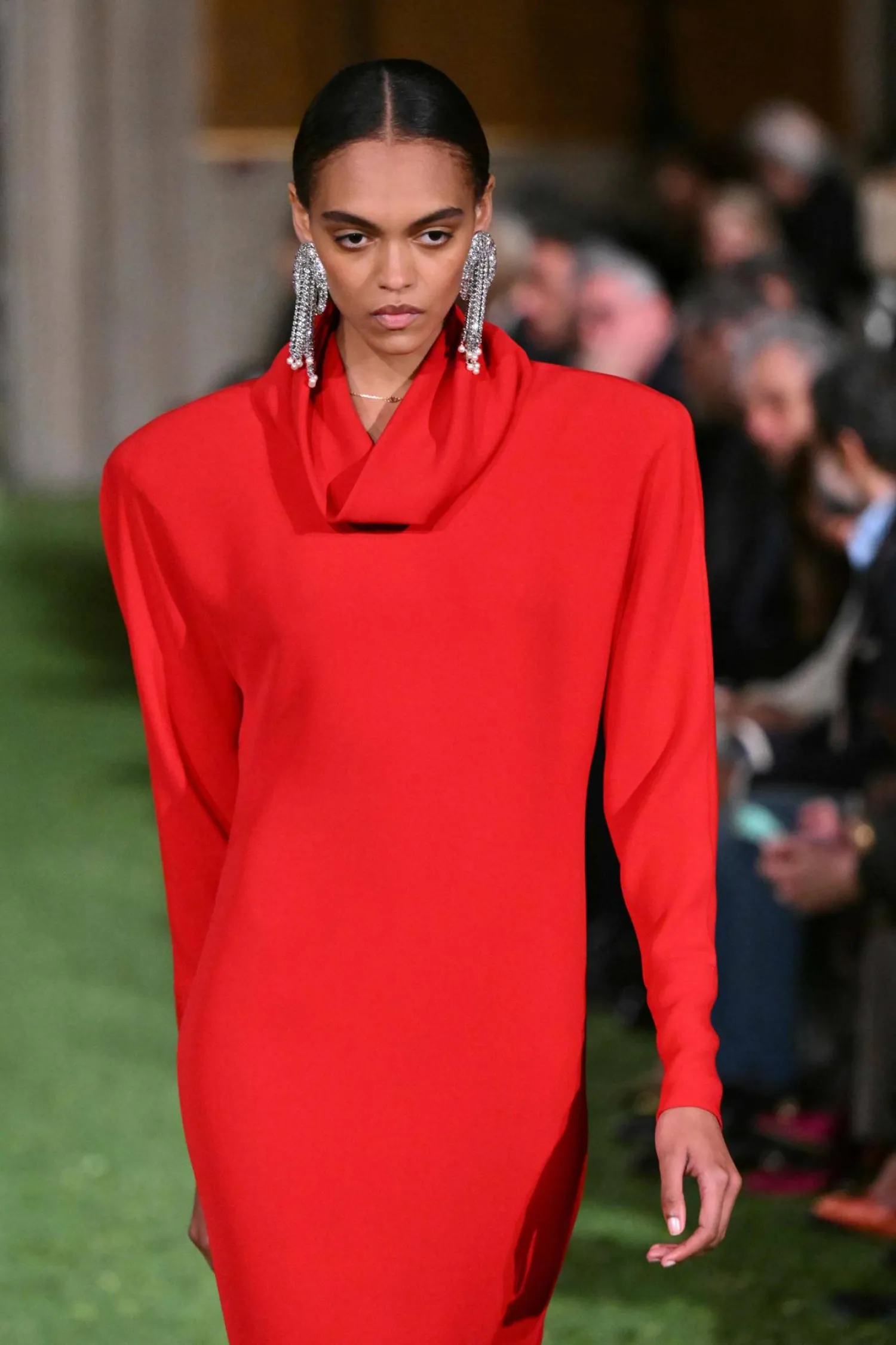
A model presents a creation by Italian fashion house Valentino during the show "Interferenze" Fall/Winter 2026-2027 collection at Palazzo Barberini in Rome on March 12, 2026. (Photo by Alberto PIZZOLI / AFP)
TT

Valentino 2025 Sales, Core Profit Slide as Debt Edges Higher

A model presents a creation by Italian fashion house Valentino during the show "Interferenze" Fall/Winter 2026-2027 collection at Palazzo Barberini in Rome on March 12, 2026. (Photo by Alberto PIZZOLI / AFP)

Italian luxury group Valentino reported lower sales and earnings in 2025 from the previous year, while its net debt increased, a company filing showed on Tuesday.

Revenue fell 15% to €1.12 billion, ‌while earnings ‌before interest, taxes, ‌depreciation ⁠and amortization (EBITDA) dropped 41% ⁠to €174 million, the filing said.

Net debt rose to €1.13 billion at the end of 2025 from €1.08 billion a ⁠year earlier, it ‌added.

Valentino ‌is controlled by Qatar-backed Mayhoola, ‌which owns 70% of ‌the company, while French luxury group Kering holds the remaining 30%.

The fashion house ‌has been facing a slowdown in luxury demand ⁠and ⁠in November received a €100 million capital injection from Kering and Mayhoola to shore up its finances after it breached loan covenants earlier in the year.


Giorgio Armani Closes Milan Menswear Week with Mediterranean-inspired Collection

A model presents a creation for Giorgio Armani's Spring/Summer 2027 men collection in Milan, Italy June 22, 2026. REUTERS/Alessandro Garofalo
TT

Giorgio Armani Closes Milan Menswear Week with Mediterranean-inspired Collection

A model presents a creation for Giorgio Armani's Spring/Summer 2027 men collection in Milan, Italy June 22, 2026. REUTERS/Alessandro Garofalo

Giorgio Armani closed the Milan Fashion Week on Monday with a summer menswear collection inspired by the Mediterranean, featuring earthy tones and lightweight natural fabrics.

Models sauntered through an arcaded courtyard in a historic downtown building wearing airy ⁠garments, including softly tailored trousers ⁠and safari jackets, often paired with large bags.

"There is enormous loyalty (to the late Giorgio Armani) but there is ⁠also a moving forward," Leo Dell'Orco, head of the men's style office and chairman of the group, told journalists on the sidelines of the event.

Reuters quoted Dell'Orco as saying that he had "lengthened and narrowed the silhouette" and used slightly ⁠longer ⁠jackets, with a cohesive color palette which spanned white, sand and shades of grey.

Alongside the menswear line-up, the show also unveiled the women's Cruise collection, the first designed by Silvana Armani, Giorgio's niece.


Milan Designers Go Lighter in Silhouette, if Not Materials, for Next Summer

Models present Dolce & Gabbana Spring/Summer 2027 men's collection at Milan Fashion Week, in Milan, Italy June 20, 2026. (Reuters)
TT

Milan Designers Go Lighter in Silhouette, if Not Materials, for Next Summer

Models present Dolce & Gabbana Spring/Summer 2027 men's collection at Milan Fashion Week, in Milan, Italy June 20, 2026. (Reuters)

In complicated, heavy times, Milan designers went lighter — if not in materials, then in silhouette.

Amid economic uncertainty, geopolitical tensions and a sweltering Milan Fashion Week, designers largely stripped things back for next summer, embracing clean lines and pared-down looks. Prada led the way, with co-creative directors Miuccia Prada and Raf Simons arguing for simplicity and familiar clothes reimagined through proportion and fabrication.

That didn’t mean dressing for the heat was straightforward. Milan’s runways were filled with leather and knits for the next summer season, suggesting that fashion’s elite may need generous air-conditioning, mountain escapes or higher latitudes to wear some of the looks.

Key trends from Milan Fashion Week menswear Spring-Summer 2027 collections that closed on Monday include the embrace of luxury materials, sartorial ventilation and lighter tailoring, while a few defiantly chose bling over restraint.

Perhaps the biggest surprise of the season was the persistence of leather.

Prada’s leather combinations were inspired by the universality of jeans, featuring slim five-pocket pants matched with cropped flat-pocketed jackets that functioned as shirts. Other designers used woven and perforated techniques to make leather more breathable, even as temperatures climbed.

In Milan, luxury and practicality were often in tension.

After years of oversized silhouettes, menswear is once again embracing the body.

Designers broadly agreed that a well-dressed man still wears a suit. The challenge was how to survive the heat. The response was ventilation, with dress shirts left unbuttoned. Some were rendered transparent. Or they were simply done away with.

Long trousers remained dominant, but there was a shift toward closer-to-the-body dressing. Dolce & Gabbana pushed the idea furthest with microshorts that showcased muscular legs, while some brands exposed torsos.

Tailoring remained central to Milan collections, but in lighter, more relaxed forms.

Designers softened construction, opened necklines and experimented with fabrics and construction that allowed more airflow. The result was tailoring designed for rising temperatures without abandoning formality.

US designer Thom Browne, now under Zegna ownership, returned to Milan for the first time since 2008 with layered suiting that drew heavily on summer-friendly seersucker and pleated skirts for men, long a brand hallmark.

The message from Milan was clear: the suit isn’t going anywhere, but it is adapting.

Of course, restraint is not for everyone. While much of Milan embraced restraint, some designers doubled down on decoration.

Philipp Plein presented a crystal-encrusted denim ensemble that takes days of handwork to complete. Dolce & Gabbana also leaned into embellishment, including beaded accents that recalled coral.

If Prada’s vision was reduction, these designers unapologetically offered maximalism and glamour.

A lighter Milan calendar created opportunities for emerging designers to gain attention alongside the industry’s biggest names.

Martin Quad made his Milan debut with unusual tailoring tricks that got him noticed in his native Copenhagen, while Domenico Orefice embraced leather and richly woven textiles for his co-ed collection.

Japanese designer Shinya Kozuka's Shinyakozuka label made its Milan debut with one of the most poetic and summery collections of the season, epitomized by a bare-chested model in a billowing sheer coat in teal worn baggy white trousers.


Gabriela Hearst On Designing for Soccer's Biggest Stage

Uruguayan fashion designer Gabriela Hearst, who designed the official uniforms for Uruguay’s national squad for the 2026 World Cup, poses for a photograph, in Montevideo, Uruguay June 3, 2026. REUTERS/Martin Varela Umpierrez 
TT

Gabriela Hearst On Designing for Soccer's Biggest Stage

Uruguayan fashion designer Gabriela Hearst, who designed the official uniforms for Uruguay’s national squad for the 2026 World Cup, poses for a photograph, in Montevideo, Uruguay June 3, 2026. REUTERS/Martin Varela Umpierrez 

Uruguayan fashion designer Gabriela Hearst, who is known for her eponymous ready-to-wear clothing line, has turned to her home country’s national soccer team with new uniforms for the 2026 World Cup, according to Reuters.

Hearst, who turns 50 this year, was raised on a ranch, where she says clothing carried deep personal meaning.

A family seamstress made garments to mark life’s milestones, often passed down through generations.

Hearst was the first Latin American to lead the luxury French fashion house Chloe, a role she held from 2020 to 2023.

Hearst, who hails from a family of cattle farmers, has said it was her husband, John Augustine Chilton Hearst, a member of the US publishing dynasty, who pointed out how her upbringing could play into her fashion career.

Speaking to Reuters while showcasing the tailored off-the-pitch sportswear at Montevideo’s Estadio Centenario — which played host to the first World Cup final in 1930 — Hearst reflects on national identity, the value of craft in the age of AI and how her upbringing in rural Uruguay continues to shape her environmentally conscious designs.

“It is hard to match football's popularity worldwide, so I see it as part of a broader multi-pronged mix, rather than something being replaced,” she said.

“For a long time, people didn’t even know where my country was, and now they do — and that’s largely thanks to football. Football opens the door, and then people discover the country beyond it,” Hearst noted.

She said it’s an honor to be Latina and to represent the quality and integrity of her culture — especially right now.

“Artists like Bad Bunny doing the Super Bowl halftime show, and even the Pope meeting with him, are examples of how wide the reach has become. I'm always very excited when the culture of my continent is represented, rooted in warmth, family, and strong values. I do think South America is having a broader cultural moment,” Hearst said.