


Taliban Officials Hold EU Migration Talks in Brussels

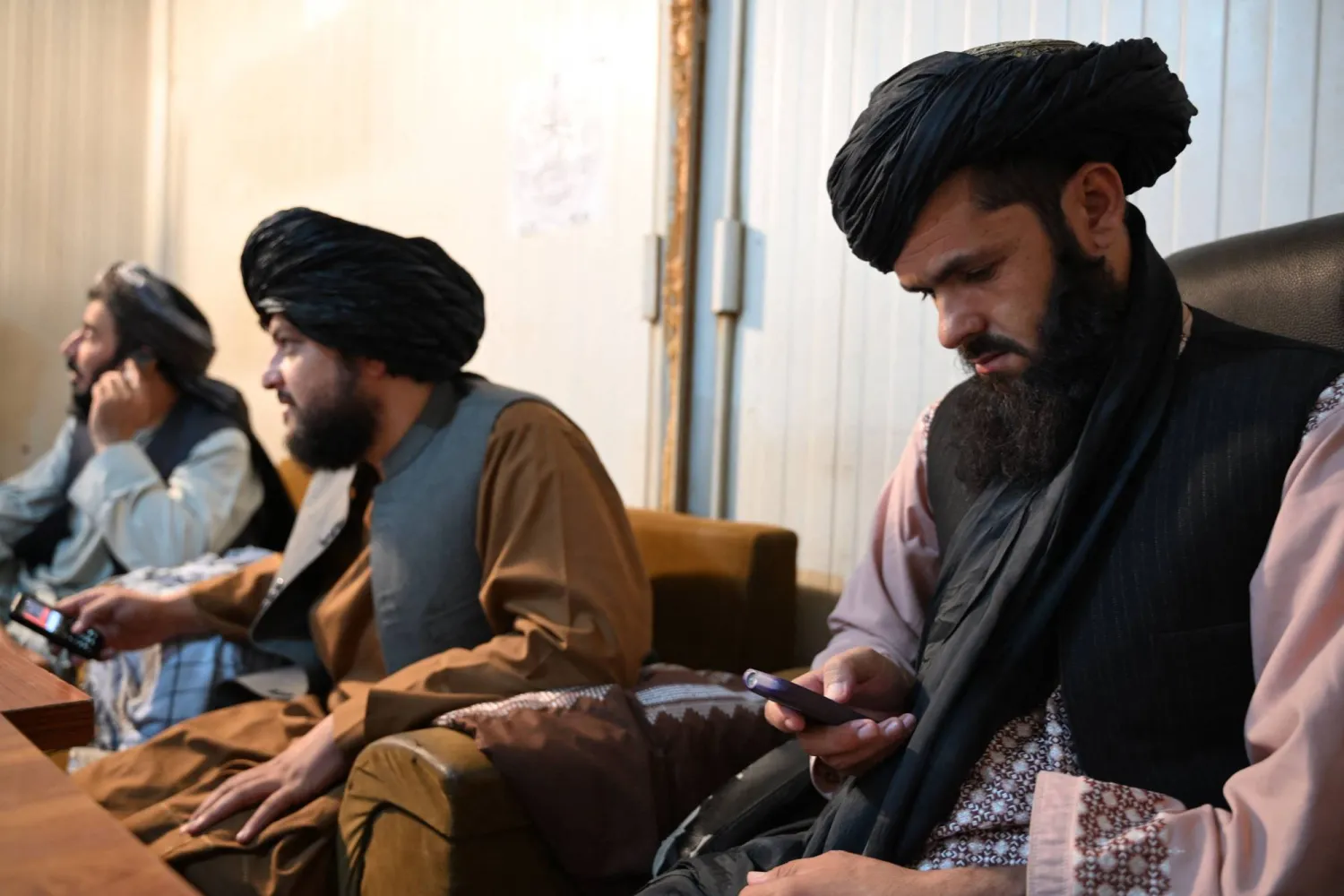
Taliban administrative staff use feature phones at the Department of Information and Culture building in Kandahar on June 22, 2026. (Photo by Sanaullah SEIAM / AFP)
TT

Taliban Officials Hold EU Migration Talks in Brussels

Taliban administrative staff use feature phones at the Department of Information and Culture building in Kandahar on June 22, 2026. (Photo by Sanaullah SEIAM / AFP)

A Taliban delegation held talks with the EU in Brussels on Tuesday on stepping up the return of failed asylum-seekers to Afghanistan, in an unprecedented visit fiercely criticized by rights activists. 

The European Commission invited a five-person delegation for discussions under a push to crack down on irregular migration and boost deportations -- although the EU does not formally recognize the Taliban administration. 

"The meetings were constructive, and there is hope that they will lead to positive developments," an Afghan official with direct knowledge of the talks, who requested anonymity due to their sensitivity, told AFP. 

A spokesman for the European Commission said 15 EU member states participated in the "technical level meeting" co-chaired by Sweden. 

The Afghan official said discussions -- the first by Taliban officials with EU representatives in Brussels -- focused on resuming consular services for Afghans in Europe, on "confidence-building measures" and "a dignified return process". 

The commission said "the identification of returnees" and "the issuance of travel documents" for them to be returned to Afghanistan, were on the agenda. 

"The focus was on persons who have committed serious crimes and who pose a security threat," the commission spokesman said. 

The European Union's outreach to Taliban authorities has drawn strong pushback from rights campaigners who say it flies in the face of the bloc's values. 

"The Taliban have erased women and girls from public life," said Nobel Peace Prize laureate Malala Yousafzai -- who was shot by Pakistani Taliban militants aged 15 and said she was "shaken and deeply disturbed" by the EU's invitation. 

The Taliban delegation in Brussels was led by foreign ministry spokesman Abdul Qahar Balkhi, and included representatives of the Afghan interior ministry. 

Brussels said the meeting was arranged upon the request of 20 EU countries and aimed at providing them the opportunity to "establish contacts" with Taliban authorities. 

It followed a January visit by EU officials to Afghanistan to explore the feasibility of organizing migrant returns. 

EU countries are responsible for arranging repatriations, although the commission can play a coordinating role. 

As host country to the European institutions, Belgium confirmed Monday it had issued the Taliban delegation five one-day visas "after a security assessment" -- valid just for Belgium and not the broader free-movement Schengen area. 

EU nations and the commission deny that hosting Taliban officials is tantamount to recognizing the government in Kabul, but critics say it reneges on the bloc's values. 

"EU countries are undermining their credibility by condemning Taliban abuses and pursuing accountability on one hand, while cooperating with the Taliban to forcibly return Afghans on the other," said Fereshta Abbasi of Human Rights Watch. 

European governments shut their embassies in Kabul when the Taliban authorities returned to power in 2021. 

This month, the European Union's migration chief Magnus Brunner defended the outreach, saying Brussels had no other option than to talk to the Taliban government about returning irregular migrants from Afghanistan. 

European governments have sought a tougher stance on migration as public opinion has hardened, fueling far-right electoral gains across the continent. 

EU countries received about a million asylum applications filed by Afghans between 2013 and 2024, according to the bloc's data agency. About half as many were approved over the period. 

Around 20 of the EU's 27 member states have expressed interest in returning some migrants without a right to stay to Afghanistan. 

Some countries have pushed ahead, with Germany deporting more than 100 Afghans with criminal convictions since 2024, via charter flights, and Austria following suit. 

Rights groups have questioned the legality and ethics of returning migrants to a country that is in the midst of a severe humanitarian crisis, with millions facing hunger and economic hardship, according to the United Nations. 

"The desperate scenes of people -- including EU staff -- fleeing Afghanistan are a recent memory," said Eve Geddie, director of Amnesty International's European Institutions Office. 

"It is unconscionable that the EU would now try and deport people to Afghanistan, which has only become more dangerous in the meantime." 


Mediator Pakistan Says Encouraging US, Iran to Resume Talks

TOPSHOT - A woman crosses Tehran's Enghelab Square on July 15, 2026, past a giant anti-US billboard featuring US president Donald Trump in a coffin with text in Persian reading "We Kill Trump".  (Photo by AFP)
TOPSHOT - A woman crosses Tehran's Enghelab Square on July 15, 2026, past a giant anti-US billboard featuring US president Donald Trump in a coffin with text in Persian reading "We Kill Trump". (Photo by AFP)
TT

Mediator Pakistan Says Encouraging US, Iran to Resume Talks

TOPSHOT - A woman crosses Tehran's Enghelab Square on July 15, 2026, past a giant anti-US billboard featuring US president Donald Trump in a coffin with text in Persian reading "We Kill Trump".  (Photo by AFP)
TOPSHOT - A woman crosses Tehran's Enghelab Square on July 15, 2026, past a giant anti-US billboard featuring US president Donald Trump in a coffin with text in Persian reading "We Kill Trump". (Photo by AFP)

Pakistan said on Thursday it would encourage the United States and Iran to stop violence and resume talks under a memorandum of understanding (MoU) it helped mediate last month.

"While the implementation of the MoU is facing challenges, Pakistan will continue to encourage all sides to end violence and resume technical-level talks in accordance with the MoU," Tahir Andrabi, Pakistan's foreign office spokesman, told reporters in Islamabad.

"We express the hope for an early normalization of the situation in Strait of Hormuz and underscore the importance of ensuring the continued safety, security and freedom of maritime navigation," he added.

The United States has this week been striking Iran, drawing retaliatory Iranian attacks on US interest in the Gulf as they battle over the strategic Hormuz shipping route.

That sent global oil prices soaring and led to concerns of spikes in inflation even in nations far from the conflict.

The key oil and gas artery, which Iran insists it controls, is central to the rekindled fighting that has entered its sixth day despite a preliminary deal in June aiming to end the war.

"Pakistan recognizes the urgent need to address the impact of the current situation on global energy supplies and other economic commodities including trade and food security," Andrabi said.


US War Against Iran Enters a New Phase

The US deploys two aircraft carriers and more than 20 US Navy warships across the Middle East (CENTCOM)
TT

US War Against Iran Enters a New Phase

The US deploys two aircraft carriers and more than 20 US Navy warships across the Middle East (CENTCOM)

By: Julian E. BarnesEric Schmitt and David E. Sanger


The Trump administration has lurched back into a war against Iran that had never really ended.

When the war started more than four months ago, US forces targeted Iranian military bases, missile launchers, ships and naval facilities. Israel, fighting alongside the United States, hit leadership targets, hoping to bring down Iran’s hard-line government.

Their record of success has been mixed, at best. Israel killed the supreme leader, Ali Khamenei, but the leaders who succeeded him were even more hard-line. US forces struck thousands of targets, but did not destroy Iran’s ability to control the Strait of Hormuz, the waterway through which about 20% of the world’s oil typically flows.

For roughly 90 days beginning in April, an on-again-off-again cease-fire prevailed. And then it was over.

The United States now appears to be entering Round 2 of its military campaign. This round has a new focus — but not necessarily a clearer strategy.

Iran’s ability to control the strait, despite the pummeling its navy took, is by far the most important lesson of the first phase of the war. So it is no surprise that the Trump administration is focused on trying to loosen Iran’s grip on it.

Last Tuesday, in retaliation for attacks on tankers, Trump ordered airstrikes on dozens of targets in Iran, including coastal radars, anti-ship missile launchers and a fleet of small Iranian attack boats.

After a short lull, the United States hit 140 military targets in the first of three consecutive days of heavy bombing this week.

US forces carried out new rounds of attacks on Iran throughout Tuesday and resumed a naval blockade of Iranian ports, a strategy that showed some success in the earlier phase.

The strikes are intended to open the waterway to shipping. The purpose of the naval blockade is to put economic pressure on Iran by choking off its trade and to flex American military might.

Trump was quick to declare success.

“The Strait of Hormuz is open to ALL Ship traffic except for Iran — and that is because of their lying, violent, malicious leadership, which is taking them down the path of TOTAL DESTRUCTION,” Trump wrote on Truth Social on Tuesday morning.

But exactly what the US military will do to enforce the blockade, and how far it will go to exert control of the strait, is not clear.

Round 1 of the war came at a high cost. Tehran has estimated that at least 3,500 Iranians have died in the war, including 175 at an elementary school.

Thirteen US service members have been killed. And the war has cost tens of billions of dollars already, and the new round could drive those financial costs up substantially.

A critical question for the next phase is whether Trump will consider an operation to take Kharg Island, a key export hub for Iran’s oil in the northern Arabian Gulf.

Trump publicly mused about ordering the Marines to take control of the island during the first phase of the war, but ultimately abandoned those plans for fear of high US casualties.

Such an operation would be a far bigger escalation than Trump has undertaken so far. But it would be difficult, and lives could be lost in either taking or holding the island.

The United States continues to have a fearsome arsenal in the region, including two aircraft carriers, and dozens of carrier- and land-based attack and surveillance planes.

“There are currently more than 20 US Navy warships and hundreds of military aircraft operating across the Middle East,” Central Command said in a statement announcing the resumption of the blockade. “American forces remain vigilant, lethal, and ready.”

In the strikes last week, US forces hit more than 170 Iranian military targets. In three consecutive days of heavy bombing this week, the United States has hit 140 military targets.

Analysts said the Trump administration was sending a pointed message to the government in Tehran that the United States was willing to broaden its mission again and hit sites that have both military and civilian uses.

But senior US officials said the real focus of the current phase is undoubtedly the strait.

So far, Trump had not ordered resumption of such an all-out conflict, in part because that could prompt Iran to target not only US military bases in the region, but also energy infrastructure in those nations.

Attacks on those facilities could send oil and natural gas prices skyrocketing even higher.

Senior officials said the goal of the new military campaign is to force Iran to allow tankers and other commercial cargo ships to pass freely through the strait, and ultimately to return to the bargaining table to resume nascent talks on more difficult, long-term issues like the fate of Iran’s highly enriched uranium.

Administration officials acknowledge that the military strategy is not without risks. Iran has shown it has an asymmetric advantage. Iranian forces do not have to hit every ship passing through the strait, or sink any of them. They only have to cause enough damage and issue enough threats to scare shipping companies and insurers.

This week, Iranian missiles struck two crude oil carriers that were transiting the southern part of the strait. The attack killed an Indian crew member. Another tanker, carrying liquefied natural gas, was also hit and caught fire near the Omani coast.

Senior US officials said time remains on the American side as Iran’s economy collapses.

During the uneasy peace, Iran was able to get many of its tankers out, and to empty storage tanks that were overflowing with oil.

The resumed blockade will cause that oil to back up once more, and the money Iran has made from its oil exports will begin to dry up.

But the real question is: Can Iran’s hard-line leadership outlast Trump’s anxiety over rising oil prices?


*The New York Times


Why Greater Tunb Matters Near the Strait of Hormuz

An aerial view of Iran’s Qeshm Island near the Strait of Hormuz (Reuters)
TT

Why Greater Tunb Matters Near the Strait of Hormuz

An aerial view of Iran’s Qeshm Island near the Strait of Hormuz (Reuters)

US strikes on Greater Tunb on Wednesday thrust one of the most sensitive points at the entrance to the Strait of Hormuz back into the center of the confrontation, after US Central Command said it hit coastal defense systems, storage sites and cruise missile launchers in a 90-minute assault.

CENTCOM said the strikes were aimed at reducing Iran’s ability to attack commercial vessels in the strait.

Greater Tunb, one of three Emirati islands occupied by Iran since 1971, hosts a military airfield, Iranian Revolutionary Guard Corps Navy bases, garrisons and missile assets used to monitor nearby shipping lanes.

Former IRGC Navy commander Alireza Tangsiri had called the island vital to Iran’s control of the strait because it sits between the main inbound and outbound shipping routes.

Tangsiri, who was killed in an airstrike in Bandar Abbas on March 26, said in an earlier state television interview that losing Greater Tunb would mean losing control of transit routes through the Strait of Hormuz.

Its location, he said, gave Iranian forces the ability to monitor maritime traffic and shape its movement.

Tangsiri also tied Abu Musa and Sirri islands to Iran’s gas fields and Gulf trade, warning that the loss of Abu Musa could lead to the loss of Sirri and its military positions, gas fields and trade routes.

He had overseen the expansion of IRGC bases across the islands, including the military airfield on Greater Tunb and facilities on Sirri.

Islands and shipping lanes

Greater Tunb is part of a chain that includes Abu Musa, Lesser Tunb, Qeshm, Larak, Hormuz and Sirri. Studies have described the islands as forming Iran’s “defensive arc” around the strait.

Iranian officials have likened them to “unsinkable aircraft carriers” because they host anti-ship missiles, surveillance posts and naval bases.

Greater Tunb’s importance also lies in its proximity to the two main shipping lanes.

Tehran says vessels must follow routes and schedules set by Iranian authorities and secure prior approval. Washington is pressing for a southern route along the Omani coast that would fall outside Iranian control.

The routes have become a central point of dispute since the Islamabad memorandum of understanding on June 17.

Iran interprets its fifth provision as granting Tehran a role in regulating passage. The United States says the Strait of Hormuz is an international waterway that cannot be subjected to unilateral permits or fees.

Greater Tunb is a forward military outpost in Iran’s network of control over the strait.

The strikes were aimed at disabling coastal defense and missile sites that could be used against vessels and weakening Iran’s ability to impose its rules on shipping.
