
Airlines Should Still Avoid Airspace Over Iran After Framework Deal, EU Agency Warns

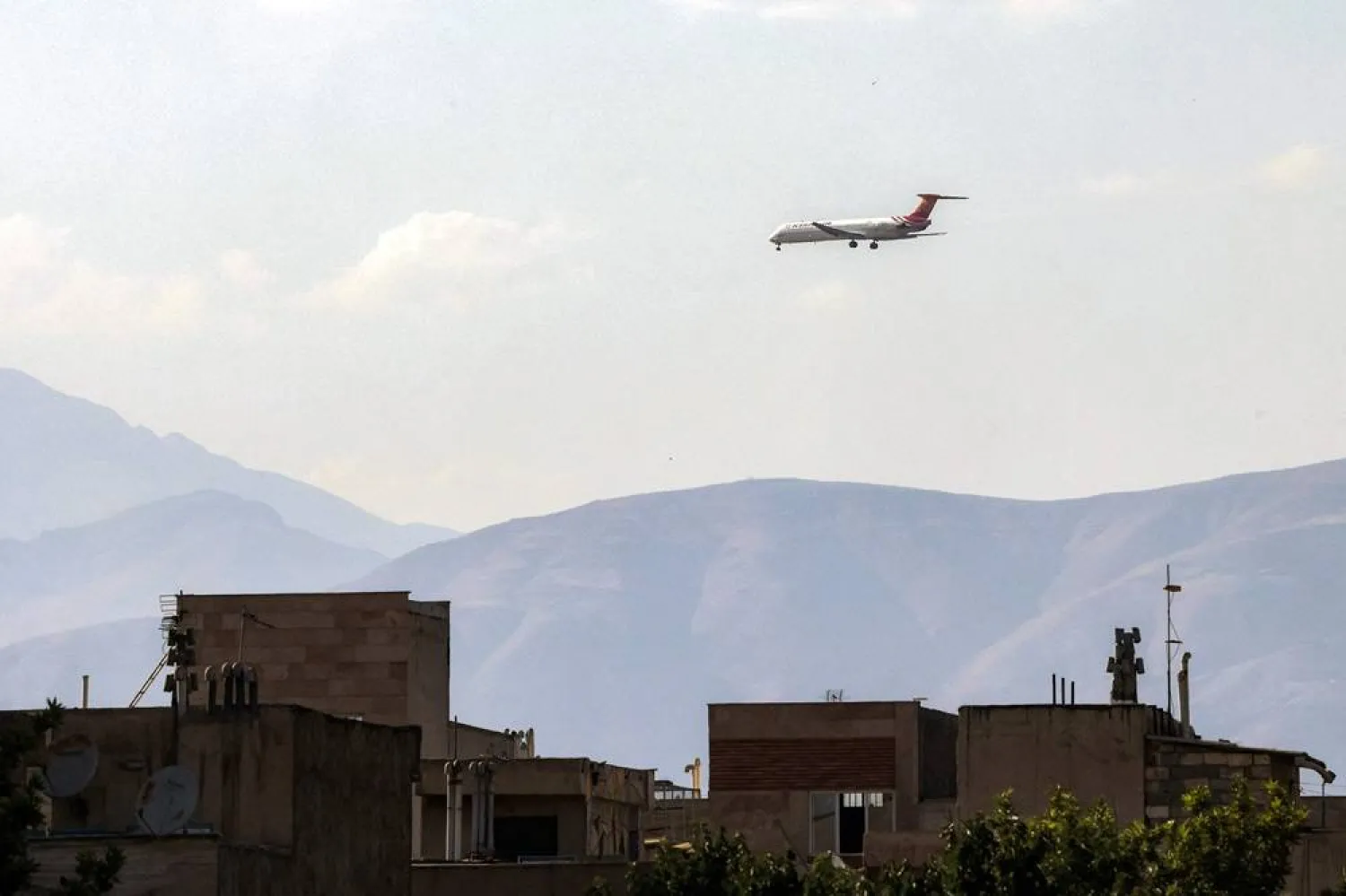
 A Kish Air Airlines McDonnell Douglas MD-82 passenger aircraft prepares for landing at Tehran's Mehrabad Airport on June 20, 2026. (AFP)
A Kish Air Airlines McDonnell Douglas MD-82 passenger aircraft prepares for landing at Tehran's Mehrabad Airport on June 20, 2026. (AFP)
TT

Airlines Should Still Avoid Airspace Over Iran After Framework Deal, EU Agency Warns

 A Kish Air Airlines McDonnell Douglas MD-82 passenger aircraft prepares for landing at Tehran's Mehrabad Airport on June 20, 2026. (AFP)
A Kish Air Airlines McDonnell Douglas MD-82 passenger aircraft prepares for landing at Tehran's Mehrabad Airport on June 20, 2026. (AFP)

Airlines ‌should continue to avoid the airspace over Iran, Iraq and Lebanon and remain cautious across the region despite the framework deal between Washington and Tehran, because violations remained possible, the ‌EU aviation safety ‌agency EASA said.

EASA ‌said ⁠on Wednesday it ⁠was extending its conflict-zone advisory for the region until July 1.

Short-term violations of the US-Iran ceasefire remain possible, ⁠in particular in ‌and ‌around the Strait of ‌Hormuz and neighboring airspace, the ‌agency said.

The agency also flagged the fragile ceasefire between Israel and Hezbollah, creating ‌the potential for military activity impacting the airspace ⁠of ⁠Lebanon.


Arcapita, Hines to Explore Joint investments in GCC Industrial and Logistics Real Estate

Arcapita's headquarters in Manama, Bahrain. Photo: Asharq Al-Awsat
TT

Arcapita, Hines to Explore Joint investments in GCC Industrial and Logistics Real Estate

Arcapita's headquarters in Manama, Bahrain. Photo: Asharq Al-Awsat

Arcapita Group Holdings Limited, the global alternative investment firm, and Hines, one of the world’s largest real assets investment managers, announced on Wednesday a partnership to together explore the creation of an institutional-grade platform focused on industrial and logistics real estate assets across the Gulf Cooperation Council (GCC).

The platform would seek to combine Hines’ global real estate investment, development and operating standards with Arcapita’s regional investment, structuring and asset management expertise, supported by Lintara, Arcapita’s local operating platform, a joint statement said.

Through the partnership, the two companies would focus on jointly originating, structuring and executing investments across both development opportunities and stabilized income-producing assets, it added.

Arcapita is headquartered in Manama, Bahrain. It also operates from its offices in the United States, the United Kingdom, Saudi Arabia, the United Arab Emirates and Singapore.

Hines is based in Houston, Texas.

Martin Tan, Arcapita’s Chief Investment Officer, said: “This strategic partnership marks an important step in our approach to the GCC industrial and logistics opportunity. Market fundamentals across the region have reached a depth and maturity that support the case for a dedicated, institutional-scale platform rather than a transaction-led strategy.”

“As GCC countries continue to focus on supply chain resilience and national self-sufficiency, we see a compelling opportunity to help deliver modern logistics infrastructure at scale. By bringing together Arcapita’s long standing regional track record, sourcing and asset management capabilities with Hines’ globally recognized development expertise, the platform would be well positioned to pursue high-quality opportunities across the sector.”

As for Hines’ Global Head of Real Estate, Steve Luthman, he said that the GCC represents one of the most compelling logistics growth markets globally.

He welcomed “the opportunity to partner with Arcapita to explore the development of a structured, platform-led entry into a rapidly growing market, backed by deep local relationships and execution capability.”


Al-Jadaan: Economic Resilience, Partnerships Are Key to Meeting Global Development Challenges

Saudi Finance Minister Mohammed Al-Jadaan addresses the OPEC Fund Development Forum in Vienna. (X)
TT

Al-Jadaan: Economic Resilience, Partnerships Are Key to Meeting Global Development Challenges

Saudi Finance Minister Mohammed Al-Jadaan addresses the OPEC Fund Development Forum in Vienna. (X)

Saudi Finance Minister Mohammed Al-Jadaan warned that the world is facing increasingly difficult economic conditions shaped by uncertainty, fragmentation, geopolitical conflicts, trade tensions, debt risks, and challenges related to energy security and broader security concerns, factors he said threaten to undermine global development goals.

Addressing the OPEC Fund Development Forum in Vienna, held to mark the 50th anniversary of the OPEC Fund for International Development (OFID), Al-Jadaan described the milestone as an opportunity not only to celebrate the institution’s achievements over the past half-century, but also to reflect on lessons learned and consider the challenges and opportunities that lie ahead.

Over the past five decades, the OPEC Fund has helped tackle some of the world’s most pressing development challenges, supporting sustainable development, economic growth, and prosperity while improving living standards in low- and middle-income countries, he noted. Its efforts have enabled millions to gain access to electricity, quality education, and clean energy solutions, while expanding economic opportunities and improving essential services.

Al-Jadaan outlined three priorities for preventing setbacks in global development progress.

The first is placing resilience at the center of development strategies. Rather than serving merely as a response to crises, resilience must become a long-term, proactive approach.

Building systems capable of withstanding shocks requires investment in infrastructure, energy, food security, healthcare, education, and institutional capacity, he argued. It also demands inclusive policies tailored to local needs that diversify sources of income, improve livelihoods, and stabilize fragile markets.

The second priority is strengthening partnerships. No country can confront development challenges alone, Al-Jadaan said, emphasizing the critical role of development finance institutions in mobilizing resources, sharing knowledge, and fostering innovation. The private sector, he added, remains essential for driving investment, creating jobs, and delivering practical solutions.

Greater cooperation among development partners can improve coordination, attract additional capital, and maximize development impact.

Turning to his third priority, Al-Jadaan stressed that trust and national ownership must remain at the heart of development efforts. Development financing is most effective when aligned with national priorities, responsive to local realities, and built on genuine partnerships.

Expanding the OPEC Fund’s activities and deepening cooperation with partner countries would help align financing strategies with national development plans, improve the efficiency of resource allocation, strengthen implementation, and deliver measurable results, he said.

Al-Jadaan also underscored the importance of candid feedback from development partners and their support for bold, long-term structural reforms that enhance resilience, growth, and prosperity.

Fifty years is not a limit to what can be achieved. It is the foundation on which we build, he stated. He added that stronger partnerships and shared commitments will help safeguard the gains of the past five decades and advance sustainable development in the decades ahead.


Geopolitics and AI in Spotlight at China’s ‘Summer Davos’

Chinese Premier Li Qiang delivers his speech at the opening ceremony of the World Economic Forum (WEF) in Dalian, China's Liaoning province on June 24, 2026. (AFP)
TT

Geopolitics and AI in Spotlight at China’s ‘Summer Davos’

Chinese Premier Li Qiang delivers his speech at the opening ceremony of the World Economic Forum (WEF) in Dalian, China's Liaoning province on June 24, 2026. (AFP)

Breakthroughs in technologies such as AI are touted as drivers of economic growth, but headwinds include concerns over job losses and geopolitical tensions, speakers told AFP at China's "Summer Davos" this week.

The annual conference organized by the Switzerland-based World Economic Forum (WEF) brings together policymakers and experts across sectors crucial to the global economy.

AI "is really changing industry and the economy", offering new opportunities in education, healthcare and other areas, Mirek Dusek, WEF's managing director, said Tuesday.

"We are blessed with a lot of technological advancements recently, but the main imperative for decision-makers around the world is really: how do you make sure this counts in the real economy?" Dusek told AFP.

There is also a "risk of a backlash against some of these technologies", he warned.

Fears are growing of AI-driven disruption to labor markets and the potential security risks it poses, from breaches of cyber defenses to its use in conflict.

Adding to pressure on the international economic system is the US-Israeli war with Iran, which has stymied shipping from the oil-rich Middle East.

- 'Tepid environment' -

These shadows have spurred the World Bank to lower its global growth forecast for this year to its lowest level since the Covid pandemic.

The world economy is currently facing "a tepid environment", Dusek said.

"We all know that there is a threat of lost opportunity in terms of global growth if we really go into a state of severe fragmentation."

Chinese Premier Li Qiang was due Wednesday morning to deliver a closely watched speech at the WEF's "Annual Meeting of the New Champions", hosted this year in the northeastern port city of Dalian.

The occasion provides an opportunity for Beijing's number-two leader to deliver a message about the Chinese economy to the influential group of tech and business leaders in attendance.

China's economy -- second in size only to that of the United States -- has struggled in recent years to keep up with the breakneck pace of development it maintained in previous decades.

Despite a striking boom in exports and AI tech, sluggish household consumption and an entrenched property sector debt crisis have weighed on growth since the pandemic.

Complicating matters is Beijing's tumultuous relationship with Washington.

Graham Allison, professor at the Harvard Kennedy School and a frequent unofficial interlocutor with Chinese and US foreign policymakers, told AFP in Dalian that a potential war between the two great powers is very much on the table.

Allison is known for coining the term "Thucydides trap" -- which he defined Tuesday as "the dangerous dynamic that occurs when a rapidly rising power, like... China over the past generation impacts a major ruling power", such as the United States.

- Avoiding woes of history -

Thucydides, an ancient Greek historian, "warns us that business as usual, diplomacy as usual (and) statecraft as usual produces war" in such a situation, Allison said.

However, recent high-level engagement between the Chinese and US presidents is reason for optimism that a war can be avoided, he added.

At a summit in Beijing last month, Xi Jinping asked Donald Trump if the countries could "transcend the so-called 'Thucydides Trap' and forge a new paradigm for major-power relations".

Allison told AFP that Xi "clearly gets it" and that his mention of the obscure historical concept "wasn't by accident".

Trump, meanwhile, is "erratic in his own way", said Allison, calling the Iran war this year a "terrible" and "unnecessary mistake".

But he "understands China is different", he said.

Xi's response last year to sky-high tariffs imposed by Washington on China -- strangling US access to critical rare-earth minerals -- made Trump realize that he is "now up against somebody that is roughly (his) peer".

"These two presidents are clearly trying to redefine the relationship or reframe it in a way that'll overcome Thucydides's trap."