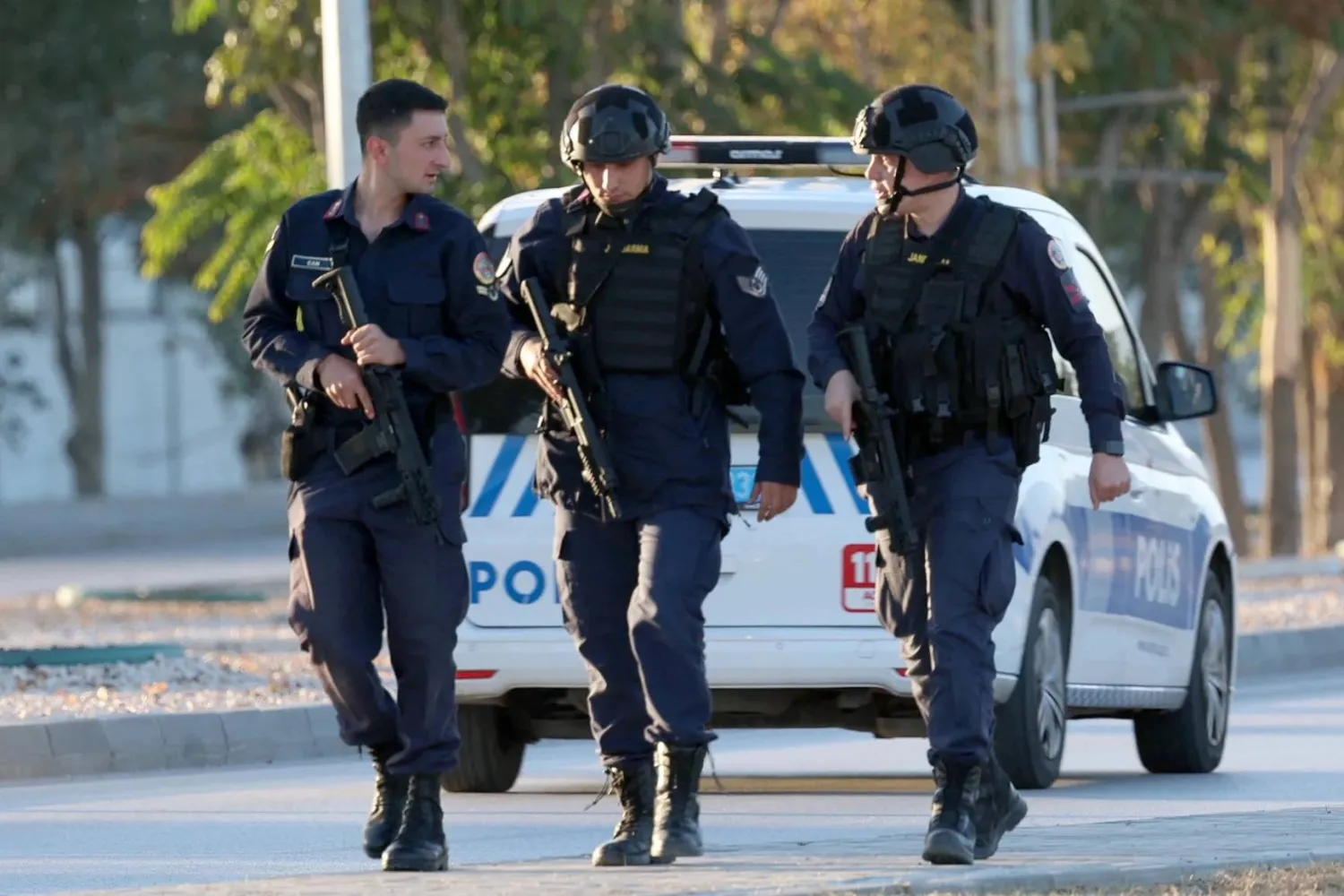
ISIS Suspect Killed in Raid Ahead of Ankara NATO Summit

The prosecutor's office had on Tuesday confirmed issuing warrants for 241 people, with anti-terror police arresting 209 people in early morning raids in and around the city. (AFP file)
TT

ISIS Suspect Killed in Raid Ahead of Ankara NATO Summit

The prosecutor's office had on Tuesday confirmed issuing warrants for 241 people, with anti-terror police arresting 209 people in early morning raids in and around the city. (AFP file)

Police shot dead a man suspected of ties to ISIS group militants during a raid on a district near Ankara, security sources told Turkish media Wednesday.

The incident occurred during police raids early Tuesday, two weeks before the July 7-8 NATO summit in the capital Ankara that world leaders from 32 nations, among them US President Donald Trump, will attend.

The shooting happened in Sazagasi, about 100 kilometers (60 miles) south of the capital, during a simultaneous operations that saw police arresting more than 200 people, the DHA and IHA news agencies reported.

The suspect, M.K., was shot dead when a police special force unit raided an address where he was staying with his wife N.K.

IHA news agency said the pair had opened fire first on police, prompting a shootout.

"The police carried out an operation here, but I don't know who the suspects are supposed to be linked to," local neighborhood leader Nuri Demir told AFP by phone.

"We saw ambulances transporting wounded, but I don't know anything else," he added.

Contacted by AFP, neither Ankara's provincial governorate nor the Ankara public prosecutor's office would make a comment on the incident.

The prosecutor's office had on Tuesday confirmed issuing warrants for 241 people, with anti-terror police arresting 209 people in early morning raids in and around the city.

Of the total number wanted for arrest, 56 were identified as ISIS suspects, while 185 were identified as belonging to several far-left organizations branded terror groups by Ankara.

It was not immediately clear on Wednesday whether police had managed to round up any of the remaining 32 suspects.


US Deportees Face Escalating Police Violence, Intimidation in Eq.Guinea

Handout picture released by Guatemalan Migration Institute shows Guatemalan migrants descending from an US military plane after being deported from US at the Guatemalan Air Force Base in Guatemala City on January 24, 2025. Guatemalan Migration Institute via AFP
TT

US Deportees Face Escalating Police Violence, Intimidation in Eq.Guinea

Handout picture released by Guatemalan Migration Institute shows Guatemalan migrants descending from an US military plane after being deported from US at the Guatemalan Air Force Base in Guatemala City on January 24, 2025. Guatemalan Migration Institute via AFP

The masked police officers burst into Ahmed Soliman's hotel room in Equatorial Guinea and dragged him and two dozen other US deportees outside, guns drawn, to deliver a message: go home.

"I have police officers yanking on my neck, trying to throw me on the ground, I have officers elbowing me in my back," Soliman, 30, told AFP of the incident, which occurred two weeks ago.

"Machine guns pointed at our faces, all this just so that they can tell us they're tired of us here in this country," he recalled, saying he and four others were handcuffed and hit by police, in an incident confirmed by two other deportees.

Authorities are ratcheting up pressure on deportees held at the hotel, which has become a dumping ground for expelled US immigrants, including Soliman, who arrived in April, said AFP.

The deportees say they're facing verbal and physical abuse from police, meagre rations and constantly being pushed to return home.

The authoritarian petro-state in central Africa has become a key transit point in President Donald Trump's immigration crackdown, which involves shipping people that the United States can't legally send home to "third countries" like Equatorial Guinea instead.

As their stay at the hotel, under watch from armed guards, drags on for months, authorities are getting impatient, deportees told AFP. A local lawyer also confirmed that deportees are facing pressure to return to their home countries.

"Anytime a problem happens, anytime we're asking for our rights for something, they say, 'Hey, if you don't like it, go back to your country,'" Soliman, who had lived in the United States since he was three and fears returning to his native Egypt because he is gay, told AFP.

The deportees cannot claim asylum in Equatorial Guinea.

But they say they can't leave, because they fear for their lives in their home countries -- and because they were deported without passports.

Soliman said authorities are pressuring him to accept a government-issued travel document instead.

Washington has expelled at least 50 people, mostly Africans, to Equatorial Guinea since November.

Twenty-seven remain in the hotel as Equatorial Guinea has deported people to their home countries, or onward to "fourth" countries.

- 'They're trying to intimidate you' -

At the hotel, the deportees are held on the premises by armed guards.

"They threaten you each and every day," said another deportee, who gave her first name, Petagaye, and has been held in the hotel since June.

"They tell you, 'oh, you need to go back to your country'. Or they tell you, 'oh, just kill yourself, because America don't care'," the 35-year-old said.

Deportees used to be able to walk around the hotel grounds, and sometimes get a police escort to a nearby corner store -- often in exchange for a few dollars -- but that too has seen a crackdown, a deportee who gave the name Him, a pseudonym, told AFP.

"They're trying to intimidate you," said Him, who fled what is now Eritrea during that country's war for independence from Ethiopia, and arrived in the United States as a refugee when he was 13.

"Even though you know you could go back and get killed, even though you ran away from a country and proved it in a federal court of law that we can't go back," said Him, 47.

Neither the US State Department nor Equatorial Guinea's national security minister responded to a request for comment.

- Ebola scare -

In July, deportees were sent into a panic when a guard told them an Ebola patient was being housed in the hotel.

Videos shared with AFP showed men in hazmat suits walking through the building.

Authorities have not commented on the incident and Equatorial Guinea has not reported any Ebola cases.

The three deportees interviewed by AFP had been in the United States since they were children, and spoke with American accents.

All three had won deportation protections preventing them from being sent to their home countries after judges found their lives would be in danger.

Under previous administrations, people with such protections, though legally weaker than asylum, have been allowed to legally work and live in the United States.

The Trump administration has argued that it can still deport people with such protections, as long as it doesn't send them to their home country.

A lawsuit was filed in June at the African Commission on Human and Peoples' Rights, the continent's top human rights body, to try to halt US deportations to Equatorial Guinea.

For now, the deportations continue: 10 more people arrived on July 30, US and local lawyers said.


Heavy Rain Causes Flooding Near Tokyo, At Least 5 Dead and Travelers Stranded

A view of a flooded road following heavy rain in Ichikawa, Chiba prefecture, near Tokyo, Japan, late 13 August 2026 (issued 14 August 2026). EPA/JIJI PRESS
TT

Heavy Rain Causes Flooding Near Tokyo, At Least 5 Dead and Travelers Stranded

A view of a flooded road following heavy rain in Ichikawa, Chiba prefecture, near Tokyo, Japan, late 13 August 2026 (issued 14 August 2026). EPA/JIJI PRESS

Record-breaking rainfall that pounded cities east of Tokyo overnight flooded roads and dozens of homes, stranded thousands of people, caused power outages and left at least five people dead and one missing.

The Japan Meteorological Agency downgraded its most severe warning for heavy rain in more than a dozen municipalities in Chiba prefecture as rain subsided Friday morning but forecast more rain later in the day.

Photos and television footage showed widespread damage after daylight with homes, cars and parts of railway tracks flooded with muddy water.

The Ground Self-Defense Force said it dispatched buses to pick up about 4,000 stranded people who stayed overnight at the Soga train station, a local route that also serves Tokyo Disney, an operation finished later Friday. The theme park did not report any damage.

Thousands of people who were stuck overnight at the Narita airport serving the Tokyo region gradually left as train service partially resumed Friday morning with delays. Flights in and out of Narita were operating normally Friday, with many people returning home at the end of Japan's Bon Buddhist holiday week.

Hundreds of people took shelter overnight at the Chiba prefectural government building, The Associated Press reported.

The prefecture said five people were found dead and another person was missing. The victims included a man found floating on a flooded road in Ichikawa city and a woman who had been stuck in a flooded car in Sakura city. Two people were presumed dead after being pulled from flooded cars in Kashiwa city and in Chiba.

More than 170 homes were flooded in the prefecture and more than 300 people were taking shelter at public facilities as of Friday afternoon, Chiba officials said.

The torrential rain and flooding also knocked out power to about 18,000 homes Friday morning, down from 68,000 earlier, according to the TEPCO Power Grid.

Record-breaking rainfall of 11.5 centimeters (4.5 inches) fell in just one hour in Chiba City and 9.7 centimeters (3.8 inches) fell in one hour in Sakura, which was also a record. JMA forecast official Takuya Hosomi told a televised emergency news conference that unprecedented levels of rainfall were recorded.


Trump Orders the Navy to Return to an Older System of Launching Jets off Aircraft Carriers

File photo: The USS Abraham Lincoln departed San Diego, California on November 21, 2025 for duty in the South China Sea and was rerouted to the Middle East before US-Israeli attacks on Iran that began February 28. US NAVY/AFP/File
TT

Trump Orders the Navy to Return to an Older System of Launching Jets off Aircraft Carriers

File photo: The USS Abraham Lincoln departed San Diego, California on November 21, 2025 for duty in the South China Sea and was rerouted to the Middle East before US-Israeli attacks on Iran that began February 28. US NAVY/AFP/File

President Donald Trump is ordering the US Navy to remove the advanced system used to launch fighter jets from its newest type of aircraft carrier and return to using older steam catapults that he has long said he prefers, according to a directive issued Thursday.

The new mandate would likely cost billions of dollars and revert the Navy’s most advanced ships to a system that takes more sailors to operate and is more difficult to maintain.

The memo directs the Pentagon and the Navy to present Trump with plans to remove the Electromagnetic Aircraft Launch System, also known as EMALS, within two months. It also says the Ford-class carrier's electromagnetic weapons elevators should be replaced.

The move comes after years of Trump railing against the new, magnetically powered catapult system that shoots fighter jets off the deck of the carriers. It also comes at a time when the US military is trying to find funding from Congress for all its desired equipment and as the Navy is struggling to fill its ships with enough sailors, said The Associated Press.

Trump's ire with the new technology goes back to at least 2017 in his first term, when he claimed the new system is “not good” and “doesn't have the power” of the older, steam systems in an interview with Time magazine.

“You're going to goddamned steam,” Trump said at the time. The topic has frequently come up since then at rallies and other events.

While Trump is looking to roll back the latest technology, the newest Chinese aircraft carriers employ electromagnetic catapults and France said it plans to use the system on its new carrier.

Trump's memo directs the fourth Ford-class carrier, the USS Doris Miller, to be the first ship to include the new changes. That will leave the USS Gerald R. Ford, as well as the forthcoming USS John F. Kennedy and USS Enterprise, untouched.

However, redesigning an already finalized ship for such a major system change will not be an easy task.

General Atomics, the company that makes EMALS, told The Associated Press in an email that the decision not to proceed with the system on the USS Doris Miller “warrants careful reconsideration.”

Trump's memo that mandates the removal of the system also noted that one of the issues facing shipbuilding is the Navy's constant design changes, “which have resulted in cost growth, delays, and cancellations.”

General Atomics said the work on the Doris Miller's catapults and arresting gear was already halfway complete and said “changing course now would introduce significant cost, schedule, and integration risks."

The move comes as Congress will weigh the necessary budget and funding bills that the Trump administration has said they need to fund the Pentagon and the Iran war.

Defense Secretary Pete Hegseth estimated last month that the war's cost grew to $37.5 billion as Republicans prepared a $95 billion package to fund the military, along with other White House priorities.

Hegseth said the supplemental war funding is an “urgent, necessary” injection of money, and with Trump's proposed $1.5 trillion defense budget a generational investment in the military.

The House narrowly adopted both but the Senate still must act when it returns in September.

Some of the key advantages to the electromagnetic system are its ability to launch aircraft at faster speeds while being easier to maintain, requiring fewer sailors to operate and using less space aboard the ship.

EMALS aboard the USS Ford cut the number of sailors need to operate the catapults from about a dozen to two.

Reverting to a system that requires more people to operate it comes as the Navy has struggled to translate its recruiting successes in the past year to actually filling jobs on warships. At the start of the year, the Navy had about 20,000 unfilled posts across the fleet.

In February, the Navy touted the system in a press release that said it allowed the USS Ford to launch and recover aircraft at a higher rate than its predecessor, the Nimitz-class ships.