


Oil Extends Slide to More than 1% on Expectations of Smoother Crude Flows via Hormuz

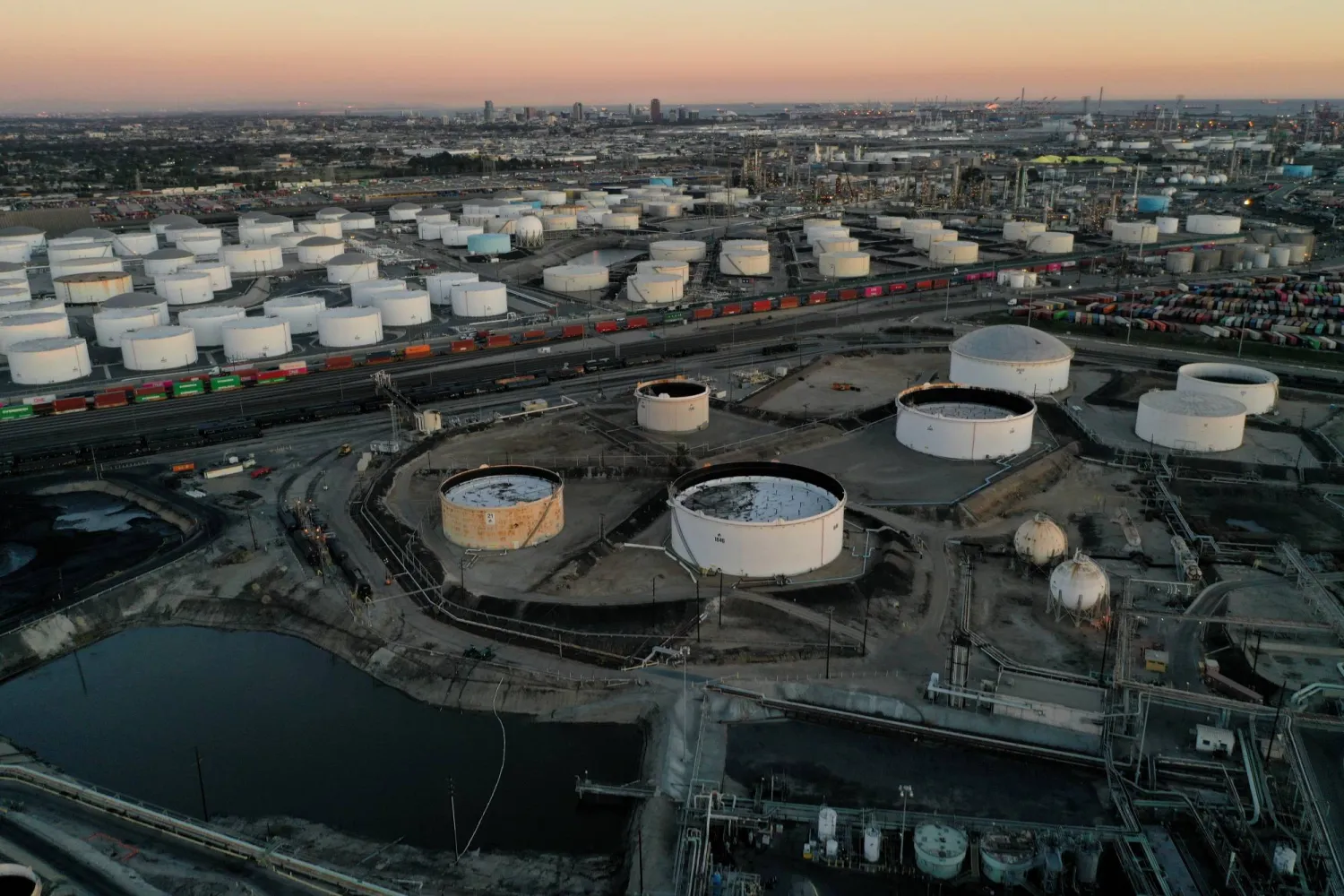
Storage tanks for crude oil, gasoline, diesel, and other refined petroleum products in Carson, California (Reuters)
TT

Oil Extends Slide to More than 1% on Expectations of Smoother Crude Flows via Hormuz

Storage tanks for crude oil, gasoline, diesel, and other refined petroleum products in Carson, California (Reuters)

Oil prices fell more than 1% on Wednesday, extending this week's losses to hit fresh four-month lows on signs that more oil tankers are set to move out of the Strait of Hormuz.

Brent crude futures were down $1.37, or 1.8%, at $75.71 a barrel by 0805 GMT. US West Texas Intermediate slipped by $1.08, or 1.5%, to $72.13.

Brent touched a low of $75.60, its weakest level since February 27, the day before the initial US-Israeli strikes on Iran. WTI fell as low as $72.03, the weakest since March 3.

"While there are early encouraging signs of increased tanker activity, the market is pricing in the broader scenario of Iranian oil re-entering the global market and the Strait of Hormuz normalising," said Tim Waterer, chief market analyst at KCM Trade.

"If sanctions are eased, Iranian production and exports could ramp up relatively quickly given the substantial amount stored on tankers — we are likely talking weeks rather than months," Waterer added, Reuters reported.

Prices have also come under pressure this week from the 60-day sanctions waiver Washington granted Tehran after initial peace talks, allowing Iran to sell oil, and from an easing of hostilities in Lebanon, with prices approaching pre-war levels.

Ship-tracking data showed that three stranded supertankers passed through the strait on Tuesday. The UN shipping agency said an evacuation plan is under way to enable hundreds of stranded ships to sail through the strait after the US-Iran ceasefire deal.

On Tuesday, Oman and Iran agreed to press on with discussions about managing navigation in the strait. US Secretary of State Marco Rubio said that any attempt by Iran to levy transit fees would violate international law.

Uncertainty remains over the durability of the accord, however. US President Donald Trump said on Tuesday that Iran had agreed to nuclear inspections into "infinity", though Tehran said it had made no such concession.

"Markets are currently assigning too much confidence to a favorable outcome without fully discounting the risks associated with unresolved nuclear issues and inspection disputes," said Mark Malek, CIO at Siebert Financial.

Investors are also watching how quickly Middle Eastern producers can restore exports and whether more ships will enter the region.

Meanwhile, US crude stocks fell by 765,000 barrels in the week to June 19, market sources said, citing data from the American Petroleum Institute.

Nine analysts polled by Reuters estimated, on average, that crude inventories fell by about 4.5 million barrels in the past week.



Saudi Maritime and Logistics Congress Kicks off in Jeddah in October

The Jeddah Superdome will host the 2026 edition of the congress. (Saudi Maritime and Logistics Congress)
TT

Saudi Maritime and Logistics Congress Kicks off in Jeddah in October

The Jeddah Superdome will host the 2026 edition of the congress. (Saudi Maritime and Logistics Congress)

The Saudi Maritime and Logistics Congress will kick off in Jeddah on October 21 and 22, with the participation of more than 15,000 specialists from over 90 countries, coinciding with the Kingdom's efforts to boost its position as a global logistics hub.

The Jeddah Superdome will host the 2026 edition of the congress, which brings together government officials, representatives from port authorities, shipping companies, logistics operators, investors, and major buyers in the sector.

The event comes at a time when the Kingdom is focusing on developing its maritime transport infrastructure and logistics services under the National Transport and Logistics Strategy. This strategy aims to increase port capacity to 40 million twenty-foot equivalent units (TEUs) annually by 2030.

The congress will explore opportunities to develop port capacity, logistics zones, shipping corridors, maritime transport services, and digital infrastructure, alongside shifts in the energy sector, infrastructure and technology investments, and supply chain resilience.

The congress program will focus on five key themes, including trade corridors and connectivity; ports, logistics, and industrial competitiveness; the energy transition; infrastructure investment and economic development; and technology and resilience.

The Saudi Ports Authority (Mawani) and the Transport General Authority (TGA) are participating as main partners in the 2026 edition, while the event is being organized in cooperation with Bahri and Seatrade Maritime Saudi, a subsidiary of Informa.


Saudi Ministry of Industry Participates in 63rd Damascus International Fair

26 August 2026, Syria, Damascus: People walk at the Damascus Fair Grounds during the opening ceremony of the 63rd Damascus International Fair. (dpa)
TT

Saudi Ministry of Industry Participates in 63rd Damascus International Fair

26 August 2026, Syria, Damascus: People walk at the Damascus Fair Grounds during the opening ceremony of the 63rd Damascus International Fair. (dpa)

The Saudi Ministry of Industry and Mineral Resources is participating in the 63rd Damascus International Fair, taking place from August 26 to September 4.

The participation aims to strengthen economic and industrial integration between the two countries, showcase the growth and development of Saudi industries, and expand access for Saudi goods and services to regional markets.

Saudi non-oil exports to Syria reached SAR1.23 billion in 2025, representing growth of more than 123% compared to 2024.

The fair serves as a key platform for fostering international investment partnerships across a wide range of economic sectors, particularly energy, industry, and technology.

The 63rd edition brings together around 1,000 entities from 60 countries, as well as Syrian ministries, institutions, and artisans, highlighting the fair’s significant economic and developmental impact.


Saudi Arabia, Pakistan Aim to Raise Agricultural and Food Exports to Reach $3 Billion

The Saudi and Pakistani delegations are seen in Islamabad. (SPA)
TT

Saudi Arabia, Pakistan Aim to Raise Agricultural and Food Exports to Reach $3 Billion

The Saudi and Pakistani delegations are seen in Islamabad. (SPA)

Saudi Arabia and Pakistan have agreed to bolster cooperation in the fields of food security and agriculture, as both sides look to increase the value of Pakistani agricultural and food exports to the Kingdom to $3 billion.

The announcement was detailed in a joint statement issued at the conclusion of a high-level Saudi delegation's official visit to Pakistan from August 26 to 28. Led by Saudi Minister of Environment, Water, and Agriculture Abdulrahman Al-Fadley, the delegation included senior officials from the ministry, the General Food Security Authority, and other relevant government entities.

The discussions focused on the rice, red meat, and fruit sectors, as well as fruit concentrates, green fodder, and water-efficient agricultural technologies.

Pakistani rice supplies to the Saudi market reached approximately 169,000 tons in 2025, with an estimated value of $163 million, while annual meat supplies totaled around 30,000 tons, valued at $167 million. Saudi Arabia has expressed its desire to double the volume of meat supplies in the future.

The two sides agreed to increase the share of Pakistani fruit exports and fruit concentrates in the Saudi market, empower the private sector, and facilitate communication between business leaders, alongside expanding mutual recognition of quality certificates.

The two sides also discussed opportunities to expand the green fodder trade and build long-term supply partnerships, while Saudi Arabia encouraged Pakistan to join the International Dates Council, an invitation welcomed by Islamabad.

During the visit, Saudi Arabia reviewed investment proposals from Pakistani companies across the livestock, agricultural manufacturing, and rice value chain sectors, with both sides agreeing to coordinate on exploring and exploiting these opportunities.

Both sides reaffirmed their commitment to strengthening their comprehensive strategic partnership. Pakistan welcomed the invitation to attend the 43rd Saudi Agriculture Exhibition, scheduled to be held in Riyadh in October, and both parties agreed to maintain ongoing coordination to follow up on the implementation of the reached understandings.