


Japan Cancels 120 Flights as Twin Storms Approach

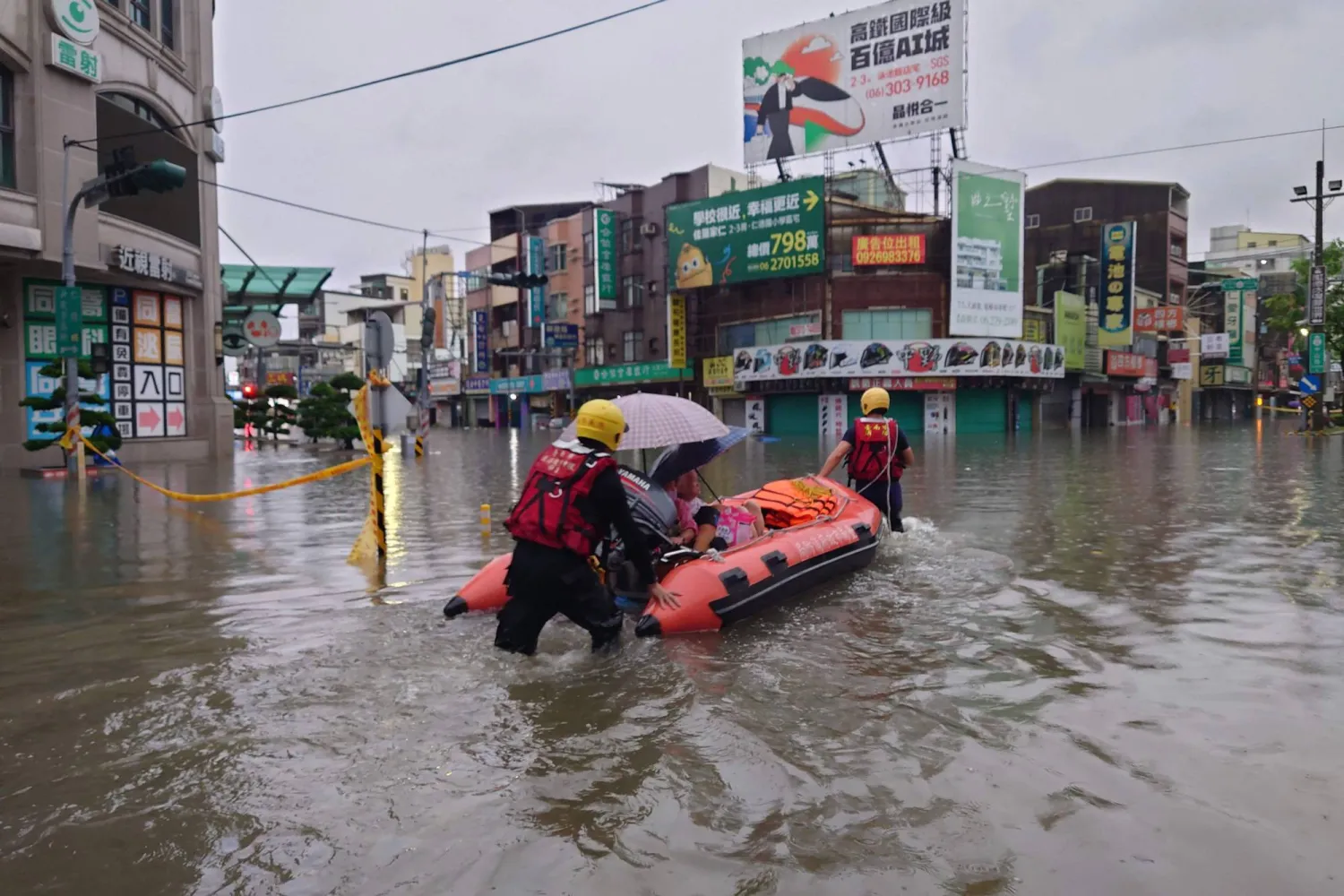
This picture taken and released by Taiwan's Central News Agency (CNA) on June 26, 2026, shows firefighters using an inflatable rescue boat to evacuate residents through floodwaters after heavy overnight rain caused severe flooding from approaching typhoon Mekkhala in Tainan, Taiwan. (Photo by YANG SIH-RUEI / CNA / AFP)
TT

Japan Cancels 120 Flights as Twin Storms Approach

This picture taken and released by Taiwan's Central News Agency (CNA) on June 26, 2026, shows firefighters using an inflatable rescue boat to evacuate residents through floodwaters after heavy overnight rain caused severe flooding from approaching typhoon Mekkhala in Tainan, Taiwan. (Photo by YANG SIH-RUEI / CNA / AFP)

Japanese airlines cancelled more than 100 flights on Friday as two tropical storms barreled towards the archipelago, with authorities advising evacuations in some areas because of possible flooding and landslides.

Severe tropical storm Mekkhala was downgraded from a typhoon but still carried gusts of up to 144 kilometers (89 miles) per hour, according to forecasters, with heavy rain already pounding parts of southern and western Japan.

The weather system was expected to skirt the islands of Kyushu and Shikoku over the weekend and potentially converge with tropical storm Higos, which was also swirling further out in the Pacific.

That could result in the atmospheric phenomenon known as the Fujiwhara effect when two storms interact, making forecasting their movements and strengths more difficult.

Japan Airlines and All Nippon Airways cancelled a total of 120 flights to and from the southern regions of Okinawa and Kagoshima, AFP reported.

The Kyoto region advised several thousand residents to evacuate, warning of potential landslides, as footage from public broadcaster NHK showed a raging brown river running through the area.

Officials in Kyoto and Osaka said water levels in rivers were rising and warned that vigilance was required because of the threat of flooding.

Automaker Toyota suspended operations at a plant in Kyushu because of road closures caused by heavy rain, while Nissan also said it planned to halt some production lines, Kyodo News reported.

The Japanese military also cancelled the planned maiden flight of a V-22 Osprey transport aircraft to Miyako Island that was part of joint exercises with the United States, Kyodo said.
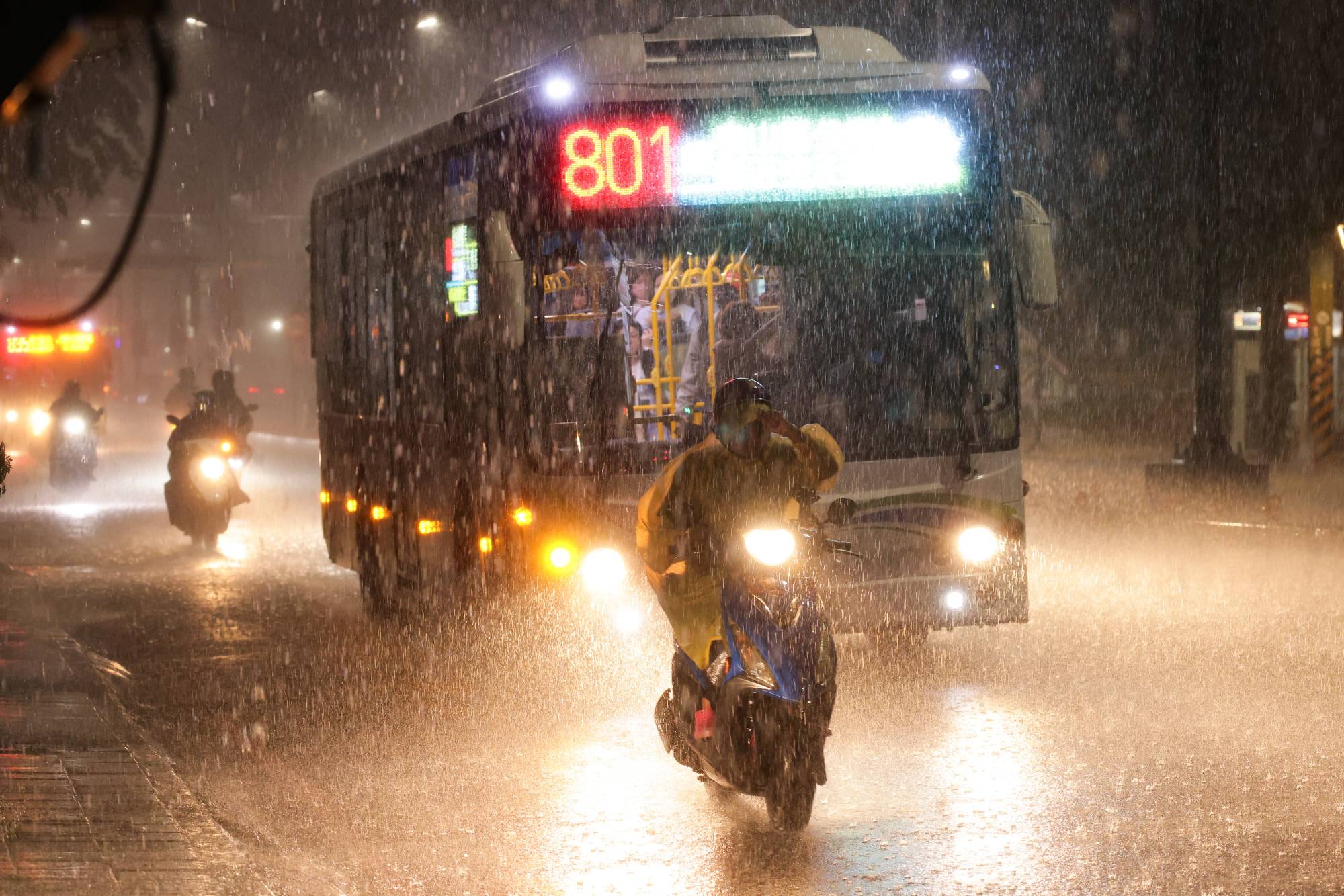
A motorist maneuvers during a downpour of rain in Taipei, Taiwan, 25 June 2026. EPA/RITCHIE B. TONGO

In Taiwan, more than 1,600 people were evacuated from their homes, and schools and offices were shut in several areas, as Mekkhala triggered torrential rain, floods and landslides across the island.

No casualties were recorded, but authorities warned on Friday of potentially dangerous debris flows in mountainous areas of Hualien county in the east as well as in Kaohsiung and Pingtung in the south, where the weather forecasting agency said as much as 88cm (34.6 inches) of rain had fallen since Thursday.

Scores of people living downstream from a recently detected barrier lake in a rugged area of Hualien have left their homes, a local official said. Some train lines were suspended.



IAEA Head: 'Very Strong' Nuclear Verification Needed in Iran after War

26 June 2026, Japan, Tokio: International Atomic Energy Agency (IAEA) Director General Rafael Mariano Grossi addresses the media during a press conference at the Japan National Press Club. Photo: Rodrigo Reyes Marin/ZUMA Press Wire/dpa
TT

IAEA Head: 'Very Strong' Nuclear Verification Needed in Iran after War

26 June 2026, Japan, Tokio: International Atomic Energy Agency (IAEA) Director General Rafael Mariano Grossi addresses the media during a press conference at the Japan National Press Club. Photo: Rodrigo Reyes Marin/ZUMA Press Wire/dpa

"Very strong" verification is needed in Iran following the Middle East conflict to ensure that it does not develop nuclear weapons, the UN atomic watchdog chief said on Friday.

International Atomic Energy Agency (IAEA) head Rafael Grossi's remarks come as the United States and Iran negotiate a broader agreement to end the war, with Tehran's nuclear program a key sticking point.

"I think the objective of this (recent US-Iran preliminary) agreement is to ensure that there is no development of nuclear weapons in Iran. The government of Iran has declared quite clearly that this is not their intention," Grossi told reporters in Japan.

"But of course intentions are not enough. We have to have a very strong verification system in place... as soon as is practicable," AFP quoted the IAEA chief as saying.

Grossi said the watchdog had also "barely initiated" talks with Iran following its preliminary agreement with the United States about what to do with Tehran's uranium stockpile.

"Initial conversations have taken place... We expect this work to pick up soon," Grossi said.

Before the conflict, the IAEA estimated that Iran had 440 kilograms (970 pounds) of uranium enriched to 60 percent.

That is close to the 90 percent needed to make a bomb and well above the 3.67-percent limit set by a now-defunct 2015 agreement with Iran.

Iran suspended cooperation with the IAEA after Israel and the United States launched a previous wave of attacks in June 2025, and its inspectors have not seen the material since.

Under the terms of the preliminary agreement between Tehran and Washington, this stockpile is meant to be "downblended" under IAEA supervision.

Grossi said the "widespread impression" was that the stockpile remains where it was before June 2025 near Iran's Isfahan facility.

However, that facility was bombed and Iran said that it does not plan to allow the IAEA to inspect sites that were attacked.

Grossi also said on Friday that an alternative to diluting could be shipping the enriched uranium out of Iran.

"The memorandum of understanding, as you may have noted, includes the possibility of downblending as one alternative," Grossi said.

"It could also be shipped out directly. It would perhaps be more complicated, but there are a few technical alternatives to deal with the material," he said.

Iran has consistently denied seeking to acquire an atomic bomb, while remaining adamant about its right to operate a full-scale civilian nuclear program.

Before the 12-day war in 2025, Iran as a signatory to the nuclear non-proliferation treaty -- unlike Israel, which is widely assumed to have atomic weapons -- allowed the IAEA to inspect its nuclear sites under its safeguards deal with the Vienna-based body.

Iran agreed a landmark nuclear deal with six big powers in 2015 limiting its nuclear program in exchange for sanctions relief, but US President Donald Trump walked away from the agreement during his first term.


Report: Rate of People Dying in ICE Custody Highest in Over Decade

Federal agents detain an individual after exiting immigration court at the Jacob K Javits Federal Building in New York City on July 23, 2025 (AFP)
TT

Report: Rate of People Dying in ICE Custody Highest in Over Decade

Federal agents detain an individual after exiting immigration court at the Jacob K Javits Federal Building in New York City on July 23, 2025 (AFP)

The rate of people dying in Immigration and Customs Enforcement (ICE) custody has reached its highest level in over a decade, two rights groups said on Thursday.

According to a joint report by Human Rights Watch and Physicians for Human Rights, at least 52 deaths have been reported in ICE holding facilities since US President Donald Trump's second term began in January 2025.

Trump has made combating illegal immigration a top priority of his second term.

“We have seen the death rate in ICE custody skyrocket,” Reagan Williams, a HRW researcher who co-authored the report, told AFP.

“Instead of taking action to address this crisis and protect the lives and health of those in custody, we’ve seen the administration pour its resources into subjecting more and more people to prolonged detention,” she said.

From January 2025 to January 2026, the annual mortality rate in ICE custody was up 140% compared with a year earlier – an increase disproportionate to the higher detainee population, the report said.

A spokesperson for the US Department of Homeland Security, which oversees ICE, denied the reported spike in deaths.

“Consistent with data over the last decade, death rates in custody under the Trump administration are 0.009% of the detained population,” he said.

But June 25’s report found that, as immigration detention centers have grown, medical care has been lagging, partly due to crowding and people spending longer in custody.

“As bed space has rapidly expanded, we have maintained a higher standard of care than most prisons that hold US citizens – including providing access to proper medical care,” the spokesperson said. "For many illegal aliens, this is the best healthcare they have received their entire lives,” he added.


After Trump’s Outburst, Senate Republicans Reverse Course on Iran

Republican Senator Bill Cassidy of Louisiana (EPA)
TT

After Trump’s Outburst, Senate Republicans Reverse Course on Iran

Republican Senator Bill Cassidy of Louisiana (EPA)

Washington: Robert Jimison and Michael Gold

The confrontation came over lunch. The cleanup began after dinner.

Hours after US President Donald Trump angrily confronted Senate Republicans for joining Democrats to approve a war powers resolution rebuking his handling of the war in Iran, Republican leaders brought another, nearly identical measure to the floor.

In a 50-to-47 vote, with one senator voting “present,” they defeated the measure in a largely symbolic move that did nothing to change the resolution the Senate had narrowly approved a day earlier. Instead, it served as an unmistakable gesture to mollify a furious president who had just berated them.

Of the Republican senators who voted to adopt a resolution on Tuesday that instructed him to end the war with Iran or seek Congress’s approval to continue, two shifted their votes: Senators Bill Cassidy of Louisiana and Rand Paul of Kentucky.

Cassidy, who hours earlier angrily confronted Trump over a lack of transparency on the status of the war, said that he changed his vote after a meeting with Vice President JD Vance and Steve Witkoff, the president’s special envoy, at the White House.

“I was going to vote yes, but I had a briefing this evening, and it was complete,” he said moments after voting against the measure, adding: “I am reassured.”

Paul, who voted “present,” said that Trump’s remarks in his lunch meeting with senators had affected his vote, though not his views on the conflict and Congress’s role in declaring war.

“I did listen to the president today, and the president feels like it reduces his leverage to find a deal, and I do think it is important that we have peace negotiations,” Paul said.

Trump celebrated Wednesday’s late-night vote, thanking Republican leaders in a social media post that falsely claimed that the Senate had “changed its vote on Iran.”

Trump said that the new vote “puts Iran on notice.”

Ultimately, the maneuver did not undo Tuesday’s vote, which was the first war powers measure approved by both chambers since the war began and remains adopted. Wednesday’s vote neither rescinded nor superseded it.

Still, Republicans sought to characterize the procedural move as a chance to “re-vote,” even though the initial action cannot simply be erased through a subsequent vote on different legislation.

“That train has left the station,” said Senator Tim Kaine, Democrat of Virginia, whose resolution was called up by Republican leaders.

He noted that because of the rules surrounding the procedural tool used to call up the vote Wednesday’s vote to defeat the so-called “motion to proceed” does not prevent him from forcing another vote on the same resolution at another point, it simply prevents the chamber from taking up a final vote to consider it.

“My bill is in exactly the same position as it was before they did this vote,” he said.

The remarkable sequence underscored the lengths Republican leaders were willing to go to contain the latest clash between Senate Republicans skeptical of the war and Trump, which unfolded during a closed-door lunch earlier in the day.

The vote was the last one senators took before leaving for a planned recess that is set to last until July 13.

It capped off a turbulent day on Capitol Hill that began after Trump abruptly called off the ceremonial signing of a bipartisan housing bill that Republicans had already started championing as a major accomplishment ahead of the midterm elections.

Dismissing that legislation as “minor,” Trump instead urged Republicans to swiftly pass an elections bill that Republicans have acknowledged does not have the votes to advance.

But at his lunch meeting, Trump made clear that he was equally furious about the Senate adopting a resolution on Tuesday that instructed him to end the war with Iran or seek Congress’s approval to continue it. In that vote, four Republican senators joined Democrats, and it succeeded because two other Republican senators were absent.

According to lawmakers who attended Wednesday’s lunch, the president berated Republicans who had voted with Democrats and singled out several senators by name. The meeting then erupted into a shouting match between Trump and Cassidy, who has become an increasingly outspoken critic of the president after losing his primary race to a challenger backed by Trump.

Among Cassidy’s complaints was that senators had yet to receive a comprehensive briefing on the Iran war. Hours later, the senator went to the White House for a briefing on the Iran war with Vance and Witkoff.

In a social media post, Cassidy said that the meeting addressed “many of my concerns” on the Iran war.

Republican leaders were also helped in their effort to defeat the resolution by the presence of Senator Dave McCormick of Pennsylvania, who missed Tuesday’s vote because he was traveling with Trump at the time.

Tensions with lawmakers over the war were likely to continue, however, as Trump asked Wednesday to approve $87.6 billion in extra spending this year for the war and several unrelated programs — a request that appeared all but dead on arrival in the Senate.

The New York Times