


Syria Hails Shift From Captagon Hub to Anti-Drug Partner

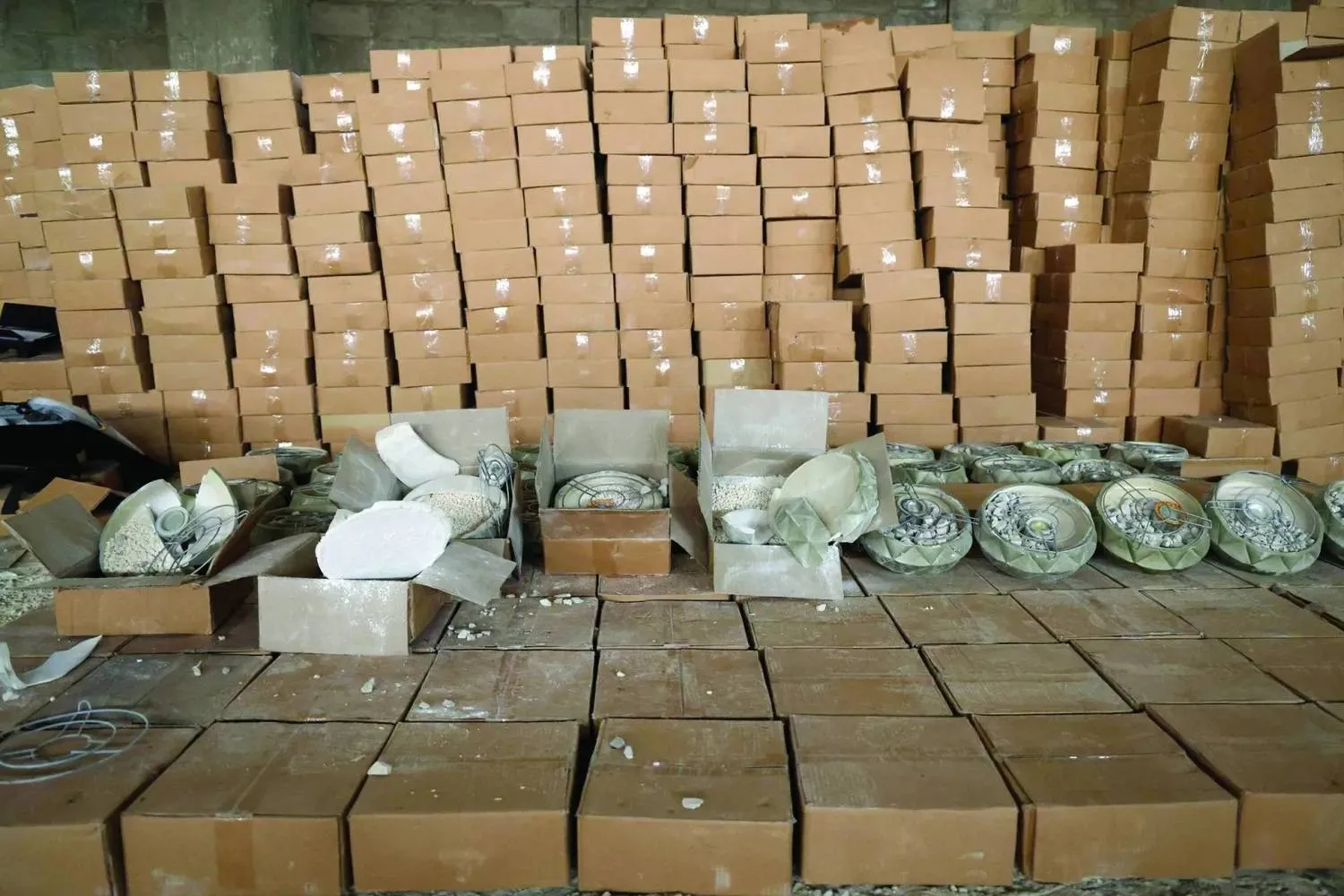
Syria’s Anti-Narcotics Directorate seized 25 million professionally packaged Captagon pills. (Syrian Interior Ministry)
TT

Syria Hails Shift From Captagon Hub to Anti-Drug Partner

Syria’s Anti-Narcotics Directorate seized 25 million professionally packaged Captagon pills. (Syrian Interior Ministry)

Syria on Friday marked what it called its shift from a “Captagon hub” to a “partner in combating it,” as the world observed the International Day against Drug Abuse and Illicit Trafficking.

The official Syrian Arab News Agency, SANA, said this year’s event was held under the slogan “The global drug problem: persistent issues, new challenges and innovative responses,” citing rapid changes in global drug markets, the rise of new substances and increasingly complex smuggling routes.

SANA said the occasion came as Syria presses ahead with efforts to dismantle drug production and smuggling networks following changes in the file after the fall of the former government, a reference to the government of former President Bashar al-Assad.

“After years in which Syria, under the former regime, was one of the world’s most prominent hubs for producing and smuggling Captagon, the country entered a new phase after liberation,” SANA said in a report on Friday.

That phase, it said, is focused on dismantling drug factories, pursuing trafficking networks and expanding international cooperation, turning Syria “from a source of threat into an active partner in combating it.”

SANA said that in December 2025, one year after Assad’s government fell, the United Nations Office on Drugs and Crime, UNODC, confirmed the disruption of large-scale Captagon manufacturing in Syria.

It said the Syrian government had dismantled 15 Captagon manufacturing facilities and 13 smaller storage sites since December 2024, the month the former government fell.

The agency said UNODC’s 2026 report also noted that disruption in the Captagon market after Assad’s fall had pushed up pill prices in some areas. The report also warned that some users could turn to other synthetic drugs, such as methamphetamine.

Coinciding with the international anti-drug day, SANA said the Interior and Health ministries had launched a national campaign under the slogan “Syria Without Drugs.”

Brig. Gen. Khaled Eid, head of the Anti-Narcotics Directorate, told Syrian Alikhbariah that reaching a “Syria Without Drugs” was not just a slogan, but a national project built on scientific and carefully studied plans.

He said the campaign rests on a balance between deterrence and treatment. “The user is viewed as a victim who requires care, while the dealer and smuggler are treated as perpetrators of a crime that requires punishment,” he said.

Eid said the Interior Ministry had faced “a complex reality” in recent months, including local manufacturing centers and distribution networks targeting young people. He said this required stronger security controls, tighter oversight of border crossings, better-equipped anti-narcotics units with modern tracking technology, and an integrated database on active networks.

According to SANA, Syria’s Anti-Narcotics Directorate has carried out 1,550 drug seizures and interdiction operations since Assad’s fall. The operations led to the dismantling of 90 international smuggling networks and the closure of 17 Captagon factories.

The seized materials included 697 million Captagon pills, 15 metric tons of hashish, 10 million narcotic pharmaceutical pills, 180 kg of cocaine, 84.5 kg of crystal meth, 7 kg of heroin and 221 metric tons of chemical precursors, according to Eid.

Separately, the UN Security Council unanimously passed a resolution renewing the mandate of the United Nations Disengagement Observer Force in the Golan, known as UNDOF, during a session on Thursday.

Syrian Alikhbariah quoted Syria’s Permanent Representative to the United Nations, Ibrahim Olabi, as saying at the session that Syria was now one of the most stable countries in the region and was “engaged in reconstruction, restoring institutions and attracting investment.”

He also cited Syria’s cooperation with international partners on counterterrorism, chemical weapons-related obligations and regional security.

Olabi also addressed political change in Syria, saying “the change in Syria was represented by the disappearance of a regime that practiced torture and used chemical weapons.”

On Israel, Olabi expressed “Syria’s concern over Israeli statements about not withdrawing from Syria,” saying “Israel’s current actions can be interpreted as an attempt to seize the lands it occupied.”

Olabi said the change in Syria that Israel appeared to fear was the removal of “an authoritarian regime that used chemical weapons against its people.” He asked whether Israel preferred the situation that had existed under Assad.

UNDOF was established after the October 1973 war under the Disengagement of Forces Agreement signed by Syria and Israel in 1974. The force has operated since then in the buffer zone to monitor compliance with the ceasefire in the Syrian Golan Heights, which Israel has occupied since 1967.



Israel Declares Closed Military Zone in West Bank’s Taybeh

The site of a new Israeli settlement near the Palestinian Christian village of Taybeh, in the Israeli-occupied West Bank, August 10, 2026. (Reuters)
TT

Israel Declares Closed Military Zone in West Bank’s Taybeh

The site of a new Israeli settlement near the Palestinian Christian village of Taybeh, in the Israeli-occupied West Bank, August 10, 2026. (Reuters)

Israel's military said Monday it had declared a Christian-majority town in the occupied West Bank a closed military zone to keep out Israeli settlers and other non-residents.

The new tactic is designed to keep Israelis out of Taybeh, which is surrounded by settlements to its east and west and has been subject to arson, vandalism and settlers coming onto private and village property.

The order does not apply to Palestinian residents or journalists, who the army said would be allowed unless soldiers determine their presence poses a threat. The army said its troops would detain suspects and disperse gatherings to keep the peace.

The designation comes after months of the army and police struggling to maintain order throughout the territory, where at least 87 Palestinians have been killed by Israeli settlers or soldiers in 2026, according to the Ramallah-based Palestinian Health Ministry.

Parts of Taybeh lie in what's called “Area B,” where Israel maintains security control, but residents have complained that the army and police are slow to respond to attacks by extremist settlers.


Family of Former Palestinian Ambassador Urge Lebanon to Not Extradite Him

Former Palestinian ambassador to Beirut Ashraf Dabbour (circulated)
TT

Family of Former Palestinian Ambassador Urge Lebanon to Not Extradite Him

Former Palestinian ambassador to Beirut Ashraf Dabbour (circulated)

The family of former Palestinian ambassador to Lebanon Ashraf Dabbour urged Lebanese authorities on Monday to not extradite him after authorities in Ramallah requested his transfer over corruption allegations.

Lebanon's public prosecutor ordered the arrest of Dabbour, ambassador from 2012 to 2025, last week after questioning him based on a warrant from the Palestinian Authority over corruption and embezzlement during his tenure, a judicial official told AFP at the time.

The judiciary then recommended in a letter to the justice ministry that Dabbour be extradited as his case involves "Palestinian funds", another official said on Monday, on condition of anonymity.

The request must be signed by the justice minister, president and prime minister before security forces can hand him over.

"We are not asking for his protection from the judiciary, nor are we asking for charges to be dropped," Dabbour's daughter Israa said in a press conference in Beirut.

"Why should our father be moved from the country where he lived, and from the place where the alleged crimes took place, in order to be tried somewhere else?" she said, calling on the Lebanese judiciary to look into the case instead of sending him to Ramallah.

Dabbour has a "critical health condition and is in intensive care", according to his daughter, who appealed to Lebanon to "provide him with the necessary care".

In April, Lebanese authorities detained Dabbour over the same case before releasing him with a travel ban.

He has repeatedly denied the accusations on social media, accusing Yasser Abbas, son of Palestinian President Mahmoud Abbas, of leading a campaign against him.

Israa Dabbour said "the file includes political accusations seeking to settle personal scores" without elaborating.

Lebanon's National Human Rights Commission asked the cabinet last week to "refrain from approving the extradition" due to "reliable information that raises serious reasons to believe that (Dabbour) is at risk of being subjected to torture, ill-treatment or arbitrary detention".

The organization also pointed to legal loopholes that could prevent the handover due to the lack of "an effective treaty between Lebanon and the State of Palestine that regulates extradition".


Libya's Central Bank Governor Submits Resignation

A view of the Central Bank of Libya in Tripoli, Libya, August 26, 2024. REUTERS/Aymen Sahli
TT

Libya's Central Bank Governor Submits Resignation

A view of the Central Bank of Libya in Tripoli, Libya, August 26, 2024. REUTERS/Aymen Sahli

The governor of Libya's Central Bank (CBL), Naji Issa, has submitted his resignation to the country's rival legislative chambers, according to two documents seen by Reuters on Monday.

In the documents, whose authenticity was confirmed by Issa, he said he could not continue in his post, but did not explain why, citing the sensitivity of the reasons.

Issa said in the documents addressed to the heads of the two rival chambers that he could not continue in his post.

"I apologize for not being able to continue in my duties as Governor of the Central Bank of Libya, without stating the reasons, due to their sensitivity," the two documents read.

Issa confirmed the authenticity of the letters in a message to Reuters, declining to reveal more about the reasons behind his decision.

The two documents are dated August 9.

The two legislative chambers are the eastern-based House of Representatives that was elected in 2014 and the High Council of State in the west, which was formed as part of a 2015 political agreement and whose members were drawn from a parliament elected in 2012.

Libya has been divided since 2014 into rival authorities in the west and east that emerged from the chaos following the fall of Muammar Gaddafi in a NATO-backed uprising in 2011.

The head of the High Council of State, Mohamed Takala, asked Issa to stay in his post "in order to maintain financial, economic and political stability" until the resignation is considered and ruled on in accordance with constitutional and legal procedures.

The House of Representatives has not yet responded to Issa's request.

Issa took up the post in 2024 when the two legislative chambers agreed his appointment as a way to end a standoff over control of the CBL that led to the ousting of former governor Sadiq al-Kabir.

The standoff was triggered when western factions moved in August 2024 to oust Kabir and replace him with a rival board, leading eastern factions to shut down all oil production. The move sharply reduced Libya's oil output and exports during the crisis.