Iraq’s PM Sends Positive Signals Ahead of Trump Meeting

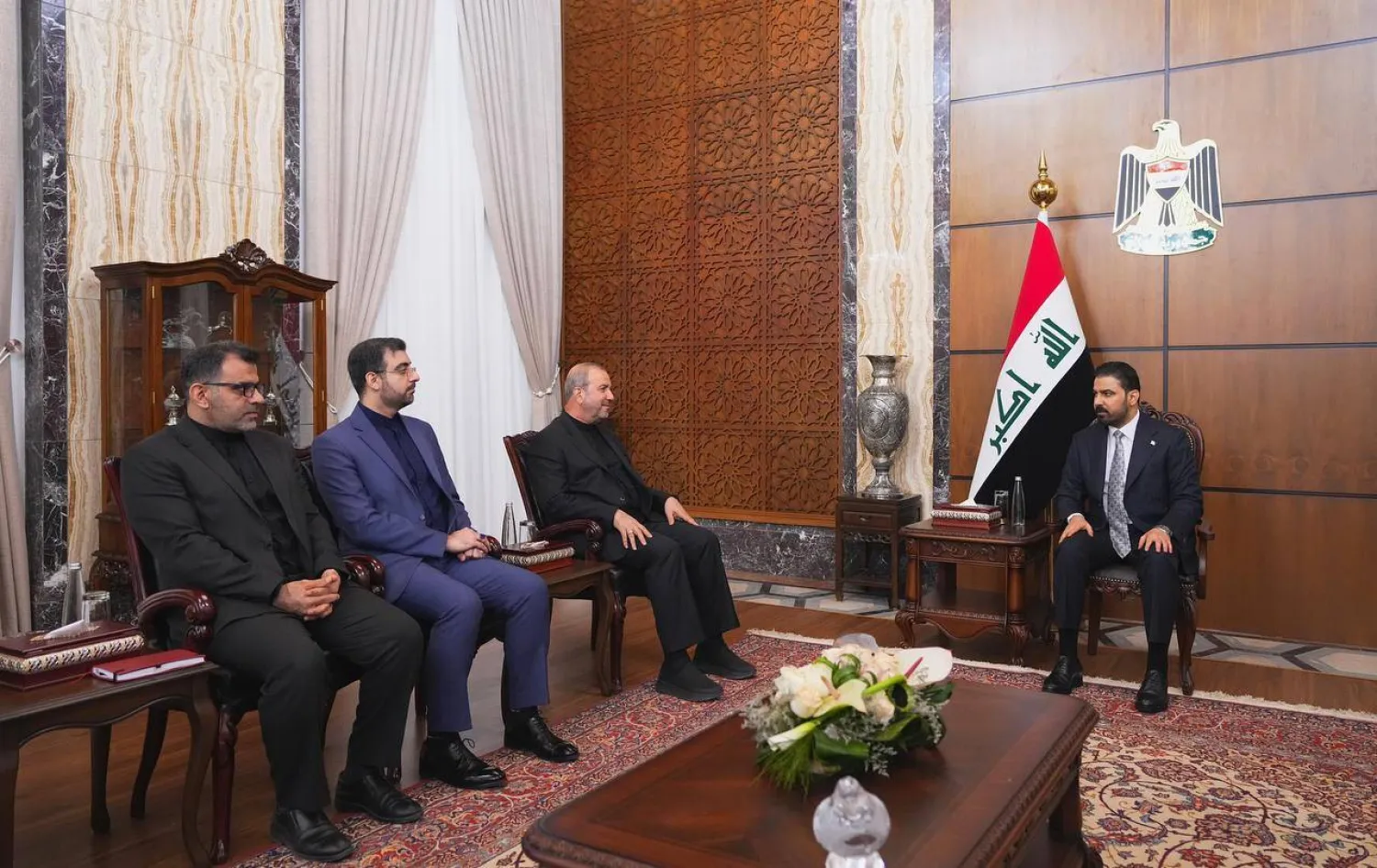
Iraqi Prime Minister Ali Al-Zaidi during his meeting with Iranian Ambassador Mohammad Kazem Al-Sadeq in Baghdad (Government media)
TT

Iraq’s PM Sends Positive Signals Ahead of Trump Meeting

Iraqi Prime Minister Ali Al-Zaidi during his meeting with Iranian Ambassador Mohammad Kazem Al-Sadeq in Baghdad (Government media)

Iraqi Prime Minister Ali al-Zaidi has been sending positive signals to Washington ahead of a planned mid-July visit, as analysts say his government is trying to reorganize ties with the United States based on an economic and security partnership while preserving relations with Iran.

US Secretary of State Marco Rubio said Washington had recently received good and constructive signals from the Iraqi government on armed factions, in a reference to efforts to place weapons under state control and disarm armed groups.

In his latest remarks carried by state media, al-Zaidi urged armed factions to “preserve their history after contributing to the fight against terrorism, and to work through the state,” renewing his government’s rejection of “weapons outside official institutions.”

Al-Zaidi said his government sought a “strong economic partnership” with the US, while stressing that Baghdad’s ties with Tehran were “based on good neighborliness, respect and common interests, as is our relationship with all countries of the region.”

“Iraq does not accept dictates from any party, and the decision will always be made according to the interests of Iraqis first,” he said, adding that his government’s strategic direction was built on “a strong partnership with the US, starting from Iraq’s interest, and not at the expense of any other party.”

He said Iraq “does not follow a policy of blocs or hostility, and wants to be a space for communication and stability, not an arena for conflict,” in a reference to US-Iranian competition in Iraq.

On Iraq’s regional ties, al-Zaidi said the “Gulf Arab states represent a historical, cultural and social depth and a source of strength for Iraq.”

Balancing Iran

Al-Zaidi’s expected visit to Washington comes as Baghdad seeks to reshape its relationship with the US while maintaining balanced ties with Iran, amid regional shifts that followed this year’s Israel-Iran war.

Iraqi researcher Muhanad Seloom said al-Zaidi “is clearly seeking a strong partnership with the US at all levels,” calling the approach “good.”

Seloom said there was popular support for fighting corruption and restricting weapons to the state, giving the government the basic tools to move ahead despite the complexity of the issue of militias.

Speaking to Asharq Al-Awsat, Seloom described Iranian as “negative.” He added that it was not in Iraq’s interest to enter into hostility with Iran, and that the US understood the special nature of Baghdad’s relationship with Tehran.

The ‘project to eliminate militias’

Political science professor Talib Muhammed Karim said al-Zaidi “is not going to Washington carrying a project to eliminate militias in the military sense, but rather a project to strengthen the state and restore its legitimate monopoly over the use of force.”

Karim told Asharq Al-Awsat that the wager was to build an internal consensus, backed by regional and international support, that would allow weapons to be gradually restricted to the state under the law.

He said Iranian influence was not confined to the security sphere, but extended to political, economic and social ties built up over more than two decades.

Reducing that influence, he said, would not come through a political decision or external pressure alone, but through stronger Iraqi state institutions, a more diversified economy and broader Arab and international partnerships. That, he said, would automatically reduce the impact of any outside influence.

Karim said the success of the Washington visit “will not be measured by whether there is a confrontation with armed factions,” but by Iraq’s ability to secure US and international backing for the state project, attract investment, strengthen the economy and expand security cooperation in ways that reinforce state sovereignty.

A shifting US view

Political science professor Abbas Abboud Salem offered a different reading, saying Iraq’s political system “cannot be reduced to the will of one person.” The post-2003 political scene, he said, is built on multiple competing political forces.

Salem told Asharq Al-Awsat that the silence of these forces does not mean they have given al-Zaidi a mandate to radically change Iraq’s policy.

What has changed most, he said, is the US view of Iraq. According to Salem, Washington moved from direct occupation to managing Iraq after the withdrawal as a zone of influence balanced with Iran, and then to seeking a return through direct influence amid regional geopolitical shifts.

Salem said these shifts were pushing Iraq to rebuild its alliance with the US in response to regional challenges and to reduce losses as the regional order is being reshaped.


Damascus Moves to Reconnect Aleppo Countryside, End a Decade of Territorial Division

Preparations for the launch of the second phase of the “Echo of Resilience 2” project in Manbij (Ministry of Emergency and Disaster Management)
TT

Damascus Moves to Reconnect Aleppo Countryside, End a Decade of Territorial Division

Preparations for the launch of the second phase of the “Echo of Resilience 2” project in Manbij (Ministry of Emergency and Disaster Management)

A convoy of Syrian army heavy machinery headed to Manbij in northern Syria on Saturday to help tear down wartime earthen barriers and fill trenches stretching 841 kilometers across 255 cities and villages, in a drive to erase former frontlines and reunite areas divided by years of conflict.

The operation, in eastern Aleppo province, aims to consolidate state authority and reintegrate the affected areas administratively and economically.

Syria's Ministry of Emergency and Disaster Management, which oversees the "Echo of Resilience" project in cooperation with Aleppo governorate, said the campaign would dismantle military fortifications, clear their remnants, rehabilitate damaged areas and reopen roads between towns and villages.

The ministry said the work would improve public services and help restore normal life and stability in the affected areas.

The project's second phase began on Thursday in Manbij and its surrounding countryside and is expected to last seven months. It aims to make the area safer by clearing landmines and other remnants of war, allowing displaced residents to return home and farmers to reclaim access to their fields and resume cultivation.

The new phase follows an initial operation launched in early July around Azaz in northern Aleppo province, seven kilometers from the Turkish border.

That phase concluded on Nov. 12 after crews cleared 202 kilometers of earthen barriers and trenches, reconnecting about 33 towns and villages and easing civilian movement.

Manbij's Divided Past

The work in Manbij carries particular political and geographical weight. Before the fall of the former government, the city and its surroundings were a volatile meeting point for three rival military forces.

The Syrian Democratic Forces (SDF) and the Manbij Military Council controlled the city and surrounding areas, while Turkish-backed Syrian National Army factions held positions to the north and west. Forces of the former government, backed by Russia and Iran, were stationed to the south.

The rival deployments left hundreds of kilometers of trenches, double-layered earthen barriers and minefields along four main fronts.

The fortifications stretched from the Sajur River toward Jarablus in the north, through the area around Arima toward al-Bab in the west, and from Abu Kahf toward Deir Hafir in the south to the vicinity of Tishrin Dam and Qara Qozak Bridge on the Euphrates River's western bank in the east.

Removing those defenses is intended to reopen vital transport and trade routes linking eastern and northern Aleppo and restore access to farmland that had been isolated or off-limits for years.

From Military Frontlines to State Control

The two phases of the "Echo of Resilience" project coincide with efforts to implement a Jan. 29, 2026, agreement between the Syrian government and the SDF.

The agreement seeks to end territorial divisions, integrate the affected areas administratively and economically, extend state control across Syria and ensure the return of forcibly displaced people and other residents once suitable conditions are in place.

Around Azaz, once a flashpoint along the frontlines facing Tal Rifaat and Afrin, the removal of earthen barriers marked a practical step toward dismantling former lines of confrontation and reconnecting Syrian territory, officials overseeing the project told the Syrian Arab News Agency (SANA).

Observers of Syrian affairs say the dismantling of military fortifications by Syrian army units in a strategic area such as Manbij sends a clear political message: the state is consolidating control on the ground while reducing the military presence in residential and agricultural areas.

They say the shift could also strengthen border security and revive regional trade.


How Will the Showdown Between al-Zaidi and Kataib Hezbollah End?

Members of Iraq's Kataib Hezbollah carry the group's flag in central Baghdad (AFP)
TT

How Will the Showdown Between al-Zaidi and Kataib Hezbollah End?

Members of Iraq's Kataib Hezbollah carry the group's flag in central Baghdad (AFP)

A two-week standoff between Iraqi Prime Minister Ali al-Zaidi and Kataib Hezbollah has erupted into a public war of accusations, complicating government efforts to bring the weapons of Iran-backed armed groups under state control.

Tensions flared after leaked intelligence reports accused Kataib Hezbollah of smuggling thousands of barrels of oil extracted from Jurf al-Sakhar, south of Baghdad. The group has controlled the area for nearly a decade, barring successive governments from entering.

On Friday, the government sent a committee headed by the Popular Mobilization Forces (PMF) to investigate the smuggling allegations.

Lieutenant General Saad Maan, head of Iraq's Security Media Cell, said neither political parties nor armed factions were represented on the committee investigating the smuggling of petroleum products in Jurf al-Sakhar.

A senior official in the ruling Shiite Coordination Framework told Asharq Al-Awsat that the investigation into Kataib Hezbollah's alleged oil sales marked the first government move on the ground inside the restricted area controlled by the group.

Iran's patronage

Kataib Hezbollah was founded after the 2003 US invasion of Iraq by Abu Mahdi al-Muhandis, who was killed in a US strike near Baghdad International Airport in early 2020 alongside Qassem Soleimani, commander of the Quds Force of Iran's Revolutionary Guard Corps.

The Coordination Framework official said the group's strength and influence could not be understood without examining its ties to its Iranian patron.

Successive governments had largely failed to confront Kataib Hezbollah or enter Jurf al-Sakhar because of the power it drew from its close ties with Tehran, the official said, describing it as the spearhead of factions loyal to Iran's doctrine of guardianship of the Islamic jurist.

Despite a lack of reliable figures on its fighters and weapons, the official warned against underestimating the group's military strength.

Kataib Hezbollah has a sizable arsenal of rockets and drones, the official said, without specifying their types or numbers.

But Iran's financial backing was largely limited to the group's early years, the source said. Over the past few years, Kataib Hezbollah has developed a network of financial interests of its own, potentially including oil investment or theft.

The group also receives substantial funding from the PMF through three brigades under its command.

The official warned that the standoff with al-Zaidi's government had reached a dangerous point, raising serious alarm within the Coordination Framework.

Senior Shiite leaders were working intensively to avert a possible confrontation between the government and Kataib Hezbollah, the official said.

Taking on armed factions

Will al-Zaidi see the confrontation through?

Political analyst Akeel Abbas believes the prime minister has already gone further than any of his predecessors in confronting armed factions over their weapons.

Al-Zaidi has not only openly challenged one of Iraq's most powerful armed groups but also exposed corruption cases in Jurf al-Sakhar, an area of exceptional geographical and political sensitivity, Abbas told Asharq Al-Awsat.

"The decision to confront the group has already been made," Abbas said, although the nature of that confrontation could change as events unfold.

The Coordination Framework's influence over the dispute appears to be waning, he said, with its traditional role as mediator between the prime minister and armed factions no longer as effective as before.

Abbas called the latest standoff a significant development that challenged a long-standing assumption in Iraqi politics: any prime minister who confronted armed factions would be ousted.

US backing and the judiciary

Two factors have strengthened al-Zaidi's hand, according to Abbas: US backing at a time when Iran is grappling with acute weakness and turmoil, and support from Iraq's judiciary.

Together, he said, they have made the difference in the confrontation.

Still, Abbas did not rule out a retreat by the prime minister.

Under current circumstances, al-Zaidi appears to hold the stronger position against Kataib Hezbollah, a striking reversal in Iraqi politics, he said.

But backing down would be difficult for the prime minister, making a political deal between the two sides the more likely outcome as both seek to avoid defeat.

No clear strategy

Ayad al-Anbar, a political science professor at the University of Baghdad, is less convinced by the government's campaign to bring armed groups' weapons under state control.

He questioned whether the government has a coherent strategy for disarming the factions or confronting Kataib Hezbollah.

"The government's strategy for bringing weapons under state control remains unclear," Anbar told Asharq Al-Awsat.

Instead, he said, authorities rely on short-term tactics that shift with events and the reactions they provoke.

There is little sign of a clearly defined plan, with successive steps or contingency options, he said. Government measures trigger responses from armed factions, only for tensions to ease and the escalation to be contained.

Anbar said the same pattern applied to the government's latest pressure tactic: economic pressure.

The confrontation with Kataib Hezbollah and the wider disarmament issue have become exercises in political sparring and shows of force rather than a serious debate over a fundamental problem, he said.

The Iraqi state's fragility inevitably weakens its security system and allows competing centers of power and control to emerge, Anbar argued.

"In a country of political fiefdoms, why wouldn't those with weapons seek to become security fiefdoms themselves?" he asked.

That, he said, explains a fundamental part of the problem.


Senior Hamas Commander Killed in Israeli Strike

File photo of Samir Abu Younis
TT

Senior Hamas Commander Killed in Israeli Strike

File photo of Samir Abu Younis

Hamas' armed wing said on Sunday that a senior commander who helped plan and oversee the October 7, 2023, attack on Israel had been killed in an Israeli airstrike.

The Al-Qassam Brigades identified the commander as Samir Abu Younis, 53, the commander of its Rafah brigade, and said he was killed on Saturday.

The Israeli military said ⁠on Sunday it ⁠had struck a senior commander in Hamas' armed wing but did not identify him.

Medics said Abu Younis was killed and others were wounded in an airstrike that targeted him in a street in ⁠the Mawasi area of Khan Younis in the southern Gaza Strip.

Hamas said Abu Younis joined Hamas' armed wing in 1991 and had held several senior operational roles in Rafah before becoming commander of the brigade.

Hamas said his funeral would be held on Sunday afternoon in Khan Younis.

An October 2025 ceasefire halted major fighting but has not stopped Israeli attacks ⁠or ⁠secured Hamas' disarmament.

Gaza health authorities say at least 1,600 Palestinians have been killed since the ceasefire went into effect. Five Israeli soldiers have been killed during the same period.

Palestinian authorities say more than 74,000 people have been killed in Israel's military campaign against Gaza, launched after Hamas-led fighters killed about 1,200 people in southern Israel in October 2023.