


NASA Robot Mission Aiming to Rescue Space Telescope

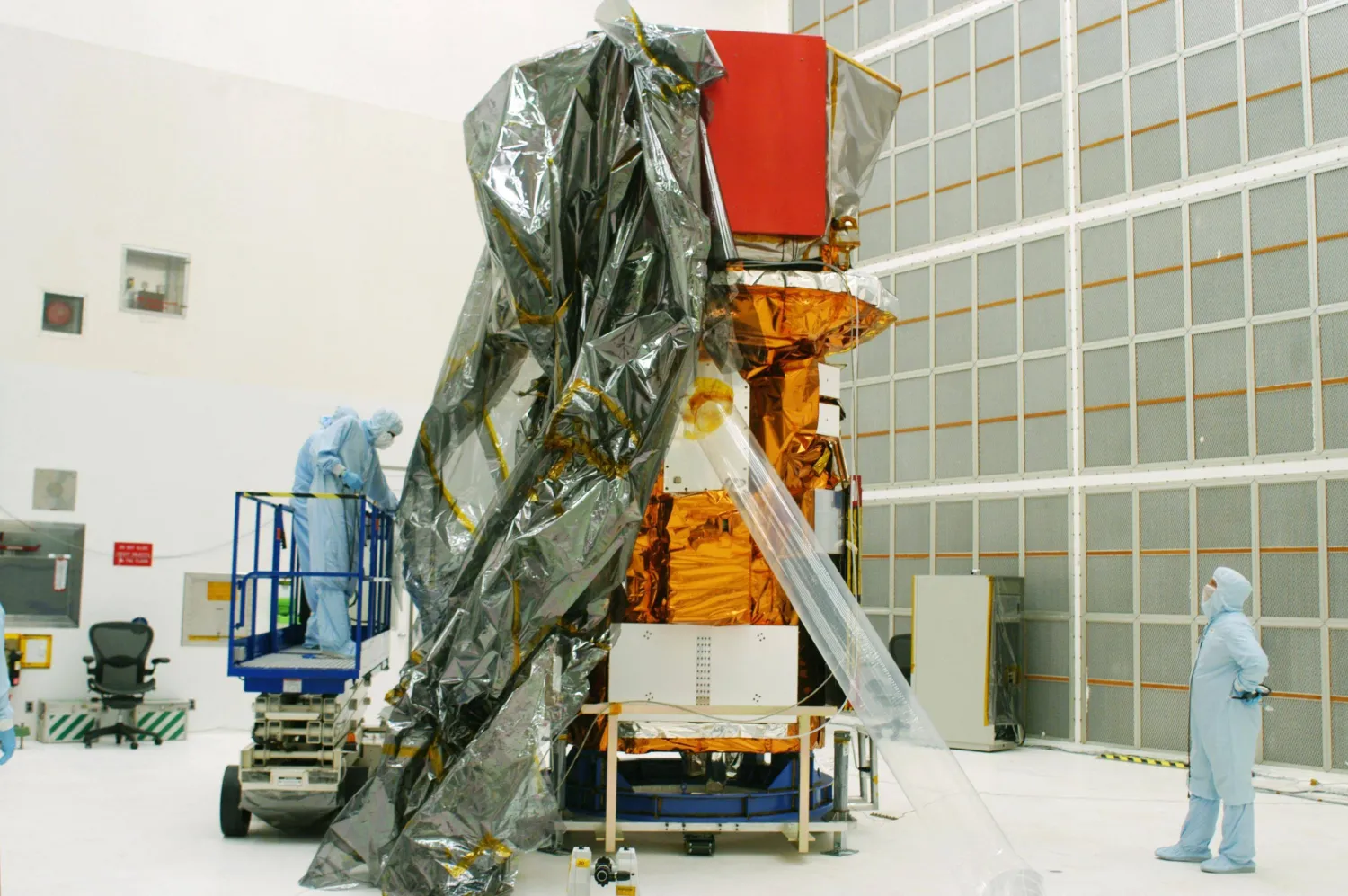
This handout photo released by NASA on July 31, 2004, shows the Swift spacecraft being unwrapped in Hangar AE at Cape Canaveral Air Force Station at Kennedy Space Center, Florida. (Photo by Handout / NASA / AFP)
TT

NASA Robot Mission Aiming to Rescue Space Telescope

This handout photo released by NASA on July 31, 2004, shows the Swift spacecraft being unwrapped in Hangar AE at Cape Canaveral Air Force Station at Kennedy Space Center, Florida. (Photo by Handout / NASA / AFP)

NASA on Tuesday is set to launch a daring robotic rescue mission, a long shot bid to prevent one of its aging telescopes from vanishing into dust.

If successful, the effort could pave the way for giving other satellites a second life.

The operation is set to last several months, kicking off with the launch of a robot designed to rescue the Swift space telescope that's currently falling towards Earth.

Without intervention, Swift is expected to soon burn up in the atmosphere.

The rescue spacecraft developed by the US startup Katalyst is slated to lift off Tuesday at 1023 GMT from a Pacific Ocean atoll aboard a small rocket named Pegasus.

The rocket-propelled launch vehicle will not take off from a launch pad. Instead, it will be released from a jet.

"Everything about this mission is so crazy," said NASA astrophysicist Regina Caputo with a laugh during an interview with AFP.

After it reaches an orbit near that of the telescope, the robot must locate Swift across the vastness of space.

The aim is then for the robot to maneuver around the telescope and latch on with three movable arms.

It will then vie to tow Swift into a stable orbit over the course of at least a month, rescuing it from destruction by moving it about 300 kilometers higher.

"This is a lot of firsts stacked on top of each other," said Shawn Domagal-Goldman, the director of NASA's astrophysics division, during a recent call with reporters.

"I'm just deeply thankful that we're even giving this a go."

The idea of such a rescue might seem odd at first glance.

The Neil Gehrels Swift Observatory telescope was launched in 2004, and was originally designed for a two-year mission.

The device was intended to study gamma-ray bursts, what Caputo called "the most energetic things that happen in the universe."

She likened it to a supercharged version of a supernova, which is a dramatic, explosive death of a star.

Gamma-ray bursts are extremely brief, she explained, so the telescope was placed at an altitude of approximately 600 kilometers in low Earth orbit, so it could remain in constant communication with researchers.

But with that pro came a con -- at such an altitude, the device without its own propulsion would eventually drift closer to Earth and burn up in the atmosphere.

Caputo said that phenomenon was expected and normal, because when the Sun is in its more active cyclical stages, it emits more particles and causes an expansion of Earth's atmosphere.

That creates drag, meaning satellites in low Earth orbit lose altitude.

Yet when forecasts in early 2025 indicated the telescope was nearing the end of its life, NASA began considering a possible rescue.

"We decided, yeah, we want to go save this one this time, because of how special it is," said Domagal-Goldman.

Despite its age, the Swift telescope remains in high demand within the scientific community, not least for its rapid response capabilities.

Should it burn up, it could not be immediately replaced.

The mission attempting unprecedented maneuvers has a projected cost of $30 million to save the device, which originally cost $250 million.

The rescue robot named LINK will have to overcome numerous challenges and unknowns.

For example, engineers do not have a clear picture of what the back of the telescope actually looks like -- even though that's where the robot must latch on.

With a laugh, Caputo projected the chances of success at "maybe 50-50."

Still, both NASA and the company Katalyst believe the mission -- which could run into the fall -- might pave the way for new possibilities in spacecraft management, and is worth a shot.

Robert Lamontagne, a vice president at Katalyst, said during a call with journalists that it could represent the "start of a new model" to "refuel, reposition, repurpose, repair, and even upgrade satellites, even if they were never prepared for it."



Owners Reunite with Pets in Quake-hit Colombia

A rescuer pets a dog in the aftermath of an earthquake, in Pereira, Colombia, August 12, 2026. REUTERS/Juan David Duque
TT

Owners Reunite with Pets in Quake-hit Colombia

A rescuer pets a dog in the aftermath of an earthquake, in Pereira, Colombia, August 12, 2026. REUTERS/Juan David Duque

A beaming Vickye Giraldo holds her rescued kitten tight against her chest outside her ruined home in quake-hit Cali, Colombia.

The country's third-largest city was pummeled by a 7.4 magnitude earthquake on Monday, along with swaths of Colombia's coffee region and western coast.

With at least 273 people dead and thousands more injured, rescuers dig tirelessly through the wreckage, searching for survivors before time runs out.

The critical 72-hour window to find people alive came to a close on Thursday, but Giraldo and others are drawing hope from their reunions with furry friends.

"It's an indescribable moment," the 56-year-old lawyer told AFP, planting a kiss on her cat Polux's head after rescuers pulled the animal from the detritus of its owner's apartment.

Giraldo had lived with two dogs and two cats in a building that now slants dangerously to one side.

One dog made it out alive, while the other did not survive and Giraldo's other cat remains missing.

"These have been very hard days, thinking we might not be able to rescue them, but in the end it's a dream come true. It really is," she said, tearing up as she cradled Polux in her arms.

Another Cali resident and animal lover, Andrea Paredes, has not given up hope on reuniting with her dog and cats.

Her husband "managed to grab one little dog" before fleeing the shaking building, Paredes said.

The quake destroyed over 12,000 homes, official data shows, making thousands of families destitute.

Applause met rescuers on Thursday after they rescued a dog from another collapsed building.

A team of veterinarians rushed to assist the visibly feeble creature, giving him water before carrying him away on a stretcher.

"Pets are like children. I insist on that," volunteer Nelson Vidales told AFP.

"I know there are a lot of people thinking about humans, but the time must come when pets are looked for too. That's what I'm here for," he said.


Etna Ash Keeps Catania Airport Shut Until Friday, Disrupting Summer Travel

 A drone view of volcanic ash and lava during an eruption at Mount Etna, forcing authorities to suspend flights at Catania airport, in Sicily, Italy, August 12, 2026. (Reuters)
A drone view of volcanic ash and lava during an eruption at Mount Etna, forcing authorities to suspend flights at Catania airport, in Sicily, Italy, August 12, 2026. (Reuters)
TT

Etna Ash Keeps Catania Airport Shut Until Friday, Disrupting Summer Travel

 A drone view of volcanic ash and lava during an eruption at Mount Etna, forcing authorities to suspend flights at Catania airport, in Sicily, Italy, August 12, 2026. (Reuters)
A drone view of volcanic ash and lava during an eruption at Mount Etna, forcing authorities to suspend flights at Catania airport, in Sicily, Italy, August 12, 2026. (Reuters)

Flights at Catania airport in Sicily will remain suspended until early Friday because of ash from Mount Etna's ongoing volcanic activity, which has forced hundreds of flights to be cancelled or rerouted over the past week.

All arrivals and departures at the island hub, Italy's fifth-busiest airport by passenger traffic, will be ‌suspended through 2 ‌a.m. local time on ‌August ⁠14, airport operator ⁠SAC said in a statement late on Wednesday.

Passengers were advised to check the status of their flights with their airlines before travelling to the airport.

The prolonged restrictions come at ⁠the height of the summer holiday ‌season, affecting thousands ‌of passengers, and have placed additional pressure ‌on Sicily's other airports.

Mount Etna, Europe's ‌highest and most active volcano, frequently disrupts operations at Catania airport, whose operator launched the sale of a stake of at ‌least 51% in May.

Marco Viccaro, president of the Italian Volcanological Association, ⁠said ⁠the activity at Etna, which began on August 6, is more energetic than previous episodes and is continuing in a sustained way.

"This suggests that deeper, gas-rich magma is playing a more active role, making the fragmentation process more efficient and leading to increased ash production, which is severely disrupting air traffic to and from Catania airport," he added.


Canadian Wildfire That Forced 20,000 to Flee May Signal ‘New Normal’

Smoke rises from the Brunswick Creek wildfire, looking north over the Fraser River near Boston Bar, British Columbia, Canada, August 11, 2026 in an aerial photograph. (BC Wildfire/Handout via Reuters)
TT

Canadian Wildfire That Forced 20,000 to Flee May Signal ‘New Normal’

Smoke rises from the Brunswick Creek wildfire, looking north over the Fraser River near Boston Bar, British Columbia, Canada, August 11, 2026 in an aerial photograph. (BC Wildfire/Handout via Reuters)

A wildfire that forced more than 20,000 people from their homes in western Canada moved so quickly that crews had to abandon firefighting to help residents escape, a pace British Columbia’s premier said Wednesday may represent a “new normal.”

The Bald Range wildfire erupted Friday near Summerland, a community of about 12,000 in British Columbia’s Okanagan region. By Wednesday, it had grown to about 184 square kilometers (71 square miles) after destroying homes and killing an 80-year-old woman.

"There’s an important set of lessons for us to take about how quickly this moved and that this may be our new normal for fire speed," Premier David Eby said. He said the blaze outpaced wildfire modeling and left some residents with little time to evacuate.

Officials have begun damage assessments, but the area remained unsafe Wednesday and there was no timeline for residents to return.

Crews were clearing vegetation to help slow the fire’s spread as officials warned that thunderstorms could bring erratic winds and increase fire activity. Highway 97, a major route through the area, remained closed.

Eby visited an evacuation reception center in Penticton, where he said he met people devastated by the loss of their homes.

“A lot of emotions in there, obviously,” he told reporters, calling the woman’s death a “tragic loss.”

Summerland pharmacist Jonathan Kiesman said he was worried about displaced patients getting their medications and said seeing the fire approach the community “almost brought tears to my eyes.”

Officials said they were withholding broader details on property losses until residents could be notified directly.

“The last thing that I would want is somebody to have the shock of finding out on social media or on television about their home being lost,” British Columbia Emergency Management Minister Kelly Greene said.

Eby said the province would review the response, including whether changes are needed to wildfire planning, building standards and vegetation management near communities.

Given the drought and summer heat, he warned, “this is very unlikely to be the last significant fire we see this summer.”

Summerland Mayor Doug Holmes warned that recovery would be long and difficult.

Canada has endured a series of severe wildfire seasons in recent years, with smoke repeatedly drifting into the United States. In record-setting 2023, fires burned more than 14.6 million hectares (36 million acres), an area roughly the size of Illinois.

Canada has warmed faster than the global average in recent decades, while the amount of land burned by wildfires has increased substantially. Much of the country’s forest is remote and dominated by spruce and pine, conditions that can make fires difficult to contain once they become established.