


‘I’m Going to Stay Calm’: 48 Hours Under the Rubble in Venezuela

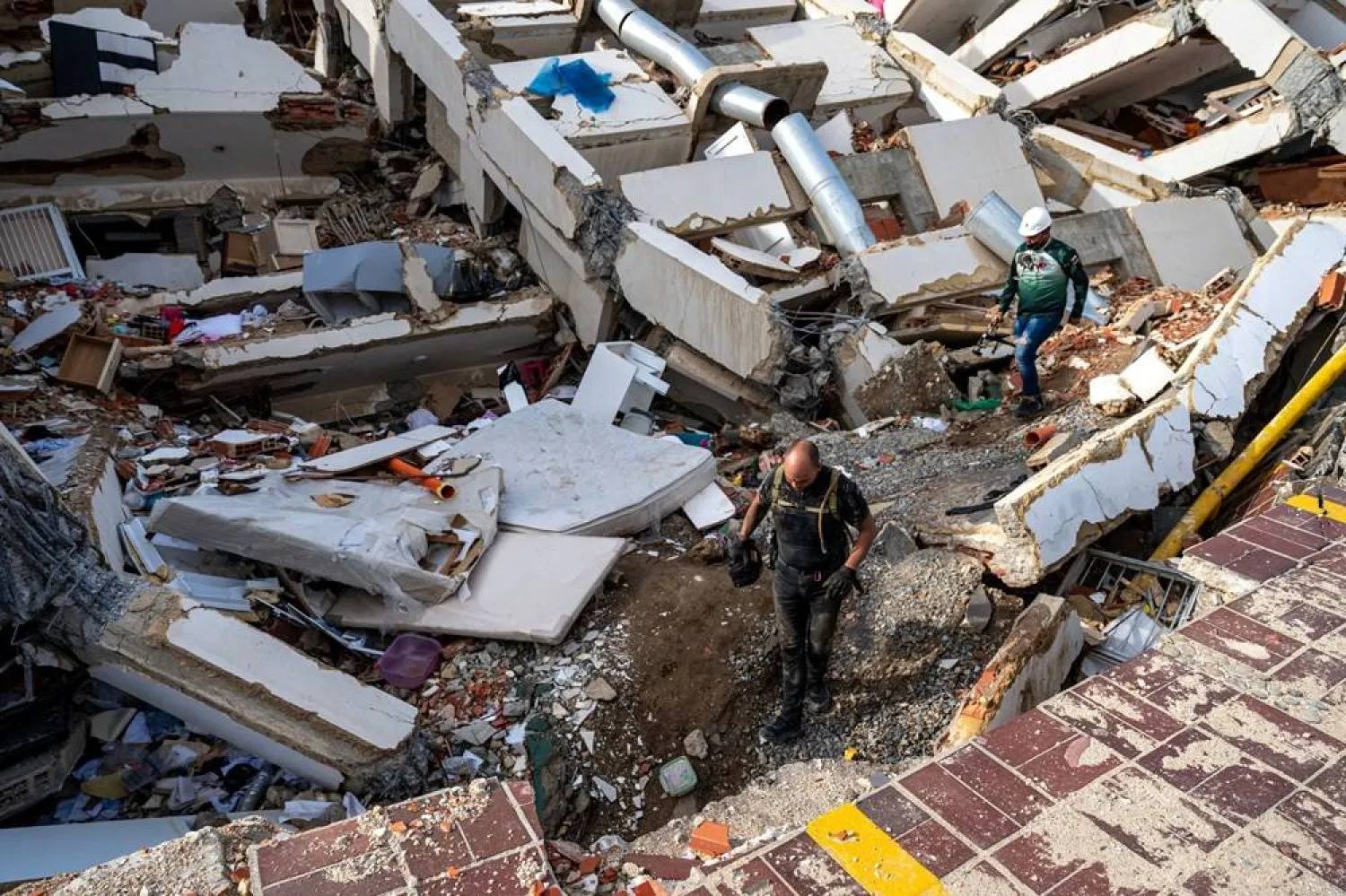
Volunteers and rescuers help to find survivors in a collapsed building in Caraballeda, La Guaira state, Venezuela, on June 30, 2026, following the June 24 twin earthquakes. (Reuters)
TT

‘I’m Going to Stay Calm’: 48 Hours Under the Rubble in Venezuela

Volunteers and rescuers help to find survivors in a collapsed building in Caraballeda, La Guaira state, Venezuela, on June 30, 2026, following the June 24 twin earthquakes. (Reuters)

Andrea Canonico focused on her breathing to stay calm as she lay trapped under a building that had crumbled during the two powerful earthquakes that struck Venezuela last week.

Just 23 years old, Canonico spent almost 48 hours in the same position before being pulled out -- alive.

"The most important thing about all of this was that I never lost hope," Canonico told AFP in the Los Corales neighborhood in the city of La Guaira, the hardest-hit by the disaster.

She is holding on to that hope for her 20-year-old brother and 91-year-old aunt who remain missing.

Wednesday's 7.2 and 7.5 magnitude earthquakes have killed almost 2,000 people, with warnings that the figure could soar.

- 'I'm going to sleep' -

"I told myself, I'm going to sleep," Canonico recalled, up to her elbows in bandages following the ordeal.

"This is in the middle of a full-blown disaster," she had told herself. "It's surely going to keep shaking. I'm going to stay calm; I'm not going to get worked up about the breathing issue."

She says she was able to sit up despite being covered by around six meters of rubble.

"I had my phone, of course," which allowed her to keep track of time and enjoy a little light.

She was able to communicate with a man who was stuck a little higher up. Once he got out, he told his rescuers that she was also trapped.

"Above me there was an opening I was able to climb up through," Canonico said, explaining how she "managed to reach the other opening the rescuers were making."

"From there I kept climbing while they pulled me up, and that's how I was able to get out."

- 'The mole' -

"Is anyone alive in here?!" the voice of Moises Faramaya ricochets around the ruins of the same neighborhood.

The ex-miner is using his know-how to rescue others in the same situation as Canonico.

The 26-year-old says he has rescued 16 people alive and recovered 22 bodies in La Guaira, which authorities have declared a "disaster zone."

He told AFP about one of the rescued, who he heard "scratching at a wall."

"The person was pinned down but could move their hand. And I got them out alive," said Faramaya, who says he uses "nothing but a pickaxe and a shovel" to pick through the rubble.

Nicknamed "the mole," Faramaya says he got good at digging during a six-year stint in the mines of El Callao in the mineral-rich state of Bolivar.

Firefighters and experts ask for his help, and he hardly eats or sleeps, only smoking cigarettes to "stay active" during his brief breaks.

"The work you do in there isn't easy -- the dust, the smell of dead people who are already decomposing. But here we are, persevering," he said.

- Between hope and despair -

Authorities recently declared that everyone in Canonico's building had died.

Alexander Garcia, a 44-year-old waiter, said he heard firefighters declare "Code 14," which he later found out meant that there were no survivors.

But when US rescue workers and Spanish sniffer dogs found traces of life, his hopes for his two trapped brothers were rekindled.

"Everyone heard them, everyone," he told AFP after his mother was pulled from the detritus alive but later died.

Rescue efforts continue under torchlight as darkness falls.

Heavy rain on Tuesday morning paused operations and dampened spirits, however.

The critical 72-hour window during which survivors were still likely to be found closed on Saturday evening.

Hopes of finding survivors had faded substantially by Tuesday.


Leaders of China, Russia and India are Among Heads of State Meeting to Counter US Influence

FILE - Russian President Vladimir Putin, left, gestures while speaking to Chinese President Xi Jinping during the Shanghai Cooperation Organization (SCO) summit in Samarkand, Uzbekistan, Sept. 16, 2022. (Sergei Bobylev, Sputnik, Kremlin Pool Photo via AP, File)
TT

Leaders of China, Russia and India are Among Heads of State Meeting to Counter US Influence

FILE - Russian President Vladimir Putin, left, gestures while speaking to Chinese President Xi Jinping during the Shanghai Cooperation Organization (SCO) summit in Samarkand, Uzbekistan, Sept. 16, 2022. (Sergei Bobylev, Sputnik, Kremlin Pool Photo via AP, File)

The leaders of China, Russia and India are among the heads of state gathering in Kyrgyzstan this week for the summit of the Shanghai Cooperation Organization, a group billed as a counterweight to US global influence.

Chinese President Xi Jinping, Russian President Vladimir Putin and Indian Prime Minister Narendra Modi are scheduled to attend the events in Bishkek, the capital of the Central Asian nation, The Associated Press said.

Multiple one-on-one meetings are scheduled on the sidelines, including one between Putin and Xi on Monday, as well as talks between the Russian leader and Iranian President Masoud Pezeshkian on Tuesday, the day of the official SCO sessions.

Russia, now 4½ years into its full-scale invasion of Ukraine, and Iran, six months into a war with the United States and Israel, see the summit as an important platform to strengthen their relations with non-Western partners.

The SCO was founded in 2001 by China, Russia and four Central Asian states as a security forum. Over the past quarter-century, it has grown in size and influence, although its goals and programs remain vague and its brand recognition low.

It now includes 10 nations: Russia, China, India, Iran, Pakistan, Belarus, Kazakhstan, Kyrgyzstan, Tajikistan and Uzbekistan. Many other countries have the status of “dialogue partners."

Along with Russia, China has presented the SCO as an alternative to Western-aligned organizations like the G7, and in recent years has wanted to expand the scope and influence of the organization, pledging development and financial assistance.

China’s Ministry of Foreign Affairs said last week that the organization has successfully “explored a new path for regional cooperation.” Beijing has consistently promoted the idea of an alternative world order with Russia’s support.

Summit attendees have significant disagreements

For many SCO members, the summit will be an opportunity to show that they maintain strong ties on the global stage despite souring relations with the West.

The organization is not a unified political or military bloc, however, and analysts note that its members have significant disagreements and their own distinct interests.

For countries such as India, however, experts say the summit is likely to be more about optics and strategic signaling than substantive outcomes.

The forum is heavily influenced by China and includes Pakistan as a member — both of which are rivals for India.

Dinakar Peri, a fellow in security studies at Carnegie India, said the SCO gives India a seat at the table in a region increasingly shaped by competition among the larger powers, allowing it to protect its interests, track shifting geopolitical currents and project itself as a reliable stakeholder.

“While it may not entirely shape the agenda, it gives New Delhi a first-hand view of the region and allows it to hedge its position with others,” Peri said.

Türkiye, which holds partner status within the SCO, also seeks to use the platform to strengthen its position in the region.

It views SCO membership as part of a balanced foreign policy that seeks to maintain its traditional ties with the West as a part of NATO, while strengthening its influence in Eurasia.

President Recep Tayyip Erdogan, who brought his country into the SCO as a “dialogue partner” in 2012, has repeatedly stated that he wants Türkiye to become a permanent member. While Türkiye has close trade ties with the European Union under a 1995 trade deal, its EU membership bid has stalled for more than 25 years.


NATO’s Arctic Moves Pose ‘Direct Threat’ to Russia, Says Lavrov

Russian Foreign Minister Sergei Lavrov attends a press conference in Moscow, Russia, 25 August 2026. (EPA)
TT

NATO’s Arctic Moves Pose ‘Direct Threat’ to Russia, Says Lavrov

Russian Foreign Minister Sergei Lavrov attends a press conference in Moscow, Russia, 25 August 2026. (EPA)

Russia sees ‌NATO activity in the Arctic as a direct security threat, Foreign Minister Sergei Lavrov said in an article published on Monday, as the alliance members boost their presence in the region in the wake of Russia's war on Ukraine.

In February, NATO launched a mission called Arctic Sentry to bolster its presence in the far north, underscoring the alliance's increased focus on the Arctic amid ‌tensions with Russia ‌and US President Donald Trump's ‌push ⁠for the acquisition of ⁠Greenland.

Russia, which has a naval fleet including nuclear-armed submarines in the Arctic, sees the region as its sphere of interest where it also develops a shipping route to connect with the Asian nations.

Moscow has earlier protested the Arctic Sentry mission ⁠and in the article, Lavrov, President ‌Vladimir Putin's long standing foreign ‌minister, said Russia sees NATO military exercises in the ‌region as "aggressive".

"Such military activity in the Far ‌North poses direct threats to Russia's security. The risks of incidents that could trigger an armed confrontation, with potentially catastrophic consequences, are increasing," he said in the ‌article published by the Russian foreign ministry.

Russia has the largest military presence and ⁠the ⁠most extensive military infrastructure in the Arctic and in recent years China has started to increase its activity in the mineral-rich area, mostly in partnership with Moscow.

Norway, a Russia's neighbor, this month expanded a recently created military brigade headquartered in the Arctic, the latest move by a NATO nation to boost its defense footprint in the wake of the Ukraine war which Russia started in 2022.

Moscow has previously dismissed allegations that it poses a threat to NATO.


Nearly 20 Still Missing After North Cyprus Ferry Capsize Kills Eight

A helicopter rescues a passenger off a ferry that capsized off the coast of Northern Cyprus, August 30, 2026. (Reuters)
TT

Nearly 20 Still Missing After North Cyprus Ferry Capsize Kills Eight

A helicopter rescues a passenger off a ferry that capsized off the coast of Northern Cyprus, August 30, 2026. (Reuters)

Nearly 20 ‌people were missing on Monday after a ferry capsized off northern Cyprus, killing at least eight, as divers joined search teams scouring deep waters for any survivors.

The double-hulled ferry with 267 aboard took in water and flipped over on Sunday just off the port city of Kyrenia, leaving survivors clinging to the overturned hull. They were rescued by passing vessels ‌and the coastguard ‌authorities.

"We've been waiting since the ‌morning, ⁠for 12 hours ⁠or maybe more," said Naif Ezer, one of those waiting anxiously outside the port for news of passengers through the early hours of Monday.

Of three friends traveling home to see families, one had been found but the ⁠other two were still missing, ‌he added.

Some of those ‌waiting sat and silently wept, while others scrolled ‌mobile phones for updates.

It was unclear if ‌people remained trapped on the vessel, now lying on the seabed at a depth of more than 500 m (1,640 ft).

Divers from Türkiye were assisting ‌the search, officials said. They gave differing estimates of the missing, with ⁠some saying ⁠19, and others 18.

The ferry ran into trouble shortly after leaving Kyrenia for the Turkish port of Tasucu in Mersin province, one of several daily sea shuttle links with Türkiye.

Separate accounts said the wide-bodied vessel jolted violently before slamming onto the sea surface, with part of its bow bursting open on impact.

Authorities have detained the captain and crew of the vessel for questioning.
