
Sudanese Army Shifts Battle Back to Darfur

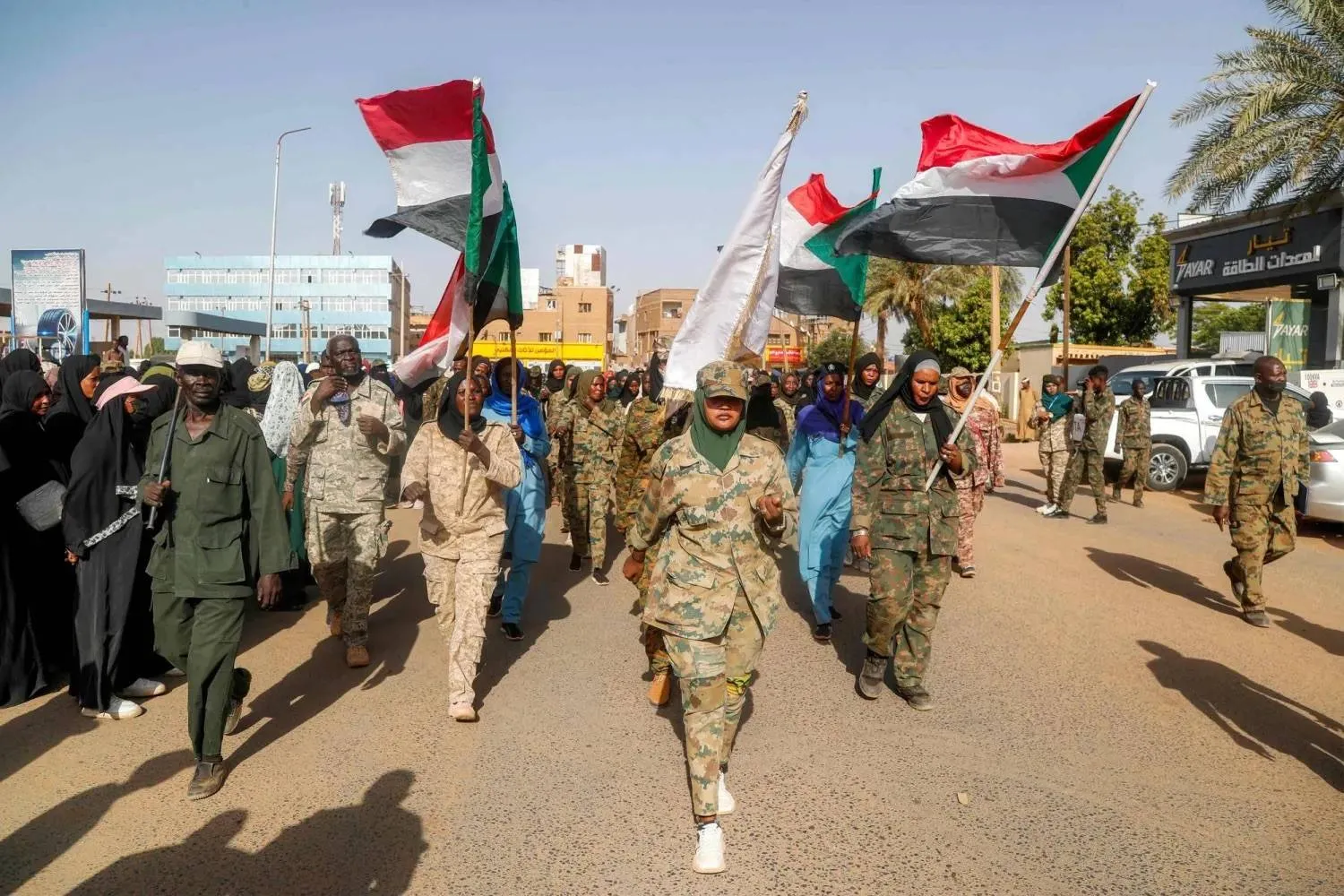
Members of the army-backed Popular Resistance march in Omdurman in support of the military’s campaign in Darfur, Kordofan, and Blue Nile State (AFP). 
TT

Sudanese Army Shifts Battle Back to Darfur

Members of the army-backed Popular Resistance march in Omdurman in support of the military’s campaign in Darfur, Kordofan, and Blue Nile State (AFP). 

Fighting has intensified once again between the Sudanese army and the paramilitary Rapid Support Forces (RSF) across several fronts in the western Darfur region, as military tensions also mount around the city of El Obeid, the capital of North Kordofan state, where both sides are reinforcing their positions.

Over the past two days, the Sudanese army and allied Joint Forces, a coalition of armed groups, have launched operations in West and North Darfur targeting strategic border areas as part of an effort to expand their battlefield presence and open new fronts.

Local sources said army units are advancing toward El Geneina, the capital of West Darfur, under the cover of warplanes that have carried out airstrikes on military positions inside the city. The advance marks one of the army’s most significant military gains in Darfur in months as fighting continues to spread across Sudan.

The renewed clashes come as attention remains focused on El Obeid, where military escalation has intensified amid continued drone attacks and troop buildups despite international calls for a ceasefire and restraint.

Former Sudanese army Chief of Staff Hashim Abdel Muttalib told Asharq Al-Awsat that the army and its allies had carried out what he described as a successful maneuver that returned the fighting to Darfur, reflecting a new phase in military planning. He said the army had regained the initiative and predicted further developments in the region, adding that recent advances in western and northern Darfur were part of plans previously announced by Assistant Commander-in-Chief Lt. Gen. Yasser Al-Atta.

On Monday, the Joint Forces announced they had seized the border town of Kulbus in West Darfur near Chad and said they remained in control of Tina, Karnoi, and Ambro in North Darfur.

The Sudanese army also said it had carried out operations across Darfur, Kordofan, and Blue Nile, inflicting heavy losses on the RSF. The paramilitary group did not immediately comment.

The El Fasher Resistance Committees Coordination, a local civic group, said in a Facebook statement that army forces were approaching El Geneina under the cover of airstrikes targeting military sites inside the city.

The RSF captured Kulbus and nearby towns in October 2025. The town lies about 140 kilometers (87 miles) from El Geneina.

Military analyst Abdullah Mohammed told Asharq Al-Awsat that the renewed fighting in Darfur could prolong and widen the conflict, pushing the war into a more violent phase. He said one of the main objectives of military campaigns is to cut an opponent’s supply lines and deny access to strategic positions, suggesting the army’s operations in West Darfur are aimed at regaining control of the border with Chad.

By contrast, Mohammed Al-Nayer, spokesman for the Sudan Liberation Army Movement, said it was too early to conclude that the war had shifted decisively back to Darfur. He described the operation in Kulbus as a temporary incursion by army-allied Joint Forces that lasted only a few hours before withdrawing after large RSF reinforcements arrived.

Al-Nayer said the objective was to tie down RSF forces in attritional battles inside Darfur, limiting their ability to sustain operations in Kordofan and Blue Nile.



Palestinians Face Uncertain Future as Gaza Marks 1,000 Days of War

Palestinians make their way past the rubble of residential buildings destroyed during the Israeli offensive as displaced people shelter in tents, in Gaza City, June 15, 2026. REUTERS/Dawoud Abu Alkas
TT

Palestinians Face Uncertain Future as Gaza Marks 1,000 Days of War

Palestinians make their way past the rubble of residential buildings destroyed during the Israeli offensive as displaced people shelter in tents, in Gaza City, June 15, 2026. REUTERS/Dawoud Abu Alkas

It's the 1,000th day of war since a Hamas-led attack on Israel that sparked the war in Gaza. Other conflicts have emerged in the region, and fragile ceasefires show scars of persistent attacks. Both Israelis and Palestinians are weary of the strain.

The fate of over 2 million Palestinians in Gaza, largely displaced and living amid ruins, remains uncertain. Israeli forces controlled over half of the territory under the ceasefire that took effect on Oct. 10, but Israel's government has expanded that and says it aims to hold 70%, The Associated Press said.

Few people can get in or out. Further ceasefire steps, including Hamas' disarmament and the immense task of reconstruction, have stalled.

“Much more needs to be done so that even a semblance of normality can come back, and we are far, far away from this,” the International Committee of the Red Cross regional director, Nicolas von Arx, said this week.

Here’s a look at what has happened over the 1,000 days and what may lie ahead.

Palestinians are still being killed Israeli strikes have lessened considerably since the ceasefire took effect, but they continue almost daily.

Gaza’s Health Ministry counted 1,053 Palestinians dead since the ceasefire as of Tuesday, including over 350 women and children. In recent days, they included a teenage girl on her way to school and a mother with her 1-year-old daughter.

“Where is this ceasefire they keep talking about?! Shame on them,” one Palestinian, Wisal Abu Khater, said this week after another deadly strike, lashing out at Arabs who she said have failed Gaza's people and are busy watching World Cup games instead.

The United Nations on Wednesday warned that the Israeli expansion in Gaza increases deadly risks for civilians in “areas lacking clear demarcation on the ground."

The Health Ministry said over 3,400 people have been wounded since the ceasefire. The ministry is part of the Hamas-led government and maintains detailed casualty records seen as generally reliable by UN agencies and independent experts. It does not give a breakdown of civilians and militants but says women and children make up roughly half the dead.

Israel’s military says it targets Hamas and other militants, often asserting they were planning attacks, and accuses Hamas of using civilians as human shields.

The Oct. 7, 2023, Hamas-led attack on southern Israel killed about 1,200 people and took 251 hostage. All hostages or their remains have been freed or handed over, some of them recounting abuses. Israel's retaliation has killed a total of 73,066 Palestinians as of Tuesday, Gaza’s Health Ministry says.

The Trump-created Board of Peace has made little progress

The top diplomat overseeing the ceasefire, Nickolay Mladenov, has made it clear: The next steps in implementing the US-brokered deal are stalled over the difficult issue of Hamas disarming.

This has been a high-profile test of the Board of Peace created and led by US President Donald Trump. Launched with fanfare and billions of dollars in international pledges earlier this year with the sole aim of Gaza’s recovery from war, the board now says little publicly.

Hamas' disarmament would open the way for other steps, including new administration of Gaza and the deployment of an international stabilization force to assist with security and reconstruction efforts. While Hamas hasn’t outright rejected disarming, it has indicated it wants to hold on to some weapons and demanded further concessions from Israel.

A divided Israel faces an election Israelis over the past 1,000 days have been traumatized by the Oct. 7 attack — the deadliest in Israel's history — and other conflicts that followed: against the Iranian-backed Hezbollah militant group in Lebanon, the Iranian-backed Houthi group in Yemen and Iran itself.

Iran’s armed proxies had attacked Israel, saying they acted in solidarity with Palestinians. Prime Minister Benjamin Netanyahu pressed Trump to jointly attack Iran on Feb. 28. That revived the conflict in Lebanon, where Israeli forces have advanced to their deepest point in over a quarter-century

None of these fronts have completely calmed.

These conflicts and their toll — including mounting deaths for Israeli soldiers, continuing attacks along Israel's border with Lebanon and international allegations of genocide in Gaza, which Israel rejects — are weighing on Israelis and the national mood as Netanyahu seeks reelection this fall.

Netanyahu has projected confidence, but he faces a tough challenge.

Over 60% of Israelis think he shouldn't run again, according to a poll by The Israel Democracy Institute published last month. Anger has been high over the security failures before Oct. 7, the lack of a state commission of inquiry to investigate them and unpopular exemptions from military service granted to Netanyahu's ultra-Orthodox governing partners.

Gaza's in rubble as humanitarian aid still faces obstacles Palestinians in Gaza say they are near their limit. Sheltering in vast tent camps with basic if any utilities, or in the skeletons of bombed-out buildings, they continue to live amid the hum of Israeli drones and the daily threat of strikes.

The ceasefire was meant to bring a surge in humanitarian aid like medicines and fuel. Aid groups and others say that has not happened. All of Gaza’s border crossings remain tightly restricted, and at times they have closed completely. The UN last month said 17 hospitals are still not functional.

“Cumbersome" Israeli approvals and customs procedures limit crucial supplies, UN humanitarian chief Tom Fletcher said last month, adding that even prosthetic limbs have been affected by concerns about having a potential "dual” use as weapons.

Famine was declared in Gaza City last August, but food security experts later said there were “notable improvements” after the ceasefire. The Israeli military body responsible for coordinating civilian affairs in Gaza, COGAT, said Wednesday that “the quantities of food that are being brought in far exceed the nutritional needs of the Gazan civilian population.”

With Israeli forces expanding in Gaza, and Hamas militants accused of illegally executing Palestinians for alleged collaboration with Israel or crimes like looting, people say they are stressed and exhausted.

“We had everything before the war,” said Mahmoud Ashour, a 33-year-old shop owner in Khan Younis. “And now we’re just craving a bite to eat."


Looting of Yemen’s Antiquities Surges in Houthi-Controlled Areas

Smuggled Yemeni antiquities offered for sale abroad (local media)
TT

Looting of Yemen’s Antiquities Surges in Houthi-Controlled Areas

Smuggled Yemeni antiquities offered for sale abroad (local media)

The looting of Yemen’s antiquities is surging in areas under Houthi control, as illegal excavations increasingly target historic sites rich in archaeological treasures. Experts accuse influential figures of shielding organized trafficking networks that loot and smuggle artifacts abroad, placing a significant part of Yemen’s cultural heritage at risk.

Experts say the provinces of Ibb and Dhamar, south of Sanaa, home to some of Yemen’s most important ancient cities and the capitals of early Yemeni kingdoms, have become hotspots for unauthorized excavations in recent months. Ancient cemeteries and archaeological sites are being systematically dug up in search of rare artifacts, while Yemeni antiquities are increasingly surfacing on illicit markets in the country and overseas.

Yemeni antiquities expert Abdullah Mohsen revealed that a collection of rare artifacts was recently offered for sale in the city of Yarim, in Ibb, just days after illegal excavations were carried out at several ancient cemeteries in the historic city of Zafar, the former capital of the Himyarite Kingdom.

The collection includes gold jewelry and valuable bronze artifacts, among them a rare gold dagger hilt dating to the first century AD. According to experts, it is only the third known example of its kind from the Himyarite era.

Illegal excavations have become increasingly frequent (local media)

Mohsen said he received photographs of the artifacts from a Yemeni heritage enthusiast who requested anonymity for security reasons.

He added that the objects display unmistakable archaeological characteristics confirming their authenticity and scholarly value, and strongly suggest they originated from the recently looted burial sites.

Heritage experts say the close timing between the illegal excavations and the appearance of the artifacts on the black market are a clear sign that organized networks are systematically extracting and rapidly trafficking antiquities, exploiting weak oversight and the absence of effective protection for archaeological sites.

Yemeni artifact for sale in the United States (local media)

Rare discoveries

Archaeology professor Layla Aqil identified the gold object shown in the photographs as the hilt of a sword or dagger, crafted with intricate gold wirework and decorated with the Heracles knot, a motif widely used during the Hellenistic period between the first and third centuries AD as a symbol of strength and authority.

She said the hilt is only the third known example of its type, resembling two previously discovered daggers - one housed in the Museum of Islamic Art collection and the other unearthed at the Al-Asibiyah archaeological site.

Both feature delicate floral motifs inlaid with colored enamel, a further sign that the newly surfaced piece dates from the same period.

Aqil also noted that the twisted gold bracelets found in the collection represent a classic form of jewelry in ancient Yemen. Comparable examples have been excavated at Al-Asibiyah, Qaryat Al-Faw, and the Al-Hasmah site in Shaqrah, Abyan province, and are believed to date from between the first and third centuries AD.

Experts stress that the importance of these artifacts extends well beyond their monetary value. They provide critical evidence about the history of Yemen’s ancient kingdoms and the evolution of their craftsmanship, technology, and artistic traditions, making their loss an irreplaceable scientific and cultural setback.

Archaeological inscription found near homes in Houthi-controlled areas (local media)

Organized smuggling

Archaeologists have also warned of expanding antiquities trafficking networks operating in Ibb and Dhamar, saying illegal excavations have become increasingly frequent over recent months as institutions responsible for safeguarding cultural heritage have weakened and archaeological sites remain largely unprotected.

They said they possess information indicating that the rare artifacts are now in the hands of an influential network specializing in looting historic sites and trading antiquities.

According to their accounts, the group enjoys the backing and protection of influential figures in Houthi-controlled areas, enabling illegal excavations to continue and facilitating the organized smuggling of artifacts out of Yemen.

The experts warned that the destruction of archaeological sites results not only in the loss of historic objects but also in the irreversible destruction of archaeological layers and their scientific context, depriving researchers of historical evidence that can never be recovered and inflicting lasting damage on Yemen’s cultural legacy.

They called on the relevant authorities and international organizations responsible for protecting cultural heritage to act urgently by dismantling trafficking networks, recovering stolen collections, halting illegal excavations, and strengthening protection for archaeological sites.


Government Delay Revives Specter of ‘Two Administrations’ in Iraq’s Kurdistan Region

A photo published by the Patriotic Union of Kurdistan website showing Bafel Talabani meeting Masrour Barzani. 
TT

Government Delay Revives Specter of ‘Two Administrations’ in Iraq’s Kurdistan Region

A photo published by the Patriotic Union of Kurdistan website showing Bafel Talabani meeting Masrour Barzani. 

Nearly two years after elections for Iraq’s Kurdistan Region parliament, the winning Kurdish parties have yet to convene the legislature, elect a speaker, or form a new government. Had that process moved forward, it would have produced a fully empowered cabinet to replace Prime Minister Masrour Barzani’s administration, which has been serving in a caretaker capacity since before the October 2024 regional elections.

In May 2023, Iraq’s Federal Supreme Court, which rules on constitutional disputes, declared the extension of the Kurdistan parliament unconstitutional and ruled that Barzani’s cabinet should be considered a caretaker government.

With the political stalemate showing no sign of easing, a senior figure in the Patriotic Union of Kurdistan (PUK) warned that the region could drift toward “two officially separate administrations.”

Speaking to Asharq Al-Awsat on condition of anonymity, the official said Kurdistan already operates under a dual administrative system in practice, but warned that the arrangement could become formal if Kurdish parties remain unable to agree on a new government.

The Kurdistan Region effectively had two separate administrations from the mid-1990s until 2006, following armed conflict between the Kurdistan Democratic Party (KDP) and the PUK. The KDP governed from Erbil and Duhok, while the PUK administered Sulaymaniyah, with separate governments, security forces, and financial institutions.

The split officially ended in 2006 with the formation of a unified Kurdistan Regional Government after years of political negotiations following the 1998 Washington Agreement, although both parties retained strong influence in their traditional strongholds.

The PUK official blamed the KDP for delaying government formation, saying it “wants everything” and is unwilling to relinquish key government positions to other parties. The two dominant Kurdish parties have repeatedly traded blame for the prolonged political paralysis.

A senior KDP official previously told Asharq Al-Awsat that continued failure to form a government could ultimately force the region to hold fresh elections.

According to politicians and activists, the rival bloc — which includes the PUK and the New Generation Movement — is demanding the premiership and an equal share of senior government positions.

The PUK official acknowledged that a return to separate administrations would undermine the region’s future but said the party remains prepared to make concessions to preserve Kurdistan’s unity. He also pointed to a recent meeting between PUK leader Bafel Talabani and the party’s parliamentary bloc, during which Talabani stressed that the PUK is not obstructing the formation of a new cabinet and supports accelerating the process.

However, comments from other senior PUK figures have raised concerns. Yousif Goran, a member of the party’s political bureau and head of its research center, wrote on the party’s official website that the long-term viability of the Kurdistan Region “in its current form” is increasingly in doubt because of internal political dysfunction and shifting regional and international dynamics.

He added that the region has not experienced such deep political polarization since the administrations were unified in 2006 and argued that meaningful political change is now essential. He also warned that Iraqi Kurdistan no longer enjoys the level of international backing it received after 1991, when it effectively separated from Baghdad’s control.

Meanwhile, Kifah Mahmoud, media adviser to KDP leader Masoud Barzani, dismissed talk of separate administrations as “political suicide” that would endanger the region’s highest interests. He described such proposals as part of broader efforts to undermine the Kurdistan Region and its federal model, insisting that parliament is the proper forum for resolving political disputes.

Mahmoud also said early elections remain one option for breaking the deadlock, while arguing that the PUK’s alliance with the New Generation Movement should have been formed before, rather than after, the regional elections.