
Government Delay Revives Specter of ‘Two Administrations’ in Iraq’s Kurdistan Region

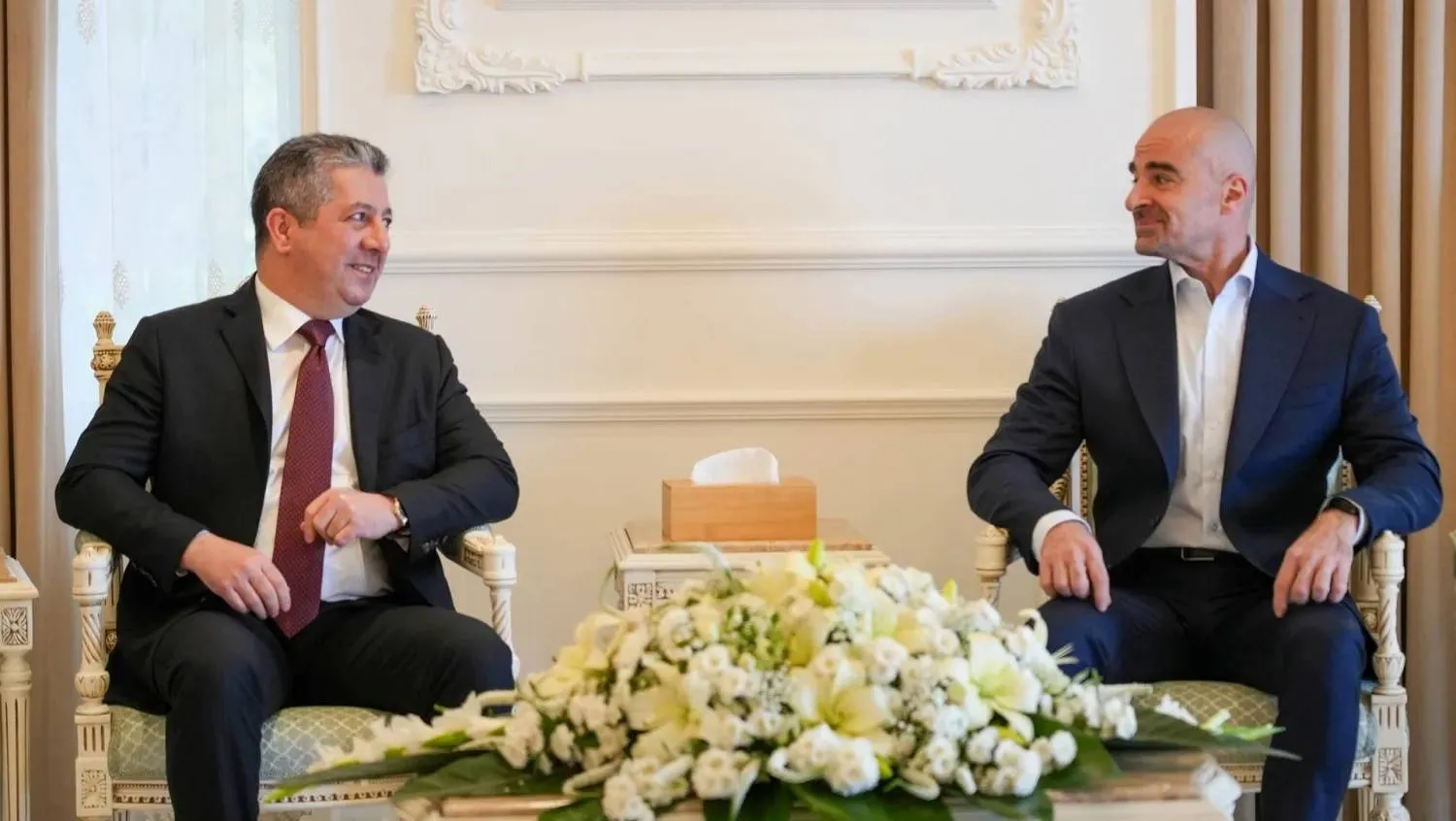
A photo published by the Patriotic Union of Kurdistan website showing Bafel Talabani meeting Masrour Barzani. 
TT

Government Delay Revives Specter of ‘Two Administrations’ in Iraq’s Kurdistan Region

A photo published by the Patriotic Union of Kurdistan website showing Bafel Talabani meeting Masrour Barzani. 

Nearly two years after elections for Iraq’s Kurdistan Region parliament, the winning Kurdish parties have yet to convene the legislature, elect a speaker, or form a new government. Had that process moved forward, it would have produced a fully empowered cabinet to replace Prime Minister Masrour Barzani’s administration, which has been serving in a caretaker capacity since before the October 2024 regional elections.

In May 2023, Iraq’s Federal Supreme Court, which rules on constitutional disputes, declared the extension of the Kurdistan parliament unconstitutional and ruled that Barzani’s cabinet should be considered a caretaker government.

With the political stalemate showing no sign of easing, a senior figure in the Patriotic Union of Kurdistan (PUK) warned that the region could drift toward “two officially separate administrations.”

Speaking to Asharq Al-Awsat on condition of anonymity, the official said Kurdistan already operates under a dual administrative system in practice, but warned that the arrangement could become formal if Kurdish parties remain unable to agree on a new government.

The Kurdistan Region effectively had two separate administrations from the mid-1990s until 2006, following armed conflict between the Kurdistan Democratic Party (KDP) and the PUK. The KDP governed from Erbil and Duhok, while the PUK administered Sulaymaniyah, with separate governments, security forces, and financial institutions.

The split officially ended in 2006 with the formation of a unified Kurdistan Regional Government after years of political negotiations following the 1998 Washington Agreement, although both parties retained strong influence in their traditional strongholds.

The PUK official blamed the KDP for delaying government formation, saying it “wants everything” and is unwilling to relinquish key government positions to other parties. The two dominant Kurdish parties have repeatedly traded blame for the prolonged political paralysis.

A senior KDP official previously told Asharq Al-Awsat that continued failure to form a government could ultimately force the region to hold fresh elections.

According to politicians and activists, the rival bloc — which includes the PUK and the New Generation Movement — is demanding the premiership and an equal share of senior government positions.

The PUK official acknowledged that a return to separate administrations would undermine the region’s future but said the party remains prepared to make concessions to preserve Kurdistan’s unity. He also pointed to a recent meeting between PUK leader Bafel Talabani and the party’s parliamentary bloc, during which Talabani stressed that the PUK is not obstructing the formation of a new cabinet and supports accelerating the process.

However, comments from other senior PUK figures have raised concerns. Yousif Goran, a member of the party’s political bureau and head of its research center, wrote on the party’s official website that the long-term viability of the Kurdistan Region “in its current form” is increasingly in doubt because of internal political dysfunction and shifting regional and international dynamics.

He added that the region has not experienced such deep political polarization since the administrations were unified in 2006 and argued that meaningful political change is now essential. He also warned that Iraqi Kurdistan no longer enjoys the level of international backing it received after 1991, when it effectively separated from Baghdad’s control.

Meanwhile, Kifah Mahmoud, media adviser to KDP leader Masoud Barzani, dismissed talk of separate administrations as “political suicide” that would endanger the region’s highest interests. He described such proposals as part of broader efforts to undermine the Kurdistan Region and its federal model, insisting that parliament is the proper forum for resolving political disputes.

Mahmoud also said early elections remain one option for breaking the deadlock, while arguing that the PUK’s alliance with the New Generation Movement should have been formed before, rather than after, the regional elections.



Iraq Seizes $20 Mn, Recovers 60 Kg of Gold in ‘Deputy Oil Minister’ Case

Image published by Iraq's Supreme Judicial Council of the seized funds.
TT

Iraq Seizes $20 Mn, Recovers 60 Kg of Gold in ‘Deputy Oil Minister’ Case

Image published by Iraq's Supreme Judicial Council of the seized funds.

Diaa Jaafar, the investigating judge at Iraq’s Central Anti-Corruption Criminal Court, announced on Sunday that authorities had seized $20 million and recovered 60 kilograms of gold in a corruption case involving suspended Deputy Oil Minister for Refining Affairs Adnan al-Jumaili.

In a statement released by Iraq’s Supreme Judicial Council and reported by the German Press Agency (dpa), Jaafar said that, in coordination with the Kurdistan Region, authorities had seized $20.34 million, 200 million Iraqi dinars, and seven vehicles, in addition to recovering 60 kilograms of gold.

The seizures were made as part of the case against Jumaili and other individuals allegedly involved in the corruption scheme.

He said that follow-up and investigative efforts to recover funds obtained through squandering and irregularities in projects carried out by the defendant and others involved in the case led to the seizure of the cash, gold jewelry and vehicles.

The judge said the investigation is ongoing and that authorities are pursuing other suspects before completing the necessary legal procedures against them.


Hamas Delegation in Cairo for Gaza Ceasefire Talks

15 August 2026, Palestinian Territories, Gaza: Tents sheltering displaced Palestinians crowd the beach, as the coastline has become a refuge for thousands displaced from different parts of the Gaza Strip by the war. (dpa)
TT

Hamas Delegation in Cairo for Gaza Ceasefire Talks

15 August 2026, Palestinian Territories, Gaza: Tents sheltering displaced Palestinians crowd the beach, as the coastline has become a refuge for thousands displaced from different parts of the Gaza Strip by the war. (dpa)

A Hamas delegation, chaired by the group’s leader Khalil al-Hayya, is in Cairo Sunday for Gaza ceasefire-related talks with Egyptian officials, the group said.

The talks come as mediators push for the implementation of a roadmap to move forward with US President Donald Trump’s peace plan, which calls for the disarmament of Hamas and other Palestinian groups in Gaza, the withdrawal of Israeli forces from the area as well as handing over power to Palestinian technocrats.

Israel’s Prime Minister Benjamin Netanyahu has rejected Trump’s latest plan to advance the stalled ceasefire in Gaza, saying Israel will not withdraw from any of the roughly 60% of the territory it controls until Hamas has been completely disarmed — something the group controlling the other 40% has long resisted.

It wasn’t immediately clear whether al-Hayya would meet with Trump’s son-in-law and negotiator Jared Kushner, the Board of Peace’s high representative Nickolay Mladenov, or executive board member and former British Prime Minister Tony Blair, who are scheduled to travel to Israel and Egypt this week.


Israel Vows to Go After Hezbollah as It Names Another Killed

15 August 2026, Lebanon, Nabatieh district: An Israeli warplane carried out an airstrike on a house in a tourist area of Ansar, southern Lebanon, before dawn, completely destroying the building and causing extensive damage to surrounding properties. (dpa)
TT

Israel Vows to Go After Hezbollah as It Names Another Killed

15 August 2026, Lebanon, Nabatieh district: An Israeli warplane carried out an airstrike on a house in a tourist area of Ansar, southern Lebanon, before dawn, completely destroying the building and causing extensive damage to surrounding properties. (dpa)

Israel vowed Sunday it would hit Hezbollah again if threatened, as it identified what it described as a commander killed in strikes a day earlier that also left several children dead. 

Israeli strikes on Saturday killed 11 people in southern Lebanon, according to authorities, in the deadliest attacks since a deal was reached in June aimed at ending hostilities. 

Israel said the strikes were a response to Hezbollah setting off explosive drones inside a so-called "security zone" in southern Lebanon, seriously injuring three Israeli troops including an officer. 

"No score will be left unsettled in any arena. We'll defend our soldiers and our civilians with full power," Defense Minister Israel Katz wrote on X. 

The Israeli military identified one of those killed on Saturday as Abu Hassan Alaa, saying he was a senior commander of Hezbollah's Badr unit who had been involved in firing drones at Israeli troops. 

Israel earlier said that the strike killed a commander in Hezbollah's elite Radwan Force, Ali Samir Al-Haj Hassan. 

The Israeli military acknowledged that Hassan's family was present but defended the strike by saying they were not the target. 

Lebanese President Joseph Aoun said a whole family had been killed in the strike in the village of Ansar, with Lebanon's health ministry reporting that three children and two women died. 

Imran Riza, the UN humanitarian coordinator for Lebanon, condemned the strike. 

"Children and civilians continue to pay an unacceptable price. International humanitarian law is clear: civilians must be protected at all times," he said. 

Prime Minister Benjamin Netanyahu's office accused Hezbollah of deliberately placing civilians in harm's way. 

Hezbollah denied the account, saying that "another entire family has been wiped out following orders issued by Netanyahu". 

"Netanyahu, who is the subject of proceedings before the International Criminal Court over war crimes and crimes against humanity committed in Gaza, is once again presiding over the killing of Lebanese civilians," Hezbollah said in a statement. 

Hezbollah pulled Lebanon into the regional war in March by firing rockets at Israel in support of Iran, after US-Israeli strikes there sparked war in late February. 

Lebanon and Israel signed a US-brokered deal in which Lebanon's army will gradually take over security in southern areas occupied by Israel, but Hezbollah has refused to disarm.