


Venezuela’s Interim Leader Angrily Defends Earthquake Response

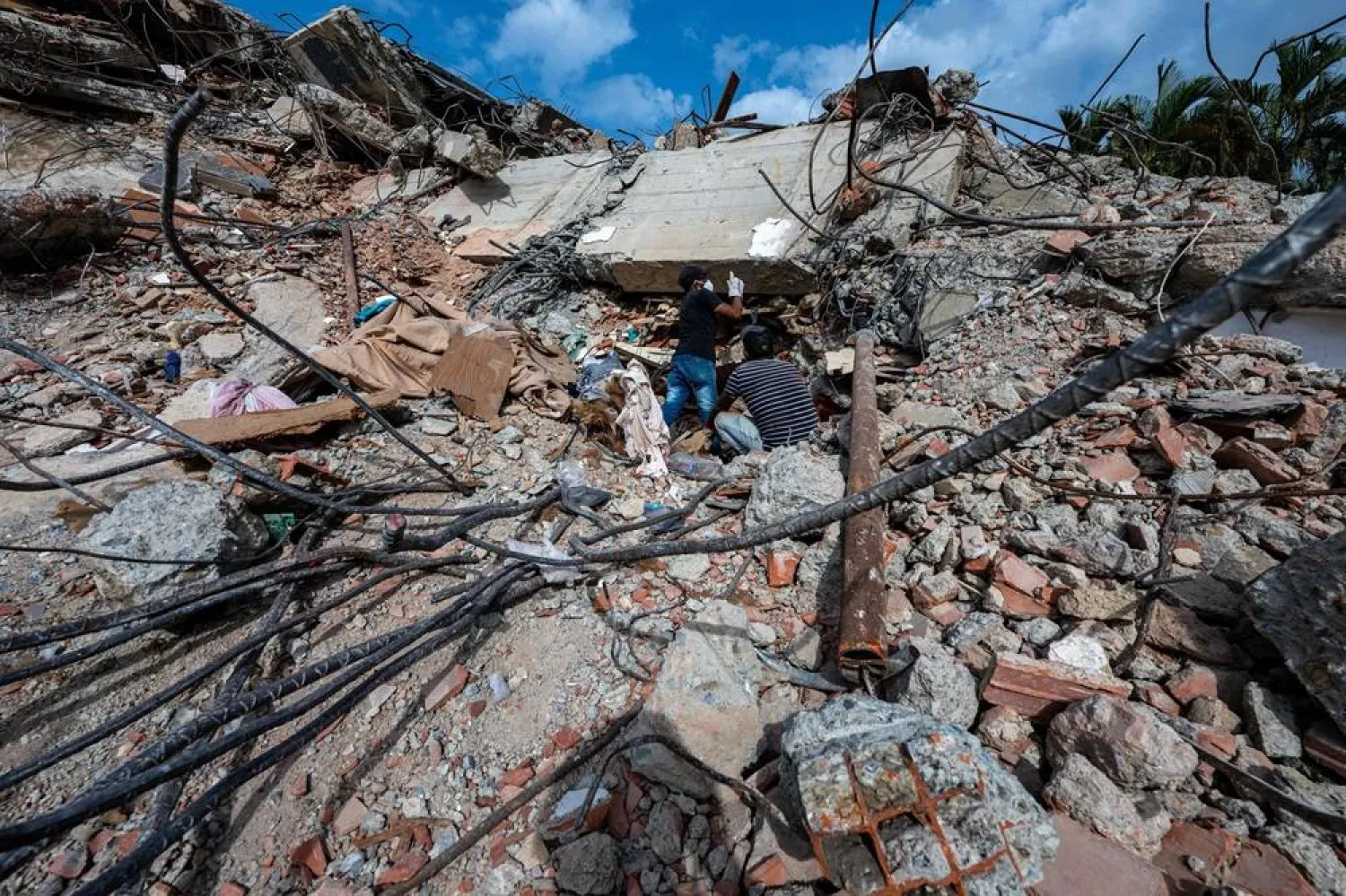
This photograph taken on July 2, 2026 in Caraballeda in the state of La Guaira shows volunteers looking for survivors in a collapsed building following the June 24 twin earthquakes. (AFP)
TT

Venezuela’s Interim Leader Angrily Defends Earthquake Response

This photograph taken on July 2, 2026 in Caraballeda in the state of La Guaira shows volunteers looking for survivors in a collapsed building following the June 24 twin earthquakes. (AFP)

Venezuela's US-backed acting President Delcy Rodríguez on Thursday issued a fiery defense of her government's response to last week's devastating earthquakes, lashing out at critics who say authorities reacted too slowly, pushing back on suggestions that the true death toll is far higher than the government has acknowledged and rejecting accusations that the nation's shoddily constructed social housing exacerbated the disaster.

The self-described socialist government of Rodríguez, striving for legitimacy months after the United States removed former President Nicolás Maduro from power in January, has come under fire for what residents have described as a sluggish and haphazard response to the quakes.

Residents of the hardest-hit state, La Guaira, have complained that the initial absence of a serious government search-and-rescue operation left them alone to scour for neighbors and loved ones with their bare hands. Rescuers have lamented the country's shortages of specialized equipment.

Experts have warned that substandard construction of social housing projects — a hallmark policy of former President Hugo Chávez — left neighborhoods vulnerable to quakes.

At a press conference for foreign journalists in the capital of Caracas late Thursday, Rodríguez, wearing a black ribbon as a symbol of mourning, refused to accept the criticism.

“We did not wait one day, two days or three days. We activated immediately,” she said, lacing into media outlets that she accused of spreading misinformation. “To politicize a humanitarian tragedy like this — when the Venezuelan government and its authorities have spared no effort, public, private, national, or international — is disgraceful."

Authorities have counted at least 2,295 people killed by the earthquake as of Wednesday — a number that’s expected to rise. They did not offer an updated death toll on Thursday, and have maintained tight control over public communications and relief efforts.

A rare bright spot in the misery

The stench of decomposition hung heavy over streets of flattened buildings as rescue missions to find survivors of Venezuela’s devastating earthquakes increasingly turned to the recovery of corpses.

Desperate for good news, Venezuelan and international emergency workers celebrated the near-miraculous rescue of a 43-year-old security guard found alive after nearly eight days under the rubble — five days beyond the critical 72-hour mark following a quake when experts say finding survivors is most likely.

National broadcasters reran footage of the exuberant moment he was pried free from the collapsed mall and lifted onto a stretcher as crowds cheered. Trapped in an air pocket beneath the concrete, Hernán Alberto Gil Flores survived on the food and water that rescuers managed to pass him through crevices.

Elsewhere across La Guaira, an air of hopelessness was setting in. The port city of Catia La Mar teemed with officials carrying body bags and stacking wooden coffins.

More than 38,000 reports of missing people — many of them likely buried beneath the rubble — have been sent to a website set up by the Venezuelan opposition, as the government has not given official figures for those missing.

When one journalist asked Rodríguez about the true, still-unknown toll of the disaster, citing reports that the United Nations is procuring 10,000 body bags, Rodríguez defended the government's tally.

“We do not want to speculate," she said. “The numbers we provide are rigorously verified.”

In La Guaira, several of Chávez's signature social housing projects were razed by the earthquakes, prompting suspicions of flawed construction. Rodriguez deflected the accusations, claiming on Thursday that about 80% of the collapsed buildings were privately developed. She did not offer evidence.

Rodríguez’s denies a slow government response

Pressed on reports that residents were on their own in the first 48 hours after the quakes, with heavy machinery and official aid scarce, Rodríguez acknowledged that “naturally, at the sites where the building collapsed, the first people to arrive were survivors of the collapse itself, relatives and neighbors."

But she railed against what she called “narratives manufactured in propaganda laboratories" and claimed that a day after the quakes, “We had already mobilized the full capacity of the Venezuelan state together with the private sector.”

The disaster has evolved into the biggest test of competence yet for Rodríguez, who served as deputy to Maduro until his ouster and became interim leader with the backing of the Trump administration.

Her comments Thursday came a day before the extension of her 180-day mandate as acting leader was set to expire. It was unclear what would happen once the deadline passes Friday.

Under Venezuela’s constitution, temporary absences are to be filled by the vice president — which was Rodríguez’s former role — for up to 90 days. These interim appointments can be extended by the national assembly for an additional 90 days. The National Assembly, controlled by Rodríguez’s party, can trigger a snap election if lawmakers declare the post permanently vacant.

US support of a government under fire

In contrast to the aftermath of Venezuela's catastrophic 1999 landslides, when then-President Chávez rejected offers of assistance from an adversarial US, Rodríguez has publicly welcomed aid and rescue teams from governments across the political spectrum — including the Trump administration and its regional allies.

In expressing thanks for the foreign help, Rodríguez singled out Israel, which has no diplomatic relations with Venezuela. She praised President Donald Trump and Secretary State of Marco Rubio, saying they “remained constantly attentive and offered support.”

Washington has thrown its support behind Rodríguez in its bid to open up Venezuela’s lucrative energy industry and largely turned its back on opposition leader and Nobel Peace Prize winner María Corina Machado, who this week accused Rodríguez’s government of blocking her return to the country.

The US has committed over $300 million and deployed some 900 military personnel to support rescue operations. On top of that, John M. Barrett, the US chargé d’affaires to Venezuela, said the US would make revenue from Venezuelan oil production, controlled by the US Treasury since Maduro’s seizure, available for relief efforts. That promise has made demands for more transparency in US management of Venezuelan oil sales all the more urgent, analysts say.

“Venezuelans really need that money to be used for the protection of Venezuelans,” said Laura Cristina Dib, Venezuela program director at the independent human rights organization Washington Office on Latin America.



Trump Says Iran Cannot Have a Nuclear Weapon

President Donald Trump boards Air Force One at Morristown Airport, Sunday, Aug. 16, 2026, in Morristown, N.J. (AP Photo/Julia Demaree Nikhinson)
TT

Trump Says Iran Cannot Have a Nuclear Weapon

President Donald Trump boards Air Force One at Morristown Airport, Sunday, Aug. 16, 2026, in Morristown, N.J. (AP Photo/Julia Demaree Nikhinson)

US President Donald Trump reiterated on Monday that Iran cannot have a nuclear weapon amid a lack ⁠of progress in diplomatic ⁠efforts to resolve the Middle East conflict.

"The ⁠number one Goal is, and always will be, that Iran cannot have, in any way, shape, or form, ⁠a Nuclear ⁠Weapon," Trump said in a post on Truth Social.

His comment came as the 60-day negotiating period to find a peace deal between the US and Iran was expiring, with no word of an extension and both sides seemingly as far apart as they were two months ago.

Iran said Monday it is working to finalize a joint statement with Oman on a plan to manage the transit of ships through the Strait of Hormuz.

Fully reopening the waterway to commercial shipping has been a key demand of the United States, but it remains unclear whether the deal will meet Washington's criteria.


Iran Working to Finalize Hormuz Agreement with Oman

FILE PHOTO: Vessels near the Strait of Hormuz, as seen from Musandam, Oman, August 10, 2026. REUTERS/Stringer/File Photo
TT

Iran Working to Finalize Hormuz Agreement with Oman

FILE PHOTO: Vessels near the Strait of Hormuz, as seen from Musandam, Oman, August 10, 2026. REUTERS/Stringer/File Photo

Iran said Monday it has reached an agreement with Oman over a plan for ships to transit the Strait of Hormuz, which runs between the two countries, and the sides are now working to finalize details for a joint statement.

Iranian Foreign Affairs spokesperson Esmail Baghaei told reporters in Tehran that “an understanding has been reached regarding the map of the transit route.”

He did not elaborate, but details that have previously emerged suggest the deal would reopen the strait with ships entering through a route close to Iran and exiting through a route close to Oman. Ships would transit without paying fees or tolls during the interim period.

The US has sought an acceptable deal on opening the strait before ending its blockade of Iranian ports and it was not clear whether this would meet Washington’s expectations.

Iran effectively closed the strait — through which roughly one-fifth of the world’s traded oil supplies passed before the war — after Israel and the US attacked the country on Feb. 28.

Baghaei conceded the talks with Oman have gone slowly, “but we had planned, and still plan, to finalize the understanding in the form of a package: the map plus a joint statement.”

His comments came as a 60-day deadline for finding an agreement to end the war expired, with no signs of a deal between the US and Iran.


Residents Jeer French PM on Visit to Fire-Hit Region

France's Prime Minister Sebastien Lecornu arrives for a meeting with officials at Technowest in Merignac, on the outskirts of Bordeaux, south-western France on August 17, 2026 following the giant wildfire. (AFP)
TT

Residents Jeer French PM on Visit to Fire-Hit Region

France's Prime Minister Sebastien Lecornu arrives for a meeting with officials at Technowest in Merignac, on the outskirts of Bordeaux, south-western France on August 17, 2026 following the giant wildfire. (AFP)

Dozens of residents on Monday jeered the French prime minister as he arrived in a region hit by wildfires earlier this summer, in a show of anger over the government's handling of the worst such crisis in France in decades.

Some 200 people dressed in black gathered in front of the town hall in Le Porge in southwestern France, where 183 homes burned down when wildfires swept through the Gironde region in late July and early August, at one point even threatening the city of Bordeaux.

They jeered, whistled and shouted anti-government slogans as the tinted-window car with a flashing light carrying Prime Minister Sebastien Lecornu approached for a meeting with the mayor of Le Porge, Martial Zaninetti, an AFP correspondent said.

"Where is he? Where is he?" the crowd shouted.

"It would have been the least he could do" for the prime minister to meet the residents, said Tony Veiga, a 65-year-old pensioner. "It really amounts to treating us as if we don't matter."

Lecornu's office said he had spoken with affected residents and farmers.

"We have absolutely nothing to hide regarding how fire protection operations have been conducted over the past few weeks," Lecornu said as he met local officials in the nearby town of Merignac after leaving Le Porge.

He had already visited Le Porge on Sunday afternoon to tour the municipality with the mayor -- a trip that had not been announced and took place without press cameras.

There is anger in the region among some residents who allege authorities prioritized fighting fires in the upscale Cap-Ferret peninsula -- where many affluent Parisians take holidays -- over protecting homes of local residents.

"He doesn't want to meet us; it's a shame. We had things we wanted to say," said Ludivine Daurignac, organizer of a group of affected residents who plan to file complaints and get "truth, transparency, and justice".

"We were met by lines of riot police blocking our access," she said.

Having burned through 42,000 hectares, the fire was brought under control on August 1.

It was the largest such fire in France by surface area since 1949, with the flames coming within 15 kilometers (10 miles) of the Bordeaux metropolitan area and forcing the evacuation of more than 220,000 residents and tourists.