


Trump Mixes Patriotism with Partisanship as He Celebrates America’s ‘Joyous’ 250th Anniversary

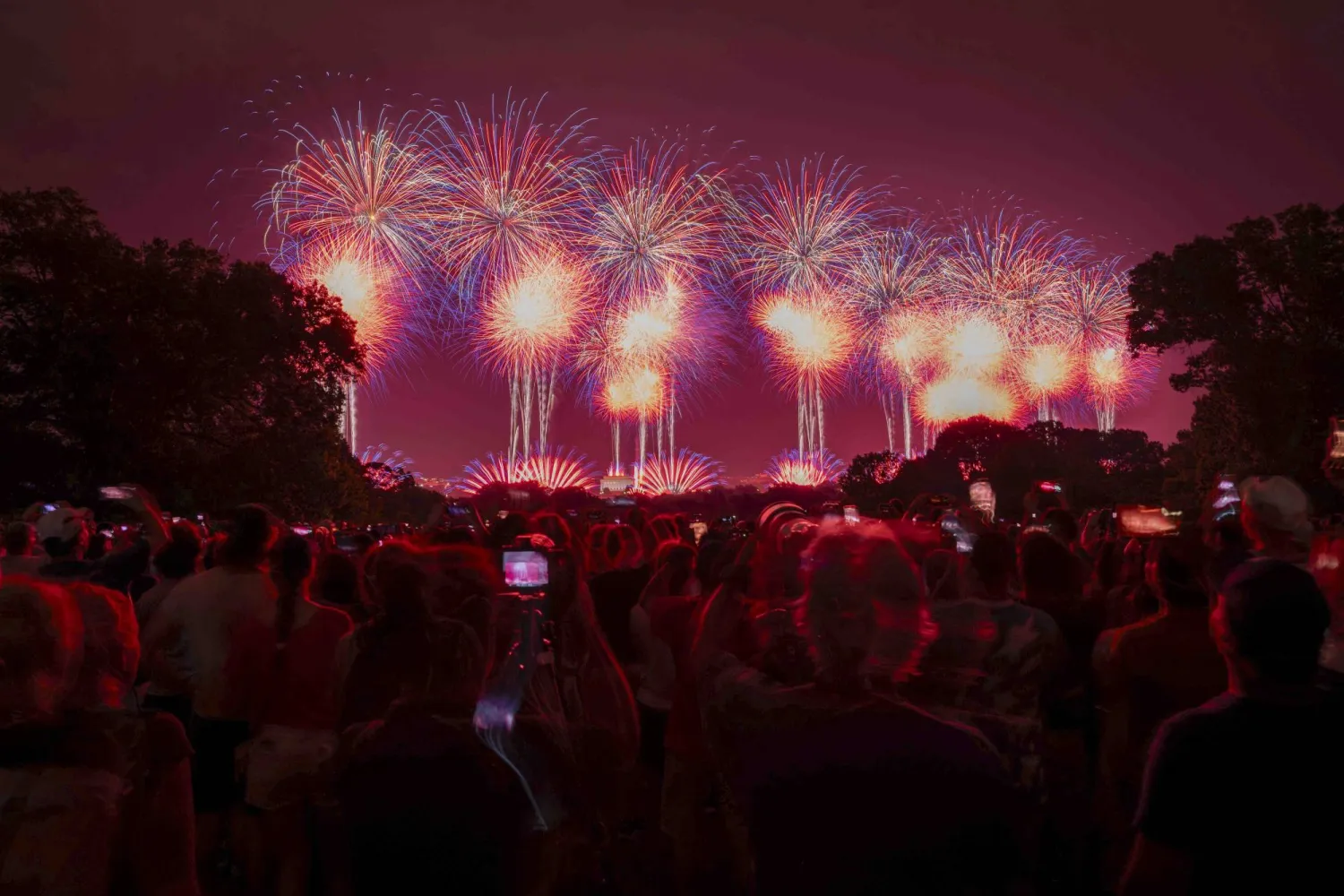
Fireworks light up the DC Skyline as seen from the Iwo Jima Memorial in Arlington, Virginia, USA, 04 July 2026. (EPA)
TT

Trump Mixes Patriotism with Partisanship as He Celebrates America’s ‘Joyous’ 250th Anniversary

Fireworks light up the DC Skyline as seen from the Iwo Jima Memorial in Arlington, Virginia, USA, 04 July 2026. (EPA)

President Donald Trump mixed partisan politics with patriotic appeals on Saturday as he commemorated the 250th anniversary of American independence, a moment he declared “one of the most joyous and glorious milestones of all time.”

Speaking in Washington after storms prompted a roughly two-hour evacuation of the National Mall, Trump honored veterans, including several from World War II and one of the first Black officers to lead a Special Forces team in combat in Vietnam. They appeared before flags that symbolized some of the most significant and challenging moments in American history, from the one that was draped over Abraham Lincoln's casket to the one that flew on the plane piloted by the Wright Brothers.

Yet Trump also leaned into partisan territory unusual for an Independence Day address, which presidents typically use as a moment to unify the country. Instead, he stumped again for the SAVE America Act, an elections bill that's encountering challenges even from Trump's fellow Republicans in Congress. He highlighted his support for the Second Amendment and revived denunciations of communism, which are becoming an increasingly central part of Trump's message ahead of the November midterms.

The speech capped a holiday that Trump has gone to great lengths to shape to his own tastes. He was introduced by two musical performers who often appear at his trademark rallies, including Lee Greenwood, who performed “God Bless the USA.” The event organizers were largely aligned with the White House, supplanting a bipartisan organization that was launched by Congress a decade ago.

“We will always be on top,” Trump said. "We will never let our country fall. We will always be the best.”

Trump didn’t talk about himself as much as he does during his normal rally speeches. Still, he still found time to include a joke about seeking a third presidential term and about World War II’s “greatest generation.”

“They are the greatest generation,” Trump said. “I hate to admit that, but they are.”

Anticipation for the milestone holiday has been building for much of the year, serving as an opportunity for Americans to reflect on their complicated history as onetime colonists of an empire who became a superpower of their own. Organizers of celebrations months in the making had to adjust or cancel activities entirely as much of the East Coast sweltered under heat that approached and in many cases surpassed triple digits.

Severe weather prompted the cancellation of celebrations in Hartford, Connecticut, along with Harrisburg and Wilkes-Barre, Pennsylvania. Spectators at Boston’s fireworks and concert were told to briefly seek shelter before events later resumed. An evacuation was also ordered in Philadelphia. New York and Pittsburgh moved forward with fireworks but shifted the time to accommodate the shifting weather.
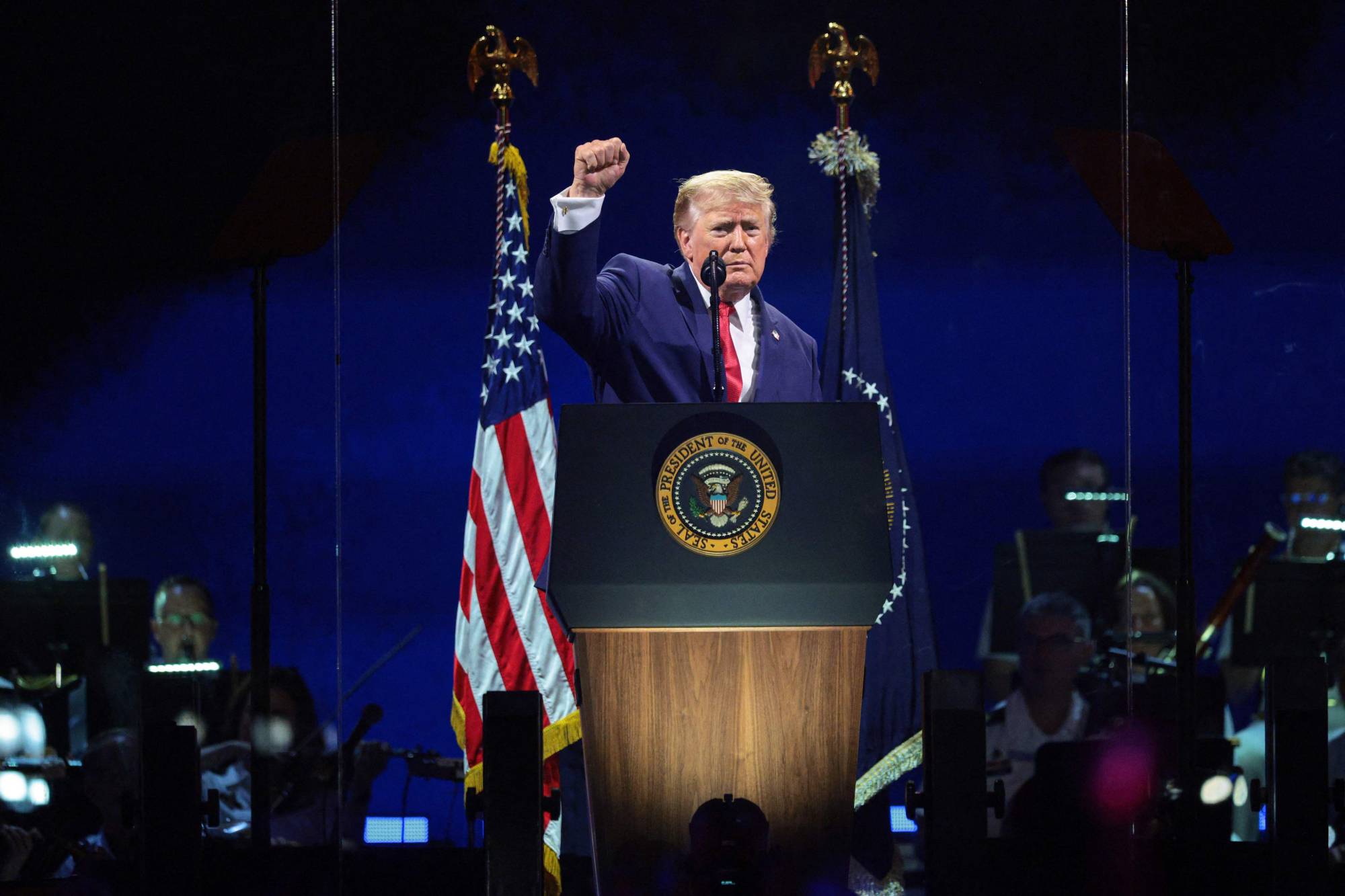
President Donald Trump raises his fist while speaking at "Salute to America 250" Fourth of July celebrations on the National Mall on July 04, 2026 in Washington, DC. (Getty Images/AFP)

The disruption was particularly acute in Washington, where signs at the Great American State Fair posted an alert shortly after 7 p.m. ET encouraging participants to leave the area. Crowds gathered in museums, subway stations and federal buildings near the Mall. At the Ronald Reagan Building and International Trade Center they waited in chairs and sat on the floor to cool off in the air conditioning.

Crowds were building in the area several hours before the evacuation. Tina Hale, 58, of Cohoes, New York, watched three of her grandchildren children dip their hands into a pool of water near a museum. Hale pointed toward the sky and urged them to look up as three military jets roared above the crowd.

“If that doesn’t make you proud to be an American,” she said.

David Koshko, 42, and his wife, Jennifer Koskho, of Harrisburg, Pennsylvania, came to Washington for a baseball game but planned to stay for the city’s fireworks show. After baking in the heat for hours during the Pittsburgh Pirates’ win over the Washington Nationals, they took a break in the shade of an overpass near the National Mall to plot their next stop.

“Just to be a part of the 250 years (anniversary) is an amazing thing,” said David Koshko, a commercial driver and veteran of the Marine Corps reserves.

In Philadelphia, fireworks began to crack as early as midday in the birthplace of the nation near the site where the Declaration of Independence was adopted by delegates to the Second Continental Congress. Hundreds of visitors were gathering at Independence Hall in the sweltering heat to await the celebrations coinciding with the France-Paraguay World Cup knockout game at Philadelphia Stadium, which began with commemorations of the holiday.

“It’s one big party in here,” Carlos Alban, who traveled to Philadelphia from Chicago to watch the match, said as he arrived at the stadium, adding that he spotted a fan in the parking lot dressed as one of the Founding Fathers.

In New York, tall ships, with their masts, rigging and white sails outlined against a blue sky, made a procession around the Statue of Liberty and up the Hudson River, recalling the fanfare around America’s 200th anniversary in 1976.

The 43 ships were followed by a display of aerial might with a stealth bomber and the Navy's Blue Angels. Patrouille de France, the French Air Force's acrobatic teams, flew over New York Harbor with their red, white and blue trails, evoking images of the American flag.

“We got up early and just rode our bikes about a mile down here to come see the scene,” said Oona Moore, a Jersey City, New Jersey, resident who took in the New York festivities. “We saw the tall ships and we saw the planes, you know, all different manner of military aircraft. I’ve never seen it so close and in the sky at the same time.”

At George Washington's Mount Vernon, people took the Oath of Allegiance to become US citizens. They stood with eyes closed and hands over hearts for the national anthem.

In Phoenix, Steven Dortch, 25, and his brother JayLn Dortch, 23, gathered at Granada Park to try to forge a new July 4 cookout tradition. JayLn Dortch said young people in the US give him hope by thinking for themselves and not taking the words from older people at face value.

He said the country needs to keep in mind the everyday, hardworking people who “keep America going.”



US Supreme Court Lifts Limits on Third-country Deportations

The United States has deported thousands of migrants to so-called third-countries, including Liberia, as part of US President Donald Trump's immigration crackdown. Matthew Jacobs / AFP
TT

US Supreme Court Lifts Limits on Third-country Deportations

The United States has deported thousands of migrants to so-called third-countries, including Liberia, as part of US President Donald Trump's immigration crackdown. Matthew Jacobs / AFP

The US Supreme Court on Tuesday lifted restrictions on the deportations of immigrants to countries that are not their own, while agreeing to hear the issue on its merits in December.

The conservative-dominated high court granted an emergency request by the Trump administration to suspend a lower court ruling that restricted, but did not outright ban, so-called "third-country removals."

The lower court had said people targeted with deportation must be given effective notice ahead of time about where they are being sent to allow them to raise concerns about potential persecution, said AFP.

The three liberal justices on the nine-member bench said they would not have granted the administration's request.

President Donald Trump campaigned on promises to expel millions of undocumented migrants from the United States and has taken several actions aimed at speeding up deportations since returning to the White House in 2025.

The Trump administration has defended third-country deportations as necessary since the home nations of some of those who are targeted for removal sometimes refuse to accept them.

In a brief to the Supreme Court, opponents of lifting the restrictions argued that the lower court ruling did not fully block all third-country deportations, "it simply requires them to do so lawfully."

Trump's solicitor general, John Sauer, meanwhile told the court that the rapid deportation to third countries was "an essential tool to remove certain aliens, including some of the worst criminal aliens."

The lower court ruling "created substantial logistical problems" with removals, he said.

- 'Indefensible' -

An AFP investigation found that the US has offered multimillion-dollar deals and threatened visa restrictions in a bid to get "third countries," especially in Africa, to take such deportees.

Once in these countries -- and outside US jurisdiction -- deportees have been subject to abuse by local guards, indefinite detention, or quickly re-deported to their home countries.

According to an investigation published last week, the United States has deported more than 25,000 people under secretive agreements with 35 countries to take migrants with no ties to those nations.

The investigation by Forbidden Stories found the administration has earmarked $410 million to be paid directly to the receiving countries, or to United Nations agencies to facilitate the returns.

The vast majority of the deportees -- around 20,000 -- were sent to Mexico, but the rest were dispersed to 27 other countries across Latin America, Africa, and the Pacific, and agreements have been finalized with seven more.

Congress has made it US policy not to deport people to countries where their lives would be in danger or they could be subject to torture.

After the high court's ruling, some Democratic lawmakers were calling for more formalized steps to prevent such deportations and uphold due process.

"Congress must step in. No one should be shipped off to a country that is not their own without basic due process and a meaningful opportunity to raise legitimate fears for their safety," House Democrat Lois Frankel said on X.

Rob Menendez, another congressional Democrat, called the Supreme Court's decision "indefensible."

"Taxpayers shouldn't fund tearing people from the only home they've ever known, nor should our legal system fast-track these unilateral deportations."


US Withdraws from European Anti-Corruption Panel

FILE PHOTO: A general view of a US State Department sign outside the US State Department building in Washington, DC, US, July 11, 2025. REUTERS/Annabelle Gordon/File Photo
TT

US Withdraws from European Anti-Corruption Panel

FILE PHOTO: A general view of a US State Department sign outside the US State Department building in Washington, DC, US, July 11, 2025. REUTERS/Annabelle Gordon/File Photo

The Trump administration has withdrawn the United States from a top European anti-corruption watchdog as it forges ahead with plans to disengage from international and multilateral organizations that it accuses of exceeding their mandates, being inefficient or not adapting to US policies.

The Council of Europe said Tuesday that the US formally notified it a day earlier that it would leave the Group of States against Corruption, or GRECO. Only two other countries have left GRECO before — Russia and Belarus.

The State Department confirmed the move, saying that US participation, which requires an annual monetary contribution, “does not provide tangible benefits to US national security.”

“The era of writing blank checks to international bureaucracies is over,” it said. “The department is instead prioritizing higher-impact tools to combat corruption, such as visa restrictions, sanctions, and targeted foreign assistance to strengthen foreign criminal investigations into corruption directly threatening US security and prosperity.”

The Strasbourg-based Council of Europe said the US had been “a valuable contributor” to GRECO "and to the exchange of experience and good practice in preventing and combating corruption.”

“GRECO remains open to resuming cooperation with the United States in the future in support of shared efforts to prevent corruption, strengthen integrity and uphold the rule of law,” it said in a statement.

The decision was announced a week after the Organization for Security and Cooperation in Europe said the US had declined to invite its members to observe November’s congressional midterm elections, a sharp break from past practice.

The US has already withdrawn from a number of European-based UN and multilateral agencies, including the World Health Organization and the UN Human Rights Council, and is weighing further such steps.

The US withdrew in January from another Council of Europe panel — the Venice Commission, which is an advisory body on constitutional law.

GRECO was created in 1999 by the Council of Europe to monitor compliance with the organization’s anti-corruption standards. Membership is not limited to European Union members, and the United States joined a year after its founding.


Iran Hangs Two Anti-government Protesters

The Iranian flag waves in front of the International Atomic Energy Agency (IAEA) headquarters, amid the coronavirus disease (COVID-19) pandemic, in Vienna, Austria May 23, 2021. (Reuters)
TT

Iran Hangs Two Anti-government Protesters

The Iranian flag waves in front of the International Atomic Energy Agency (IAEA) headquarters, amid the coronavirus disease (COVID-19) pandemic, in Vienna, Austria May 23, 2021. (Reuters)

Iran's judiciary announced that two men were hanged on Wednesday over charges relating to anti-government protests that peaked in January, having begun a month earlier over economic grievances.

The two, Ali Hemmati and Majid Nik-Andish, were found guilty of involvement "in the riots of January that resulted in the martyrdom of four security personnel" in the northeastern city of Mashhad, said the judiciary's Mizan Online website.

It added that they also "inflicted extensive damage on public property by setting fire to shops, banks, buses, etc, and even torching trees".

They "were executed by hanging early Wednesday, following the Supreme Court's confirmation of their sentences".

In late December, a protest movement initially sparked by the high cost of living rapidly evolved into widespread anti-government demonstrations that peaked on January 8 and 9.

Iranian authorities reported more than 3,000 deaths, attributing the violence to "terrorist acts" orchestrated by the United States and Israel, while foreign-based NGOs maintain that security forces fired on protesters, said AFP.

US President Donald Trump had threatened at the time to intervene militarily in Iran, before the United States and Israel launched a joint attack on Iran on February 28, triggering the Middle East war.

Since then, arrests and executions have multiplied in the country, linked both to the conflict and to the protests that took place earlier in the year.

In 2025, Iran executed at least 1,639 people, the largest number for any year since 1989, according to the NGOs Iran Human Rights and Together Against the Death Penalty.

According to Amnesty International, Iran is responsible for the second most executions of any country, after China.