Israeli Fire Kills Six People in Gaza, Medics Say

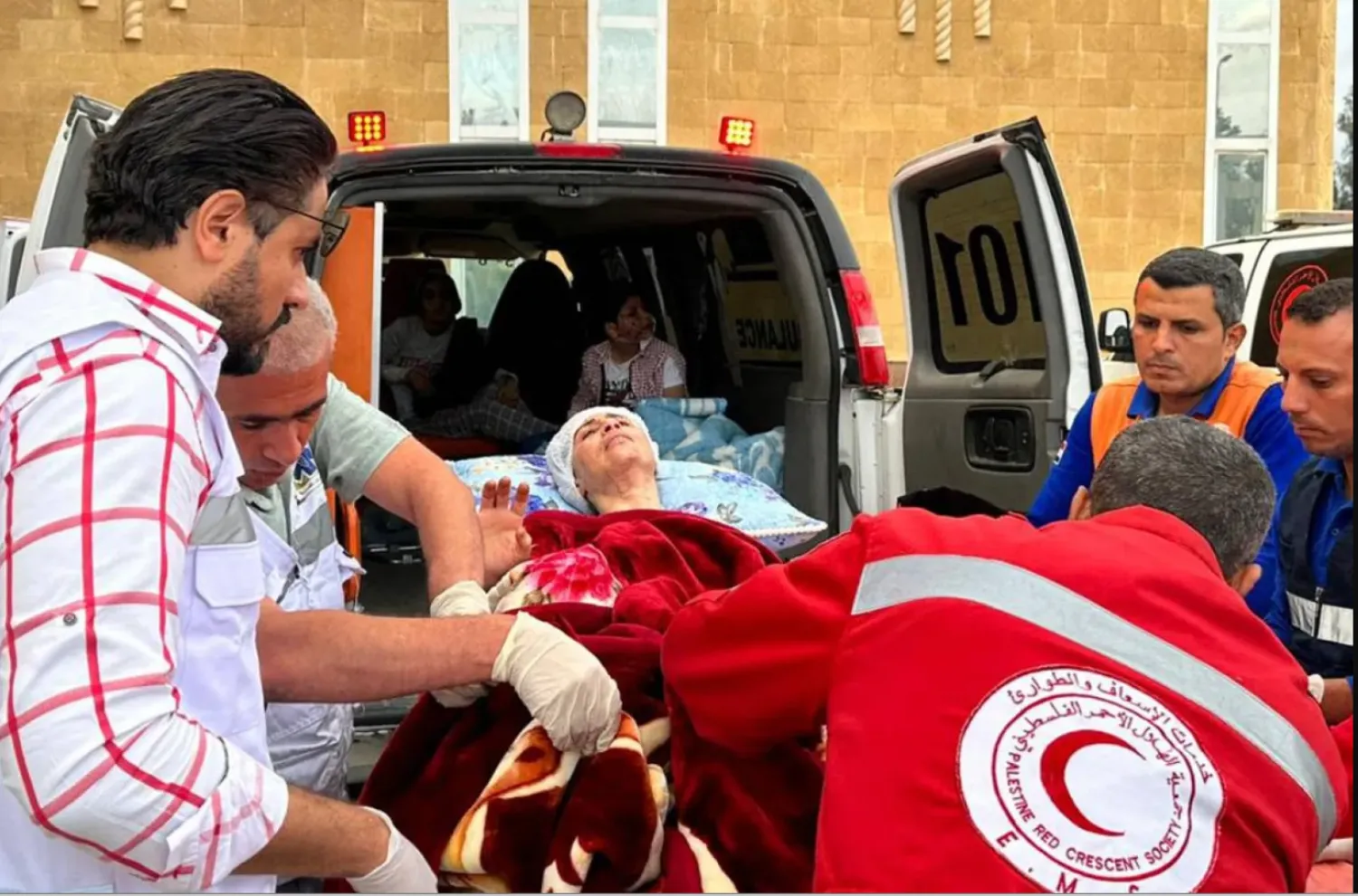
Palestinian casualties are transported by paramedics after arriving from Gaza at the Egyptian side of the Rafah border crossing (File/AFP).
TT

Israeli Fire Kills Six People in Gaza, Medics Say

Palestinian casualties are transported by paramedics after arriving from Gaza at the Egyptian side of the Rafah border crossing (File/AFP).

Israeli strikes and gunfire killed at least six Palestinians in the Gaza Strip on Tuesday, the territory's health officials said. 

Medics said an Israeli airstrike killed a man and wounded two children in the Mawasi area of Khan Younis in southern Gaza. The Israeli military told Reuters they had targeted a Hamas fighter. 

Another Israeli airstrike hit near a tent encampment housing displaced families in western Gaza City, killing one person and wounding five others, medics ‌said, while ‌a third airstrike in Khan Younis killed one person and ‌wounded ⁠three others.  

The Israeli ⁠military said both of those strikes had also targeted fighters.  

The Popular Resistance Committees, a militant group that has long carried out armed attacks against Israel, said one of the two Israeli strikes in Khan Younis had killed a senior leader of the group, Waheed Abu Salem.  

Later on Tuesday, one Palestinian was killed and nine others were wounded by Israeli gunfire in an area of Rafah in the south of Gaza, medics ⁠and witnesses said.  

Meanwhile, in Gaza City's Tel Al-Hawa neighborhood, ‌an Israeli airstrike hit a vehicle, killing two ‌people, medics said, taking Tuesday's death toll across the Gaza Strip to at least six.  

The ‌Israeli military did not immediately comment on the last two incidents.  

CEASEFIRE VIOLATIONS 

Israel has ‌repeatedly carried out strikes in Gaza since a US-mediated ceasefire with Hamas was reached last October, saying it is targeting fighters who threaten its forces or who took part in the October 2023 attack on Israel. 

Hamas has accused Israel of violating the ceasefire. Nikolay Mladenov, ‌US President Donald Trump's appointed Board of Peace envoy to Gaza, has said both sides have violated the agreement.  

Since the ⁠ceasefire took effect ⁠eight months ago, more than 1,070 Palestinians, many of them civilians, and four Israeli soldiers have been killed in Gaza, according to figures released by the two sides. Hamas does not disclose the number of its fighters killed. 

Israeli troops control more than 60% of Gaza, patrolling what Prime Minister Benjamin Netanyahu describes as a buffer zone to deter Hamas attacks. Netanyahu says Israel will not withdraw from the territory. 

Israel's devastating aerial and ground bombardment of Gaza displaced nearly the entire population of 2 million people, most of whom now live in tents or damaged buildings in a narrow coastal strip of territory governed by Hamas.  

Hamas-led fighters killed 1,200 people during their cross-border attack into Israel on October 7, 2023, according to Israeli tallies. The Gaza health ministry said more than 73,000 Palestinians have been killed in the territory since then. 


Egypt Fears Escalation in Iran War Would Be More Destructive, Foreign Minister Says

26 October 2026, Egypt, New Administrative Capital: Egypt's Foreign Minister Badr Abdelatty attends a press conference at the Egyptian Ministry of Foreign Affairs in the New Administrative Capital near Cairo. Photo: Michael Brandt/dpa
TT

Egypt Fears Escalation in Iran War Would Be More Destructive, Foreign Minister Says

26 October 2026, Egypt, New Administrative Capital: Egypt's Foreign Minister Badr Abdelatty attends a press conference at the Egyptian Ministry of Foreign Affairs in the New Administrative Capital near Cairo. Photo: Michael Brandt/dpa

Egypt's Foreign Minister Badr Abdelatty said on Saturday he was "extremely worried" that a new escalation in the war between the United States and Iran would be more destructive and have a major ‌impact.

He was ‌speaking at the ‌IISS ⁠Manama Dialogue security ⁠summit in Bahrain.

"The second round will be more dangerous, more destructive, and it will lead to nowhere. We have to draw lessons from the past," ⁠he said.

An interim agreement ‌reached in ‌June failed to secure a lasting ‌ceasefire in the Iran war ‌or restore normal shipping through the Strait of Hormuz. Iran has since proposed that Washington lift its ‌blockade of Iranian ports in exchange for Tehran reopening the ⁠disrupted ⁠waterway within seven days.

Qatari mediators returned to Tehran on Friday in a renewed effort to broker a deal, but the sides remain divided over whether nuclear negotiations or relief from the blockade and oil sanctions should come first.


Lebanon Draws Up Plan to Govern 12 Palestinian Refugee Camps

The Shatila Palestinian refugee camp in southern Beirut. (AFP file)
TT

Lebanon Draws Up Plan to Govern 12 Palestinian Refugee Camps

The Shatila Palestinian refugee camp in southern Beirut. (AFP file)

Lebanon has begun addressing the governance of its Palestinian refugee camps, seeking to establish a framework for security, administration and services in a system where responsibilities overlap among Palestinian factions, popular committees, state institutions and the UN agency for Palestinian refugees (UNRWA).

Prime Minister Nawaf Salam on Friday launched consultations on a plan prepared by the Lebanese-Palestinian Dialogue Committee, headed by Ambassador Ramez Dimashkieh, before its final version is submitted to the Cabinet.

Salam stressed that Palestinian refugee camps fall under Lebanese sovereignty and are subject to Lebanese law.

“The presence of state institutions in the camps must become clear and consistent,” he declared.

He linked the governance initiative to the National Accord Document, the state’s exclusive control over weapons and its sole authority to decide on war and peace.

Salam also referred to the understanding reached between Lebanese President Joseph Aoun and Palestinian President Mahmoud Abbas in May 2025, as well as steps already taken to address the issue of Palestinian weapons.

He stressed that the initiative would cover security, the rule of law, and social, economic and service-related conditions.

The prime minister revealed that a draft law was being prepared to regulate refugees’ rights and obligations, including employment and social security.

He reaffirmed Lebanon’s commitment to the Palestinian right of return and its rejection of permanent resettlement, stressing that UNRWA and the international community must continue to bear responsibility for refugee services, without the Lebanese state replacing the agency.

For his part, Dimashkieh described the launch of consultations on a national plan to govern Palestinian refugee camps as an unprecedented step toward establishing a unified Lebanese state vision for their management and administration.

The camps are located on Lebanese territory and fall under Lebanese sovereignty, and that any new arrangements would be developed through partnership and dialogue with all Palestinian groups, without exception, he stressed.

Speaking to Asharq Al-Awsat, Dimashkieh explained that the initiative could be the first of its kind in Lebanon’s history of dealing with Palestinian refugee camps.

“For the first time, consultations are being launched to develop a unified Lebanese state plan for managing and governing the camps, rather than having each institution continue to deal with the issue separately, according to its own area of responsibility,” he noted.

The main problem, according to Dimashkieh, has been the absence of coordination and a common vision among the institutions involved, including the security services and Lebanese Army, governorates and municipalities, the ministries of health and labor, and UNRWA.

“Each institution viewed conditions in the camps from its own perspective, without an overarching framework to organize responsibilities and mechanisms for addressing the various issues,” he explained.

Dimashkieh revealed that consultations would continue over the next six months, bringing together the relevant Lebanese and Palestinian parties to reach the best possible formula for governing the camps.

Discussions will cover security, administrative and legal matters, including the role of security forces, the possible adoption of community policing and issues falling within the jurisdiction of the Justice Ministry and other relevant institutions.

He stressed that Palestinians would be key partners throughout the process, with no group excluded.

“The aim is to listen to everyone and reach a formula that commands the broadest possible consensus.”

Dimashkieh further underscored the growing urgency of reorganizing camp administration, particularly as the demographic composition of some camps has changed considerably.

“In some camps, Palestinians now account for only around 30% of residents, compared with approximately 70% who are Syrians or people of other nationalities,” he pointed out.

These demographic shifts require both Lebanese and Palestinian authorities to reconsider how the camps are administered and how their circumstances are addressed, he explained.

As for the next steps, Dimashkieh said that the proposal agreed upon after consultations and the identification of mechanisms for addressing the issue would be submitted to the Lebanese Cabinet for a decision.

12 camps and a legacy dating back to the Cairo Agreement

Lebanon’s 12 official Palestinian refugee camps are spread across several regions.

Five are in the south: Ain al-Hilweh, Mieh Mieh, Rashidieh, Burj al-Shemali and Al-Buss.

Four are in Beirut and Mount Lebanon: Burj al-Barajneh, Shatila, Mar Elias and Dbayeh.

Two are in the north, Beddawi and Nahr al-Bared, while the Bekaa Valley hosts the Jalil camp in Baalbek.

The number of registered Palestinian refugees differs considerably from the number actually residing in Lebanon.

UNRWA had approximately 488,000 refugees registered as of June 2025, while a 2017 Lebanese-Palestinian census counted around 174,000 Palestinians living in camps and gatherings, using a different methodology.

The UN agency’s registration figures do not constitute a census of current residents.

The roots of the camps’ special security arrangements date to the 1969 Cairo Agreement, which the Lebanese parliament annulled in 1987.

Nevertheless, Palestinian popular committees and factions have continued to play roles in the camps.

In 2025, factions affiliated with the Palestine Liberation Organization handed over weapons to the Lebanese Army. However, the issue of arms held by all Palestinian organizations has yet to be fully resolved.


Israeli War Machine Continues Bombing and Destruction in Gaza

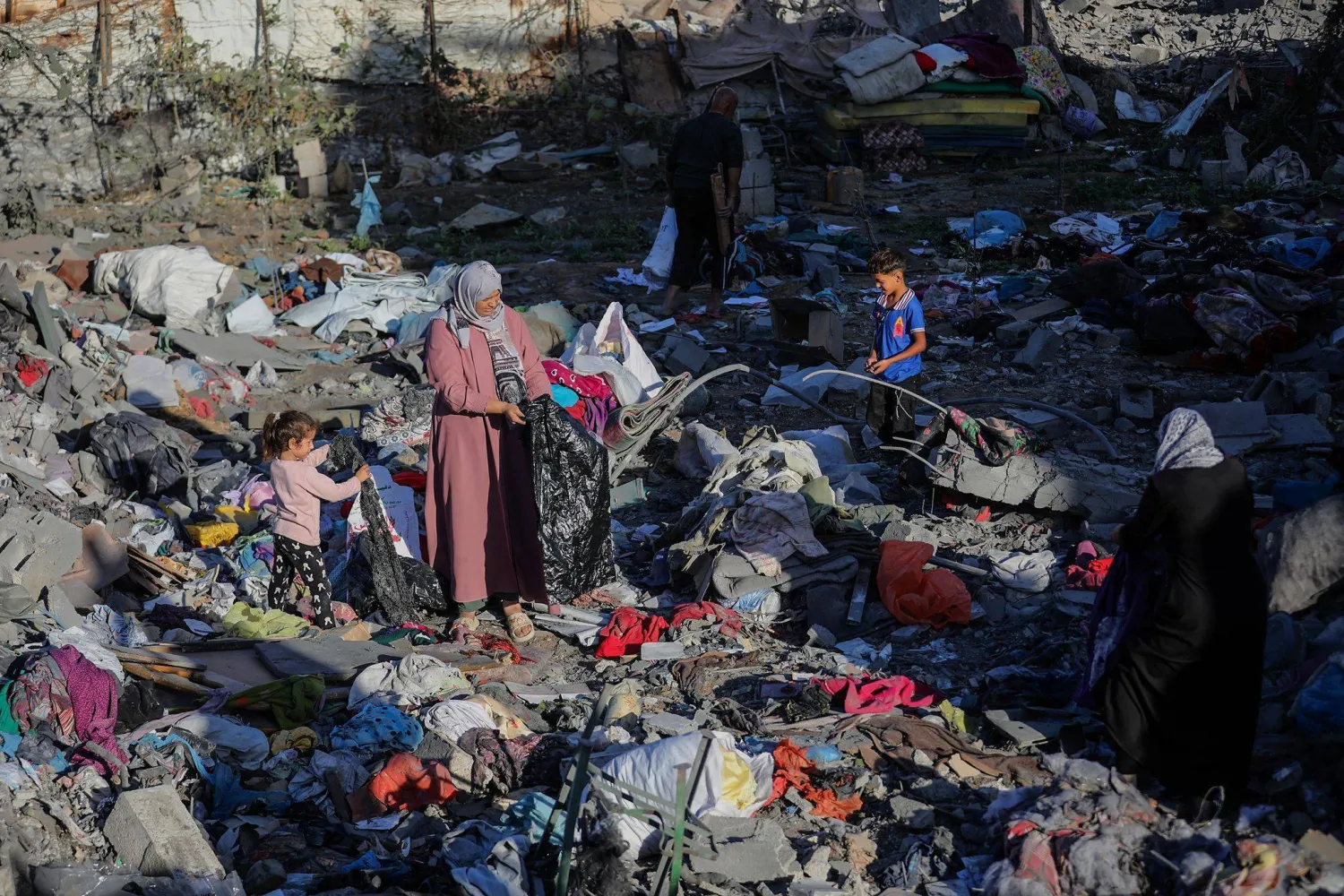
Palestinians stand amid the rubble of their home, destroyed by an Israeli strike in Bureij refugee camp on Friday (DPA). 
TT

Israeli War Machine Continues Bombing and Destruction in Gaza

Palestinians stand amid the rubble of their home, destroyed by an Israeli strike in Bureij refugee camp on Friday (DPA). 

The Israeli war machine continues its operations across the Gaza Strip, where Palestinians face further displacement and the destruction of homes and entire residential blocks amid relentless airstrikes, artillery shelling, demolitions and the expansion of the so-called Yellow Line.

Dozens of Palestinians have been forced to flee al-Masdar village, east of Deir al-Balah in central Gaza, as Israeli ground incursions expand by the day. They joined hundreds of others recently displaced from the village and surrounding areas east of Deir al-Balah and south of Maghazi refugee camp, seeking refuge west of Salah al-Din Road.

A field source told Asharq Al-Awsat that Israeli forces, assisted by armed gangs, had spent more than 10 days bulldozing, destroying and burning homes before blowing them up, forcing families to flee to western Deir al-Balah without allowing them to take any of their belongings.

Hundreds of Palestinians have been displaced during that period under difficult humanitarian conditions, the source added.

On some days, residents were warned to evacuate. On others, Israeli forces suddenly surrounded them, questioned them and detained some, subjecting them to torture.

According to information available to the source, one person was killed and his body subsequently handed over. The fate of approximately 13 others remains unknown, while some detainees were later released.

The source explained that Israeli forces were expanding their security control by pushing the Yellow Line farther west, taking over additional stretches of territory extending hundreds of meters.

They also destroyed the headquarters of the al-Masdar Association and have concentrated engineering operations around the village cemetery over the past two days.

The source reported the excavation of a trench and the construction of a large earthen berm, similar to fortifications established by Israeli forces in other eastern areas of the Gaza Strip.

UN Documents Expansion of Israeli Military Deployment

The UN Human Rights Office in the Palestinian territories said it had documented a westward expansion of Israeli military deployment areas over the past two weeks, resulting in fresh displacement in Gaza City’s Shujaiya neighborhood and areas east of Bureij, Deir al-Balah and Maghazi in central Gaza.

According to the office, the westward ground advance in Shujaiya was accompanied by at least two attacks on displacement camps and the demolition of some of the few buildings still standing in the area, with Palestinian witnesses reporting the use of explosive-laden robots.

The office said Palestinians in Gaza were finding themselves surrounded by Israeli forces that continued to push them farther inward, as part of a stated objective to expand Israeli military deployment to 70% of the territory.

It explained that the continued shrinking of areas available to civilians was accompanied by new waves of displacement in locations bordering Israeli military positions, known as the Yellow Line.

Airstrikes Destroy Homes and Educational Facilities

The developments come amid continued airstrikes targeting homes in residential blocks across Gaza.

Late Thursday, Israeli warplanes destroyed a three-story residential building in the Saftawi neighborhood, north of Gaza City, after Israeli intelligence officers ordered residents of the building and surrounding area, extending hundreds of meters, to evacuate.

Families were given only minutes to leave and were not permitted to retrieve their belongings before the building was destroyed. Nearby homes also sustained damage, leaving several families without shelter.

Gaza’s Education Ministry said the bombing destroyed the Little Smile Kindergarten and the neighboring Al-Zahraa Private School, depriving hundreds of students of access to education.

In a separate attack, Israeli warplanes struck a house in Bureij refugee camp in central Gaza after Israeli intelligence officers ordered residents of the entire surrounding residential block to evacuate.

The strike caused extensive damage to numerous nearby homes, forcing residents to flee after losing their only shelter.

The Israeli military said the two strikes targeted weapons warehouses belonging to Hamas.

The military routinely makes similar claims following strikes on homes in residential blocks still standing in Gaza, saying it is destroying weapons depots and military equipment stored there by Hamas and Islamic Jihad.

Both groups consistently deny the allegations and accuse Israel of deliberately destroying the remaining homes in the territory amid continued violations of the declared ceasefire agreement.

Further Casualties Reported

On Friday afternoon, medical teams recovered the body of a Palestinian from the al-Waha area, northwest of Beit Lahia in northern Gaza, several days after an Israeli drone targeted him there.

Several Palestinians were wounded Friday by explosives dropped from Israeli quadcopter drones, as well as artillery shelling and gunfire from military vehicles in areas near the Yellow Line.

Four Palestinians were killed Thursday, including two in an airstrike on a vehicle in Maghazi refugee camp in central Gaza, another by gunfire in southern Gaza and a fourth in a shooting in Jabalia refugee camp.